Phillips: TAA Isn’t There Just To Care For Horses, But To Protect Racing’s Future

“I take care of my own,” responded the prominent owner who declined to make a commitment of financial support to the Thoroughbred Aftercare Alliance.

In that response is a lack of understanding about the purpose of the TAA. While the “goal” of the TAA is to assure that Thoroughbreds exiting racing receive a soft landing with a new owner who promises to assume responsibility of care, thereby relieving the racing industry of its responsibility. The “purpose” of the TAA is to protect the sport of horse racing and thereby assure its future. The goal and purpose are very different things.

It makes little difference to the TAA if you believe that horses are just livestock or that horses are a revered companion animal worthy of better treatment. These are individual values, a debate about which the TAA need not engage. What is incontestable, however, is that if we want Thoroughbred horse racing to survive, all of us must commit to a broad scope of aftercare, more than just “taking care of my own.”

Racing participants understand that Thoroughbred racing is essentially a pyramid with graded stakes at the top, descending through a myriad of classes to a very broad base of claiming ranks at the lowest end of performance. While owners and breeders of every ilk aspire to the pyramid's peak, the reality is that everyone who has owned, trained or bred horses for very long has had their share of disappointments. These disappointments work through the system and generally depart the sport through these bottom claiming ranks. All know this and rely upon the broad base to hold up the value of those special horses at the top of the pyramid. Without this base the economics of the sport will not function.

It is wonderful that so many top breeders, trainers and owners have special outlets or their own field of equine pensioners that they take care of post racing. But not all Thoroughbreds are so lucky and with the mobility and breath of our sport, keeping track of a horse you bred, raced or trained is an effort. And besides, people say, isn't that someone else's responsibility once ownership of the horse was transferred?

In a perfect world, it is the transferees' responsibility, but this is not a perfect world. Those “special equines” who earn private pensioner status rely on a healthy sport with its broad base of the less talented through which they rise to earn that “special” pensioned treatment. To be clear, the TAA vigorously pursues all sectors and all levels, including the most modest of our sport, to help finance their on-the-ground partners who do the work of retraining, rehoming and sanctuary. These efforts most certainly include education and fundraising at the very base of the pyramid. But efforts at the base of the pyramid, while financially helpful, burn a lot of oxygen and are more long-term approaches at a time when the public demands immediate results.

John Phillips

This sport is a privilege. Those of us who have enjoyed its thrills and love its culture, however experienced, must do more than just “take care of our own.” We must take care of the future of the sport and if that means we must do more than our share of aftercare, then so be it. To whom much is given, much is also required.

The TAA, with an ever-increasing number of partners (the total is now estimated to be at 83) with 175 retraining, rehoming or retirement facilities, is desperately trying to defend the sport by answering the public's clear demand for a soft landing of our athletes as they exit racing competition. TAA is a well thought-out, practical and effective answer to the public's concern. Our “first exit from racing” philosophy is getting closer every year to assuring that all horses exiting racing get this soft landing from the sport.

Whether you're an owner, breeder, buyer or seller, a stallion farm or trainer, when the TAA seeks your support, keep in mind that our “purpose” is to protect the sport. And now with COVID-19 negatively impacting TAA's income, we need those who “take care of their own” for which the TAA is most appreciative, to take one further step and help the TAA take care of the sport.

John Phillips is a third-generation horseman, owner of Darby Dan Farm near Lexington, Ky., and manager of Phillips Racing Partnership. Phillips has served on a number of board positions in the racing industry and has previously been a director of the board of the Bluegrass Conservancy, Thoroughbred Club of America, and Breeders' Cup, and is currently a director of The Jockey Club Information Systems and is on TOBA's executive committee. Phillips also served two terms as a racing commissioner in Kentucky. He is the immediate past president of the Thoroughbred Aftercare Alliance and serves on its board and executive committee.

The post Phillips: TAA Isn’t There Just To Care For Horses, But To Protect Racing’s Future appeared first on Horse Racing News | Paulick Report.

Source of original post

Making Claims: Let The Courts Strengthen What It Means To Be A Thoroughbred

In “Making Claims,” Paulick Report bloodstock editor Joe Nevills shares his opinions on the Thoroughbred industry from the breeding and sales arenas to the racing world and beyond.

It came as no surprise when The Jockey Club's Stud Book cap on foals born in 2020 or later was formally taken to the courts on Tuesday. The only question was who would be the one to throw the gauntlet down, and when they'd do it.

Now that the bell has officially been rung, there's potentially a lot more on the line than just how many mares a stallion can breed in a year. The very nature of what a Thoroughbred is, and how one is made, could hang in the balance.

In the complaint filed by Spendthrift Farm, Ashford Stud, and Three Chimneys on Tuesday, one of the demands from the plaintiffs reads as follows:

“For an injunction requiring the [Kentucky Horse Racing Commission], through its Chairman and Executive Director, to permit Thoroughbreds to race in Kentucky regardless of their inclusion in the Jockey Club Registry.”

Taken at face value, this reads like a simple request to allow stud farms to continue breeding as many mares to its stallions as they want, beyond the 140-mare cap. For all we know, that might be the only thing the plaintiffs had in mind when the document was written up.

However, the open-ended nature of its language could potentially prop open the door to sidestep other longstanding rules that define what a Thoroughbred is anywhere in the world – namely, that they must be conceived on a live cover.

A horse of Thoroughbred blood conceived via artificial insemination, embryo transfer, cloning, or any other means besides the only one that's allowed, is not a true “Thoroughbred” by The Jockey Club's definition, and it would not be included in the registry. This is one of the building-block rules of the breed.

If Thoroughbreds are allowed to race in Kentucky regardless of their inclusion in the Jockey Club registry, the lock to Pandora's Box would seemingly be left unfastened for whatever interpretation one would want to use.

The live cover issue is one that's being debated and litigated on a global scale, and blowing open the American Stud Book would be a huge precedent with potentially vast ripple effects. The plaintiffs are aware of that global balance, noting in their filing that foals conceived after a stallion's 140th mating of the season would not be eligible for registration in any reputable jurisdiction in the world once it's deemed unable to be registered domestically.

This is a court case that could change the process of Thoroughbred breeding worldwide. It's also an incredible opportunity to reinforce the legal standing of the Stud Book cap and, in turn, the very definition of a Thoroughbred, assuming The Jockey Club and its fellow defendants prevail.

If this conflict was inevitable, which it was as soon as the cap was announced, it's best to get it over with.

Speaking with some prominent figures in Kentucky's stallion industry, I wasn't alone in this thought process.

“I think everybody thought it would come to some kind of challenge, be it stallion farms or an individual breeder who couldn't breed to the horse they wanted to because he was over 140,” said John G. Sikura of Hill 'n' Dale Farms. “While it's frustrating and takes a long time, I think the legal challenge is a good one to answer the question. When something's legally held, whether you like it or don't like it, the future is defined. It's better than being muddled or uncertain.”

The question of whose job it is to regulate Thoroughbred breeding, The Jockey Club or the individual state commissions, is one of the core issues of the lawsuit. Settling the matter in the courts would not only firm up the legal standing of the Stud Book cap, a win for The Jockey Club would also better establish its authority to set and enforce rules in an industry where so many other guidelines vary from state to state.

There are enough drums beating for a central national authority in horse racing, so I won't add my mallet to it here, but it's hard to argue that the industry would be helped in any way by a weakened Jockey Club – arguably the closest thing we have to that central office.

Duncan Taylor of Taylor Made Farm said he understood the reasoning behind the suit, specifically noting the cap's restriction on the idea of free-market capitalism, but he also noted that hardly any industry goes completely unregulated. Any form of regulation is ultimately a man-made restriction to the marketplace, and if man-made rules are created in any venue, they tend to be challenged.

Even if the lawsuit's demand language did explicitly state that it only wanted to overturn the Stud Book cap, Taylor said a defeat of that magnitude in court could make it easier to pull apart other pillars of The Jockey Club's rulebook.

“I would say that I could file today and say we should have artificial insemination, and if their case wins, then the AI case ought to definitely win,” he said.

This case could be seen as a potentially helpful one for proponents of the cap, immunizing it from future legal challenges, but it's only helpful if The Jockey Club and the other defendants win. Otherwise, there will be a lot of open-ended questions suddenly needing answers.

If you're looking for past performance, there is a bit of precedence in this matter, and it looks good for the cap staying in place.

When the United States Trotting Association worked toward instituting its own stud book cap for Standardbreds in the mid-2000s, and ultimately implemented it in 2009 (Spoiler alert: Everything was fine), there were several legal challenges that the measure had to overcome from parties claiming it violated antitrust laws.

I wanted to get some perspective on what to expect from the legal challenges, so I spoke with USTA president Russell Williams, who was a board member at the time the Standardbred rule was implemented. He was one of the cap's most vocal supporters, despite running top breeding operation Hanover Shoe Farms, which took one of the biggest hits from the new rule.

Williams, himself a lawyer, said the rule was created with the expectation that it would have to prove itself out in court, so steps were taken ahead of time to make sure it would stand up to the barrage. An intensive study by the University of Kentucky's Dr. Gus Cothran was commissioned to establish scientifically that there was a looming issue with genetic diversity. Then, the language was given the green light by one of the country's leading law firms specializing in antitrust.

Williams said he expected The Jockey Club would come out on top in the end, even if the case and the argument aren't quite apples-to-apples with what the USTA faced. The burden of proof in the scientific backing will rest harder with The Jockey Club, given it hasn't publicly produced a similar go-to study to hold up against the claims that the science isn't there, as accused by the plaintiffs.

With that being said, the diminishing variety in the Thoroughbred gene pool doesn't take a PhD to deduce in the annual Report of Mares Bred.

The foal crop is at its lowest point in decades, fewer stallions are standing at stud, and the number of stallions covering 140-plus mares per season has exploded since the turn of the century. These trends have been a part of The Jockey Club's platform for the cap since it first went public with a proposed rule change in the summer of 2019.

Putting names behind the numbers further shows just how compounded the top of the Thoroughbred market could become if the trend continues. Of the 42 stallions that covered 141 or more mares last year, 15 were by one of five sires: Curlin, Into Mischief, Uncle Mo, Speightstown, and Tapit. Of those five stallions, all but Tapit were also in the group themselves.

Though the odds appear to tilt toward the defendants, one can't expect this will be resolved quickly, or even necessarily in the defendants' favor. If it goes before a jury, as the plaintiffs requested, juries have done crazier things. Either way, this won't be settled as quickly and neatly as a one-hour episode of Law and Order.

Meanwhile, the first foals affected by the Stud Book cap will go through the sales ring as yearlings this summer and fall. It would be nice for everyone involved if they knew exactly what kind of blue sky they were buying into at that point in the calendar, but we can only venture a guess as to what might happen in the months between then and now.

If all goes as expected, I figure the breed will emerge from this lawsuit better off for it. Now, let's just see if it all goes as expected.

The post Making Claims: Let The Courts Strengthen What It Means To Be A Thoroughbred appeared first on Horse Racing News | Paulick Report.

Source of original post

The Friday Show Presented By Diamond B Farm’s Rowayton: Sam Houston Strong

Chris Griffin, track announcer at Sam Houston Race Park, joins Ray Paulick and Joe Nevills on this week's edition of The Friday Show in the wake of the historic deep freeze that wreaked havoc with the electrical grid and water supply in Houston and other Texas cities.

“It was a unique situation, a bit scary at times, but we got through it,” Griffin said. “Your immediate thought if you're involved with horse racing – and it should be – is how are the horses going to be handling the conditions and what we are going to go through.”

Fortunately, an emergency plan was in place, and the backstretch community rallied to make it work. “Last week was a very trying, difficult time where we all had to work together,” he said.

After four lost racing days, the action resumed this week, just in time for Saturday evening's Texas Preview Day, and Griffin provides some insights on the 12-race card featuring five stakes for Texas-breds.

Finally, bloodstock editor Joe Nevills gives a toast to Spendthrift Farm's Vino Rosso in our new segment spotlighting the stallion's first foals.

Watch this week's Friday Show below.

The post The Friday Show Presented By Diamond B Farm’s Rowayton: Sam Houston Strong appeared first on Horse Racing News | Paulick Report.

Source of original post

‘A Stupid, Stupid Rule’: New York Restrictions On Married Jockeys Stifling Davis’ Business

“The dumbest rule in racing.”

That's how attorney Bill Gotimer said TVG analysts have described New York's Commission Rule 4040.2 which reads: “No jockey, nor such jockeys' spouse, parent, issue nor member of such jockey's household, shall be the owner of any race horse. All horses trained or ridden by a spouse, parent, issue or member of a jockey's household shall be coupled in the betting with any horse ridden by such jockey.”

The rule has become a topic of discussion in recent weeks as Gotimer said it has recently begun hindering the business of his client, jockey Katie Davis, since her marriage to fellow rider Trevor McCarthy.

Davis married McCarthy in December 2020 and the couple shifted their tack from Maryland to New York. They were later informed that since their marriage, Rule 4040.2 would require the racing office to couple their mounts whenever they rode in the same race, whether or not their horses had the same trainer or owner.

McCarthy has gotten off to a swimming beginning in New York, riding 19 winners from 154 starters this year for mount earnings over $1 million, putting him well on his way to surpassing last year's total earnings. Davis, by contrast, has had just one win from 53 mounts so far, despite coming into the season off two strong years in Maryland. Just before their departure, McCarthy was a leading rider at Laurel Park, while Davis was seventh in the standings there.

Mike Monroe, current agent for Davis, and Gary Contessa, who had her book briefly after her move to New York, both agree that the rule has negatively impacted Davis's ability to get mounts. Both heard from trainers who had named Davis on their horses, only to take her off after they learned about the coupling rule. Media reports have indicated the racing office at Aqueduct has discouraged trainers from using Davis in races where McCarthy is already named, since it would not cause a coupling of what would otherwise be two betting interests in the race. The New York Racing Association has categorically denied that racing office personnel have exerted pressure on trainers not to use Davis.

“It's a stupid, stupid rule,” said Contessa. “It's absolutely ridiculous. When I was booking her, I had a trainer – I'll not say who – who's a bettor. Most trainers are lousy bettors, but they like to bet on their horses and this guy liked to bet. This guy gave me four calls for Katie and two or three days later he told me 'Gary I can't do it because I can't have these horses coupled. I want to get 10-1, I don't want to get 3-1.'

“On the racing office side, they're losing a betting interest and if you really evaluate betting races, losing one betting interest or gaining one betting interest earns or decrease that race by about $100,000 in wagers.”

Monroe said the rule does apply equally to Davis and McCarthy – if McCarthy is named on a mount after Davis, the trainer of McCarthy's horse will be informed that they will be coupled with Davis's mount – but McCarthy is booking mounts so quickly that he's usually named first. Monroe admits the mounts Davis has gotten have not done as well as they would have hoped, but is confident the coupling issue is the primary reason her career has stalled in New York.

“All we're really asking for is a fair shake, a level playing field. It's not a level playing field right now,” said Monroe. “We all know the racing office is having a difficult time with a shortage of entries, but that should not impact Katie Davis' status of being named on a horse. That's what we're trying to bring out here.”

Where did this rule come from?

Although Rule 4040.2 has become a target of complaint for Davis and her supporters recently, the New York State Gaming Commission told Gotimer it has been on the books since at least September 1974.

Though the rule is negatively impacting a female rider in 2021, a letter from New York State Gaming Commission executive director Robert Williams points out the rule is not written to only apply to female riders. It's true however, that the rule (logically) seems to have come about after women became licensed by New York state, which happened in 1969. And Monroe and Gotimer point out that the rule is going to naturally be unevenly impactful towards which ever spouse has less career momentum.

“There's going to be a day when you face this question with same-sex spouses,” said Gotimer.

Part of the reason the rule about married jockeys may have seemed dormant for the past 47 years is that there have been relatively few instances where married jockeys have tried to ride against each other in New York. The closest comparable case in recent memory may be Jose Ortiz and Taylor Rice Ortiz, but Taylor said they never had the opportunity to find out how the rule may have impacted their careers.

Taylor and Jose were engaged for some months before their wedding in December 2016. Taylor said she didn't know about Rule 4040.2 and was planning to continue with her career as a jockey, but found out she was pregnant with the couple's first child shortly before the wedding, prompting her to retire. Taylor, who has many immediate and extended family members in the sport, said she knew that marriage could complicate things.

The Ortiz family as of 2017

“I had heard of my dad's generation had been married and they had conflicts, and I knew that if you're a jockey and you're married to a trainer, you have to ride for your significant other,” said Ortiz. “What Trevor and Katie are going through, I had no idea the extent of it.”


That doesn't mean that she can see the logic in New York's rule. After all, she points out, she rode for her aunt, trainer Linda Rice, on many occasions but also rode for other trainers in races where Rice was saddling an entry and was never coupled in those races. She lived with Ortiz for several months before their marriage – an arrangement that was common knowledge on the backstretch – and that did not result in the racing office coupling their entries.

During the summer, when many riders, trainers, and others descend upon Saratoga Springs from out of town, Taylor Ortiz said it's also common for family members and close friends to share rental houses, as Jose and Irad Ortiz have done in the past, and cohabitation hasn't resulted in entries being coupled.

“What's crazy to me is that the horse racing industry is so intertwined between family and marriage,” said Ortiz. “So we could have stayed engaged forever, but as soon as we sign documents saying we're married it's a problem for one of your rules? It doesn't make sense to me.”

In initial research, Gotimer said he could find no other rule currently on the books in other major American racing jurisdictions that places the same kind of restrictions on riders as the New York State Gaming Commission. Instead, he found that cases where states or tracks had restrictions on married jockeys and had subsequently removed them.

In 1998, married riders Harry Vega and Amy Duross were told by Suffolk Downs stewards they couldn't ride in the same race, but that policy was later overturned by the Massachusetts Racing Commission. When jockeys Angel Serpa and Carol Cedeno were married, they competed against one another on uncoupled horses in Florida.

“[The restriction is] based in two concepts, neither one of which are really acceptable,” said Gotimer. “One is that licensed parties in New York state, and in particular jockeys, can't be trusted. I think that's a wild insult to world-class athletes.

“I think the second point is that it's based on an anachronistic idea that one spouse controls another. I don't see that in racing, and I don't see that in New York.”

Gotimer said he has not been retained for the purpose of bringing any legal action against the commission, but is hopeful the two sides can reach some kind of agreement about improved rule language.

“The Commission has commenced an examination of the rule origin, the harm it sought to prevent, its present applicability, and in what manner the harm – if any – can be addressed by alternative means,” said commission spokesman Brad Maione. “Additionally, we are seeking to place the rule in context, considering how similar situations are governed in other regional racing jurisdictions, in larger U.S. racing states and in major international jurisdictions.

“The rule appears by its plain language to be integrity-based with neutral applicability, but we intend on undertaking a de novo review.”

The rule has impacts on jockey/trainer combinations, too

Though Rule 4040.2 has mostly been discussed in the context of its impacts to two married jockeys, it has also come up for married trainer/jockey duos in New York.

Rachel Sells, who has had her trainer's license since 2017, is married to jockey Jose Soñe and is based at Finger Lakes. When she takes a horse to a race at a New York Racing Association track, Soñe must either sit the race out or ride her horse – he cannot ride for a competing trainer. At Finger Lakes, she said they were initially told that Soñe could ride other trainers' horses running against hers, but his mount would be coupled with her horse if he did so. Sells pushed back.

“We had issues with the racing office a few times,” she said. “I'm not one to sit back and let things happen. I'm a very vocal person. One day I called the racing office after I was informed my husband got taken off a horse because I had a horse in the race and I let them know they were denying him the right to a living and that's illegal. You can't tell somebody not to ride him because it's going to make the body of the race smaller.”

Eventually, Finger Lakes changed its house rules on the issue.
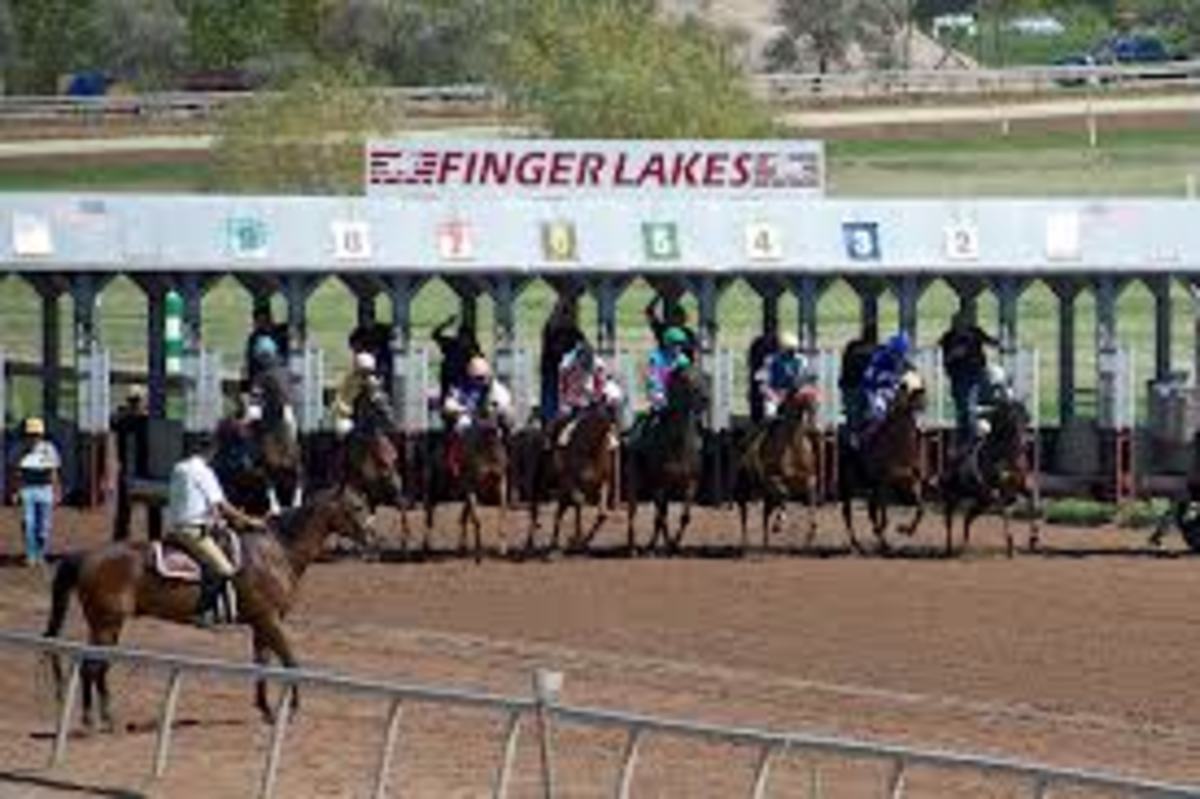
It's not a problem for Soñe to give first preference to Sells' horses, but for a rider with a wide client base, it might be. Taylor Ortiz pointed to the case of Rosie Napravnik, who had long been one of the go-to riders for Mike Maker when her husband, former Maker assistant Joe Sharp, opened his own training barn. Napravnik retired in 2014 upon learning that she was pregnant, not long after Sharp put out his shingle, so they didn't have much chance to find out how much her business may have been limited by the requirement that she give preference to Sharp's horses.

When saddling at her home base of Finger Lakes, Sells is still not permitted to own horses herself because she lives with Soñe, which she said has forced her to pass up great business opportunities. When she travels to a NYRA facility or anywhere out of state however, she encounters no problems running horses as both owner and trainer.

“For me, I could see if I do own a horse and I have a horse in the race, he has to ride that horse; I understand that,” she said. “But it's not even just for me. I have a groom who works for me and she's dating a jockey and wanted to buy a horse last year. I called the stewards and asked them about it and they said no, because she cohabitates with a jockey. It's not even just for trainers.”

Soñe doesn't ride as many races these days, though Sells said that's not because he has to give her first call as a trainer. Soñe has been a licensed rider since 2001 and while Sells said he will decide for himself when to hang his tack up, he isn't taking as many mounts as he once did.

“He's a lot more cautious on who he chooses to ride for,” she said. “At some point I do want him to be able to retire from riding and just come be with me and not have to worry about it.”

After all, being a jockey is a tough gig.

The post ‘A Stupid, Stupid Rule’: New York Restrictions On Married Jockeys Stifling Davis’ Business appeared first on Horse Racing News | Paulick Report.

Source of original post

Verified by MonsterInsights
