More to Come for Derby Sire Protonico

For all the round-the-clock pedigree scrutiny and conformation analysis that goes into finding a stallion that will produce a winner on the first Saturday in May, it took a horse standing for $5,000 and lacking that coveted Grade I win on their race record to get the job done.

Of the 26 fifth-year stallions standing in Kentucky today, Protonico was one of five to breed less than 20 mares last year. And yet, here he is now sitting atop the Leading Second-Crop Sires list after his son Medina Spirit charged home to win the 2021 GI Kentucky Derby at 12-1 odds.

When Protonico began his career at Taylor Made Farm in 2017, he bred just 34 mares. After moving over to Darby Dan Farm the next year, he couldn't do much better there with a 51-strong book. Eventually, he found a home at the Ryan family's Castleton Lyons Farm outside of Lexington and not long after, produced a Kentucky Derby winner from his first crop of 3-year-olds.

“It's kind of a fairytale story,” Castleton Lyons equine manager Pat Hayes said. “It just goes to prove that a good racehorse can come from anywhere- at any level and any price point in the stallion ranks. It gives a lot of assurance to breeders that good stallions might not be priced expensively, but they are out there. So you just have to dig a little deeper, I guess, and hope you land on one.”

While most of the commercial market may have initially turned its nose at the near million-dollar earner, Protonico's owner and breeder Oussama Aboughazale never wavered in his belief in the horse.

“The first time I met Mr. Aboughazale was in the spring of 2019,” Hayes recalled. “He put his arm around me and said, 'Pat, this horse will breed a champion.' So for all this to happen with his first crop is truly a testament of Mr. Aboughazale's belief in him. He told us he was going to support him with 10 to 20 mares every year and he has lived up to that and bred some really nice mares to him.”

Perhaps Aboughazale developed such a passionate faith in Protonico when he had a bird's-eye view of the son of Alpha Spirit (A.P. Indy) during his early days on the track. Aboughazale trained Protonico in his first two career starts, taking the colt to a 12 3/4-length debut victory before he was transferred to Todd Pletcher's barn for his 3-year-old campaign.
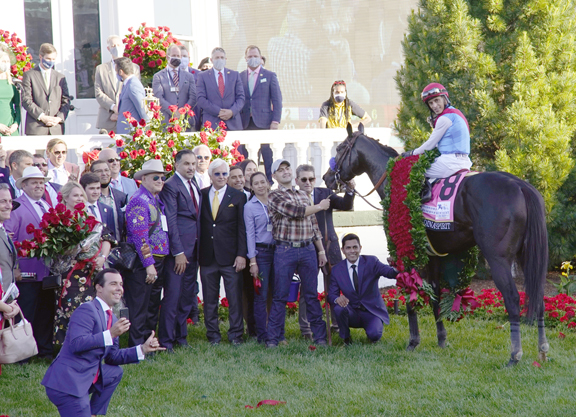
Medina Spirit's win in the 2021 Kentucky Derby gave his sire the first Grade I victory of any second-crop sire this year. | Horsephotos

As a sophomore, Protonico reeled off victories in the GIII Smarty Jones S. and GIII Discovery S. but came just short of a Grade I win in the Clark H., where he bested third-place finisher Constitution (Tapit), but came up just half a length short of Hoppertunity (Any Given Saturday). He came back at four to take the GIII Ben Ali S. and GII Alysheba S. for Aboughazale's Sumaya U.S. Stable.

“The stallion game is so competitive here,” Hayes said. “He was just a tick off in the Clark H. to win a Grade I, and I think that really hurts a stallion coming to retire in Kentucky. But his pedigree was there. There were a couple of other Giant's Causeways retiring at the same time as him, but looking at his race record, we thought he was just as good as a lot of them.”

So the team at Castleton Lyons was rewarded last weekend, when their belief in the previously-disesteemed stallion was fulfilled by Medina Spirit's victory and the calls starting coming in with breeder's begging for a slot with Protonico in the last few weeks of breeding season.

“Going into the Derby, I think everybody at the farm was a little nervous,” Hayes admitted. “We thought it was possible, but watching the race and seeing him go wire-to-wire was awesome. Since then, the phones have been ringing quite a lot. It's been pretty hectic, but we've gotten a lot of contracts to Protonico since, which is what every stallion owner wants to hear.”

What was the first thing Hayes heard from Aboughazale after the big day at Churchill Downs?

“I spoke with him yesterday and his comments were, 'I told you so,'” Hayes relayed with a laugh.

Hayes added that it should come as no surprise that a grandson of the 'Iron Horse' would display such grit.

“Medina Spirit has that heart and courage that Protonico had as a racehorse. When they were all bearing down on him in the [Kentucky Derby] stretch, he just kept fighting and fighting. Bob Baffert has touched on this a lot this week, that the horse never gives up and doesn't know how to say stop. It's great for a stallion to pass that along and Medina Spirit really embodies a lot of what Protonico was as a racehorse. They have quite a similar way of running with a low head carriage and they're very economical movers.”

Karl Keegan, who founded Lucan Bloodstock last year, was the eye behind the famed recommendation Aboughazale gave to Amr Zedan that resulted in Medina Spirit's $35,000 purchase for Zedan Racing Stables at the 2020 OBS July Sale.

Keegan vividly recalls first seeing Medina Spirit on the OBS sales ground.

“I was stabled at barn 15 and this horse kept catching my eye at barn 16, so I went to take a closer look and I was blown away.”

At the time, Keegan was working with several Sumaya Stables-owned horses, so he called their team to pass on the tip.

“That night I went home and watched his breeze a bunch of times and was amazed he had stopped the clock in :33 flat,” Keegan said. “We had a conference call the next day with the Sumaya team and they were happy about my positive review of the son of their stallion, so that gave Mr. Aboughazale the confidence to pass on the information to his good friend Amr Zedan and as they say, the rest is history.”

Protonico has had only 10 starters from his first two crops of runners, but three are already winners. Keegan, who breaks 2-year-olds for Aboughzale in Ocala, believes there are many more to come.
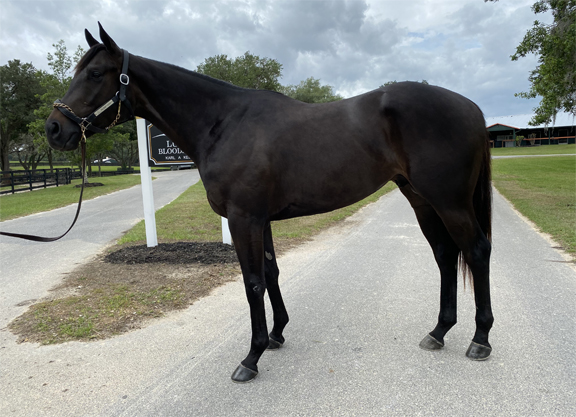
This week Protonic Power begins training with Todd Pletcher, the same trainer who oversaw his sire's career. | Karl Keegan

“We had five Protonico 2-year-olds this winter at Lucan,” he said. “They were all good-sized horses with strong bone and exceptional depth of girth. From day one in the round pen to breezing on the racetrack, they went out every morning and did their job.”

Hayes added of the youngsters on the ground at Castleton Lyons, “One thing we're really seeing with them is the athleticism and the walk. They've all got great bodies and are generally correct. Physically, Protonico is a really nicely-balanced horse. He's a great mover and has a really strong body. He has a lot of Giant's Causeway's traits, but even more so of A.P. Indy from the damside.”

One young son of Protonico that stands out to both Keegan and Hayes is a 2-year-old named Protonic Power. The colt is a three-quarters sibling to Princess Noor (Not This Time), the speedy filly purchased for $1.35 million last year who went on to take the GI Del Mar Debutante S. and GII Chandelier S. for Zedan Racing Stables.

“He's owned by Samaya Stables and he looks great,” Hayes said. “We're looking forward to seeing him at the races this year.”

Keegan reported that Protonic Power has wrapped up his early training and is shipping to Todd Pletcher on Saturday.

“He's a very good-looking, powerful horse with good balance,” Keegan said of the juvenile. “He's training super. He reminds me a lot of Medina Spirit, just a tad smaller. I had seen him at Castleton Lyons when I was up in Kentucky for the [2020] Keeneland September Sale and I was very excited at the chance to break and train him. When he got to our farm I went back and looked at some photos and  video I had taken of Medina Spirit at the OBS Sale and saw a lot of similarities.”

While the team behind Protonico eagerly anticipates more chapters to come in their stallion's Cinderella story, they aren't quite finished celebrating an unforgettable weekend as the stack of contracts on Hayes's desk continues to grow.

“This is a huge thing for Castleton Lyons,” Hayes said. “It's been a thoroughbred farm since the late 1700s and has had a lot of highs and lows over the years. Since the Ryan family took it over, they've typically had stallions in the barn since 2004 and we've had Malibu Moon, Bernstein, and Gio Ponti, who was a great homebred and is still standing here. To have a new stallion with some buzz around him right now is great for the farm and the staff and more importantly, great for the owners.”

The post More to Come for Derby Sire Protonico appeared first on TDN | Thoroughbred Daily News | Horse Racing News, Results and Video | Thoroughbred Breeding and Auctions.

Source of original post

This Side Up: Something Missing in the Modern Derby

The fastest two minutes in sport? Maybe. Only sometimes, these days, it feels as though time is standing still.

Last Saturday we had yet another GI Kentucky Derby where the protagonists had already volunteered themselves before the clubhouse turn. For the moment, speed seems to have a lock on the race. You have to go back to Orb for a closer; and beyond, for the flamboyant pounces of Calvin Borel.

This time round, the first four were all in the first six at the first bend. At the quarter-pole, they were already in their finishing positions. Was this a horse race, or a procession?

The paradox is that while everyone wants to be pressing the pace in the modern Derby, that doesn't seem to involve going especially fast. Once you get your position, it seems you don't have to apply perilous levels of energy to hold it.

The most obvious explanation is the starting points system: sprinters are no longer contributing to the pace because they can't earn a gate in two-turn trials. If that's the case, we need to be very careful about what we're doing to the defining examination of the American Thoroughbred. Because we may find ourselves hammering our genetic gold into stallion ingots in too cool a forge.

Obviously a 20-runner stampede round two turns is a pretty brutal test, by the standards of American racing, and possibly jockeys are now exploiting the dilution of the pace. They feel it's imperative to get a position, to avoid the traffic; but they would get a nosebleed even thinking about Angel Cordero's fractions on Spend A Buck in 1985.

To be fair, a fast surface and the indefatigable speed we associate with Bob Baffert has now produced consecutive times more in keeping with the old days than the three preceding years, where you could have used a sundial rather than a stopwatch to clock them on or around 2:04.

Spend A Buck missed two minutes by a fifth after blazing 1:09.6 and 1:34.8. If that was a historic achievement–putting him behind only Secretariat, Monarchos and Northern Dancer–then the fact remains that only Baffert's lionhearted Bodemeister (Empire Maker) in 2012 has recently posted terror fractions. Take him out, and the other 14 Derby fields to clip :46 for the half did so between 1962 and 2005; while the other eight to go a mile under 1:35.5 did so between 1952 and 2001.

But you can't blame the driver for the engine, so perhaps there's another dimension to all this. Perhaps we need to ask whether breeders are limiting the available horsepower?

The whole point of the Derby, as the ultimate measure of the maturing dirt Thoroughbred, is to find an optimal equilibrium between speed and stamina. We talk about “carrying” speed and, in this unique race, that should imply a really punishing burden.

It's precisely for that reason, indeed, that I am always complaining about the myopia of contemporary European breeders in largely neglecting dirt stallions. Combing speed and stamina is the grail at Epsom no less than Churchill Downs, and those Europeans who claim to be helpless against the Galileo (Ire) dynasty should duly come to the Bluegrass for a solution. After all, I could be wrong, but I always understood Galileo to be the grandson of a horse that won the Kentucky Derby in two minutes flat. As it is, commercial breeders in Europe succumb to a childish dread of stamina and instead pollute the gene pool by mass support of precocious sprint sires without the slightest pretension to Classic quality.

But this is a two-way street. If the trademark of a dirt horse is the ability to carry speed, then what do we most admire in a top-class European grass horse? Well, it's a different brand of speed: that push-button acceleration, that turn of foot. Not Frankel (GB), funnily enough: I always said he really ran like a dirt horse. But most of those European champions imported by the great Kentucky farms, to seed the modern American Thoroughbred, were classical turf dashers: Blenheim II (GB), Sir Galahad III (Fr), Nasrullah (Ire), Ribot (GB), Sea-Bird (Fr), Caro (Ire).

And it appears that the European breeder does not have a monopoly on parochialism. Standing a turf horse in Kentucky is becoming close to impossible, commercially, whether indigenous or imported. If many American breeders nowadays reckon their families can do without the kind of “toe” that distinguished, say, Karakontie (Jpn) or Flintshire (GB), then I guess we had better get used to a deficiency of class in the Kentucky Derby closers–and settle for “speed” horses that don't actually run terribly fast.

We need to strive for the best of both worlds. As it is, the benchmark Classics on both sides of the ocean have lately obtained a ceremonial quality: a virtually private contest at Epsom, to establish which of the top half dozen colts at Ballydoyle has most stamina, and a peloton of sharp breakers at Churchill whose pursuers lack the flamboyance to run them down.

Two footnotes on the last closer to win the Derby. First, his finish was set up by Palace Malice (Curlin), forced into a white-hot tempo he could not maintain (:22.57, :45.33, 1:09.8). Second, Orb is by a son of a top-class French filly. Her own dam, also a Group 1 scorer, was by French Classic winner Green Dancer-whose own sire, Nijinsky, bears historic witness to the transferability of speed-carrying dirt genes to the European environment.

But we are where we are. And, that being so, let's hear it for Baffert. Forget bloodlines, here is a genius who is single-handedly impacting the breed–not least, in this context, by loading Quarter Horse speed into his works. If he seldom bothers with turf pedigrees, then at least he's maximizing class and dynamism in the modern dirt horse.

There seems to be some kind of nebulous mainstream agenda against Baffert, who has just saddled the first Derby winner with no raceday medication since 1996. But our own community has been too ungenerous to one of the greatest achievers in the sport's long history. Since 2000, Baffert has been recognized by one Eclipse Award as Outstanding Trainer. One! That was in 2015, when he had just ended our 37-year wait for a Triple Crown winner.

He's a confident guy and doesn't need to be told how good he is. (Actually I sometimes wonder if something of that rubs off on his horses, too). All the same, he's only human and absolutely entitled to feel affronted by this. With zero disrespect to the fine practitioners honored in the meantime, it's preposterous to suggest that Baffert has been professionally outperformed in 20 of the past 21 years.

Of his seven Derbys, he has won now four with horses who came under the hammer at various times–Medina Spirit (Protonico) $1,000 ($35,000 pinhook); Real Quiet (Quiet American) $17,000; War Emblem (Our Emblem) $20,000 RNA; Silver Charm (Silver Buck) $16,500 ($100,000 pinhook)–for a grand total of $54,500 between them. Maybe that's why Baffert is resented. He has made it impossible for other horsemen to complain that all they lack is opportunity.

By the same token, the greatest achiever of his generation has given everyone hope, wherever they are starting out. And that deserves gratitude from us all.

The post This Side Up: Something Missing in the Modern Derby appeared first on TDN | Thoroughbred Daily News | Horse Racing News, Results and Video | Thoroughbred Breeding and Auctions.

Source of original post

Belmont Stakes Under Consideration for Malathaat

Malathaat (Curlin), the undefeated filly who is coming off a win in the GI Longines Kentucky Oaks, could go next in the June 5 GI Belmont S.

“It has crossed our minds,” Shadwell Farms Vice President and General Manager Rick Nichols said of the Belmont. “One issue would be whether or not we could get John Velazquez. If Medina Spirit (Protonico) wins the [GI] Preakness Stakes., obviously John will have to choose him for the Belmont. No one would blame him for choosing that horse.”

Nichols said a final decision will be made in “about a week.”

“We'll talk some more about it and talk with Sheikh Hamdan's family and get their input,” Nichols said

The filly's trainer, Todd Pletcher, is no stranger to the Kentucky Oaks-Belmont route. In 2007, Pletcher went in the Belmont with Rags to Riches (A.P. Indy) after winning the Oaks. She is the last filly to win the Belmont and was the first to do so since 1905. Three fillies have won the Belmont.

Nichols admitted that there are not a lot of options right now for Malathaat against fillies. She will pass the GII Black-Eyed Susan S. at Pimlico. The Belmont Stakes card includes the GI Acorn S. for 3-year-old fillies, but the race is at one-mile around one turn and is not a good fit for the filly. The next Grade I race around two turns for 3-year-old fillies is the July 24 GI Coaching Club American Oaks at Saratoga.

“The further they go the better,” Nichols said. “There are not a lot of good choices for her. We could go in the [GII] Mother Goose Stakes, but it's only a Grade II race.”

Nichols said Malathaat returned to the track Thursday morning and galloped for Pletcher.

“Told loves her. He absolutely loves her,” Nichols said. “She's such a sweet filly around the barn. She's got so much class and has everything you'd want in a top filly.”

Malathaat kicked off her 3-year-old campaign with a win in the GI Central Bank Ashland and followed that up with a hard fought win over Search Results (Flatter) in the Oaks. A $1,050,000 purchase at Keeneland September, Malathaat is five-for-five lifetime.

The post Belmont Stakes Under Consideration for Malathaat appeared first on TDN | Thoroughbred Daily News | Horse Racing News, Results and Video | Thoroughbred Breeding and Auctions.

Source of original post

Baffert: Medina Spirit More Of A Silver Charm Than An American Pharoah

A favorite interview standby for turfwriters speaking to a jockey, trainer, or owner with historical success is to ask them to compare their most successful horses to each other. Who is better than who? Who reminds you of who? Trainer Bob Baffert, who is asked this sort of question often, was queried on Thursday's NTRA national media teleconference about the similarities between Derby winner Medina Spirit and Triple Crown winners American Pharoah and Justify.

Baffert said the colt by Protonico reminded him of neither champion, but did harken back to some more vintage runners.

The trainer has made no secret of the fact he was surprised by Saturday's result.

“After watching the race, it was pretty impressive because he didn't get an easy lead,” he said. “He carved out some serious fractions; it wasn't a gimme. Turning for home when the swarm came, I was expecting all those horses to go by him and he just dug in and outran them all to the wire. I just kept thinking of Cavonnier — I didn't want to get too excited.”

Cavonnier was Baffert's great hope for the roses in 1996, and is best remembered for a breathless finish fighting off a late charge from D. Wayne Lukas-trained Grindstone after dealing with a smack to the face from Craig Perret, who accidentally struck the gelding with his whip while urging on Halo Sunshine. Though the official margin indicates Grindstone prevailed by a nose, many on site that day swore it was a dead heat. Cavonnier would go on to be fourth in the Preakness and pull up with a badly-bowed tendon in the Belmont. Two and a half years later, Baffert got him back to the races for a win in the 1998 Ack Ack. Cavonnier would leave the track in 2000 a hometown, homebred hero in Sonoma County, Calif., where he was born. A 2016 feature by the Press Democrat indicated that the family who bred Cavonnier retired him to a life of leisure at a ranch in western Sonoma County.

Medina Spirit was 12-1 when the gates opened, and Baffert said he could see why. It was a tough field and although he had solid finishes in his prep races, Medina Spirit hadn't looked dominant. He's also not a hugely physically imposing horse — he's not short at 16.1 hands, but is a light-framed creature.

“I really can't compare him to a horse like American Pharoah or Justify,” said Baffert. “They were superior horses that came in with the Beyers were off the charts, the numbers were faster. He's getting better though. We've learned a lot about that horse.

“He reminds me of Silver Charm. He's gutty. He's going to fight, give you that extra. He's a courageous horse. When he turned for home, he had every reason…I really thought Mandaloun was going to go on by him and he would not let him by. He did that in the Robert Lewis, where Hot Rod Charlie and all these horses came to him, and he went really, really fast early. I noticed that day when he came back, he wasn't tired, he wasn't blowing hard.

“All these good horses, they have a set of lungs on them. And you can't worry about what they cost. Real Quiet was the same way, he only cost $17,000. Actually Silver Charm was a $15,000 yearling, you know. We never take their cost into consideration.”

Neither do they.

The post Baffert: Medina Spirit More Of A Silver Charm Than An American Pharoah appeared first on Horse Racing News | Paulick Report.

Source of original post

Verified by MonsterInsights