Lookin At Lucky’s Tall Boy Breaks Maiden In UAE 2000 Guineas

Calumet Farm's Tall Boy (Lookin At Lucky) broke his maiden in stirring fashion, running out a length winner of the G3 UAE 2000 Guineas Presented by Nakheel over Shirl's Bee (Bee Jersey) for trainer Doug O'Neill and jockey William Buick at Meydan on Friday evening.

Sitting just off the Charles Fipke runner after leaving the chute, the chestnut edged closer as noses pointed for home. Refusing to give his rival a breather, the pair locked horns in earnest by the 600-metre mark. Throughout the stretch drive, it appeared that Tall Boy was moving the better of the duo, but Shirl's Bee was dogged against the fence and pushed him all the way through the final furlong, as the winner inched away late. Mr Raj (Bolt d'Oro) closed to take third.

“We were going a good pace and I didn't expect to be where I was, as he struggled for pace early in America,” said Buick, winning this race for a third time. “He showed guts, good attitude and I expect connections will have one eye on the [G3] UAE Derby after that. Once we turned into the straight I felt him grow an inch and he gave me plenty in response.”

Although winless prior to his trip to Meydan, the colt has been slugged it out with some of the biggest names in the California 3-year-old division. He ran fifth when unveiled in the wake of 'TDN Rising Star' and subsequent dual Grade I-winning Juvenile Cave Rock (Arrogate) and Practical Move (Practical Joke) at Del Mar on Aug. 13. Dropped in for an $80,000 tag, he improved with a closing second in a maiden claimer still at the seaside oval on Sept. 5, and rallied for third behind fellow 'Rising Star' Spun Intended (Hard Spun) back in maiden special weight company there on Nov. 26. In his final start of 2022, Tall Boy ran fourth in the GII Los Alamitos Futurity to Practical Move in late December, and Friday's victory was O'Neill's second in the race after Fore Left (Twirling Candy) in 2020.

Pedigree Notes

Bred by Rockingham Ranch, the February-born colt was picked up by Calumet from Paramount Sales for just $40,000 as a Keeneland November weanling. He is the 72nd stakes winner for his GI Preakness S.-winning Coolmore Ashford sire. His unraced dam has fillies of 2021 and 2022 by Liam's Map, and Gun Runner, respectively. O'Neill signed for the former on behalf of Del Mar Group for $100,000 out of last autumn's Keeneland September Yearling Sale, also from Paramount.

The second dam, the winning Golden Peach, by GI Belmont victor Touch Gold, is a half-sister to Grade III winners Squadron A (Unbridled's Song) and Belgravia (Mr. Greeley), as well as the three-time graded-placed Persuading (Broken Vow). Qualique (Hawaii {SAf}), out of fourth dam Dorothy Gaylord (Sensitivo {Arg}), claimed the GI Demoiselle S. in 1983.


Friday, Meydan, Dubai
UAE 2000 GUINEAS PRESENTED BY NAKHEEL-G3, $150,000, Meydan, 2-10, 3yo, 8f, 1:37.32, fs.
1–TALL BOY, 121, c, 3, by Lookin At Lucky
1st Dam: Madame Mayra, by Scat Daddy
2nd Dam: Golden Peach, by Touch Gold
3rd Dam: Peaks Mill, by Stalwart
1ST BLACK-TYPE WIN. 1ST GROUP WIN. ($40,000 Wlg '20
KEENOV). O-Calumet Farm; B-Rockingham Ranch (KY); T-Doug
O'Neill; J-William Buick. $90,000. Lifetime Record: 5-1-1-1,
$122,186. Werk Nick Rating: A+++. *Triple Plus*. Click for the
   eNicks report & 5-cross pedigree. Click for the
   free Equineline.com catalogue-style pedigree.
2–Shirl's Bee, 121, c, 3, Bee Jersey–Shirl's Soul, by Perfect Soul
(Ire). 1ST BLACK-TYPE. 1ST GROUP BLACK TYPE. O/B-Charles
Fipke (KY); T-Doug Watson. $30,000.
3–Mr Raj, 121, c, 3, Bolt d'Oro–Sonja's Angel, by Smoke
Glacken. 1ST BLACK-TYPE. 1ST GROUP BLACK TYPE. ($70,000
RNA Ylg '21 KEESEP; €86,773 2yo '22 GOFMAR). O-Ahmad
Bintooq Al Marri; B-John B. Penn (FL); T-Ahmad bin Harmash.
$15,000.
Margins: 1, 1 3/4, 9HF.
Also Ran: Legend Of Cannes, Eye On The Prize (Arg), Magic Petition, Talentum, Tiger Nation, Morning. Click for the Video.


The post Lookin At Lucky’s Tall Boy Breaks Maiden In UAE 2000 Guineas appeared first on TDN | Thoroughbred Daily News | Horse Racing News, Results and Video | Thoroughbred Breeding and Auctions.

Source of original post

Value Sires For ’23: Part VII, Established Sires

It tells you plenty about the business today that this final leg of our quest for value on Kentucky farms should compress together stallions whose various retirements from the racetrack spanned more than decade. In devoting nearly all the previous instalments to individual classes of younger stallions, we've simply mirrored the distribution of mares, which as we all know is massively loaded towards largely unproven sires. To me, then, those few survivors that do establish a viable niche in the Bluegrass are real heroes.

While dozens of their original competitors have been banished to regional or overseas theaters, they have battled their way through and now contest a rather different market. Typically it will be oriented to those rare programs that can either afford to pay the top fees, for the likes of Into Mischief and Tapit, or at least take a longer view on building up families.

So today we must confront head-on the claim that drives so much commercial traffic towards new stallions that will, in the majority of cases, turn out to be standing at career high fees. And that's the idea those few sires that earn the label “proven” tend to become so expensive that investors have no choice but to roll the dice on relatively affordable rookies, hoping to hit a Gun Runner on the way up.

To a degree, of course, that consensus creates its own validity. Commercial breeders know where to anticipate ringside interest and as a result a stallion's debut book, very often, will prove the best he will ever assemble.

Putting that reality to one side, however, I do feel skeptical about the basic premise. For one thing, agents and managers almost invariably back off stallions as soon as they have cycled through their debut crops, long before they have had a meaningful chance to demonstrate whether or not their stock can actually run. But the principal point, and the object of the exercise today, is that there are actually plenty of stallions out there you could describe as both “proven” and affordable.

Despite career stats that will remain far beyond the vast majority of those newcomers annually flooding the gene pool, more likely than not with mediocrity, many of these stalwart operators tend to suffer flagrant commercial neglect. Their books are modest, whether measured by quality or quantity, and unsurprisingly the same then proves true of their sales dividends.

Hence, in turn, their accessible fees. That does mean that some of the horses we highlight today will seldom appeal to a fast-buck commercial breeder. But I'll keep saying it: there should be nothing more commercial than putting a winner under your mare.

So I have every confidence that in this final wrap we're not only looking at some of the worthiest stallions around, but at some of the best value as well. And because of the sheer range of this final group, we'll include rather more than usual in our round-up of near-misses.

The whole process, of course, has represented no more than one more opinion in a massively subjective environment. A ton of deserving stallions will have been overlooked; perhaps even entire farms. But nobody knows better than you what might work for your particular mare, and your particular program.

Many of the choices I've made are based on principles that a lot of people will consider impractical. When I suggest that you can get value from sires whose stock may need time to mature, and a second turn, then I absolutely accept that a lot of people need (and really “need”, as opposed to “prefer”) to get paid sooner and better than that will typically allow. Equally, however, I'm not going to flag up stallions that corral 400 mares in their first two seasons and then get their vaunted black-type action at only a pedestrian rate.

The nature of this particular beast means that we will be revisiting some old pals here. A body of work extending over several years is hardly invalidated by a single quiet one. And, as I've said before, there's no vice harder to overcome than that of being too stubborn!

BUBBLING UNDER:

I hate to admit it, but commercially the game does appear to be up with my old favorite LOOKIN AT LUCKY. It tells you everything about the unwholesome way the business is skewed that he can sire winners of America's two most iconic races and still be reduced to a fee of just $10,000. His scandalous neglect does have one benefit, however, for breeders far-sighted enough to “prove” a young mare inexpensively.

Even now his neighbor Munnings—launched simultaneously but long a darling of the sales ring, now commanding a fee 10 times higher than Lookin At Lucky–cannot beat his elite footprint. Both have 13 Grade I performers, but it is Lookin At Lucky who has produced them at a superior percentage (and, of course, from far inferior opportunity). “Lucky” should be gold on the value podium every year, but there would clearly be no point by this stage. All we can do is hand over the baton on to his big-value sons Accelerate and Country House.

MIDSHIPMAN, another podium regular, has in contrast finally had his remarkable data acknowledged by the doubling of his fee to $20,000. Somehow he can't quite crack that Grade I ceiling, but maintained his astounding consistency at black-type level in 2022, with 25 such performers representing 10.7 percent of starters. He'll have to work harder to achieve the

same profitability from his new fee, having soared to an average of $65,687 (median $50,000) for yearlings conceived at just $8,500, but hopefully his mares will also be upgrading now. What an exemplary horse! He's been a gift for so long, but I am confident he will keep on giving.

Midnight Lute | Sarah K. Andrew

MIDNIGHT LUTE almost achieved the same stakes footprint last year, at nine percent of starters–just shy of his lifetime clip, which has yielded 41 stakes winners including five at Grade I level. These are obviously headed by Midnight Bisou, but we have long since established that this is no one-trick pony. Midnight Lute really has a tremendous output for a horse standing at $12,500 and is another to mock the notion that there are no “proven” stallions out there within reach of the ordinary breeder. He looks after his clients respectably at the sales, too.

Even better stats back up SKY MESA, another whose resumé will remain far beyond the competence of the vast majority of rookies annually launched at much steeper fees than $10,000. Even among “proven” sires, you'll find quite a few at much higher tariffs that can't better Sky Mesa's lifetime 12.5 percent stakes performers-to-named foals.

Another struggling for due respect at $7,500 is FIRST SAMURAI, who nonetheless got on with business as usual in 2022 with another seven stakes winners. His buddy BLAME did not quite meet his own high standards, and rather feels due another star, but he has long demonstrated an ability to recycle his class at a rate better than his $25,000 fee. With that aristocratic pedigree behind him, I've always thought Blame highly eligible to become a distaff influence and so it is already proving. Two of the very best juveniles of 2022, Forte (Violence) and Loggins (Ghostzapper), are both out of Blame mares—surely a hugely significant straw in the wind.

BRONZE: CROSS TRAFFIC (Unbridled's Song–Stop Traffic by Cure The Blues)
$7,500 Spendthrift

Cross Traffic | Spendthrift Farm

To be honest, this lad is not quite in “proven” territory just yet, belonging as he does to the intake immediately preceding the three we grouped together last time as still “earning their stripes”. Even so, it feels like he has been around for quite some time: in his relatively short career he has managed to squeeze in some dazing fluctuations in fortune. He finds himself at another crossroads now, but the fact is that he has just confirmed (for a second time) his ability to punch above this kind of fee.

As champion freshman by multiple indices in 2018, the gray was hoisted to $25,000 for 2019 and duly received a stampede of 188 mares. The resulting crop were juveniles of 2022 and drove a spirited comeback in the all-comers' table of 2-year-old sires. Though this category was conspicuously dominated by freshmen, his 33 individual winners from 79 starters put him second overall; while his 13 black-type juveniles represented a knockout ratio of starters, surpassed in fact only by his latest successor as champion freshman, Bolt d'Oro, and the six-figure covers Quality Road and Constitution.

His four juvenile stakes winners included one unbeaten in both starts at Saratoga, and a filly that flew late into fourth at the Breeders' Cup. But despite doubling down on a reputation for precocity, Cross Traffic's stock is actually entitled to keep building. His principal earner to date, Ny Traffic, won over $900,000 across four campaigns, and remember that Cross Traffic himself only raced as a 4-year-old, when making up for lost time with a GI Met Mile second and GI Whitney success on only his fourth and fifth starts.

He has some pretty exotic names seeding the bottom line, but that certainly hasn't stopped the big horse on this farm and it felt auspicious that Cross Traffic actually elevated his yearling average in 2022 to $43,250 from $29,019, reversing a bleakly familiar trend at this stage of a stallion's career. Unfortunately his books have quickly dwindled since his renewed vogue in 2019, but his juvenile returns in both 2018 and 2022 show what he can do if given a chance—which is surely just what he deserves at this kind of basement fee.

Incidentally, a word here for his studmate JIMMY CREED, who struggled somewhat commercially with his last yearlings but counted dual Grade I winner Casa Creed and GI Breeders' Cup Juvenile Turf Sprint third Private Creed among his seven stakes scorers in 2022. His book numbers have held up healthily over the past couple of years and there's a corresponding sense that he has more to offer at just $10,000.

SILVER: HARD SPUN (Danzig–Turkish Tryst by Turkoman)
$35,000 Darley

Hard Spun | Darley

Okay, so he had no real headliner in 2022—dropping out of the top 10 in the general sires' list for the first time in four years—but his customary foil Street Sense ($75,000) was nonetheless the only stallion standing for under six figures to beat 11 stakes winners. In other words, Hard Spun maintained his customary consistency and, moreover, boosted his yearling average to $109,187 from $80,353 the previous year.

That gives a commercial dimension to his principal appeal as the most accomplished sire of runners around at this kind of fee. Hard Spun stands as high as eighth in the earnings table of active American stallions, just ahead of his longstanding accomplice Street Sense. Their ratios across all indices are uncannily similar, for horses who first crossed swords on the track and at one stage even shared a sojourn in Japan together. As Street Sense himself is widely respected as pretty fair value at $75,000, it's remarkable that you can still get to Hard Spun for less than half that fee.

As a parting gift of the breed-changing Danzig, he has duly parlayed that international influence into many different theaters—short, long; dirt, turf—and he is already proving a notable broodmare sire. That's no surprise, when he complements Danzig with all that Darby Dan royalty down the bottom line.

Sure, much like our gold pick, Hard Spun's youngsters tend not to be the most precocious. But they are worth the wait. That capacity to carry speed, after all, is supposedly the grail for breeders. Though he later landed the GI King's Bishop over seven furlongs, Hard Spun held out for second in Street Sense's Derby after setting a pace that left the eventual winner, third and fourth, respectively, in 19th, 13th and 20th after half a mile.

It's a mystery, really: Hard Spun was standing at $60,000 before his year in Hokkaido, and he dominated the fourth-crop sires' table during his absence (ahead of Street Sense, English Channel and Scat Daddy), yet has never since restored his fee to its due level. You wouldn't catch me complaining about that, however, if I had a worthy mare.

GOLD: SPEIGHTSTOWN (Gone West–Silken Cat by Storm Cat)
$80,000 WinStar

Speightstown | Louise Reinagel

So what better way to finish a project like this, where you cannot fail to offend more people than you please, than with a truly provocative pick!?

But while I, too, would love to live in a world where $80,000 feels like a bargain, then we have to accept that value is a relative concept. And, for those folks who really can afford to send a mare to the elite sires, then here's a fee that brings to mind the old advertising slogan: “Hurry while stocks last!”

This is a game of opinion and I absolutely respect your right to share the prejudice against ageing stallions and mares. To me, even so, it has a self-fulfilling quality. The most expensive sires gradually find themselves in competition with their own sons—who start out not only with all the customary freshman fanfare, and a recency bias, but generally at a more accessible fee.  Nonetheless there are copious examples of champion runners and important influences (including the one on the second step of this podium) being delivered very late in the career of their sire and/or dam.

As a very late starter (aged seven) at stud, of course, Speightstown has not had quite as exhausting a love life as his peers: Tapit, for instance, is three years younger but has 1,567 named foals against 1,344 for Speightstown. And the WinStar stalwart evidently remains as potent a genetic influence as ever, with nine new Grade I winners over the last three years.

Take the two most expensive stallions among his established rivals, Into Mischief ($250,000) and Curlin ($225,000). At those fees, they must be man enough to stand comparison. Speightstown has maintained his 130 stakes winners at 9.7 percent of named foals (Into Mischief 8.6 percent, Curlin 8 percent); graded stakes winners at 4.6 percent (Into Mischief 4.1 percent, Curlin 4.5 percent); and his 24 Gråade I winners represent 1.8 percent, exactly the same as Curlin with Into Mischief (obviously started from a lower base of mares) on 0.9 percent.

At this rarefied level, the only pair who can shade Speightstown's ratios are the ever-freakish Tapit, who costs more than twice as much; and War Front, who has always hit incredible percentages but from unusually selective books for this day and age. And while War Front himself arguably now represents value at $100,000, the fact is that some such surgery to his fee had become imperative after his 2022 yearlings, conceived at an eye-watering $250,000, couldn't redeem that sum either by average or median.

Speightstown's latest crop of yearlings, in contrast, averaged $229,450 on a conception fee of $70,000. Having for several years routinely been a six-figure cover, he was hiked back up to $90,000 for 2021 and 2022 as the elite winners just kept on coming. But he has taken a friendly trim this year and, in this giddy context, he looks authentic value for a stallion who now has Olympiad joining half a dozen other sons at stud in Kentucky.

One of those, Munnings, has now overtaken his sire in fee. Pending the testing of Jack Christopher, however, Munnings can hardly be called an established sire of sires as yet; whereas Speightstown has now been in the game long enough to be launching stallions out of his daughters (Vekoma, Laoban, Aloha West) as well.

If this seems an even eccentric way to conclude this series, so be it. But this horse, surely, is an influence that we can all agree on: commercial breeders, pinhookers, end-users. He had the physique and pedigree to cost $2 million as a yearling and duly poured on the speed on the main track. Yet he was also better than ever at the age of six, and has diversified his legacy in terms of distance and surface. His three latest Grade I winners sum him up perfectly, in tests as diverse as the Jockey Club Gold Cup, Dubai Golden Shaheen and Maker's Mark Mile.

The one dimension he has admittedly lacked is precocity, but I would trade that for his old-school soundness. He gets a stellar 83.3 percent of named foals into the starting gate, and narrowly shades even Tapit with 63.5 percent also proceeding to the winner's circle. (To pick on a couple of other stallions standing at fees that require them to face the music: Quality Road ($200,000) gets 56.6 percent winners to named foals; and Uncle Mo ($150,000) 47.1%.)

Speightstown is now 25 and must surely be nearing the final stretch of a storied career. But just think about the great names he compresses to our reach, as a result: first three dams by Storm Cat, Chieftain and Buckpasser. He has retained the vigor to serve 199 mares across the last two seasons and, if you have that kind of money, being granted one of his final audiences would be a privilege beyond price.

The post Value Sires For ’23: Part VII, Established Sires appeared first on TDN | Thoroughbred Daily News | Horse Racing News, Results and Video | Thoroughbred Breeding and Auctions.

Source of original post

Value Sires For 2023 – Part I: New Stallions

Welcome to our annual assessment of Bluegrass sire prospects for the approaching covering season. As last year, we're going to confine our focus largely to a “Value Podium” for each intake–rather than attempt, as in the past, an exhaustive (not to say exhausting) assessment of every stallion in the Commonwealth of Kentucky.

Believe me, it wasn't always easy to find something adequately civil to say about every last one! But the fact is that this is only ever one person's opinion and, as such, a hopelessly subjective exercise. By restricting ourselves to three medalists, after a few general remarks and an honorable mention for a near-miss or two, we know that those overlooked–necessarily a large majority–are bound to include many sires who ultimately get their headlines where it really counts. (So we hope that nobody perceives any kind of slight that would not only be unintended but basically invisible!)

Every mating is different, after all. Your mare may be the wrong size or shape for the stallions we like; and, besides, we all know that a choice of mate must, for many people, be more about anticipating the market than anticipating genetic efficacy. The latter, sadly, tends to be rather a luxury when you require a stallion, first and foremost, to put bread on your table.

That's especially true, of course, regarding the group we start with today. The asphyxiating commercial window of opportunity for sires is unfair on everybody: on the stallions themselves, on the farms that stand them, and on the commercial breeders who feel they have no choice but to jump onto the next round of the freshman carousel. As we're always saying, the fault does not rest with the supply but with the demand.

Those directing investment at ringside claim that their only chance of landing on a top-class cover is to be ahead of the curve, before fees catapult beyond affordability. But we know that simply isn't true. For one thing, they hardly ever follow young stallions through as their fees and averages come down, pending a meaningful examination of their stock on the racetrack. And how many agents and managers, moreover, have sufficient courage of their convictions to buy their clients the stock of an apparently unfashionable stallion like Lookin At Lucky, for instance? Yet his record of achievement, punching miles above his fee, will remain far beyond the vast majority of those rookies annually launched with huge books at what will usually turn out to be a career-high fee.

We'll see whether a place can still be found for him at the other end of the spectrum, once we come to proven sires. But it's a sad state of affairs when hardly anyone today accepts the logic that there should be nothing more commercial than putting a winner under your mare.

Flightline | Sara Gordon

Regardless, today we start with a uniformly clean slate. To reiterate: we're not looking for the new stallion “most likely.” Of course, we send our compliments to anyone who can afford $200,000 to tap into the most blatant racetrack talent seen in a while. True, value is relative. Flightline (Tapit) himself, after all, was a seven-figure yearling who turned out to be cheap. Nothing automatically disqualifies the highest fee of the intake from being its best value. Perhaps Flightline will do a Frankel (GB), and become every bit as important an influence as his track career encourages you to hope–albeit to do that, obviously, his stock will have to move on from a template of six starts across three years in training.

Each to their own. Acknowledging that objectivity must be limited to the spirit of inquiry, and that subjectivity must kick in with the first breath of an answer, let's begin our quest for the most horse for your buck. And if we do happen to turn up another Not This Time to top the podium, we accept that it will again be more by luck than judgement!

Bubbling Under

The overall quality of the intake feels strong, perhaps the strongest in a few years. If one generational talent bestrides the cohort, there are several following him into a second career absolutely entitled to close the current gap in their stature.

I also feel that a number of farms have risen to the challenge laid down in recent years by the Spendthrift team, who have expertly converted the momentum of their pioneering incentive schemes to upgrade their recruitment. There must have been times when the opposition felt as though they were being left irretrievably behind. But while Spendthrift welcomes another four newcomers for 2023, the fresh blood at several farms will reassure breeders that the Bluegrass retains a healthy depth of competition.

Ashford, most conspicuously, has assembled as many as five new sires all of sufficient standard to be starting out between $25,000 and $45,000. Our pick of those will duly be found on the podium, but we must also acknowledge the sheer solidity offered by Epicenter (Not This Time). His brilliance is underpinned by some extremely sturdy European influences, such that he really offers something really quite different, and precious, to the American gene pool.

Gainesway, meanwhile, has looked to the future, with the great Tapit in the evening his career, offering a couple of contrasting but attractive new packages in Olympiad (Speightstown) and Drain The Clock (Maclean's Music). Really, there are quite a few farms that can take their new guys to market with deserved confidence. Strictly in terms of value, however, I feel that none has stepped up to the plate better than Airdrie.

With the emerging star Girvin arriving from Florida, the Airdrie team have added further momentum by pricing both their rookies to give their clients every chance.

The one who narrowly misses the podium is Highly Motivated, a can't-miss $7,500 son of Into Mischief with two track records to his name. A horse with this kind of profile, at this kind of price, would at some farms assuredly be loaded with over 200 mares. But that's not the Airdrie way–and those who can get to him are unlikely, therefore, to find themselves inundated by alternative stock once they get into a catalogue.

Highly Motivated was classy enough to run Essential Quality (Tapit) to a neck when stretching out for the GII Blue Grass S., but his unmistakable forte was Into Mischief speed, showcased by a 96 Beyer eclipsed only by Jackie's Warrior (Maclean's Music) among the juveniles of 2020. That secured Highly Motivated a Keeneland track record, while the one he added as a 4-year-old at Monmouth was wrested, after 37 years, from a Horse of the Year. His name was Spend A Buck, and that sounds like a pretty good plan with Highly Motivated.

BRONZE:

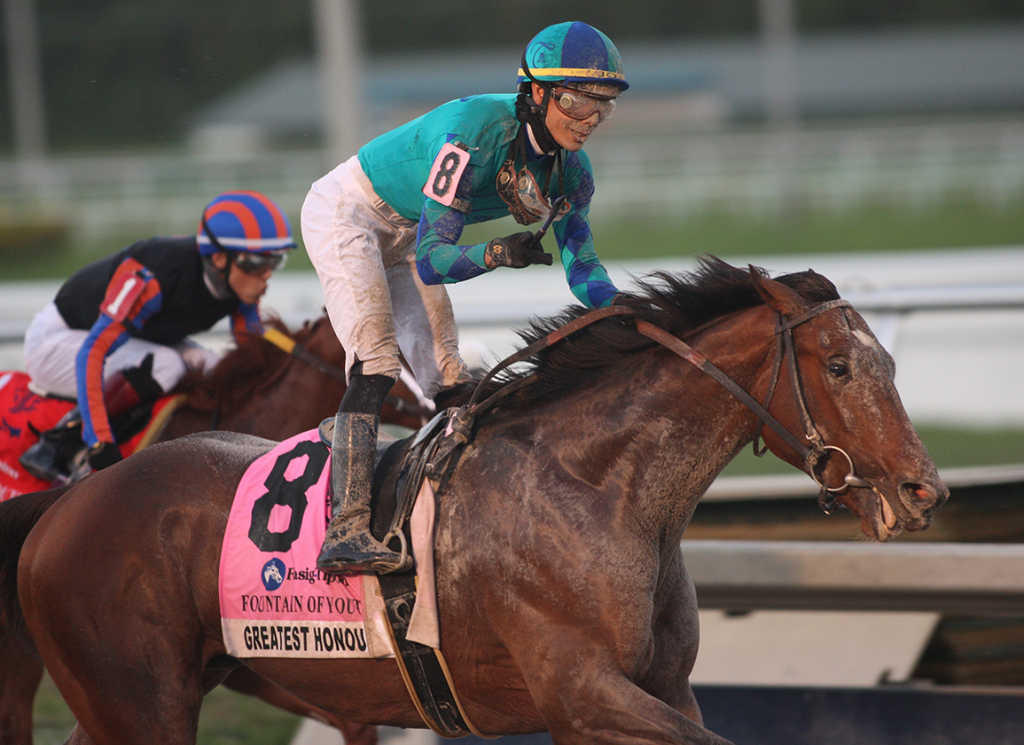
GREATEST HONOUR (Tapit-Tiffany's Honour by Street Cry {Ire})

$7,500 Spendthrift

Greatest Honour wins the Fountain of Youth | Horsephotos

No denying that this guy's derailment from the 2021 Derby trail was made to seem a long time ago when he resurfaced to rather tame effect this spring. But his fee makes ample allowance for that, and if you just rewind to the unmistakable brilliance of his original emergence, then you can only be excited to have cut-price access to such a regal bloodline.

Second and fourth dams are both Broodmares of the Year, divided by a GI Kentucky Oaks winner, with the family seeded by distaff influences of corresponding stature: Street Cry (Ire), Deputy Minister and Blushing Groom (Fr). Greatest Honour's dam was admittedly one of the least distinguished runners in this family, but she's a half-sister to Rags To Riches (A.P. Indy), Jazil (Seeking The Gold) and Casino Drive (Mineshaft) (a successful freshman sire in Japan, by the way) out of the broodmare icon Better Than Honour.

And there was no doubting that this blood had told when Greatest Honour was a flourishing sophomore in Florida. Even his juvenile grounding had been of exceptional substance: he took four starts to break his maiden, but was learning his trade by consecutive bouts with Olympiad (Speightstown), Speaker's Corner (Street Sense) and Known Agenda (Curlin)! Sure enough, when he did win a maiden, it was by beating subsequent Grade II winner Dynamic One (Union Rags).

So he was scarcely raised in grade when romping in the GIII Holy Bull S.; and he then overwhelmed Drain The Clock (Maclean's Music) in the GII Fountain of Youth S. And while the speed figures measured up, the way he appeared to be hitting his stride only deep in the stretch made him look like a horse just getting started. I was stunned that he did not follow through in the GI Florida Derby, but he disappeared for a year and then never really retrieved the thread.

But I am definitely keeping the faith, at this price. After all, the template isn't dissimilar from his sire, who started out at a lower fee than anticipated after fulfilment of his potential had likewise been thwarted by physical issues.

Above all, Greatest Honour passes the ultimate test of pedigree depth. His fourth generation is saturated with genetic potentates (Weekend Surprise, Narrate, Moon Glitter, Coup De Folie, Best In Show) corroborated far more widely than simply by those sons or daughters that happen to put them on this particular page.

This aristocratic blood, harnessed to Spendthrift's dynamic commercial program, will presumably benefit from plenty of opportunity. I wouldn't be at all surprised if that were to result in one or two candidates to redress his own misfortune on the road to the Derby–and you can't say that of too many stallions at this kind of fee.

SILVER:

EARLY VOTING (Gun Runner-Amour d'Ete by Tiznow)

$25,000 Ashford

Early Voting (right) wins the G1 Preakness S. | Mathea Kelley

Hats off to the Klaravich program, which missed the podium by a cigarette paper with Highly Motivated while also reaching its second step with this fellow, in our view the outstanding value among Ashford's exciting new quintet.

The three Ps–physique, pedigree, performance–are all lavishly present and correct.

This is a knockout specimen and, while Gun Runner will become still more extraordinary if also proving an instant hit as sire of sires, the family tree brings its own guarantees in that regard. For Early Voting's dam is, of course, a sibling to one such in Speightstown (as well as to the very talented but ill-starred Irap).

Performance, admittedly, was vexingly confined to just half a dozen starts. But Early Voting followed up his debut success with a daylight score in the GIII Withers S. before being collared by a neck, in a duel of future Classic winners with Mo Donegal (Uncle Mo), in the GII Wood Memorial. He confirmed his place among the elite of his generation when holding off Epicenter (Not This Time) in the GI Preakness, only for his career to derail in Saratoga.

Sure, he was a fresher horse at Pimlico than his new studmate; and he also got first run. But Early Voting was arguably only in a position to do that by superior early speed and, regardless of which side of the quibbling fence you fall, they were plainly in the same vicinity in terms of talent. And the relative durability of Epicenter is amply measured by the difference in their fees.

In this slightly more accessible tier, you seldom find such quality through so many dimensions: looks, natural ability (won a Classic, remember, off three starts) and genes. What worked for Speightstown (first three dams by Storm Cat, Chieftain and Buckpasser) has obviously worked for his sister, too. She is of course by a deeper staying influence (Tiznow, as against Gone West) but Gun Runner has done his stuff to produce a very alert runner. Gun Runner himself, remember, is out of a Giant's Causeway mare, which not only doubles up Storm Cat but entwines his influence with that of his nemesis Tiznow.

These are all very wholesome brands, and just look at the four mares in Early Voting's third generation. Without exception, they've shown that there is more than one string to their genetic bow. From the top: Candy Girl (Arg) (Candy Stripes) is here as dam of Candy Ride (Arg), but is also third dam of Tom's D'Etat; Quiet Dance (Quiet American) is here as granddam of Gun Runner, but is also dam of Saint Liam; Tiznow's dam Cee's Song (Seattle Song) famously produced not just classy performers like Budroyale but also the dams of Paynter and Oxbow; and Silken Doll (Chieftain), as we've already seen, unites Speightstown and Irap as well Early Voting.

That's a pretty copper-bottomed array of repeatable genetic excellence and, combined with the physical and performance attributes he has placed in the foreground, makes me confident of this horse's eligibility to last the course.

GOLD:

HAPPY SAVER (Super Saver-Happy Week by Distorted Humor)

$12,500, Airdrie

If you don't give this horse a shot, at this kind of money, then I guess you don't really buy into the only principles that ever make sense of this chaotic industry of ours.

Okay, so he was not quite a champion. But only an elite talent, and a very natural one, could win the GI Jockey Club Gold Cup as an unbeaten 3-year-old making just his fourth start; and only a matching resilience could maintain him in maturity as benchmark, in three consecutive races earlier this year, for Olympiad (Speightstown), Flightline (Tapit) and Life Is Good (Into Mischief).

That trio, needless to say, are all starting out at much bigger fees. Maxfield (Street Sense), similarly, stands at $40,000 after being pushed all the way by Happy Saver in the GI Clark S. last year. But now they all resume with a clean slate and, in terms of his eligibility to prove a conduit of genetic quality, none is in a stronger position than Happy Saver. His third dam is Weekend Surprise herself; and standing directly opposite her, as damsire of Super Saver, is her son A.P. Indy.

Super Saver will concern some people, despite Runhappy and Letruska, but the key here is that he has produced a very good racehorse by combining one spectacular maternal line with another. His own extends through generations of Ogden Phipps bluebloods; and obviously Happy Saver's dam, herself a stakes sprinter, belongs to a family that has famously produced several other stallions besides A.P. Indy.

Sure enough, the pedigree overall is heavily seeded with the right brands. For instance, Super Saver's grandsire Wavering Monarch was out of a Buckpasser mare; Super Saver's celebrated fourth dam, Numbered Account, was by Buckpasser; and so, too, was Weekend Surprise's mother Lassie Dear. That's typical of what happens when families extend their quality back to the days of much smaller books. Access to a top-class stallion was a privilege, earned by blood or performance or both. The mares behind Happy Saver, as celebrities in their own right, have corresponding consorts: after his mother by Distorted Humor, the next four dams are by all-time distaff legends in Deputy Minister, Secretariat, Buckpasser and Sir Gaylord.

The quest for value in stallions is about seeking the potential to punch above their presumed weight. If stallions couldn't sometimes produce foals better than themselves, the breed would stagnate at best and mostly decline. And a stallion's ability to elevate his potency, relative to his track career, must lurk in his blood. Yes, you want to see evidence on the track of a functional vitality in his genetic make-up. Happy Saver gave us that in spades. But he has every right to surpass even that exalted standard in his next career.

Like many horses going to stud, for one or two reasons we didn't see his very best as he closed out. But he had previously been a set-your-clock campaigner at the highest level, moreover one blessed with real flair. If you rewind to the very beginning, for instance, he won a sprint on by 5 1/2 lengths on debut in essentially the same time as the GI Woody Stephens S. winner on the same card.

This, in other words, is a horse whose stock can someday make us grateful that “Happy” days are here again.

The Value Podium: New Sires

Gold: HAPPY SAVER Airdrie $12,500

An elite competitor with aristocratic pedigree at an accessible fee

Silver: EARLY VOTING Ashford $25,000

A pacey Classic winner out of Speightstown's half-sister

Bronze: GREATEST HONOUR Spendthrift $7,500

Another of royal blood and made a lasting impression early

The post Value Sires For 2023 – Part I: New Stallions appeared first on TDN | Thoroughbred Daily News | Horse Racing News, Results and Video | Thoroughbred Breeding and Auctions.

Source of original post

Taking Stock: Los Al Futurity’s Predecessor Produced Sires

When it comes to “sire-making races,” the Gl Metropolitan H. is usually the first that's thrown into the conversation. Quality Road, the 2010 winner, is the most notable recent example, and before him it was Ghostzapper in 2005, but that's about it for the past 20 years despite the race's vaunted reputation. The Gl Florida Derby is a better recent gauge for making stallions: Nyquist (won in 2016), Constitution (2014), Dialed In (2011), Quality Road (2009), Scat Daddy (2007), Empire Maker (2003), and Harlan's Holiday (2002) are a stronger group than the Met Mile winners since 2002.

Harlan's Holiday sired Grade l winner Into Mischief in his first crop, and Into Mischief holds a wide-margin lead over second-place Quality Road on the general sire list with a month to go, $27,148,605 to $20,426,226, despite Quality Road's son Emblem Road's 2022 earnings of $10,110,758 – most of that from winning the world's richest race, the G1 Saudi Cup.

Into Mischief stands at Spendthrift for $250,000 live foal and has led the general sire list each year since 2019, and this will be his fourth consecutive year doing so.

The Spendthrift kingpin's lone Grade l win came in the CashCall Futurity at Hollywood Park in 2007. The race is now called the Los Alamitos Futurity and is a Grade ll event. It will be contested on Dec. 17 during the six-day Winter Thoroughbred Meet at Los Alamitos, which begins this weekend and features the Gl Starlet S. for juvenile fillies Saturday. Both races could have an impact on the leading freshman sire race.

Among colts, Justify's (Scat Daddy) promising son Arabian Lion is being targeted for the Futurity. At the moment, Hill 'n' Dale's Good Magic (Curlin), who sired Gll Remsen S. winner Dubyahnell Saturday; Spendthrift's Bolt d'Oro (Medaglia d'Oro), the sire of Gll Kentucky Jockey Club S. winner Instant Coffee the Saturday before; and Justify are in a heated three-way battle for the championship. Each has at least one colt for the Classics preps so far–Justify's Champions Dream won the Glll Nashua S. on Nov. 6, and before that, Good Magic's Blazing Sevens won the Gl Champagne S. Oct. 1–but the standout division leader is three-time Grade l winner Forte, who will be named champion juvenile colt of 2022.

Forte is by Hill 'n' Dale's Violence (Medaglia d'Oro), who also won the Gl CashCall Futurity, in 2012. Like Into Mischief, the race was Violence's only top-level win. Those two alone could give the CashCall Futurity some clout as sire-making race, but there's more.

The race was called the CashCall Futurity for seven years at Hollywood, from 2007 to 2013, and two other winners of it with subsequent stallion bona fides were the now-deceased Pioneerof the Nile (won in 2008), who stood at WinStar, and Coolmore America's Lookin At Lucky (2009). Into Mischief, Pioneerof the Nile, and Lookin At Lucky each has a Gl Kentucky Derby winner: Authentic, Triple Crown winner American Pharoah, and Country House, respectively. It's four if Mandaloun is thrown in for Into Mischief. That's four of the last eight winners of North America's most prestigious race – quite the haul, isn't it? Will Forte make it five of nine?

Synthetic Surface

If all of this wasn't surprising enough, recall that the CashCall Futurity was contested on a synthetic surface at Hollywood. In retrospect, the facts belie the longstanding hypothesis held at the time by many in the business that all-weather racing would lead to the ruin of dirt sires, which Into Mischief, Pioneerof the Nile, Lookin At Lucky, and Violence decidedly are. And, no slight to the others, Into Mischief is an iconic stallion who inhabits another sphere altogether.

Into Mischief also happens to be the only one of these four CashCall Futurity winners to race entirely on all-weather. Trained by Richard Mandella for B. Wayne Hughes, Into Mischief won three of six starts and was second in each of his other three starts, earning $597,080.

Pioneerof the Nile, a son of Empire Maker, raced on dirt and turf as well as all-weather, winning a Saratoga maiden special at two on turf in his second start for Bill Mott. In his next start in the Gl Lane's End Breeders' Futurity at Keeneland on all-weather, Pioneerof the Nile was third. After that, he was fifth in the Gl Breeders' Cup Juvenile at Oak Tree's all-weather Santa Anita meet, and then he was switched by owner Zayat Stable from Mott to Bob Baffert and kept in training in California.

For Baffert, Pioneerof the Nile next won the CashCall Futurity. The colt began his 3-year-old season with three consecutive wins at Santa Anita in the Gll Robert B. Lewis, the Gll San Felipe, and the Gl Santa Anita Derby. He made his first start on dirt in the Derby, finishing second to Mine That Bird. After an 11th-place finish in the Gl Preakness, Pioneerof the Nile was retired with a record of five wins from 10 starts and $1.6 million in earnings. All of his stakes wins were on synthetic surfaces at either Hollywood or Santa Anita. Before his premature death at age 13, Pioneerof the Nile stood for $110,000 at WinStar.

Baffert also trained Lookin At Lucky, a champion at two and three for owners Mike Pegram, Karl Watson, and Paul Weitman. Lookin At Lucky, by Smart Strike, won five of six starts at two, all on all-weather, including the Gl Del Mar Futurity in addition to the CashCall Futurity at the highest level. Unlike Into Mischief and Pioneerof the Nile, Lookin At Lucky also won on dirt, including two Grade l races, the Preakness and the Haskell Invitational. Altogether, the colt won nine of 13 starts and earned $3.3 million before entering stud at Coolmore America, where he's still a productive stallion standing for a bargain fee of $10,000. In Chile, where he has shuttled through the years, he has an exceptional record of Group 1 success.

Todd Pletcher trains Forte and also trained his sire, Violence, who ran for Black Rock Stables. Like Lookin At Lucky, Violence won on dirt as well. The Medaglia d'Oro colt won a maiden special at Saratoga in his first start and followed up with a win in the Gll Nashua at Aqueduct before crossing the country for the CashCall Futurity. He made only more start after that, a second-place finish in the Gll Fountain of Youth at Gulfstream and was retired with a record of three wins from four starts and $623,000 in earnings.

Like Into Mischief, the CashCall Futurity was his lone win at top level. Violence will stand for $50,000 next year, up from $25,000 this year, and in Forte he has a legitimate Triple Crown contender and his first champion. Before Forte, who won the the Gl Hopeful at Saratoga and the Gl Breeders' Futurity at Keeneland in the lead-up to nailing the juvenile championship with an impressive upset of previously undefeated Cave Rock in the Breeders' Cup Juvenile, Violence was mostly known for three Grade 1-winning sprinters, Dr. Schivel, No Parole, and Volatile.

Forte has elevated Violence's profile into the Classics realm, and if the colt continues to progress and lands the Derby, he'll put Violence into an elite club of CashCall Futurity winners who have sired Derby winners. But even if Forte doesn't win the Derby, these four stallions have put the CashCall Futurity up there with other races that are more frequently associated as sire makers.

Sid Fernando is president and CEO of Werk Thoroughbred Consultants, Inc., originator of the Werk Nick Rating and eNicks.

The post Taking Stock: Los Al Futurity’s Predecessor Produced Sires appeared first on TDN | Thoroughbred Daily News | Horse Racing News, Results and Video | Thoroughbred Breeding and Auctions.

Source of original post

Verified by MonsterInsights