Letter to the Editor: Bill Casner

Editor's note: Bill Casner, a long-time participant in many facets of racing, is probably best known for founding WinStar Farm with Kenny Troutt and winning the 2010 GI Kentucky Derby with Super Saver. Among Casner's many roles in the sport have been founding director of the Race for Education and Kentucky Equine Education Program (KEEP). He has sold his interest in WinStar to Troutt and currently operates as Casner Racing.

Horse racing is in a firestorm. We are at survival tipping point. The decisions that are made in the short term will determine whether horseracing can endure as we know it. The American public has no tolerance for what they perceive as a sport that is immersed in carnage. I commend Churchill Downs for suspending racing to take a hard look at their future and to explore solutions that will be significant in mitigating breakdowns and restoring confidence to our fans.

The one decision that would be a major game changer is to convert the racing surface at Churchill Downs to synthetic. In the released 2022 The Jockey Club (TJC) Equine Injury Database (EID) for the year 2021, injuries on dirt were 1.44 per 1,000 horse starts. Turf injuries were 0.99 per 1,000. Injuries on synthetic were vastly diminished with 0.41 per 1,000. This data shows that synthetic surfaces are 3.5 times safer than dirt and 2.2 times safer than turf. These stats are compelling in showing the exponential safety of today's synthetic surfaces over dirt and turf.

The data is compelling but it doesn't tell “WHY” synthetic tracks are safer. Back in 2006, I chaired the shoeing committee for TJC Welfare and Safety Summit. We were tasked to examine the safety of toe grabs which Dr. Sue Stover at UC Davis had shown to significantly contribute to breakdowns. We employed sophisticated high-speed cameras with a closed group of nine horses provided by Chris McCarron's jockey school to understand why toe grabs were contributing to breakdowns. We filmed the hoof's contact with the racing surface using a variety of shoes with varying toe grab lengths on both dirt surfaces and Keeneland's synthetic track.

The results were dramatic. What we learned was the effect of “slide” on the lower limb of the horse. With Queen's Plates, the front foot has an average slide on dirt of 3 1/2 to 5 inches. The average slide on synthetic was 1 1/2 inches. Slide is important to understand. It's the “give” in a horse's stride. The increased length of slide on dirt causes two things to happen. First, it magnifies torque on a horse's lower limb. If a horse “toes in” the limb incurs torque medially because of the increased forces on the outside of the hoof. If they toe out, then the torque is lateral with the increased forces on the inside of the foot. And when horses step in holes on a dirt track, the torque can go either way. This doesn't happen on synthetic tracks because of the shorter slide which greatly diminishes torque. Also, a horse's foot is always landing flat on a synthetic surface as opposed to the cuppy holes that cover a dirt track. Synthetic also provides a much higher energy absorption than dirt with a higher energy return.

The second important factor that we were able to measure was the magnified load on the pastern that was presented on dirt. Because of the exaggerated slide and delayed break over on dirt, the pastern continues to load through the stride, increasing its drop by as much as an inch over synthetic. We were also able to see this increased load when horses landed in the “holes” created on dirt tracks.

As you can visualize, the increased load or drop of the pastern creates excessive strains on the suspensory apparatus of the horse's lower limbs magnifying the opportunity for a catastrophic failure. When a horse blows out its suspensory apparatus in a race it leads to a broken leg in the next few strides.

Suspensory and tendon injuries are extremely rare on synthetic but occur way more frequently on dirt because of these magnified strains.

The videos also exposed how lethal toe grabs were on all surfaces. They were especially detrimental on synthetic because they abruptly stopped the foot not allowing any slide. This is why trainers were experiencing rear-end injuries early on because they were continuing to use toe grabs on the rear feet.
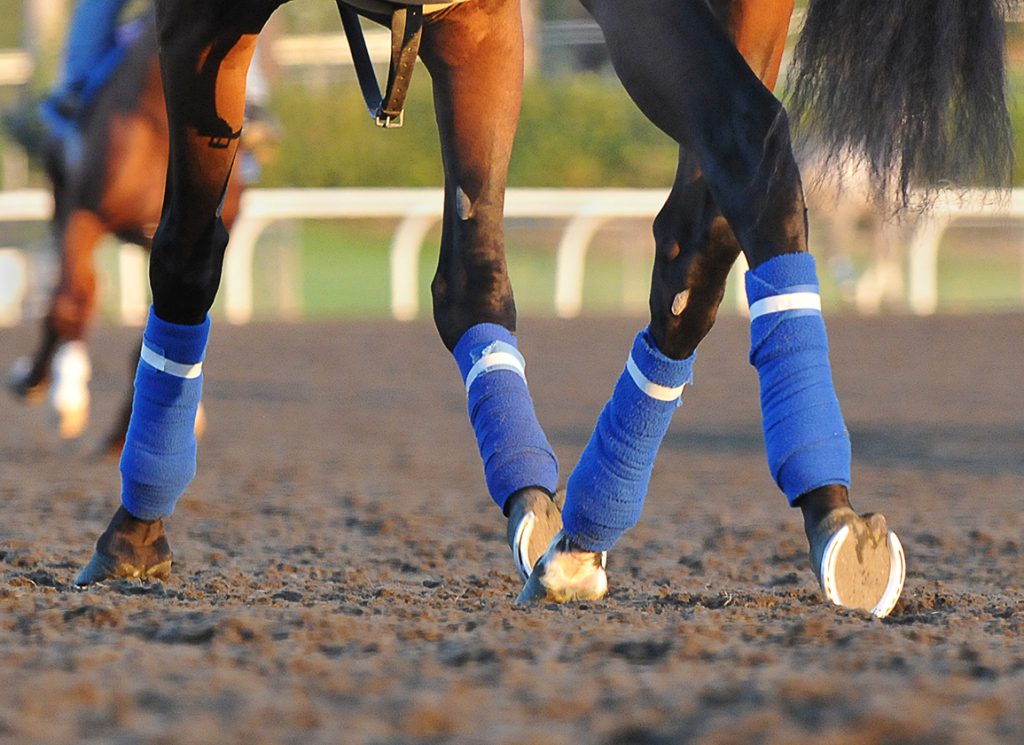
Sarah Andrew

Catastrophic break downs are rarely caused by one bad step although this is more likely on dirt. As most orthopedic surgeons will testify, they are the result of cumulative microscopic injuries that accrue with the thousands of steps a horse accumulates in training and racing. It's the laws of physics. Excessive torque and loads on a horse's legs will eventually take its toll. With a synthetic surface these strains are greatly diminished and a horse's natural ability to remodel its bone will repair and strengthen it at a cellular level.

We not only have the irrefutable data over hundreds of thousands of horse starts on synthetic but we have the notable success of several major tracks that have employed them.

The first is Keeneland. The last meet they ran on synthetic in 2014 was the most successful meet in Keeneland's history at that point. All-time attendance and handle records were set. There were record field sizes, minimal scratches with inclement weather when races were taken off turf. And most importantly, there were zero breakdowns!

The second is Santa Anita. The last meet run at Santa Anita in 2009 had an injury rate of 0.57 per 1,000 horse starts compared to their pre-synthetic era on dirt of 2.78 per 1,000. That computes to a 4.8 times higher safety record. This is in spite of a poor-quality installation that would not properly drain, eventually having a subsurface membrane failure allowing aggregate to float to the surface.

Here are some compelling stats from three tracks currently running on synthetic surfaces: Golden Gate, Presque Isle, and Gulfstream.

Golden Gate had an injury rate of .38 per 1,000 with 12,986 horse starts in 2021 and 2022 on their Tapeta surfaces.

Presque Isle race meets in 2021/2022 had 0.24 injuries per 1,000 with 8,178 horse starts.

Gulfstream with its newly installed Tapeta track had the best record of all with only one injury out of 7,085 horse starts with 0.14/1,000. This translates to a 9.7 times safer surface than their dirt track.

Belmont has recognized the advantages of having a synthetic surface with its scheduled completion in the spring of 2024.

Injuries on a national basis have dropped significantly at certain tracks since the implementation of intensified pre-race veterinary examinations of our horses and have the promise of continuing to diminish injuries with mandated requirements by HISA. This high-level scrutiny of starters combined with the safest possible racing surface will dramatically reduce injuries and show the world that we care.

Horseracing is a sport with a rich history of tradition. The thought of changing the racing surface of the Kentucky Derby to a synthetic surface will not appeal to those that value tradition above the safety of our horses and the survival of our beautiful sport. If we do not take drastic proven steps to significantly eliminate breakdowns we are destined for the fate of Greyhound racing.

Today's public has no stomach or tolerance for what they perceive as abuse of our horses. The “writing is on the wall” or in our case the New York Times, CNN and the 6 o'clock news. We either embrace innovative change supported by the data to maximize safety for our horses and riders or we are destined to experience a slow painful death.

The post Letter to the Editor: Bill Casner appeared first on TDN | Thoroughbred Daily News | Horse Racing News, Results and Video | Thoroughbred Breeding and Auctions.

Source of original post

Letter to the Editor: The Triple Crown

Bill Finley (If Baseball Can Change, So Can the Triple Crown, TDN, Tuesday, May 16, 2023) has hit the nail on the head. As one who was and now is again a baseball fan, I agree that baseball's changes have been dramatic and effective. Some traditions are great, but when traditions are barriers to one's existence they need to be rethought.

The truth is that only our sport's diehards would even know the difference if we spread our Triple Crown races out a month apart. The reality is that the general public or the occasional follower couldn't care less whether we changed the timing or not. We are arrogant to think that such a change would make a difference to the point of decreasing interest. On the contrary, at this point in our sport's history, any tradition that decreases the quality of our product and therefore discourages general public interest needs to be abandoned. We no longer have the luxury of being stubborn.

John Phillips, Darby Dan Farm

The post Letter to the Editor: The Triple Crown appeared first on TDN | Thoroughbred Daily News | Horse Racing News, Results and Video | Thoroughbred Breeding and Auctions.

Source of original post

Letter to the Editor: Racing Owner Conversations

by Edd Roggenkamp, Versailles, Kentucky

Racehorse owners are the lifeblood of this industry. Without owners, there is no need for breeding farms, sales companies, consigners, vets, feed companies, et al. But the number of licensed racehorse owners is declining in most states, which is a seriously negative trend for the horseracing industry.

Over the nearly 30 years that I have owned and raced Thoroughbreds, I have always found it most interesting to sit down and have a candid conversation with another racehorse owner. It lets me find out how they manage their stable, design their tactics and adjust their racing strategy. Universally, their love for the sport and enthusiasm is contagious. These conversations, often over coffee in the track kitchen, have been a big help as I climbed up the steep learning curve of owning race horses. I was lucky early-on to meet some knowledgeable owners, that were enthusiastic, but realistic, and willing to share their “how to” tactics. Some of my best conversations were with small guys, often operating on a budget, but smart, careful, and having great fun owning racehorses and winning races. But such conversations are not always easily available to folks that want to own a race horse, or a new owner that wants to learn fast, or even a veteran who wants to hear different ownership strategies.

There are lots of articles and videos covering high-flying trainers and jockeys talking about their Grade 1 racing success, but how about the day-to-day ideas and strategies of the dedicated people that own the horses and write the checks?

So, the idea was hatched. Let's record a series of candid and freewheeling Racehorse Owner Conversations with all kinds of experienced and successful owners. We'll ask them to share their strategy, their level of involvement, how they acquire good racing stock, and how they find and develop relationships with quality support people. Then we will share these conversations freely with anybody interested in owning racehorses.

Luckily, modern podcast technology makes this possible. The first of these conversations (podcasts) are now available free on major podcast sites: Spotify, Google podcasts, Amazon Music, Apple Podcasts and many others.  Anyone can download and listen to these conversations at their leisure.

The conversations will not be just about winning graded stakes races because 80% of our sport is claiming races, and thousands of ardent owners, enjoy winning races at their local track. Ownership situations are generally the same…only the budget is different. Our first three podcast conversations are with successful owners that have won major graded stakes races (Texas-based Jerry Namy, a Grade I-winning owner at Keeneland; 2022's leading owner in Maryland Larry Johnson; and West Coast-based Grade I-winning owner Jack Hodge), but all three have started a claimer within the last year.

So go to a podcast site, search for Racehorse Owner Conversations and listen in for free to the first 3 Episodes available now. More conversations will be added shortly, and all podcasts will be archived and available indefinitely. We think you'll find these sessions with the candid, thoughtful and colorful people who share their ideas on Racehorse Owner Conversations interesting, helpful and enlightening.

The post Letter to the Editor: Racing Owner Conversations appeared first on TDN | Thoroughbred Daily News | Horse Racing News, Results and Video | Thoroughbred Breeding and Auctions.

Source of original post

Letter to the Editor: Hugh Mitchell on Woodbine

Horse racing is an honourable sport that is steeped in tradition; built by generations of hardworking and passionate individuals and families. It's an industry that brings people together from all walks of life, and is critically dependent on everyone's contribution to its stability and success. While this diversity of roles and shared passion is racing's greatest strength, it exists within a very complex and challenging business environment that results in constant pressure to plan, adapt, and aggressively fight to secure our future.

At Woodbine Entertainment, we own and operate two racetracks: Woodbine Mohawk Park (Standardbred racing) and Woodbine Racetrack (Thoroughbred racing). If you are reading this with interest, it's important to understand that Woodbine operates as a not-for-profit minded organization. The late, great breeder and visionary, E.P. Taylor, donated a large piece of land in Toronto where Woodbine Racetrack is now situated. His vision was to provide this land, and this racetrack, to the hardworking horse people of Ontario so they would always have a place to race horses and earn a living doing so. Woodbine Entertainment, formerly the Ontario Jockey Club, carries the responsibility, mandate, and obligation to honour his vision. We do not have an owner nor shareholders. We have an independent and committed Board of Directors whose job is to ensure that this mandate is strictly followed. Our executive management team is accountable to this Board.  Every decision we make is to create a strong and sustainable Ontario horse racing industry. That's why Woodbine exists, and for no other reason. Every dollar of profit we make is invested to support the entire Ontario horse racing industry. Our vision and ambition is to support all current industry stakeholders as best we can while also thoughtfully investing to grow the Ontario horse racing industry towards a strong, vibrant, and sustainable future.  It's a very difficult balance requiring judgment and trade-offs. We recognize that not everyone will agree with the decisions we make to achieve this balance, however, we hope and expect that everyone will respect our motivation and purpose to support the present and future of racing in Ontario.

A decade ago, the provincial government in power at the time ended a lucrative funding agreement that was supporting horse racing. This decision almost killed the industry in Ontario. At the time, the only path forward was for Woodbine Entertainment to lead the industry-something that was asked of us by the government, and staying true to E.P. Taylor's vision, we agreed. We worked tirelessly to reach a new long-term funding agreement that is now in place. To this day, we continue to lead the industry at a substantial cost to our operations, and we do so proudly.

While this long-term funding agreement is essential to our industry's existence today, our vision is to develop the property that Woodbine Racetrack is situated on to create new revenue streams that will eventually allow us to not depend on government funding. This will support our mandate to create a strong and sustainable Ontario horse racing industry. Every cent of profit generated from this investment will be used to support the industry. In addition to fueling substantially larger purses, we will be able to invest even more heavily in our racing facilities, people and industry support programs.

We're also investing in other game-changing areas like sports betting and technology-things that will further develop new revenue streams that will be spent back on racing in Ontario. Until we get some of these major initiatives across the finish line, we need to continue to operate prudently and be patient to allow the long-term vision to come to life. At the same time, we understand the challenges that all of our industry stakeholders face today. It's difficult to make a reasonable living, and we must provide as much support as financially possible while building towards a brighter future. We must allocate the dollars we have available today across numerous stakeholders that often have different priorities, issues, and needs.

In the meantime, wagering is Woodbine's primary line of business that can immediately drive significant incremental revenue. This revenue supports the above-mentioned purses and capital improvements. Therefore, healthy field sizes and competitive racing is necessary to provide a product that will drive wagering.

Despite the challenges our industry faces today, we are extremely confident in our future. We are a world-class racing industry with tremendous opportunity in front of us. We are blessed with an incredibly hardworking and talented group of horse people and employees. If we take care of our people today, and provide for a better future for them tomorrow, we will have successfully achieved the future E.P. Taylor envisioned decades ago.

Sincerely,

Hugh Mitchell

Chair, Board of Directors

Woodbine Entertainment

The post Letter to the Editor: Hugh Mitchell on Woodbine appeared first on TDN | Thoroughbred Daily News | Horse Racing News, Results and Video | Thoroughbred Breeding and Auctions.

Source of original post

Verified by MonsterInsights