September Snapshot of Stallion Scene

by Chris McGrath & Stefanie Grimm

It's all the trees I feel guilty about. That, and the postman's lumbago. But while many people nowadays complacently compress the world's biggest yearling auction onto a digital device, a stubborn few of us will always prefer scribbling notes on the dog-eared pages of a paper catalog.

Whichever your preference, of course, you will do well to avoid wearing out the soles of your shoes during the Keeneland September Sale–not to mention other reserves, in morale or finances. Before you start appraising individual hips, however, it might be worth attempting a wider panorama of the sale.

Because their relative representation, across what is unarguably the most comprehensive of all marketplaces, provides an interesting measure of the current balance of power among Kentucky stallions.

We've divided the sale into three sectors: Book 1, for the elite tier; Books 2 and 3, for a version of that elusive “middle market”; and Books 4, 5 and 6. Pretty crude, clearly. Many horses in Book 2 will have far more in common with their Book 1 peers than with anything in Book 3; and some in Book 4, equally, will be different class from Book 6. But, look, it's just one snapshot; a picture drawn in clumsy brushstrokes, not a draughtsman's pencil. We'll just demarcate stallion representation across the two weeks, and see what–if anything–turns up.

The first thing to remember is that catalog distribution is never a simple, scrupulously neutral assessment of merit. The sales company has to work with consignors, and consignors with their clients. The freshman, for instance, needs to be given his now-or-never platform. Same with the proven elite: bury a six-figure cover in Book 6, and you might as well send the creature in towing a plow.

There are some consignors, equally, who remain adamant that a certain type of yearling will do better if relegated to stand out from the crowd at a lower level. Whether or not that strategy is justified, it obviously backfires in an exercise like this one.

Besides, the market will nearly always end up more or less obeying the cover fee. That's certainly true of spending, especially on new sires, no matter how loudly agents claim simply to be assessing the flesh and blood in front of them. Much the same can be expected, then, when inspectors and consignors try to anticipate the market. Even so, perhaps we can find one or two stallions that deserve an extra rosette.

Quality Tells in Book 1

There's an immediate caveat here, in that some of the best yearlings of the crop have already gone under the hammer at Saratoga. As we've already stressed, however, this is just one moment in time and by no means definitive. It was tempting, indeed, to combine Book 1 with Fasig-Tipton's Select catalog. But Book I does at least give an undiluted elite flavor.

The table below is ranked according to the percentage of stallions' September entries to have gained admission to Book 1, down to a ratio of one-in-10.
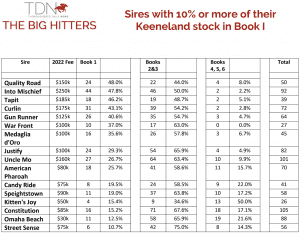
There's an unsurprising correlation between Book 1 footprint and fee. But the six-figure club has internal competition all of its own and, while the proportion of his Book I stock is only a scintilla higher than that of Into Mischief, there's no mistaking the statement made here by Quality Road.

Because this is a very important stage in the career of a stallion now in his prime at 16. This crop was conceived during his single season at $200,000, in 2020, a second consecutive hike after he had been catapulted from $70,000 to $150,000 the previous year. City Of Light had driven the initial rise before joining his sire at Lane's End in 2019, his swansong success in the Pegasus being promptly followed that year by other Grade I scores for Dunbar Road, Roadster and Bellafina.

Their sire has since reverted to $150,000, but it's obviously a great sign that he has managed to get very nearly half his September stock into the two showcase sessions. His first six-figure covers, in 2018, resulted in a spectacular juvenile, Corniche, and if that colt has since proved a source only of frustration, then the gap was helpfully filled this summer by a graduate of the previous crop, Bleecker Street, in the GI New York S. at Belmont.

Quality Road has already sold a $1.8-million filly this summer at Saratoga, where his four other hips reached $700,000, $350,000, $205,000 and $575,000 (RNA). Having worked his way up from a base of $25,000, it was vitally important for Quality Road to match his billing once promoted to the top echelon. So far as the Keeneland inspectorate and the consignors are concerned, at any rate, that seems to be pretty much what he's doing.

Nowadays, of course, Into Mischief stands alone in terms of his fee and, having exponentially advanced his record with the quality of his books, he accommodates no fewer than 90 of his 92 September entries in the first three of the six books. Tapit and Curlin, long established at this level, also house over 40 percent of their September stock in Book 1, and the phenomenal young sire Gun Runner has now also tipped that mark.

Having had 11 in Book 1 last year, the Three Chimneys champion is now up to 26. He has, moreover, already sold a couple of standouts from his third crop at Saratoga: a colt bought by White Birch Farm and M.V. Magnier topped the whole sale, at $2.3 million, while the latter gentleman also signed for another at $1.4 million. And remember that Gun Runner was only elevated to the six-figure bracket this spring.

The star of the next intake, Justify, has also consolidated well; while we should remember that Constitution remained no more than $40,000 when conceiving the 16 yearlings (of a whopping 105 in the catalog) that have made the elite book.

Beach Making Waves on Debut

Among the debutants at the sale, Omaha Beach stands apart with an impressive Book 1 ratio of one-in-eight. With two-in-three then surfacing in Books 2 and 3, moreover, he looks well positioned to maintain his early momentum as top rookie.

He dominates the table below which is restricted to Kentucky rookies with more than 15 yearlings in the September Sale.

Having processed 10 of 13 so far offered at other auctions, at an average $268,882, Omaha Beach has jumped pretty flamboyantly through every hoop so far. Even on the top fee of the intake, he looked fair value at his introductory fee and Spendthrift have meanwhile been characteristically aggressive in keeping him in the game.

Audible managed to get four into Book I, having already sent seven yearlings to Saratoga. He has punched weight with a significantly bigger proportion in Books 2 and 3 than all bar Omaha Beach.

The only other newcomers to break into Book I, with one apiece, are Catholic Boy, Vino Rosso and Preservationist. I'm a huge fan of the latter, who was launched against a fairly steep commercial slope, so he deserves congratulation for getting hip 179 into the premier book off a $10,000 cover. This colt must be pretty special, in the circumstances, so y'all get down to Barn 12 and take a look! The dam is a half-sister to a Grade II winner/Grade I runner-up and has already contrived graded stakes winners by Creative Cause and, wait for it, Haynesfield.

Don't be alarmed by how many of these freshmen will be doing the bulk of their trade in the second half of the sale. That's pretty standard for many established sires, and we all know how vital sheer volume is to the launch of these fellows. And it can't be reiterated enough that this is just one fleeting glimpse of one market, however big. Budget stallion Flameaway, for instance, hit one out of the park at Saratoga at $425,000.

All these horses have to do now is run.

Grass is Greener

One real paradox is the deference the U.S. market will show to turf stallions based in Europe, while giving so little commercial oxygen even to the most eligible imports to Kentucky.

A number of European stallions surface in this catalog, mostly with a single shot. Given American activity at the breeding stock sales in recent times, most of these yearlings were presumably imported in utero with their dams. And, curiously, they have all been given a ticker-tape reception.

Galileo (Ire), Frankel (GB) and Kingman (GB) unsurprisingly get the Book 1 limelight for their respective samples. No Nay Never, as a thriving son of Scat Daddy, fields four–one in Book 1, the rest in Book 2. But even stallions that maybe aren't so well known in Lexington get full respect: Bated Breath (GB), Calyx (GB), Study Of Man (Ire) and Wootton Bassett (GB) all field their solitary offerings in Book 2. Caravaggio, himself since imported to Kentucky, has been followed over the water by four from his last European crop and all but one are accommodated in Book 2.

Stoking the Embers

When a stallion is pensioned, or sold abroad, or lost prematurely, vendors always anxious about his residual stock being ruthlessly abandoned to fend for themselves. With the marketing teams no longer putting their shoulders to the wheel, these hapless animals tend to be left to fend for themselves. It's a tribute to pure quality, then, if they retain prominence in the catalog–as, for instance, when Arrogate sells three-in-four of his final crop in the first half of the sale.

They are all collector's items, after all, but the same is true of just three yearlings salvaged here from the final crop of Tiznow. Surely it would be rash to leave town on Friday without at least checking out this trio of colts. Hip 1195 is out of a mare whose son by Tiz Wonderful won a Belmont maiden and the GIII Sanford S. on his only two starts; and the second dam is half to a French Classic winner. Hip 2011 demands a look regardless, simply because you must never miss a visit to Crestwood's consignment. And hip 2090 is out of a Storm Cat mare (herself daughter of a Grade I winner) that has previously produced a multiple graded stakes-placed Listed winner by Tonalist.

Noble Mission (GB), meanwhile, sadly proved too well named, having failed to prise open the eyes of myopic Kentucky breeders before the Japanese cannily rehomed Frankel's brother. Predictably enough, 10 yearlings from his final Kentucky crop have been dumped towards the end of the second week, but I shouldn't be at all surprised if there was a gem or two lurking there.

Among those sires still persevering against neglect, you'll find some chastening names with a bare handful coming under the hammer. Several haven't been given anything like an adequate chance, but they're in trouble enough as it is and we won't make things worse by drawing attention to specific examples.

But it's too poignant to pass over the fact that the pair responsible for the first and third past the post in last year's Kentucky Derby, Protonico and Oxbow, can, respectively, muster just two yearlings and one. Let's hope both earned some renewed attention this spring, and might yet return from the brink.

Oxbow must obviously share the plaudits for Hot Rod Charlie with the dam of that heart-warming racehorse: Indian Miss, after all, had already produced Mitole by Eskendereya. Yet Oxbow would surely be amazed to learn that even $1.6 million was insufficient to get her latest colt, by Into Mischief, to his reserve at Saratoga!

Hats off the Middle Men

Here's a club you can be proud to join; one that shows you have done what it takes to achieve a viable niche in Kentucky.

The table below probes the very marrow of the market. It excludes the absolute elite, which for present purposes we'll define as those (featured in Table A) whose Book 1 footprint represents 10% or better of their September stock. It also leaves out the freshmen, who are a case apart and duly treated as such in Table B. And it cuts off at 40% representation in Books 2 and 3. Believe me, that's a true badge of distinction.

You may well think it depressing that even some of these rock-solid operators must sell half their September stock in the second half of the sale. But all you have to do is think of your favorite stallion that might be eligible for this table, only he's nowhere to be seen. A quick, back-of-the-catalog calculation on his distribution will teach you due respect for these guys.

And, above all, for Ghostzapper. What an unbelievable shape we find to the distribution of his yearlings in this sale: just three in Book 1, but just four in Books 4, 5 and 6. And 33 crammed into Books 2 and 3! That is what I call a stallion you can set your clock by.

There are quite a few other veterans in this group, the odd pensioner, and indeed sadly a couple that have left us altogether. Conversely there are also one or two younger guns, notably Not This Time, who are laying strong foundations for the leap into that one-in-10 Book I echelon as the ageing sires in that group fade.

True, some of these are still riding that initial commercial wave, their longevity at this level contingent on the deeds of stock now venturing onto the racetrack. But I tip my hat to anyone who can keep less than 25% of his trade out of Books 4 through 6, as has Munnings in maintaining his model rise.

If only the “middle market” truly represented the middle of the road! Wherever you find yourself this September, mind the traffic–and good luck.

The post September Snapshot of Stallion Scene appeared first on TDN | Thoroughbred Daily News | Horse Racing News, Results and Video | Thoroughbred Breeding and Auctions.
Source of original post

Confidence Game: A ‘Coincidental’ Colt with Good Karma in His Corner

Kirk Godby didn't think he'd buy a horse in 2021. The plan wasn't there, no paperwork was prepared, but when partners lean on you to buy a racing prospect, it's not always a request even when it sounds like one. Godby, co-founder of Don't Tell My Wife Stables along with long-time business partner Rob Slack, didn't exactly have a master plan in place before the opportunity to purchase Confidence Game (Candy Ride {Arg}) arose. Like most small operations, there was a set budget to adhere to and buying something regally-bred almost always fell out of price range.

Which makes the story of how Confidence Game and his owners' paths crossed all the more fascinating.

“What's crazy is that I wasn't even planning on buying horses at that sale. For this year, I've already got our formation documents done for 2022, everything is rolling, everything is done. I did not have one thing done,” Godby admitted, recounting the push to buy a new prospect. “I had some of my core partners reach out like 'Are we going to get a horse this year?' and we really weren't planning on it. They really forced me to do it.”

With no way of calming the mounting calls beyond getting them the horse they wanted, he reached out to Keith Desormeaux, the partnership's sole trainer and bloodstock agent. The instructions were simple: just find something that could run.

“I called Keith and I said 'Look, I don't have anything formalized, but these guys want to buy at least one horse, for now, and I'll see how much interest [they'd have later].' Just find me one.”

The call was on short notice; only a day or two before Desormeaux purchased HIP 1462 for $25,000, and in his name, not the partnership. Godby happened to glance through the results to see if the bloodstock agent bought anything when he noticed the record come up, and immediately called his long-time friend. Was that horse spoken for by another group? No, was the response.

Well, he was now.

Out of Eblouissante (Bernardini), perhaps best known for who her sister is–as goes the story for most half-siblings to super stars–the partnership's new colt had a lot to offer on paper. The late April foal was the most recent at racing age for his dam, who claims not only a Broodmare of the Year on the bottom, but also the genetic advantage of the late Bernardini's now-known penchant as a broodmare sire.

On the top of the page, Candy Ride (Arg) was not only champion miler in Argentina but brought that wicked speed to the States, setting a new track-record in the GI Pacific Classic, and has since gone on to throw seven champions himself; names like Gun Runner, Shared Belief, and Game Winner coming to the forefront.

But it wasn't Zenyatta (Street Cry {Ire}) nor Balance (Thunder Gulch) nor the sparkling Candy Ride sons which ultimately caught Godby's attention, but rather a sister who flew under the radar: Where's Bailey (Aljabar).

“It wasn't just the page, obviously that speaks for itself,” he said, matter-of-factly. “But it was more about the connections. Zenyatta was broke and trained at Mayberry Farm in Ocala by April Mayberry, and that's where all of our horses are broke. And the second part of that was Where's Bailey. Where's Bailey is a horse Keith picked out several years back, bought her for $4,000 at the Keeneland sale. She's named after his son [Bailey]. There's too much connection here.”

The colt, seemingly a stroke of good luck straight from the karmic arc of the universe itself, was sent to said farm in Florida for his early training, and April Mayberry kept Godby well-informed of her appraisals of the last-minute addition.

My Boy Jack with Keith Desormeaux on the shank | Coady Photography

“She really, really liked [Confidence Game] at the farm as he was developing. You know, it's such a process. My Boy Jack, our Derby horse, was a favorite down there, but he wasn't…people weren't just falling all over him,” Godby said, not taking any time to mince words. “But she was always very positive about Confidence Game. He was always going forward, he was smart.”

When the horse got to Desormeaux's barn, there wasn't a dramatic up-tick of new things being asked of him. Keith Desormeaux, as Godby described him, was an old-school horseman who believed in starting a horse slow; building the miles and the foundation with jogs, gallops, slow three furlong works, and then branching into more intense requirements. And the more they asked of Confidence Game, the more he gave, and the more Desormeaux liked what he saw.

“We were so excited for his first race…and he loses first-out by 13 lengths to Damon's Mound,” he said with a chuckle. “I knew we had something special off that performance. The new partners focused on getting beaten by 13 lengths, but I knew this guy was the real deal. Of course, Damon's Mound is a monster, which he proved in the Saratoga Special.”

That referenced first race was a lesson Confidence Game needed, even if it wasn't immediately evident to all at the time. He broke a step slow, not unusual for debuters, and was asked to close from seventh in a six furlong sprint. Given the circumstances, third beaten a half-length for second wasn't the worst outcome, considering the winner's later performance in the GII Saratoga Special.

For the second start, there would be no such trouble after the break, no pack or kickback to contend with; once Confidence Game seized early command, it would not be ceded. Five lengths separated their runner from his nearest competitor in the end.

“I got to tell you, we've been in some big races and had some great racehorses through the years, but we've never been this nervous and excited coming into a race, nonetheless a maiden special weight. We just hoped that he'd prove what we thought and knew of his talent, and he certainly did that.”

Confidence Game emerged from that effort strong and ready for more, a positive sign for the future as the next target will be the GIII Iroquois S. at Churchill Downs. Godby intends to be there in-person this time, and expects a bigger crowd for the colt's third trip to post as well.

“I started this partnership because I wanted to introduce this incredible sport to as many people as I could,” he said, adding that three of his 'brand new' partners had come down from Chicago especially for the race, and they'd had a blast. “Going in the paddock, ending up winning, which tops it off, and getting their picture taken; it's the experience. Keeping them updated and informed and to see their excitement–that experience is why I do this.”

Of course, without their trainer, he readily admits that the moments he wants to create for the partners would not be possible. Desormeaux's talent as a conditioner and his eye for horses went under appreciated for a long time, he claims, but once the funds flowed in, the horsemanship became readily obvious. It was a rise through the rankings that Godby has enjoyed playing witness to.

“I tell the partners, especially the new ones, you are buying entertainment and this whole thing is driven 100 percent by him. He picks the athletes out, and trains them. I'm just the guy who organizes things and takes care of the back end.”

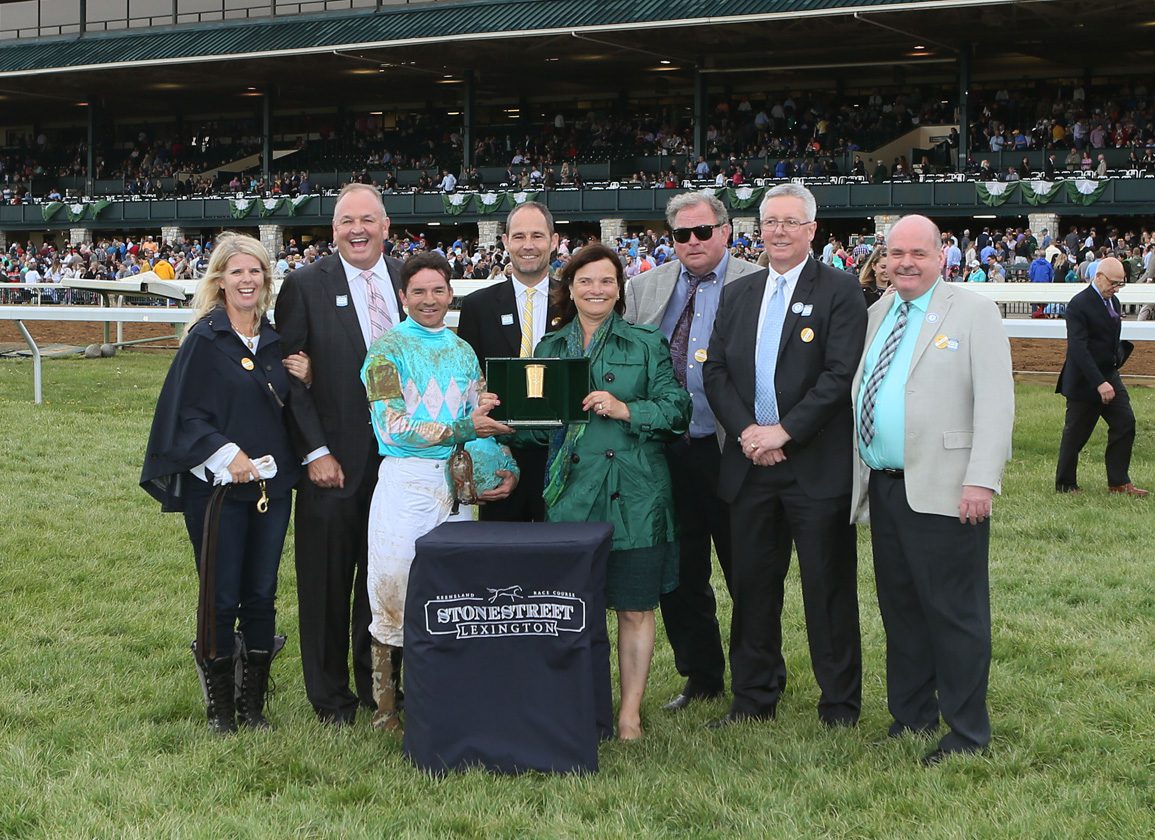
My Boy Jack wins Stonestreet Lexington; Godby (second from right) | Coady Photography

The friendship between the two goes back a ways to the humblest of beginnings. On a return home to Texas after failing as a commercial real estate salesman in California, Godby decided to work for his father's trainer–who then owned a stakes horse at Louisiana Downs–and learn the industry from the ground up. He recounts being approached by a friendly face, and the pair struck up conversation on his first day; Godby was grooming and Desormeaux cruising the shed row, and they became friends. They'd really hit it off, playing tennis or basketball nightly when time allowed.

For Godby, in the end, it was not to be. He lasted six months before returning to Texas and starting his transportation company, got married and raised a family. In the years following, he faithfully sent partners Desormeaux's way but it wasn't until 2010 where the old dream became real again. Desormeaux reached out with a proposition to start a claiming group, and it took off from there.

Several years later, and with multiple graded stakes-winner My Boy Jack (Creative Cause), Grade I-placed Danette (Curlin), and stakes-winner Candy Raid (Candy Ride {Arg}) to tally, Don't Tell My Wife Stables has another talented, promising runner in the hands of a master at his craft. And despite the name, yes, the wives do know.

“We weren't doing it to be cute or hide it from our wives…but we get so many compliments about that name, 100% positive. The one person who hates the name is Keith Desormeaux.”

The origin came from the push to formalize for the LLC designation. No one had any great ideas, but co-founder Rob Slack suggested that perhaps it was already named. Godby says one of their core partners ended almost every conference call with 'Geez, just don't tell my wife. She's going to kill me.' and the name just stuck. Their trainer's hesitation with it aside, the long-reaching respect has created a firm, steady foundation and will continue to bear fruit until he is ready to call it a career.

“[Keith]'s respected, he's old school. I love him as a brother, so to speak. We've been around each other a long time. So, until he stops training, or whenever that day comes, he's going to be our trainer, for sure.”

The post Confidence Game: A ‘Coincidental’ Colt with Good Karma in His Corner appeared first on TDN | Thoroughbred Daily News | Horse Racing News, Results and Video | Thoroughbred Breeding and Auctions.

Source of original post

Baffert and Lanni Go Big for ‘Quality’ Filly

Hall of Fame trainer Bob Baffert and agent Donato Lanni, acting on behalf of an undisclosed client, added a big-ticket item to his future roster when stretching to $1.8 million to land a Quality Road half-sister to GI Spinaway S. heroine Sweet Loretta (Tapit) late in the Fasig-Tipton Saratoga session Tuesday. The May 4 foal was consigned by Lane's End as hip 213 and bred by Mt Brilliant Farm & Ranch and W. S. Farish. Her dam was a $2.2-million KEENOV '16 purchase (in foal to Constitution) by Greg Goodman's Mt Brilliant.

The post Baffert and Lanni Go Big for ‘Quality’ Filly appeared first on TDN | Thoroughbred Daily News | Horse Racing News, Results and Video | Thoroughbred Breeding and Auctions.

Source of original post

Pompa’s Legacy Lives On

When longtime owner and breeder Paul Pompa, Jr., who campaigned the likes of dual Classic winner Big Brown, passed away suddenly in October of 2020, it was a big blow to many in the industry. Some 19 months after his passing, the owner of Truck-Rite Corp.'s legacy has reached new heights. In the past two months alone, four former Pompa horses have won stakes, topped by Grade I winners Regal Glory (Animal Kingdom) and Country Grammer (Tonalist).

“Mr. Pompa was a gentleman and a great sport to work for,” said Lane's End's Allaire Ryan, who supervised the sale of most of Pompa's horses. “First and foremost he cared about his horses and always made the right decisions for them. Alongside his trainers and the farms and training centers he entrusted with his stock, he built a very successful racing stable and commercial breeding operation. There was a plan for each horse from start to finish. Those plans might have had to change day to day, but Mr. Pompa was a discusser, a listener, a thinker and a decision maker through-and-through. Mr. Pompa was a student of the business, always took the time to talk about what was going on with his mares, foals and yearlings. He gave you his time because he was interested in the horses and genuinely cared about each of them. He enjoyed every conversation with him for being thorough, pragmatic, and above all caring.”

Shortly after Pompa's death, his family dispersed of all of his racing and breeding stock. Most of his stock sold in a dispersal handled by Ryan and the Lane's End team at the 2021 Keeneland January Sale. The headliner of that dispersal–and the entire sale–was 'TDN Rising Star' Regal Glory, who was purchased by Peter Brant's White Birch Farm for $925,000 and returned to her regular trainer Chad Brown.

A homebred out of Pompa's GSW Mary's Follies (More Than Ready), Regal Glory had won a trio of graded events prior to the dispersal, but her resume had one thing missing. She filled in that missing piece 10 months after selling to Brant when she captured the GI Martriarch S. in November. The chestnut has continued to honor her late owner and breeder Pompa this year with wins in the GIII Pegasus World Cup F/M Turf Invitational S. in January and another top-level score in the GI Jenny Wiley S. at Keeneland in April.

“This filly gave Mr. Pompa a lot to be proud of as she was a homebred for him,” Ryan said. “She dead-heated in the [GII] Lake Placid at Saratoga on very dark, stormy afternoon. I remember how long the stewards deliberated the race call afterwards–a frustrating moment for Mr. Pompa as an owner to share a big win in such tough conditions, but again, he was always the one to see the glass half full and be a good sport in trying situations. There was always tomorrow. He was so proud of this filly after that race.”

Ryan continued, “Mr. Pompa decided after he bred Mary's Follies to Curlin in 2020 that he would sell the mare in November at a time when her commercial value was at its highest. In turn, his plans for Regal Glory were to continue her career and retire her to his broodmare band at [Lane's End] farm. With Chad Brown, Mr. Pompa had this filly on the trajectory to improve with age and she's done exactly that. It's been incredibly satisfying to see Chad and Mr. Brant guide her to this stage in her career and keep her sound and happy at this age. We still cheer for her!”

A $450,000 OBSAPR purchase for Pompa, Country Grammer captured the GIII Peter Pan S. in July of 2020 and gathered some hype heading into that year's GI Runhappy Travers S. Unfortunately, he did not hit his best stride that day, finishing fifth behind GI Belmont S. winner Tiz the Law (Constitution). Shelved for the rest of the season, he was purchased by WinStar for just $110,000 at the KEEJAN dispersal.

Sent to Bob Baffert, Country Grammer showed he was only getting better with age, winning the GI Hollywood Gold Cup S. in his second start for his new connections last May. Benched for the remainder of the year, the bay made his seasonal bow in the desert, finishing second in the G1 Saudi Cup in February and upended heavy favorite Life is Good (Into Mischief) with a decisive score in the G1 Dubai World Cup a month later.

“Country Grammer was another nice physical when he came under our care at the sale,” Ryan said. “I never saw his as a young horse, but from photographs he looks like a quality individual for his sire Tonalist. He had been at WinStar's training center for some R&R and was back training leading up to the sale, so they [Elliott Walden, David Hanley, Destin Heath and Dr. Nieman] appreciated where he was in his career having that insider knowledge. By design after his passing, several of the Pompa dispersal's horses of racing age were prepared here leading up to the sale. Again, credit is due for the programs that have managed these dispersal graduates and brought them–back in Country Grammer's case–to competing at not only the graded stakes level, but now the highest international level of our sport. The win in Dubai was thrilling to see. He validated his status as a top older horse amongst the best talent in the world. It was one of those moments when I thought to myself, if only Mr. Pompa could see this.”

The most recent former Pompa horse to achieve black-type is his homebred colt Ethereal Road (Quality Road), who rallied to a good-looking victory in the Sir Barton S. last weekend. Out of Pompa's War Front mare Sustained, who is also responsible for GSW Turned Aside (American Pharoah), the bay colt brought $90,000 from Dr. Aaron Sones at the 2020 Keeneland September just one month before Pompa's passing and was turned over to D. Wayne Lukas.

A second in the GII Rebel S. in February and fourth in the GIII Stonestreet Lexington S. in April earned Ethereal Road enough points for a spot in the GI Kentucky Derby starting gate. However, the day before the race, Lukas decided his colt needed more time and scratched, opening the door for upset winner Rich Strike (Keen Ice). The Hall of Fame conditioner still won a big prize that weekend thanks to GI Kentucky Oaks victress Secret Oath (Arrogate) and initially considered both sophomores for the GI Preakness S. Instead he sent the filly to the Classic and placed Ethereal Road in an easier spot on the undercard, which he won with ease.

“Ethereal Road was a big, physically forward yearling that we raised on the farm,” Ryan said. “From day one he was that way. I remember distinctly the order in which we showed yearlings at the farm in our September sale previews to potential buyers. He was the final yearling of each show because he completely filled your eye. Turned Aside had just come off his win in the [GIII] Quick Call S. at Saratoga, so for us at the farm, it was a very exciting time to showcase a yearling colt by Quality Road out of a young, successful producer. While he would keep the odd homebred each year to race, Mr. Pompa's plan was always to take this horse to the sale.”

Pompa's name could still be connected to the winner of a Triple Crown race this year in GI Belmont S. contender We the People (Constitution). Pete Bradley purchased the colt for $220,000 at the 2020 KEESEP sale on Pompa's behalf and he was turned over to Eddie Woods, who did the early conditioning on most of the businessman's horses. Instead of selling in the KEEJAN dispersal, We the People was sent through last year's Fasig-Tipton Gulfstream Sale, bringing $230,000 from WinStar Farm, who partnered with Siena Farm and CMNWLTH.

Opening his account with a pair of wins at Oaklawn this winter, the 'TDN Rising Star' found the waters a bit too deep in the GI Arkansas Derby Apr. 2, finishing seventh. But, the bay showed he just needed time, coming back to romp in Belmont's GIII Peter Pan S. May 14 and is now headed for the Test of a Champion June 11.

“He was always a nice horse,” Woods said. “He is by a good stallion. He is a tough, hardy horse like all the Constitutions are. He was a bit disappointing in the Arkansas Derby, but I think it was just too soon for him. He showed how good he is the other day and he is a really nice horse going forward.”

Woods said he was not surprised to see Pompa's continued effect on the industry.

“He had quite an impact because he paid both ends,” the Ocala-based horseman said. “He was a good breeder and a buyer. He bought at every level. He bought yearlings and 2-year-olds. He usually spent plenty of money. He was really easy to work for and deal with. He took bad news as well as he took good news. He was a very straight forward person. You just had to be honest with him all the time. That's all he asked of you. It is ironic now to see all these horses he was involved in winning graded stakes because he would have loved it. He was so into it. It showed he had the right stock.”

Ryan echoed similar sentiments, saying, “It was a tragedy that he passed at a time when he was prepared to retire and focus solely on his racing and breeding. He enjoyed every day of it, but as we've seen since the dispersal, there was so much more coming in the pipeline that he didn't get to experience. It's been so gratifying to see the Pompa graduates compete successfully at the top levels of our sport, but it's definitely bittersweet knowing how much enjoyment Mr. Pompa would be having if they were still in his colors. I can only imagine how proud he would be!”

With the likes of Regal Glory, Country Grammer, Ethereal Road and We the People competing at the top of the game this year and even more in the pipeline, Pompa's legacy will not only grow, but leave an even bigger impact than he could have ever imagined.

The post Pompa’s Legacy Lives On appeared first on TDN | Thoroughbred Daily News | Horse Racing News, Results and Video | Thoroughbred Breeding and Auctions.

Source of original post

Verified by MonsterInsights