The Fair Grounds Stakes Scientist

From his desk in the racing office, Stuart Slagle views stakes coordination as a vocation that is part sales and part diplomacy, but for him, it is also part science.

As a former academic who received a B.S. in Zoology at the University of Texas in Austin and studied biophysics at the University of Illinois in Champaign-Urbana before working with supercomputers as a system engineer, his approach to filling a stakes race is always interspersed with the scientific method and predictive analytics.

“There is nothing like pursuing the science of a favorable outcome,” he said.

Parlaying those experiences into Thoroughbred racing actually was not a major shift. After all, it is a sport built on figures and a breeding structure handed down across generations.

Originally from Ohio, Slagle grew up among the tumbleweeds in Lubbock, Texas. Loving baseball and football in the Panhandle, he was always fascinated how statistics powered the flow of information. He turned to zoology because it was high time to declare a major during his Longhorn junior year. Classification, behavior and the distribution of animals taught him that observation could be a keen skill to develop.

Computer modeling and predictive analysis melded with handicapping races, which he gave up to seek employment in various racetrack positions over the past 20 years from being a placing judge at Sunland Park in New Mexico to the Racing Secretary at Prairie Meadows in Iowa.

“As an academic at heart, I'm fascinated by a horse's biomechanics and how aerobic exercise relates to the analysis of speed figures and their standard deviation,” he said.

Though he has studied the science behind how and why certain equine athletes fit into specific races, stakes coordination is a relatively new experience for Slagle, having been hired by Scott Jones to take the helm at the Fair Grounds in New Orleans last fall.

“There are so many experienced coordinators out there that I deeply respect in this business,” he said. “Scott is one of them, and I am just fortunate to follow in his footsteps.”

Moving forward, Slagle's job is a complicated one when it comes to selection. Before the completion of the meet Mar. 26, he will have to filled 65 starting gates that are worth a combined $8.5 million. Under Jones's tutelage, his managed lineup includes this weekend's Silverbulletday S. and the GIII Louisiana S., and of course, GI Kentucky Derby prep races like the GIII Lecomte S., the GII Risen S. and eventually, the GII Louisiana Derby.
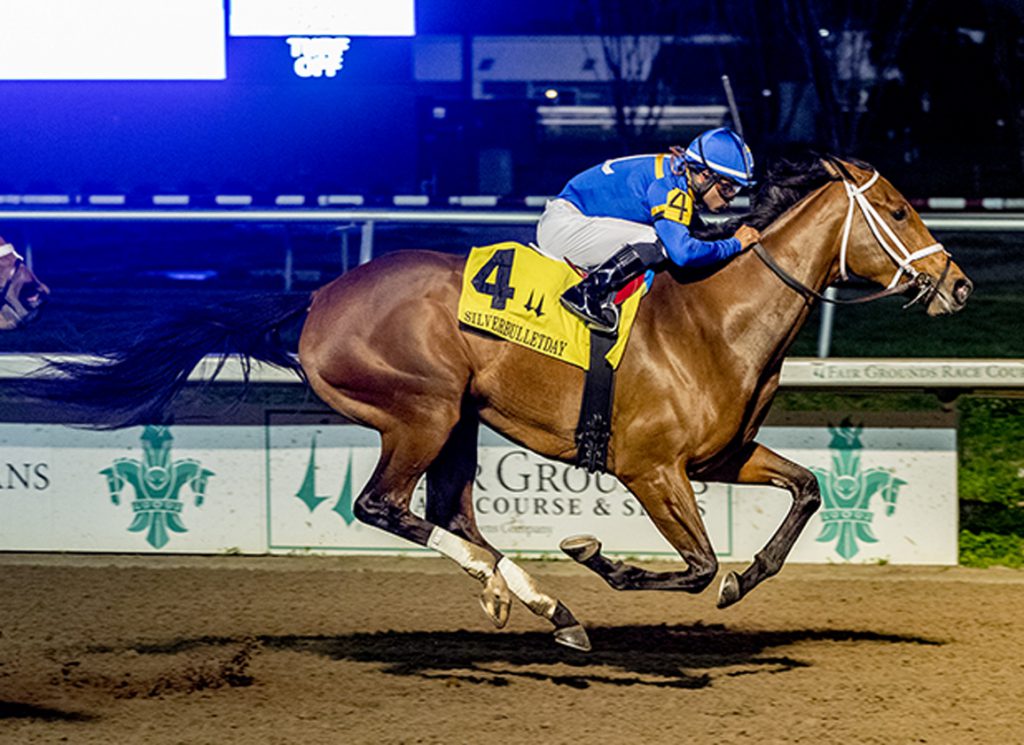
Part of Saturday's card, The Alys Look (Connect) wins the Silverbulletday S., at the Fair Grounds | Hodges Photography / Lou Hodges, Jr.

The series for both the Derby and the GI Kentucky Oaks has provided some important stops along those trails, and much continues to be criticized on social media concerning the fact that the Fair Grounds does not have a Grade I race. Slagle explains that needs to be tempered, especially when you consider all of the factors that the Thoroughbred Owners and Breeders Association employs to determine what makes a graded race.

“You have to understand that it is out of your control [grading process] because there are the race quality scores based on speed figures, there's the workbook, and how the top four finishers perform after the race, just to name a few,” he said.

Within this construct, a stakes coordinator is constantly looking at the many options before them when it comes to filling the entry box. Sure, they are trying to get the best horses possible and the largest fields, but they are also thinking tangentially about a variety of pieces of data.

“We always want horses with stakes experience,” Slagle explained. “But that is not always easy to obtain, so it is important to also think about ones that are class elevating at the right time.”

What a Thoroughbred does with their career after a race at the Fair Grounds could prove just as important to future grading of a race as what it has done before. Running numbers and looking at potential candidates comprises a sea of data. Slagle begins with a control by cold texting and calling some 70-80 trainers that could have prospective runners in their midst. He will get rapid responses, slow ones will trickle in and some will not respond at all.

The science behind the selection process moves quickly to a sales pitch, and then turns into a series of diplomatic talks as barns are cagey about showing where they are going to run next. Most of the time, they will wait till the last possible moment to declare, so Slagle has to be mindful of the options before a race closes. Poker faces are the norm.

Just as with any business, tracks want their stakes competition to have a race worth betting. In other words, a heavy favorite against a group of outclassed runners does not help the handle, and in an age when horses run less, you are asking connections to risk coming to your race, instead of to another track.

“This is a major financial commitment that owners are making by entering a stakes race, and we are asking for them to invest in the product that we are putting out there,” he said. “At the same time, we are also thinking about our patrons, the betting public, and our own bottom line, so there is no recipe for success because each time we do this it is totally different.”

Balancing all of this in his stakes lab, Slagle is seeking equine athletes with potential for success and he determines that by measuring their patterns of behavior. Looking at their early maiden races and the speed figures they posted can be coupled with the distances that they traveled in an effort to help identify potential stars in the making. The results though of these “tests” will not always come quickly, as sometimes a Thoroughbred's racing maturation develops well after they compete in a Fair Grounds stakes race. That is why decisions that are made now by the stakes coordinator can reverberate into an unknown future.

“When we are putting together a lineup, I still think regularly using the scientific method and hypotheses,” he said. “We know, for instance, which barns run off short rest and all of this data goes into forming a picture of who we should attract.”

With a wealth of experiences, and still much to learn, Slagle is utilizing all of the different disciplines he has encountered over the years at his new job in New Orleans. Like a zoologist in the field, he wants to find the right Thoroughbred that matches his ecosystem. As he builds his hypothesis about each potential entry, the next stakes race slowly, then rapidly takes shape. Then, it is on to the next one.

Returning to Stuart Slagle's desk at the Fair Grounds, there is a definite science behind his method. A background in zoology can't hurt when it comes to this type of selection process.

The post The Fair Grounds Stakes Scientist appeared first on TDN | Thoroughbred Daily News | Horse Racing News, Results and Video | Thoroughbred Breeding and Auctions.

Source of original post

This Side Up: Lecomte Starts a New Cycle

And so we begin anew. The GIII Lecomte S. always warms the heart: it's like noticing the first buds on the bare trees, as the quiet midwinter promise–familiar, expected, miraculous–of another spring to come.

In trees, each new cycle is nourished by past decay: by roots extending into soil enriched by the leaves discarded at the end of the previous one. And actually it's not dissimilar with selective breeding, so that each generation can recycle its speed, stamina, beauty, bravery.

The world may be a very different place, on and off the track, from the days when Lecomte, the 1850s Louisiana legend honored by this race, was defying the great Lexington in four-mile heats at the old Metairie racecourse in New Orleans. Lecomte, indeed, was both trained and ridden by African Americans who had been purchasable chattels, as you can read in this marvelous story by Kellie Reilly of Brisnet.


Listen to Chris McGrath read this edition of This Side Up.


But if the demands made of modern racehorses are wildly different, I still find it apt that if you go far enough back in the pedigree of the colt to beat on Saturday, Instant Coffee (Bolt d'Oro), you come to the principal legacy of Lecomte himself.

Louisiana plantation owner Thomas Jefferson Wells had bred Lecomte from a mare named Reel, whose importance to the evolving American breed was only one instance of the transatlantic distaff influence of her exported British sire Glencoe.

Though Lecomte died in a failed adventure to Britain, luckily Wells had first had him cover a handful of mares. One of his daughters was registered, in a fashion that had once been very common, simply as “Lecomte Mare.” Remarkably, she was mated with Lecomte's half-brother by his old rival Lexington. Bear in mind that Lecomte and Lexington were both sons of Boston; that the mare's second dam was by Reel's sire Glencoe; and that her fourth was Reel's mother! Few modern breeders, it is safe to say, would dare to entertain such genetic saturation.

Yet the result of this match, Lizzie G., ties together the ancestry of many great horses. One of her daughters, for instance, produced the iconic Domino; a rather longer line would eventually lead to Affirmed; and, yes, a still more attenuated one brings us to Follow No One (Uncle Mo), the dam of Instant Coffee.

These are clearly all scrolls of parchment, too faded to have the remotest bearing on Instant Coffee's competence for the tasks he could face this spring. But these are the old leaves that nourish the genetic subsoil–and, to me, this little tangent just adds a piquant extra flavor to Instant Coffee happening to line up for the Lecomte.

After all, each of these horses entwine so many different strands: through a trainer or owner or breeding program, for instance, and the things we feel they stand for; or through more peripheral associations, such as the fact that Follow No One was named by Alpine ski racer Lindsey Vonn. She had a commercial partnership with Under Armour, the sportswear company founded by Kevin Plank–whose noble attempt to revive Sagamore Farm as a force on the Turf encompassed Follow No One's racing career. And, now that the mare is on the Upson Downs Farm of Churchill chairman Alex Rankin, there's scope for another colorful thread to be woven into the great Derby tapestry.

And that's just one horse, in one trial. There are 23 futures options entered across five tracks just on Saturday, and so many others to be sieved down over the coming weeks to that final field of 20. Each will have a sentimental cargo of its own, associations that will inspire (or discourage) the allegiance of neutrals.

Down in Louisiana, meanwhile, they can claim a collective stake in the entire Lecomte field, as potential heirs to the 2019 Derby and Preakness winners, the 2021 Derby winner and the 2022 Derby runner-up, who all contested this race, GII Risen Star and GII Louisiana Derby–with the exception of Country House (Lookin At Lucky), who missed this first leg (in order to break his maiden at Gulfstream).

The Fair Grounds rehearsals have been achieving edifying new relevance since their extension in distance. To me, that represents a small but useful redress of the renunciation by modern trainers of the way their predecessors put such a deep foundation of experience and condition into their Classic horses. The old school never minded seeing two-turn horses beaten in sprints, early in the year, because they would gain in fitness and seasoning without ever forcing the engine anywhere near its maximum revs. But now that horses have to tiptoe to Churchill in May, the least they can do is get some mileage. Last year, remember, both Epicenter (Not This Time) and Cyberknife (Gun Runner) were beaten in the Lecomte, but each used that reverse as a springboard to reach the elite of the crop.

There will, no doubt, be other local horses entering the picture. Banishing (Ghostzapper), for instance, will have a spectral presence in the Lecomte, on the clock, after an excursion over the same distance earlier on the card. In breaking his maiden here by eight and a half lengths on Boxing Day, he clocked a marginally faster time than did the winner of the Gun Runner S. With Loggins yet to return to the worktab, it would be heartening if Ghostzapper could reinforce his quest for the Classic success that for now feels like an incongruous omission in the resumé of one of the greats.

The people standing Bolt d'Oro, meanwhile, are similarly not dependent solely on Instant Coffee to maintain his flying start. The champion freshman also has Itzos, half-brother to none other than Rachel Alexandra (Medaglia d'Oro), heading to Turfway after scratching from the Lecomte. He contests a race in which a horse named Rich Strike (Keen Ice) ran a negligible third last year.

So Saturday is only one early step on a long road. Instant Coffee's barnmate Zozos (Munnings) could certainly tell him a thing or two as they're being groomed for their respective races. He chased home Epicenter in the Louisiana Derby last year, before helping to set up the meltdown for Rich Strike at Churchill. But he then disappeared until a stylish resumption last month, and now explores his remaining potential against the thriving Happy American (Runhappy) in the GIII Louisiana S.

The latter represents the same team as Bell's The One (Majesticperfection), brilliantly trained by Neil Pessin to win $2 million before her retirement last fall. She has left a tough void in a barn that mustered no more than 88 starters in 2022, but in this era of “super trainers” with cavalries spread across time zones, a seasoned horseman like Pessin–reliably undiminished in endeavor, skill and passion–still only needs an adequate stone for his sling to cut those Goliaths down to size.

To be fair, that's pretty much what happened in the last Derby. True, I doubt whether a single handicapper would have come up with the right exacta if told by a time traveler, this weekend last year, that they had just seen both the required horses beaten. But we know that the next ones will be out there somewhere, once again; that on those cold stark trees, it's time to look for the first buds.

The post This Side Up: Lecomte Starts a New Cycle appeared first on TDN | Thoroughbred Daily News | Horse Racing News, Results and Video | Thoroughbred Breeding and Auctions.

Source of original post

Uncle Mo Has Three-Year-Old Mo-Mentum

When Golden Pal retired to Coolmore America for the 2023 season, he became the second son of Uncle Mo to join his sire at the farm, alongside Mo Town.

A 15-year-old stalwart of the Coolmore stallion roster, Uncle Mo is currently enjoying a bit of a hot streak with his group of 2023 three-year-olds.

Arabian Knight is the #1 ranked horse on the TDN's Derby Top Contenders off one start-the first race on the Breeders' Cup Saturday card–indicating just how impressive that race was. The $2.3-million sales topper at OBS April was named a `TDN Rising Star' and won by 7 1/4 lengths. He was Uncle Mo's 13th TDN Rising Star.

In the first two weeks of the year, Kingsbarns, an $800,000 Fasig-Tipton March 2yo, broke his maiden in his first start in an $84,000 allowance as the favorite at Gulfstream Park Jan. 14, and Scoobie Quando won the Turfway Prevue S. in his career debut Jan. 7 at Turfway.

This comes, of course, after the year in which he had his second Classic winner with Mo Donegal in the Belmont (joining Nyquist's Derby win).

As the breeding sheds prepare to open, Eddie Rosen, General Manager for Mike Repole's Repole Stables, who campaigned the champion two-year-old, agrees with the `hot' assessment, but takes a bit of umbrage that it's a current phenomenon. “He's very hot right now. But it's important to remember that he has been hot for a very long time. Consistently.”

The industry, he points out, is too often consumed with the shiny new toy. “So often, the concentration is placed on breeding to young stallions, new stallions that have been recently retired. But very few, if any stallions have succeeded like Uncle Mo from the beginning to the current time. He started out with a Derby winner and his very first crop in Nyquist, and he has continued year after year with stakes winners of all kinds.”

In fact, Nyquist leads the list of Uncle Mo's fairly staggering 24 sons at stud, topping the list with a stud fee of $55,000 at Darley. Golden Pal and Yaupon (at Spendthrift) are next at $30,000 each. An informal survey finds only Speightstown and Tapit, who each have 25 sons at stud standing in the U.S., with more.

But while Tapit turns 22 this year, and Speightstown 25, Uncle Mo is far younger.

Uncle Mo is now 15, and he's on an incredible run,” said Coolmore America's Adrian Wallace. “He's been with us at Ashford Stud now for all of his stallion career. We're privileged to have him. He's been a horse that obviously as a racehorse left no doubt as to how good he was when trained by Todd Pletcher for Repole Stable to be Champion two-year-old. He's imparted a lot of that precocity on his stock but his run continues to flourish.”

Wallace points out that Uncle Mo's recent Grade I winners ranged from Golden Pal at 5 furlongs in the Breeders' Cup Turf Sprint to Mo Donegal over the Belmont's 12 furlongs on the dirt. “It's a great depth and breadth of winners he has had, siring a Belmont Stakes winner in Mo Donegal and a very fast champion sprinter-elect on the turf in Golden Pal. I think the horse is definitely going from strength to strength every single year. He has horses running in all the best races, but the great thing is they do it short, long, dirt, and turf in this country on and all around the Northern Hemisphere.”

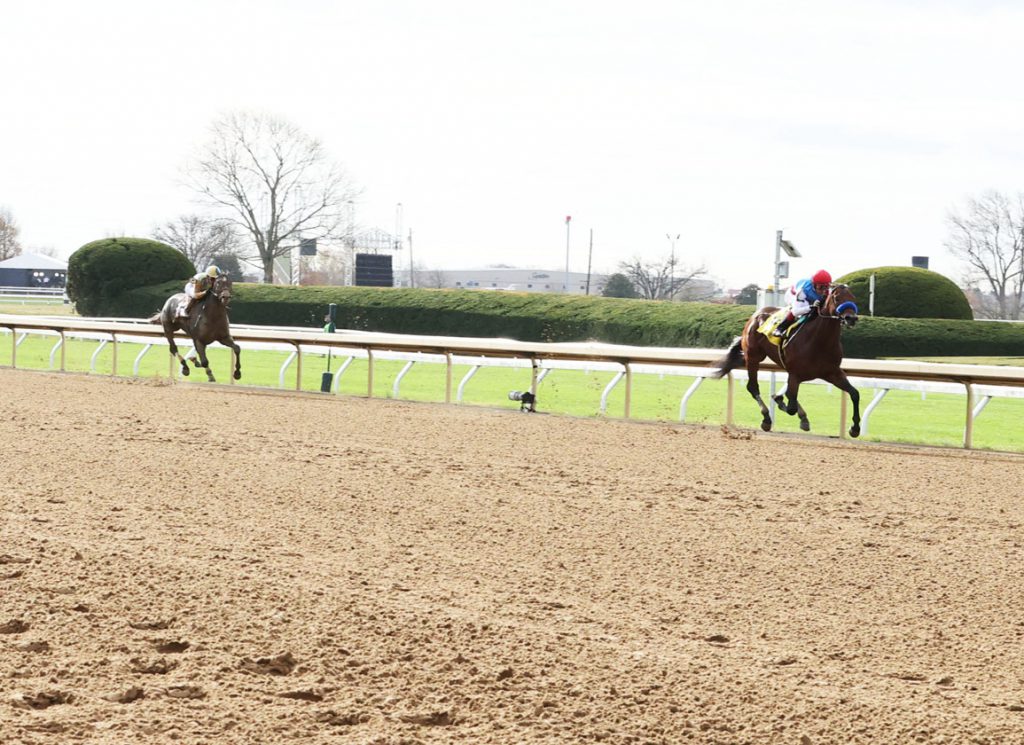
Arabian Knight wins in his Keeneland debut | Coady photo

But right now, it's Arabian Knight capturing everyone's attention.

“Arabian Night is obviously very much at the forefront of everyone's imagination being at the top of the TDN's leading Derby contenders for 2023,” said Wallace. “His much-anticipated debut here on the Breeders Cup undercard at Keeneland was highly, highly professional and brilliant. Hopefully, he will be seen to good effect in the in the Santa Anita Derby.”

Arabian Knight worked five furlongs in 59.60 at Santa Anita, but trainer Bob Baffert-who told jockey John Velazquez to ride him like he was Uncle Mo– said that he had not picked out the colt's second start yet, and would take his time with him.

“But there's not just one,” said Wallace. “I think Scoobie Quando made a very impressive debut for Ben Colebrook winning the Turfway Prevue as a maiden in a stakes race. So, we think the future is very bright hopefully throughout this classic season for Uncle Mo.”

But then again, Rosen will tell you that his future has always been bright. “He doesn't have peaks and valleys,” he said. “He's consistently coming up with stakes winner after stakes winner. He continues to make the front pages of the TDN. He's emerging as a sire of sires. He is emerging as a top broodmare sire, which proves to continue on his legacy as a great sire. I feel like every night, something good happens that's worthy of mention.”

The post Uncle Mo Has Three-Year-Old Mo-Mentum appeared first on TDN | Thoroughbred Daily News | Horse Racing News, Results and Video | Thoroughbred Breeding and Auctions.

Source of original post

CDI Argues Court Win By Baffert Would Harm Other Derby Qualifiers

The gaming corporation that controls the GI Kentucky Derby fired the latest legal salvo in trainer Bob Baffert's ongoing attempt to reverse the second year of a two-year ban the company imposed in 2021 because of a spate of drug positives in Grade I races, urging a federal judge not to grant an injunction that would lift the ban in time for the May 6 Derby.

“Baffert refuses to accept responsibility for his wrongful actions…” Churchill Downs Inc. (CDI) wrote in a brief opposing Baffert's motion for a preliminary injunction that they filed late Tuesday in United States District Court (Western District of Kentucky). “Now, as the two-year anniversary of his CDI suspension approaches, Baffert has renewed his motion in a brazen attempt to litigate his way into the 2023 Kentucky Derby.

“This belated, tactical, and meritless motion should meet the same fate as his prior unsuccessful efforts to challenge his suspension,” the CDI filing continued.

CDI also argued that an injunction would injure the connections of other Derby qualifying points earners who would “lose their fairly-earned berths in the Derby to make room for Baffert,” the filing stated.

“An injunction would force CDI to reallocate [Derby qualifying] points, retroactively depriving those owners and trainers of Derby and [GI Kentucky] Oaks berths their horses have earned under CDI's existing rules,” the filing continued. “The harm to these innocent third parties, who have played by the rules, is exacerbated by Baffert's long delay in filing his motion.”

The Hall-of-Fame conditioner's trainees have crossed the finish wire first a record seven times in the Derby.

But it was that seventh Derby winner-Medina Spirit in 2021-who triggered Baffert's banishment when the colt tested positive for betamethasone, a Class C drug, in a post-Derby test.

Citing that positive finding and other drug overages in Grade I races around the same time, CDI told Baffert in June 2021 that he would be ineligible to race at its six U.S. tracks until after the 2023 Derby, and that any horse that raced under his training license would not be eligible to accrue qualifying points to get into the 2022 or 2023 Derbies.

Baffert had initially sued CDI on Feb. 28, 2022, in an attempt to get an injunction enjoining CDI from suspending him from its tracks and races. His complaint alleged civil rights violations related to what Baffert said was a deprivation of his right to due process of law guaranteed under the Fourteenth Amendment.

Separately, Baffert fought unsuccessfully in the courts to try and stave off a 90-day suspension for Medina Spirit's drug overage that had been imposed upon him in February 2022 by the Kentucky Horse Racing Commission (KHRC).

Those legal efforts failed, and Baffert eventually had to start serving that KHRC suspension about a month before the 2022 Derby. He transferred his entire California-based stable to the care of other trainers, and his legal team at that time withdrew the motion for an injunction. (Even though his KHRC suspension has already been served, Baffert is appealing that ruling in an effort to expunge it from his record.)

Two horses Baffert trained through March 2022-the $1.7-million FTFMAR buy Taiba (Gun Runner) and 'TDN Rising Star' Messier (Empire Maker)-ran in the 2022 Derby under trainer Tim Yakteen's license, finishing 12th and 15th, respectively.

Baffert renewed his court quest to run in the 2023 Derby on Dec. 15, 2022.

In that filing, his legal team wrote that “Granting an injunction would work no hardship on [CDI]. Numerous rules and regulations already safeguard CDI's interests in health, integrity, safety, and fairness. Baffert has already served his time for the mere allegation of a violation which has yet to be fully adjudicated, and there is no doubt among industry observers and even casual spectators that Baffert suffered consequences for the mere perception of wrongdoing.”

CDI's Jan. 17 response took umbrage with that position.

“The drugging of Medina Spirit happened just months after the Baffert-trained Gamine was disqualified for testing positive for the same drug after finishing third in the 2020 Kentucky Oaks, also held at Churchill Downs Racetrack,” CDI's filing stated. “Baffert's unprecedented back-to-back drug violations cast a pall over CDI's two marquee horse racing events and triggered a national debate over the integrity of the sport.”

By banning Baffert, CDI claimed that it “acted well within its rights to protect the health and safety of its human and equine athletes and to protect its own brand and public confidence in the sport of horse racing… While Baffert has had no shortage of public relations gambits, he has failed to, and cannot, demonstrate his entitlement to a preliminary injunction.”

CDI's filing continued: “Baffert has not shown he will suffer irreparable harm absent an injunction. His 19-month delay in seeking injunctive relief negates any claim of irreparable harm. His primary alleged harm-the loss of purse money-is speculative and would be fully compensable by money damages.

“Nor will he lose his client base or suffer a loss of goodwill absent relief. Since his CDI suspension began, Baffert has run horses in hundreds of races around the world and earned millions of dollars in purse money. And none of his client-affiants say they will transfer horses from his care absent an injunction.”

CDI also alleged that Baffert's due process claim “fails as a matter of law because CDI is a private corporation, the individual defendants are not government officials, and no one violated Baffert's rights.”

The post CDI Argues Court Win By Baffert Would Harm Other Derby Qualifiers appeared first on TDN | Thoroughbred Daily News | Horse Racing News, Results and Video | Thoroughbred Breeding and Auctions.

Source of original post

Verified by MonsterInsights