Derby Clouds Offer Mandaloun Silver Lining

If those who scaled the summit of our sport a few days ago suddenly find themselves slithering back down the scree, then their closest pursuers must feel no less stunned to have retrieved a foothold that could yet allow them to resume their own climb. In its way, that must feel almost as unsettling. Everyone sees that the sport is suffering, from this latest trauma, but does that ultimately mean that nobody will be allowed to feel like a winner?

With the case against winner unlikely to be finally resolved any time soon, connections of GI Kentucky Derby runner-up Mandaloun (Into Mischief) might do worse than seek counsel from those of Country House (Lookin At Lucky). Because their experience, two years ago, could prepare the Mandaloun team for how it feels to achieve the single greatest ambition animating the American Turf in unaccountably bittersweet fashion.

Nobody would choose to enter the Derby annals under an asterisk. On the other hand, too few acknowledge the merit required to do so. Even on the face of it, there is extremely rare distinction in finding just one colt in the entire crop capable of thwarting you on that critical date, known from the moment a foal first staggers to his feet: the first Saturday in May, three years hence. And if that single colt happens to do so unfairly, well, the transferred laurels must be given and embraced as fully deserved.

It was especially hard on Country House that he was denied the opportunity to reiterate his own excellence, despite being kept in training. By the time he arrived at Darby Dan, this talented, well-bred animal had accumulated around 0.01% of the column inches devoted to Maximum Security (New Year's Day) and, later, his trainer. Of course, Country House may yet have the last laugh in their second careers. For now, however, the chief aspiration for Mandaloun must be that he is permitted to build on foundations actually not dissimilar to those laid by Country House at the time of his exit. Both, remember, appeared to take a step backward between the GII Risen Star and the GII Louisiana Derby, before ultimately beating all bar one at Churchill.

You could argue that Mandaloun has already paid a heavy price, through no fault of his own, for the scandal menacing Medina Spirit (Protonico): with no Triple Crown apparently on the line, it had already been decided to sit out the GI Preakness this Saturday.
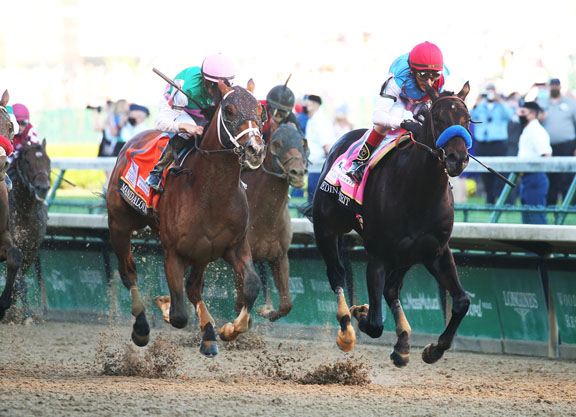
Just a half length separated Mandaloun and Medina Spirit | Coady

So let's take a step back and examine a colt whose promotion, should it come to that, would divide the toasts of our industry between two of its most reliable navigational landmarks. You could almost say that one of those iconic twin spires might represent Mandaloun's late breeder; and the other, one of the most remarkable stallions in the story of the American Thoroughbred.

True to his flair for new precedent, Into Mischief could end up with two Derby winners in eight months. We saluted 2020 as the year of his “authentication,” not only retaining the general sires' championship he had won for the first time in 2019, but doing so with a Horse of the Year who had, virtually overnight, settled the only remaining question mark against him: would an upgrade in his mares stretch Into Mischief's trademark speed sufficiently to make him a legitimate Classic influence? The Spendthrift phenomenon was still only standing at $45,000 when Peter Blum sent him Flawless (Mr. Greeley) in 2016, and their son Authentic answered that question in such explosive fashion that Into Mischief has now been hiked to a still higher fee, $225,000.

Even before Authentic, there had been straws in the wind: both Audible and Owendale emerged from much cheaper coverings to finish strongly for a Classic podium. But now we have a graduate of Into Mischief's $75,000 book, in 2017, immediately sealing the deal in terms of what he can be expected to achieve now that he has access to truly aristocratic mares.

In this instance, he has been able to tap into a family cultivated by one of the landmark modern breeders, Juddmonte Farms, whose founder Prince Khalid Abdullah died just days before Brad Cox tested the Classic waters with Mandaloun in the GIII Lecomte S. in January.

Mandaloun traces to one of the Prince's foundation mares in fourth dam Queen of Song. A $700,000 purchase at the Keeneland November Sale of 1989, Queen of Song had won six black-type races (14 in all) and was a sister to Cormorant, who had run fourth in Seattle Slew's Preakness. (Cormorant was hosed down to win the GI Jersey Derby just nine days afterward, albeit his finest hour still awaited as sire of Go for Gin.) Queen of Song doubtless held particular appeal to the Prince as a daughter of His Majesty–like Razyana, whose first foal Danehill had just been crowned champion sprinter for his European stable.

If not yet in the very front rank, relative to the Prince's overall legacy, the Queen of Song dynasty would never have survived under the Juddmonte umbrella to this point without due consistency. Sure enough, the first dam is a Group 2 winner, and the second a stakes-winning sister to a Group 1 winner. If anything, however, the real Juddmonte branding is sooner found in the homebred sires who have seeded this family, with dam and second dam respectively by sons (Empire Maker and Dansili {GB}) of the program's celebrated broodmares, Toussaud (El Gran Senor) and Hasili (Ire) (Kahyasi {Ire}).
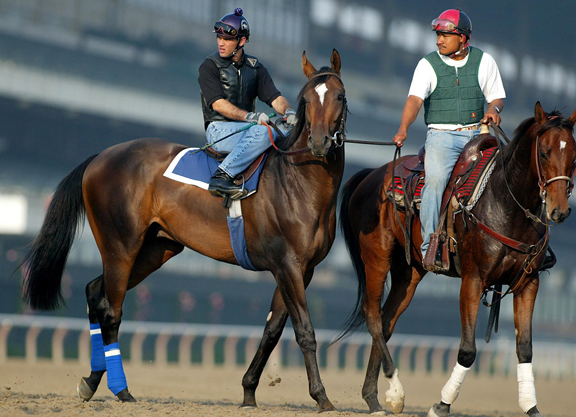
Classic winner Empire Maker is one of several Juddmonte homebreds that figure prominently in Mandaloun's pedigree | Horsephotos

Though the Prince started a stallion program pretty quickly, with the likes of Known Fact and Rainbow Quest, he was always careful to invigorate bloodlines with external sires and Mandaloun's third dam Aspiring Diva, though the last foal of Queen of Song, was the only one she conceived “in-house.” She did so with Distant View, a dashing miler by Mr. Prospector out of another of the Prince's foundation mares, Seven Springs (Irish River {Fr}), and ultimately a key broodmare influence for the whole program–with crossover reach on dirt, too, as sire of five-time Grade I winner Sightseek.

Aspiring Diva herself won a couple of races in France, and managed one Listed podium, but her key contribution would be made to a sustained wager on Distant View mares with Dansili, the son of Hasili who could not quite match the Grade I/Group 1 wins of five siblings but was probably as gifted as any. The cross would produce one Banstead Manor stallion in Bated Breath (GB), plus the dam of another in Expert Eye (GB) (Acclamation {GB}). In the case of Aspiring Diva, there were two significant dividends: one was G1 Matron S. winner Emulous (GB), and the other a stakes-winning sprinter in France named Daring Diva (GB).

Daring Diva has proved a fair producer, if no more by the elite standards of Juddmonte. Beyond a dual Listed winner/Group 2 runner-up in Ireland by Selkirk, much her most significant accomplishment has turned out to be a daughter by Toussaud's son Empire Maker.

Now, though personally adamant that the breed thrives on mutual transfusion of dirt and turf influences, I grant that nothing will work every time with horses. So I readily accept the assurance of Dr. John Chandler, so long central to the Juddmonte program in the U.S., that an attempt to combine Empire Maker (representing a gold-standard dirt line in Fappiano) with turf mares did not prove a success. (Albeit I note that a parallel experiment [Empire Maker with a turf GSW by Giant's Causeway] has this year already given us the dam of GI Santa Anita Derby winner Rock Your World {Candy Ride (Arg)}.) This is said to explain why Empire Maker was sold to Japan, only for his son Pioneerof the Nile and others to earn his repatriation. Yet it now looks as though those Juddmonte turf matings may have yielded a worthwhile dividend, after all.
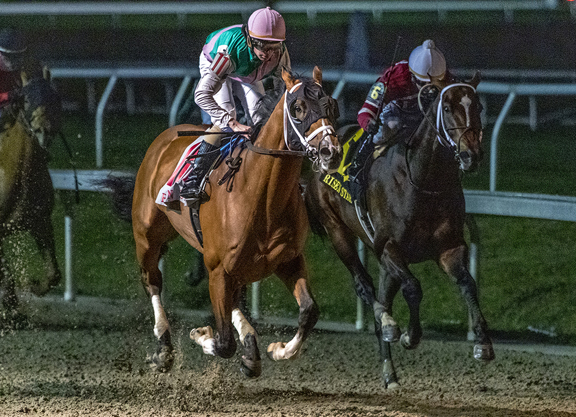
Mandaloun captured the Risen Star in February | Hodges Photography

Daring Diva's daughter by Empire Maker, Brooch, won her first four starts (unraced at two) for Irish trainer Dermot Weld between eight and 9.5 furlongs, handling each step up with an aplomb that promised she might make a rather bigger impact beyond Group 2 level than she ultimately managed. Brooch's first foal was a son of Speightstown, also sent to Weld, but he showed very little in two maidens before being gelded and then culled for just 7,000gns at Tattersalls last year. (He has since won a couple of modest handicaps for a small Newmarket yard; and actually a gelded brother to Daring Diva, First Sitting {GB}, went on to Group success after likewise being cheaply discarded.) Brooch's second foal, however, is Mandaloun.

This, to me, is a pedigree characterized first and foremost by a cluster of sires out of mares whose inherent genetic excellence has been repeatedly corroborated by other horses. Along the bottom line we have not just Empire Maker and Dansili, whose dams famously produced nine Grade I/Group 1 winners between them, but also His Majesty–whose no less distinguished mother, Flower Bowl, also gave us (from just five foals) his charismatic brother Graustark and his Hall of Fame half-sister Bowl of Flowers. And then you have Into Mischief himself, out of a modern blue hen in Leslie's Lady, famously further responsible for Beholder (Henny Hughes) and Mendelssohn (Scat Daddy).

(His Majesty actually recurs top and bottom: we've noted him as sire of fourth dam Queen of Song, and also that Dansili's sire Danehill is out of another of his daughters; but don't forget that the sire of Leslie's Lady–the seldom credited Tricky Creek–is also out of a His Majesty mare.)

This is the kind of density I love to see in a pedigree, where the strands of quality are so entwined that it becomes less and less important which particular one comes through. Yes, the bottom line has consistently produced stakes performers, in fact in an unbroken sequence of eight generations, but it has been maintained by the richness of its fertilisation.

The seedbed goes every bit as deep as you would expect, given the price paid for Queen of Song–all the way back, in fact, to Balancoire II, imported from France in 1918 to become a foundation mare for Harry Payne Whitney. She additionally unites the pedigrees of none other than Seabiscuit and Intentionally, but the branch that gave us Mandaloun extends through her daughter Swinging, whose only three foals included dual Horse of the Year Equipoise and his unraced sister Schwester.

Schwester's granddaughter was mated with Swoon's Son, who's remembered primarily for his champion daughter Chris Evert but had something extremely wholesome to impart as winner of 30 of 51 starts. The resulting filly earned two distinctions, as a producer: she produced a Kentucky Oaks winner, Bag of Tunes, and a daughter of the blazing Tudor Minstrel (Ire) who went on to produce Queen of Song.
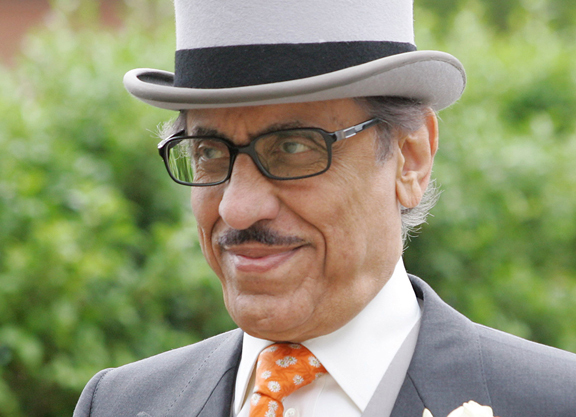
Juddmonte Farms founder Prince Khalid Abdullah | Horsephotos

The cultivation of this family by the Prince and his expert team made Mandaloun seem an apt candidate to carve a memorial in one of the few great prizes to have eluded Juddmonte. In the event, his performance at Churchill took their record to three runners-up from just six Derby starters, the others being Aptitude (A.P. Indy) and Mandaloun's damsire Empire Maker.

Who would have thought that Into Mischief would beat Juddmonte to a Kentucky Derby? Conceivably he may now haul them up that final step of the podium. Whatever happens, he stands absolutely in his pomp. Don't forget that his most luminous candidate was the derailed Life Is Good; and the pipeline is jammed with both quality and, Spendthrift's business model being what it is, quantity too. In fact, we only get to sample his first six-figure covers on the track this year.

A Derby for Mandaloun would be a windfall, for sure. But after that wild twist toward Protonico, it would also restore the weathervane to a direction it may now maintain for years to come.

The post Derby Clouds Offer Mandaloun Silver Lining appeared first on TDN | Thoroughbred Daily News | Horse Racing News, Results and Video | Thoroughbred Breeding and Auctions.

Source of original post

Commentary: ‘Neither Ignorance Nor Carelessness Make For Much Of An Excuse’

“First, Bob Baffert said it didn't happen. Now, he says it doesn't matter. He is wrong on both counts.”

So writes Tim Sullivan of the Louisville, Ky.-based Courier-Journal, who was one of a handful of reporters attending a Sunday morning press conference at which Baffert announced the finding of 21 picograms of betamethasone in the post-race sample of his Kentucky Derby winner, Medina Spirit.

Baffert's claim that morning was the the horse had never been treated with betamethasone, and he and his team had no idea how the medication could have been found in Medina Spirit's system.

Two days later, the story has changed. On Tuesday morning, Baffert released a statement (through his attorney Craig Robinson) indicating that Medina Spirit has been treated with a topical medication containing betamethasone for over 3 1/2 weeks. Otomax, the ointment indicated in that statement, was prescribed to help with a skin condition called dermatitis.

“Horse racing must address its regulatory problem when it comes to substances which can innocuously find their way into a horse's system at the picogram (which is a trillionth of a gram) level,” Baffert's statement said. “Medina Spirit earned his Kentucky Derby win and my pharmacologists have told me that 21 picograms of betamethasone would have no effect on the outcome of the race.”

As Sullivan wrote in his commentary Tuesday afternoon, the positive test DID happen, and it DOES matter, despite the claims of the Hall of Fame trainer and his attorney.

Neither the amount of the medication nor the intent with which it was used matter when it comes to disqualification of the horse: if a split sample test confirms the presence of any amount of betamethasone, Kentucky regulations call for both disqualification and loss of purse money.

Sullivan summarized: “Should Medina Spirit's split sample confirm the findings of the first test — as nearly all split samples do — Baffert's best strategy might be to claim mitigating circumstances. Neither ignorance nor carelessness make for much of an excuse, but they sure beat denying what turns out to be true.”

Read more at the Courier-Journal.

The post Commentary: ‘Neither Ignorance Nor Carelessness Make For Much Of An Excuse’ appeared first on Horse Racing News | Paulick Report.

Source of original post

Q&A: Mary Scollay on Drug Testing Protocols & Baffert Otomax Explanation

Since Sunday morning, horse racing has largely been a one-issue sport. That morning, of course, trainer Bob Baffert announced that GI Kentucky Derby winner Medina Spirit (Protonico) had tested positive for 21 picograms per milliliter of betamethasone in a post-race sample.

Betamethasone is a regulated corticosteroid commonly used in horse racing as an intra-articular joint injection. In Kentucky as of last year, a detection of betamethasone at any level is deemed a violation. The previous threshold was 10 picograms per milliliter. A split sample will now go for confirmation testing.

On Tuesday morning, Baffert released a statement explaining that following the GI Runhappy Santa Anita Derby, Medina Spirit had developed dermatitis on his hind end and that his veterinarian had recommended daily use of an anti-fungal ointment called Otomax.

“Yesterday, I was informed that one of the substances in Otomax is betamethasone,” the statement reads. “I have been told by equine pharmacology experts that this could explain the test results.”

Prior to Tuesday's announcement, Baffert had conducted a series of national interviews in which he maintained his innocence and insisted that he and his team have never administered betamethasone to Medina Spirit. During these interviews, Baffert cast serious doubts on drug testing protocols currently in use in horse racing, arguing how, among other things, the hyper-sensitivity of modern testing technologies leaves horses susceptible to positives through cross-contamination.

In Tuesday's statement, Baffert repeated those accusations, arguing that “horse racing must address its regulatory problem when it comes to substances which can innocuously find their way into a horse's system at the picogram (which is a trillionth of a gram) level.”

To discuss some of the issues that Baffert has raised in his interviews, the TDN spoke with Mary Scollay, executive director and chief operating officer of the Racing Medication and Testing Consortium (RMTC). Scollay was recently appointed to the Anti-Doping and Medication Control Standing Committee arm of the Horseracing integrity and Safety Authority.

The TDN spoke with Scollay both prior to, and after, Baffert released his statement Tuesday. In her first interview, Scollay raised the possibility that the positive could be the result of exposure through use of a topical product that contains betamethasone.

The two interviews have been spliced into the following, which has been edited for brevity and clarity.

In his statement, Baffert claims that the positive finding could be the result of use of a betamethasone-containing anti-fungal ointment called Otomax, which was used to treat dermatitis. Does this seem plausible?

It's plausible–the horse was exposed to betamethasone, so, that's beyond where we were a day ago when the horse had never been exposed to betamethasone.

In the scenario you presented in our first interview, the horse who tested positive for betamethasone after topical treatment of an ointment had also ingested the ointment. A scenario of double exposure. Would the levels of betamethasone detected in Medina Spirit also have required him to have ingested the topical ointment?

No way to know. I don't know that there's any pharmacokinetic data on concentrations of betamethasone following topical treatment. And again–because I never make anything easy, right–that would depend on the condition of the skin, too. Intact skin would likely absorb less into the blood stream than inflamed skin, or an open wound where there's more direct contact between the blood and the blood vessels and the medication.

The skin's a pretty good barrier–it's intended to prevent you from absorbing lots of stuff. If you could absorb lots of toxins and noxious substances through your skin, you'd be in trouble. Intact skin is a fairly effective barrier, so, again this is where an assessment of the horse's physical condition would be helpful. I don't know. Was the skin disease noted by the commission veterinarians in any of their contact with the horse? Don't know.

To be fair, it's not part of your routine inspection to lift the tail and look underneath. But, if the horse is jogging away from you and it's got irritated skin on the perineum, that's not something you'd notice–perhaps.

How common is Otomax?

It's a very common veterinary drug–I've used it on my Cocker Spaniels for years because they're inclined to get ear infections, and it is very useful in treating ear infections. It has a lot of use in small animal medicine. It wouldn't surprise me if it is used in equine veterinary medicine for different types of skin disease, especially the diagnosis of fungal diseases which has been referenced here, because some of the other topical medications of corticosteroids don't have an anti-fungal component, and Otomax does.

So, from what you're saying, Otomax could be a fairly ubiquitous medication on the backstretch. If so, why hasn't there been a rash–pardon the pun–of prior betamethasone positives subsequent to Otomax usage?

I don't know if it is commonly used [on the backstretch]. It wouldn't surprise me. It has extensive use in small animal medicine, and I would say that this is where I am most familiar with it as a client. You'd have to talk to practitioners on the backside to see how extensively they use it or if they carry it in their practice. A lot of topical medications come down to personal preference of the practitioner.

Again, I don't know the frequency with which it's used on the backside–nor do I know how it's used in proximity to a race. Are other people using it but withdrawing use of it within 72 hours? Because horses get bathed often, I would not expect there to be much carry over from day-to-day in terms of what's on the surface of the skin. You'd have to apply it a couple times a day–I think in this case, they said they were applying it once a day.

But again, what's the skin condition on which it's used? If it's on the girth or an area where the tack is inclined to rub, you probably are not planning on running the horse until it's resolved because that chaffing and discomfort could cause the horse to not provide maximum effort as it's uncomfortable. So, maybe most of its use is outside the context of a race, and so, it's not an issue.

These are questions I can't answer because I'm not on the backside prescribing it, and I would think if you want more information on the use of Otomax, you need to talk to some veterinarians who are attending to racehorses on a daily basis.

Taken from interview prior to Tuesday's statement:

Baffert has claimed that he's the victim of a systemic drug testing problem within the industry, and seems to have suggested he might be the subject of more deliberate efforts to tarnish his name. How likely is it that a sample was tampered with or that a testing error, deliberate or otherwise, was made?

I'm going to say highly improbable–very, very slim. There are multiple people in the test barn at any one time, and there are multiple people in the sample processing area at any one time. So, the thought that somebody would be able to successfully introduce something into a blood or urine sample without being detected, that I think is most unlikely.

Secondly, sort of as an aside, the RMTC has what's called an external quality assurance program where a couple of times a year we send sets of samples to each laboratory, and we pay another laboratory–one that's certified to do this–to put specific concentrations of substances into these blood and urine samples.

We may instruct 0.5 micrograms of [phenylbutazone, or bute] in a blood sample. Well, that requires very precise measurements and instrumentation–it's not like you just take a drop of injectable bute and plunk it into the test tube and say, 'there it is.' Doing something like that would result in extraordinarily high concentrations that would raise eyebrows and lead people to question the validity of the sample right there and then.

To tamper a sample with the addition of 21 picograms per milliliter? Say there's 6 milliliters of serum in that tube–what's that, 126 picograms of betamethasone? That's not easy to do. It's just not. There would be a large margin of error.

One of the first things you'd do if you saw a sample that high is look at the urine sample, and if there wasn't a corresponding concentration in the urine, you'd say, 'well, something's wrong here, this is not an accurate representation of what's in the horse. We need to notify the commission and decide how best to proceed.'

So, it would require two samples to be tampered with, and tampered with in such a way that concentrations of the substance present in such a way that would be complementary of each. And that to me would be tremendously difficult.

Baffert has also suggested that the finding could be a result of inadvertent cross-contamination. In a two-part TDN series last year, you voiced scepticism about the likelihood in certain circumstances of a positive being legitimately attributable to environmental contamination. What do you think of the likelihood of cross contamination in this case?

It still seems to me highly improbable. I mean, this horse, as I understand it, lived and was managed in Southern California until it came here for the Kentucky Derby. So, it's my understanding that in both circumstances, the stalls were under control of the trainer.

He has advised that this horse was never treated with betamethasone, so, I'm assuming that no betamethasone was introduced into the horse's stall in California through urine or feces or whatever. And it's also my understanding that the stalls at Churchill are unoccupied until the horses return in the spring. So, that's fresh bedding that's put down–again, it's hard for me to imagine that there was sufficient exposure in those stalls to result in a detection.

It is absolutely clear that there are substances that can be detected when you do swabs on the wall or you analyze clumps of dirt from the floor of the stall. But, again, you put clean bedding over those. The horse who is urinating over the bedding is reported never to have been treated [with betamethasone]. So, if the concentrations that had been detected in the flooring–you'd have to paw through and gnaw with your teeth in order to get some up to eat–were present in the milligram or nanogram concentrations, how much of that dirt would the horse have to eat in order to have a detectable concentration in its blood? To me the math doesn't add up.

Now, there are other ways unintended exposure can occur. We have dealt with a situation with a topical product that contains both antibiotics and betamethasone. It's used to treat wounds, and apparently, a horse had been treated topically with it, and the horse also seemed to like to lick its wounds. So, there was double exposure there through the wound as well as ingestion of the betamethasone. We attributed the finding to that level of exposure–we did not determine that the horse had been injected or that there was any nefarious activity. But the horse was exposed two ways. Clearly that was not an intended exposure.

There are certainly ways that unintended exposure can occur. But you're going to have a hard time convincing me a horse has licked enough of a stall wall to ingest a sufficient amount of betamethasone to result in a detectable finding.

Are there other ways betamethasone be found in the sample? Could it be a metabolite, for example, derived from another substance?

No, I don't believe so. I believe betamethasone is a unique medication, unique molecule. It is very similar to dexamethasone. It is the same molecular weight as dexamethasone, but the labs are able to discern the difference between the two. And again, when they report a finding for dexamethasone or betamethasone, they have unequivocally identified that molecule to the exclusion of all others.

Twenty-one picograms of betamethasone is described by some as insignificant. Can what appears such a relatively small amount of betamethasone be a performance enhancer?

You sort of ask two questions there, and so, I need to answer them separately.

First of all, we're not talking about the sum total of 21 picograms in the entire horse's body, it's 21 picograms per milliliter of blood. The horse has an awful amount of blood, probably in excess of 50,000 milliliters. That also doesn't measure the medication that has left the blood stream and entered the tissue. So, it's not 21 picograms in the entire horse–it's 21 picograms in one milliliter of blood. That's a different math problem right there.

Secondly, picogram is a measurement of weight and not potency. And so, my best way to explain this is to compare a pound of celery to a pound of Godiva chocolate. They both weigh a pound, so they have the same weight measurement, but in terms of potency–and let's say that's caloric content–they are hugely different, right? So, when you talk about a picogram of something, all you're really talking about is a measurement of weight.

Betamethasone is a potent corticosteroid administered at fairly low doses–nine milligrams or less in a single joint. Compare that to phenylbutazone which is a nonsteroidal anti-inflammatory. It's not a particularly potent drug–it's administered in gram doses. And so, we don't worry about picogram doses of phenylbutazone. We regulate phenylbutazone at the microgram level, which is one-millionth of a gram, and that's again because the drug disperses throughout the entire body.

So, you have to consider the potency of the drug, and because betamethasone is administered in low milligram doses, picogram concentrations are highly relevant.

Now, do I know what effect 21 picograms has on a horse? No, I do not. But I do know that, based on the administration studies that were funded by the RMTC, 21 picograms is consistent with the intra-articular administration of nine milligrams into a single fetlock joint at less than 72 hours prior to sampling.

Now, I'm not saying the horse in question received an intra-articular injection of betamethasone. It's clear that at the moment, no one knows how it got into the horse, and I'm not suggesting otherwise. I'm just saying that drug at that dose by that route of administration would result in that concentration within administration at less than 72 hours to a race.

Our regulation of corticosteroids is really based on racing safety and equine welfare. When I think of performance enhancing drugs, I think of EPO, doping, amphetamines, that sort of thing. The classic hop that we talk about. Whereas corticosteroids could allow a horse that is unsound to feel better and race better than he otherwise would. And so, that's a safety and welfare concern. I don't consider that to be a performance enhancing problem.

At the end of April, the Kentucky Horse Racing Commission formally agreed to end its contract with Industrial Laboratories in Wheat Ridge, Colorado, and begin using instead the University of Kentucky Equine Analytical Chemistry Laboratory as its official testing institution. The switch is expected to occur in June. Is this something that concerns you about the validity of the findings?

Absolutely not. When I worked for the commission, we were extremely satisfied with the service from Industrial Laboratories, and I don't think the switch has anything to do with dissatisfaction or lack of confidence in the services provided. I think the decision was based on local availability and supporting the home team, as it were.

I think the commission will continue to use Industrial Laboratories for split samples and maintain a good working relationship with the lab because they did their work well, and Petra Hartmann, who oversees the equine racing and testing component end of the program has been immensely helpful to the commission all along.

The post Q&A: Mary Scollay on Drug Testing Protocols & Baffert Otomax Explanation appeared first on TDN | Thoroughbred Daily News | Horse Racing News, Results and Video | Thoroughbred Breeding and Auctions.

Source of original post

Baffert, Maryland Jockey Club Reach Agreement For Medina Spirit To Run In Preakness

Bob Baffert's attorney Craig Robertson announced Tuesday afternoon that an agreement has been reached for Kentucky Derby first place-finisher Medina Spirit, and his stablemate Concert Tour, to run in Saturday's Preakness Stakes at Pimlico Race Course.

The following letter sets out the conditions of that agreement. It was sent by Robertson to Alan Rifkin, attorney for The Stronach Group, operator of Pimlico.

Dear Mr. Rifkin,

In the best interest of horse racing, and the integrity of the sport, Mr. Baffert consents to blood testing, monitoring and medical record review by the Maryland Jockey Club (“MJC”) on the horse Medina Spirit, and two other horses trained by Mr. Baffert. Medina Spirit and Concert Tour are presently entered in the Preakness Stakes and Beautiful Gift is presently entered in the Black Eyed Susan Stakes.

In addition to the testing and monitoring conducted by the Maryland Racing Commission (“MRC”) and/or in cooperation with the MRC, the horses were tested upon arrival at Pimlico and further blood samples will also be drawn today and as may be further determined by MJC from each of the horses. The MJC blood samples will be tested by a lab chosen by the MJC.

Consistent with the fair procedure process provided by The Stronach Group, Mr. Baffert consents to information regarding the results of the MRC and MJC tests, and other relevant medical and administrative records relating to the horses being disclosed to the MJC and Dr. Dionne Benson, The Stronach Group Chief Veterinary Officer.

If any of the three horses test positive for a banned substance, or at a level for a permitted therapeutic substance which is above the designated limit, or if reasonable conditions warrant after MJC's review of the medical or administrative records, Mr. Baffert, or MJC on his behalf, will scratch that horse from the upcoming race in which that horse is entered this weekend at Pimlico.

Mr. Baffert has given these consents to further the interests of horse racing and the public. MJC may provide this letter and consents herein to the MRC and Mr. Baffert consents to the public release of this letter and all testing results. Mr. Baffert represents that he has authority to grant the consents represented herein on behalf of the owners of the aforementioned horses.

The integrity of the sport is of the upmost importance to Mr. Baffert and by consenting to this testing regimen and monitoring he reaffirms his commitment and dedication to the sport. Please let me know if you have any questions.

Sincerely yours,

Craig Robertson

The post Baffert, Maryland Jockey Club Reach Agreement For Medina Spirit To Run In Preakness appeared first on Horse Racing News | Paulick Report.

Source of original post

Verified by MonsterInsights