Wild Stories, Unique Culture: Welcome To Derbyville Exhibit Opens At Kentucky Derby Museum

The Kentucky Derby is a bucket-list event for thousands of people around the world each year. Some come for the fashion, others for the party, the people-watching, or the horses. From spectators climbing the Infield's flagpole, to a skydiver surprising 100,000 fans with a parachute landing into the Infield crowd, visitors can explore the wild stories and unique culture of the Kentucky Derby at a new exhibit, Welcome to Derbyville, now open at Kentucky Derby Museum.

A ribbon cutting held Friday celebrated the opening of the exhibit, located in the Museum's Matt Winn Gallery, a space on the second floor used for rotating exhibits. The concept was born from the idea that on most Derby Days, Churchill Downs transforms into the state's third largest city, drawing its temporary residents into a remarkable cultural experience that is unique to other sporting events. The Museum's new exhibit explores this 147 acre city–Derbyville–and who comes to stay and why. Fans and critics, journalists and fashion plates, horsemen and horsewomen: there's something for everyone in Derbyville.

The unique culture of the Kentucky Derby comes to life through pictures, videos, artwork and artifacts, plus interactive components where visitors can write down and share their own Derbyville stories.

Additionally, the exhibit takes a deep dive into journalist Hunter S. Thompson and artist Ralph Steadman's raucous commentary, “The Kentucky Derby is Decadent and Depraved,” featuring some familiar (and NEW) artifacts from their trip to the 1970 Kentucky Derby. With one of Jeff Ruby's bedazzled Derby Day ensembles, the Museum is bringing to its guests a number of objects from the vault that have never been displayed.

The exhibit runs through the fall of 2022.

About Kentucky Derby Museum (DerbyMuseum.org):

Kentucky Derby Museum, a 501(C)(3) non-profit public charity organization in Louisville, Kentucky that has a commitment to ENGAGE, EDUCATE and EXCITE everyone about the extraordinary experience that is the KENTUCKY DERBY.

The post Wild Stories, Unique Culture: Welcome To Derbyville Exhibit Opens At Kentucky Derby Museum appeared first on Horse Racing News | Paulick Report.

Source of original post

This Side Up: Another Fine Messier

Red Smith put it well; of course he did. So well, in fact, that he said it all over again. In 1975, writing one of the pieces that won a Pulitzer Prize the following year, Smith declared that Kentucky Derby week was “the only one in 52 when the instrument of Satan known as horse racing becomes a showpiece of the American sports scene.” Four years later, back at the same point in the cycle, he wrote that little old ladies in Wisconsin would this week be glad to learn that Spectacular Bid and Flying Paster are Thoroughbred racehorses–though there were “vast and sinless areas in this country where they and their like are regarded as instruments of Satan for the rest of the year.” In both pieces, he then quoted Johnny Rotz recalling his Illinois boyhood: “The only time the Decatur paper mentioned racing was to tell who won the Derby and how much money Eddie Arcaro had.”

This kind of thing, to be clear, is a precious prerogative of the fourth estate. We generally feel safe in assuming that nobody out there can be paying undue attention to our hasty scribblings. (Most of the time, candidly, we're banking on it.) And maybe Smith, in 1979, was facing one of those deadlines that loom with a disproportionate burden upon the first syllable. If so, he did well then to refine his theme in a characteristically picturesque formula: come Derby week, “sinless newspapers that wouldn't mention a horse any other time unless he kicked the mayor to death are suddenly full of information about steeds that will run and the people they will run for at Churchill Downs on the first Saturday of May.”

On the day we honor one of sport's great chroniclers, in the GII Red Smith S. at Aqueduct, we should perhaps be keeping this yearly pass from Main Street in mind. Because it is now clearly open season, when it comes to inflicting the benefit of our wisdom on the hapless owners of Corniche (Quality Road), along with others in the same barn now embarking on a GI Kentucky Derby trail that remains blocked, at a crossing up ahead, by a stranded locomotive.

For the time being, there's no sign of any engineers to get the thing moving again; just a bunch of lawyers prodding each other in the chest about who's to blame. And actually, unless I've missed something, none of the ongoing litigation concerns Bob Baffert's prohibition from the home of the Derby anyway. So something has to give–just not, please, the single week of the year when we get the indulgence of “sinless” America. Because if we're not careful, we're going to find ourselves shoving 20 “instruments of Satan” into the Derby starting gate.
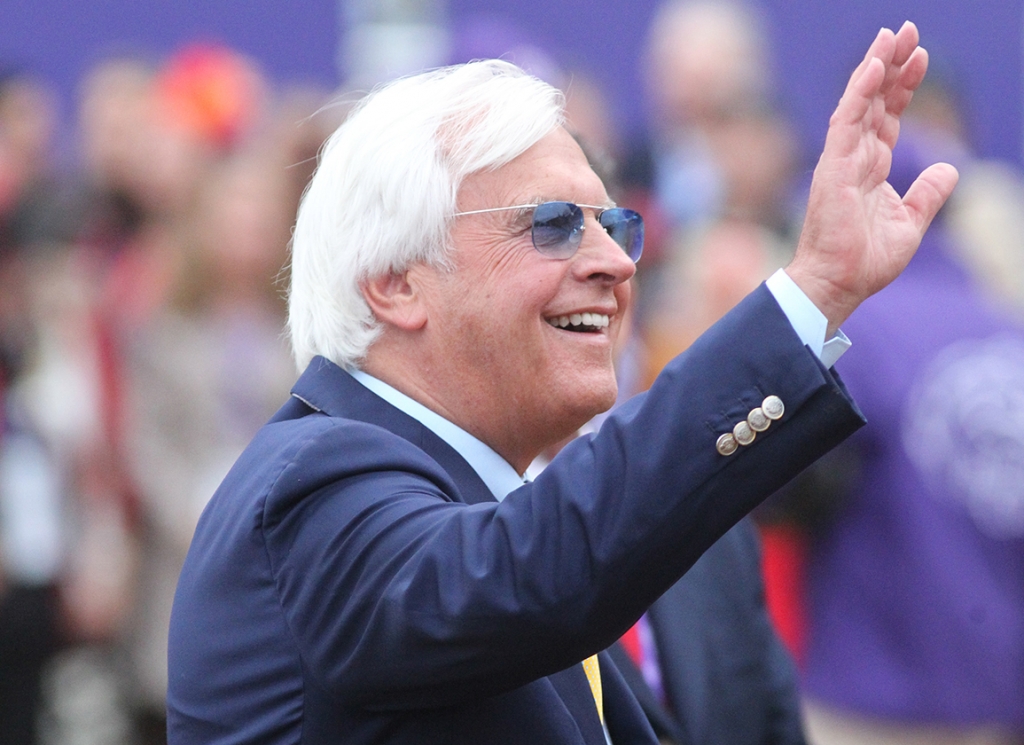
Bob Baffert | Horsephotos

Now while Baffert may be accustomed to the feeling, for the guys who spent $1.5 million on Corniche this is a once-in-a-lifetime shot at the two-minute Grail that essentially drives the spending of billions on bloodstock every year. Similarly, for the many owners of Messier (Empire Maker), winner of the GIII Bob Hope S. at Del Mar last Sunday. And it is dreadfully unfair to turn their situation into some kind of test of loyalty, or character.

It's certainly no help to urge that there are plenty of other fish in the sea. With all the considerable respect due to its author, the notion that there is the faintest equivalence between this dilemma and Spend a Buck missing the Preakness, because he could earn more elsewhere, is still making my head hurt days after it appeared in these pages.

No two ways about it: if one of the 20,000-odd Thoroughbreds foaled in North America in 2019 combines eligibility and health to claim one of those 20 gates on May 7, 2022, then that's exactly what has to happen. It's atrocious that anyone, typically having spent a fortune enduring countless malicious torments by the racing gods, should finally see that Derby sunbeam break from the clouds, and light on their horse, only to be told that this is just a theatrical device for the measurement of their decency.

In those terms, anyhow, it's a lose-lose scenario. Half the chorus pronounces that a decent person would already have moved his horse from a barn that has, if only by inattention rather than calculation, tainted the reputation of our community among “sinless” Americans. The other half, meanwhile, suggests that a decent fellow would sit out the Derby and stand by their man.

That being so, perhaps the real test of decency faces Baffert himself. He has to fight his corner, naturally. He clearly feels besieged and aggrieved. But however marginal his culpability, he has to accept some responsibility for putting his patrons in such an invidious position. If he truly has the interests of the sport at heart, as he often protests, then there's a way he might win round a lot of sceptics.

He could say: “You know, I really feel that I don't deserve this kind of treatment, relative to the charges against me. You saw how my horses ran at the Breeders' Cup, where I couldn't even break wind in private. But I do understand that I've exasperated a lot of people, especially after telling the world at Keeneland only a year ago that I was henceforth going to run the tightest ship in the game. And I have clearly exhausted the patience of some who are in a position to make that tell.

“As a result, anyhow, I have trapped valued clients and friends in a horrible corner. It simply isn't right for anyone to feel like they should even think about passing on the Derby because they feel sorry for someone who has already won it seven times. Okay, maybe six times. We'll see. But I am going to get these horses on the trail as best I can and, if nothing relieves the stalemate by the time we get to those 100-40-20 trials, then I am going to insist, really insist, that they be transferred to a trainer who can bank those points.

“I know a lot can go wrong with all these horses in the meantime, so I am going to use all my skill to keep them in the game. But then they are going on loan to Todd or whoever. Because that is the only way I can serve the shared interests of these horses; my friends who own them; and the sport I love. Someday I'll be back at Churchill. In the meantime, this is one way I can show that I can see the bigger picture; that I will deserve to be welcomed back.”
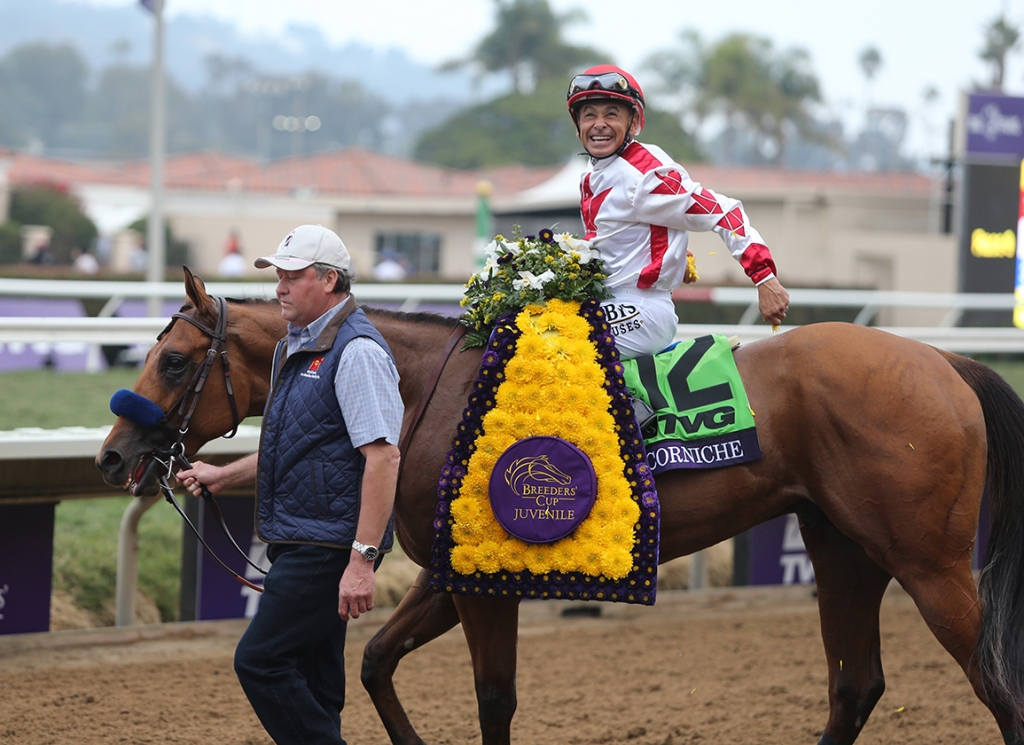
Corniche, another 'TDN Rising Star', took the Breeders' Cup Juvenile | Horsephotos

For the guys who own Corniche, after all, it's hardly as though we're talking about Clement L. Hirsch and Warren Stute, whose 48-year relationship we celebrated earlier this week. And nor is this just about the silks that happen to get paired with that blanket of roses. Think, for instance, what it would mean to Sam-Son Farm for Messier to win the Derby for a family cultivated there through five generations.

To a degree, moreover, we all have a stake in what happens next. Hopefully Baffert noticed the latest manoeuvres of those zealots who really do think of us as “instruments of Satan”, now trying to sever slots payments to the New York industry. Meanwhile we, too, manipulate opportunities of political or legal process–against each other. Some people are harnessing ideological lobbies to defend their constitutional right to pump pharmaceuticals into horses. Others, still more barefaced, dare to apply for Illinois wagering rights as reward for a commitment to local horse racing that feels rather elusive in the bulldozing of those beautiful stands at Arlington.

We all have a responsibility toward the future viability of our sport. Remember, we have a lot of enemies out there. Most are vexingly wrong-headed, but that doesn't mean they won't get a hearing in the social media age. So we had better make sure we reach Louisville next spring ready to correct any misapprehensions that might have flourished during the 51 weeks since Medina Spirit (Protonico) gave his contentious sample. Because they would doubtless be gripped, in Decatur, to read that one (or several) of the most talented colts in the crop is barred from the Derby, and why.

In this particular saga, then, we can't afford for both sides simply to keep entrenching their positions, waiting for the lawyers to lean on their spades. Because that's not going to happen any time soon. And a messy situation, meanwhile, could become Messier yet.


The post This Side Up: Another Fine Messier appeared first on TDN | Thoroughbred Daily News | Horse Racing News, Results and Video | Thoroughbred Breeding and Auctions.

Source of original post

Testing On Medina Spirit’s Urine Sample Ready To Proceed In New York

Extra testing on Medina Spirit's post-Kentucky Derby urine sample will begin next week, according to bloodhorse.com. Dr. George Maylin, director of the New York Equine Drug Testing and Research Laboratory, has now received the relevant drug metabolite reference standards from Frontier BioPharm. Testing of the sample is expected to take approximately two weeks.

The Protonico colt's Derby win is in jeopardy due to a positive post-race test result for betamethasone, a therapeutic medication that is not allowed on race day. Trainer Bob Baffert and his attorney have claimed the positive is a result of a topical cream (Otomax) used to treat a case of dermatitis on the colt's hindquarters. Though the Kentucky Horse Racing Commission has not yet held a hearing, required to disqualify Medina Spirit.

Counsel for Medina Spirit's trainer Bob Baffert and owner Zedan Stables, Craig Robertson, filed a civil suit against the Kentucky Horse Racing Commission on June 7 demanding their right to test the split urine sample, which sat undisturbed in the commission's freezer. Remnants of the original biologic samples were initially sent to be tested for those ingredients, but they were reportedly damaged before arrival at the plaintiffs' choice of labs, the New York Equine Drug Testing and Research Laboratory.

Franklin County Circuit Court Judge Thomas Wingate ordered June 16 that the remaining urine sample be flown to the New York lab, that two KHRC representatives travel with the sample, and that plaintiffs fund the flight. Upon arrival, the KHRC was to retain 5 milliliters of the sample, while the remainder was to be tested for clotrimazole, gentamicin, and betamethasone valerate, active ingredients in the topical cream Otomax.

On July 14, the sample was flown to New York accompanied by Dr. Clara Fenger and Tom Huckeby, representing Baffert and Medina Spirit's owner, Amr Zedan, as well as by KHRC executive director Marc Guilfoil and equine medical director Dr. Bruce Howard.

On Aug. 9 in Judge Wingate's courtroom, the Kentucky Horse Racing Commission's general counsel Jennifer Wolsing explained: “My understanding is that an affirmative defense is being mounted by the plaintiffs, to the extent that there may be some evidence as to how this substance (betamethasone) was introduced to the horse.

“We can't have a stewards hearing until those testing results have come back, because that appears to form the basis of the defense the plaintiffs want to mount. We would really like those results so that we can press forward with a stewards hearing and find out more about this case.”

When that hearing occurs, Medina Spirit could be disqualified and Baffert could be fined and/or suspended by the KHRC. A suspension would be reciprocated across other racing jurisdictions.

Since his run in the Kentucky Derby, Medina Spirit has run four times. He finished third in the Preakness, then won the Shared Belief Stakes and G1 Awesome Again, and finished second in the G1 Breeders' Cup Classic.

Read more at bloodhorse.com.

The post Testing On Medina Spirit’s Urine Sample Ready To Proceed In New York appeared first on Horse Racing News | Paulick Report.

Source of original post

The Week in Review: Tygart, USADA Out to Clean Up the Game

We heard from the United States Anti-Doping Agency (USADA), its CEO Travis Tygart and the Director of Equine Science Dr. Tessa Muir last week when USADA released its anti-doping guidelines, rules and protocols. Once again, we saw that these are no-nonsense, dedicated people with a track record of cleaning up other sports. The release of the guidelines was an important step toward what will be a welcome change for racing–competent, dedicated policing from an outside entity replacing the current system, which just doesn't work.

(Quotes from this story were taken from Tygart and Muir's appearance on the TDN Writers' Room podcast and from Dan Ross's coverage in the TDN and his Q&A with Tygart and Muir.)

With Thursday's release of the details, there was a lot to digest. Here's what resonated with me:

(*) USADA is not going to rely solely on drug testing, which has been proven to be a woefully inadequate way of catching cheaters. There are always a number of potent drugs out there that can't be detected by standard drug tests. USADA may not have all the tools, including wiretaps, that the FBI had when it took down Jason Servis, Jorge Navarro and others, but Tygart made it clear that there are more ways to catch cheaters than just through drug tests.

“Can you bring a case if you don't have a positive test?” Tygart said. “In some states today, I don't think that's even possible under the rules. But if you look at Article Two of the rules, it identifies about 12 different types of violations. Only one or two of those includes a positive test. So possession, trafficking, complicity, attempted administration, retaliation against a whistleblower, those are things that can be anti-doping rule violations.”

He said that scientific evidence will be combined with “buckets of evidence”, much like what you see each week on shows like Law and Order and NCIS.

Tygart said they will also rely on a tip line that is already receiving calls. All of which is a step in the right direction. Neither Navarro nor Servis had any serious violations on their records that were the result of testing, which just goes to show that a lot more beyond testing needs to be done.

(*) USADA appears to understand the importance of going after more than just the trainers. It stands to reason that in most cases where performance-enhancing drugs are used, a veterinarian is involved. And what about the owners? It's hard to imagine they don't know what's going on when their trainer is wining at 30% and 50% off the claim. They should have to pay the price when their trainer is caught.

“When the horse is in training, the owner, the veterinarian, anyone else involved with the horse, they can be held accountable if they're complicit and part of a doping or a medication issue,” Tygart said. “The strict liability of the positive test doesn't apply to them. So there will be a slightly different way that this is prosecuted, but they absolutely can be held accountable under these rules.”

He added: “It's not just the trainer training the horse that has responsibility for this culture of a clean sport. Everybody within the sport should have a responsibility to ensure that it's being done the right way.”

(*) One thing that was not addressed last week was the obvious problem of having a trainer turn the stable over to an assistant once they are suspended. Life goes on largely uninterrupted for that stable with the head trainer getting what amounts to a vacation. There's not nearly enough of a deterrent here. At least with the more serious violations, the stable should be penalized along with a guilty trainer.

(*) USADA is going to rely heavily on out-of-competition testing and trainers must let USADA know at all times where a horse is located. He also said that out-of-competition tests won't be done on a random basis. For obvious reasons, the focus will be on trainers whose results suggest they might be using something to get an edge.

“It's what we call intelligent testing,” Tygart said. “It's not random. Some call it smart testing. Some call it target testing. We will use data.”

(*) You might want to call this one the “Baffert Rule.” While USADA will distinguish between violations that involve performance-enhancing drugs and overages of therapeutic medications, Tygart believes that there is a point where enough is enough when it comes to overages. Four minor infractions or therapeutic overages within five years could result in a sanction of up to two years.

(*) Just because a horse passes post-race urine and blood tests doesn't mean that they can't be caught later on. If someone uses something illegal and a new test for that substance comes around after the fact, they could get nailed. This is another welcome development.

“We will have the ability to do what is called retrospective testing,” Tygart said. “Samples will be put into storage. And then when you develop new tests in the future, we're going to be able to bring those samples out of storage and actually then analyze them with the new methodology for those prohibited old-time substances. That's also a great deterrent to people using things where they say you can't detect it. But in the future, when those technologies and the capabilities are enhanced and changed, then we can go back and you will still be subject to sanction (for a positive test).”

(*) More than six months after the race, the Kentucky Horse Racing Commission has still not acted when it comes to this year's GI Kentucky Derby and the reported betamethasone positive on winner Medina Spirit (Protonico). That, Tygart said, will not happen after USADA takes over.

“I was pretty stunned to hear that (Medina Spirit's) Kentucky Derby case hasn't been resolved yet,” Tygart said. “That's not going to happen on our watch. I mean, it's crazy that it's taken that long to get to a final resolution, particularly when someone is competing the entire time.”

Lawsuits have been filed by horsemen's groups and six states to shoot down the Horseracing Safety and Integrity Act (HISA), which is what created the need for a new method of policing the sport, and USADA has yet to sign a contract with the Horseracing Integrity and Safety Authority. Both factors could mean that the projected start date for HISA, July 1, 2022 will not be met.

But if and when HISA goes into effect, USADA will be ready. Tygart called the new rules a “gold standard program for the industry.” He's got that right. It's time for a new era.

The post The Week in Review: Tygart, USADA Out to Clean Up the Game appeared first on TDN | Thoroughbred Daily News | Horse Racing News, Results and Video | Thoroughbred Breeding and Auctions.

Source of original post

Verified by MonsterInsights