Mucho Macho Man Stakes: Strike Hard Aiming For Strong Start On Road To Florida Derby

For Miracle's International Trading, Inc.'s Strike Hard and Matthew Williams, the trainer for his family's stable, Saturday's $150,000 Mucho Macho Man at Gulfstream Park could prove to be a milestone race.

The 11th running of the one-mile Mucho Macho Man, the first step on Gulfstream's road to the $1 million Curlin Florida Derby April 2, headlines five stakes for newly turned 3-year-olds worth $550,000 in purses on the New Year's Day holiday program.

Post time for the first of 11 races is noon.

Both Strike Hard, a gray or roan son of Grade 2 winner Flashback, and Williams, a 25-year-old native of Kingston, Jamaica, are chasing the first stakes victory of their young careers. Williams has started 143 horses since November 2018 with 13 wins, while Strike Hard has raced five times with two wins, one second and one third.

“Going into the Mucho Macho Man, I have a lot of confidence. I definitely think he's up to the challenge and the level, especially based on his last performance,” Williams said. “This race will help us decide what's next.”

Strike Hard enters the Mucho Macho Man off a popular four-length optional claiming allowance triumph Dec. 5 at Gulfstream, with Saffie Joseph Jr.-trained stablemates A. P.'s Secret and Skippylongstocking a nose apart in second and third, respectively.

It was Strike Hard's second career win at a mile, coming in 1:35.60. The winning time would rank as the second-fastest in Mucho Macho Man history behind the 1:34.39 posted in 2013 by Itsmyluckyday, who went on to run second in the Florida Derby, win three graded-stakes including the 2014 Whitney (G1), and earn more than $1.7 million in purses.

“I thought he ran a very good race,” Williams said. “They regarded A. P.'s Secret pretty well and he beat him by four lengths, and he did it in good time, too. He went in [1:22.64] for seven furlongs and 1:35 and change for a mile. That was pretty good, I thought.”

Purchased for $25,000 as a 2-year-old in training at OBS in March, Strike Hard came back to breeze five furlongs in 1:01.13 Dec. 24 over Gulfstream's main track, eighth-fastest of 34 horses.

“He's doing great. I'm happy with him,” Williams said. “I'm as happy as I can be with him.”

Strike Hard ran seventh, beaten 6 ¾ lengths, in the Sept. 18 Iroquois (G3) at Churchill Downs, his only previous stakes attempt. Junior Alvarado is named to ride from Post 2 in a field of six.

“I'd like to draw a line through that race,” Williams said. “I think we shipped him a little too close to the race, just because we were uncertain whether we'd actually get in. They were expecting a big field, there were a lot of nominations, so we didn't ship him when we had initially planned. I hope that means he didn't give us his best that day.”

Williams' best horse to date has been Dream Marie, a 4-year-old mare that has won four of 23 starts with $278,420 in purse earnings. She has placed in five stakes including seconds in the Rampart (G3) and Hollywood Wildcat and a third in the Davona Dale (G2) in 2020 at Gulfstream. Williams is hopeful Strike Hard will be even more successful.

“From early on we thought he'd be a really nice horse. He trains really professionally,” he said. “He's shown us good interest when training. I definitely like his competitiveness. The times when he was breezing in the early stages and the way he did it, the riders were always impressed with him and so was I.”

The Championship Meet's leading trainer with 17 wins since Dec. 3, Joseph is keeping the likes of Remington Springboard Mile winner Make It Big, Kentucky Jockey Club (G2) show finisher White Abarrio and A. P.'s Secret on the bench for the Mucho Macho Man, but he will be represented by Daniel Alonso's Skippylongstocking.

Joseph is seeking his second Mucho Macho Man victory in three years following Chance It in 2020, who would go on to be Grade 1 placed. Skippylongstocking may have a change of equipment following his loss to Strike Hard last time out.

“He ran a decent race last time,” Joseph said. “We're probably going to try some blinkers on him this time, so hopefully it will help him jump forward. The horse that beat him last time beat him pretty convincingly … so he has to improve.”

Skippylongstocking finished ahead of Strike Hard when they ran second and third, respectively, separated by two lengths in an Aug. 7 maiden special weight at Gulfstream. Like Strike Hard, Skippylongstocking would also graduate in his subsequent start, a 10 ½-length maiden special weight romp over Rod Two Rod going a mile Sept. 26 at Gulfstream. Rod Two Rod was fourth, two lengths behind Skippylongstocking, in the Dec. 5 allowance.

“His maiden win was good. The horse he beat came back to win but the time was slow and he beat that horse [again] the other day,” Joseph said. “That horse kind of actually gained a few lengths on him, so the form hasn't been that strong. That's the concern. I know he's a decent horse, but can he make that jump? We're going to give him one more try to find out and, hopefully, blinkers can help him move forward a bit.”

Tyler Gaffalione, who also rode Chance It in the Mucho Macho Man, gets the return call from Post 5.

Lanes Mark Racing Stable and Danny Pate's Mr Rum Runner has never been worse than third in four starts and enters the Mucho Macho Man off his first win, a Nov. 21 maiden special weight at Gulfstream going one mile. He pressed the pace before taking a short lead, lost it at the top of the stretch and came back through the lane to win by a neck.

In his prior start, Mr Rum Runner set the pace along the inside and opened a clear advantage before being chased down and finished second to Peter D in the one-mile, 70-yard Juvenile over Gulfstream's Tapeta surface Oct. 23. Peter D has gone on to win two subsequent starts.

“He's training good. Hopefully, he can take the next step. He's a nice horse. He has never disappointed us so far. We'll see how good he is,” trainer Patrick Biancone said. “He's a horse that when he takes the lead he has a tendency to pull up, so the jockey has to time the race perfectly.”

Romero Maragh is set to ride back from Post 4.

OXO Equine's Graphic Detail is entered to make his second career start and first since rallying for a half-length maiden special weight triumph sprinting six furlongs Nov. 6 at Belmont Park for Hall of Fame trainer Bill Mott. The fourth-place finisher in that race, Provocateur, came back to break his maiden by 4 ½ lengths as the favorite Dec. 23 at Tampa Bay Downs. Graphic Detail's sire, Practical Joke, won the 2016 Hopeful (G1) and Champagne (G1) and was third in the 2017 Fountain of Youth (G2) at Gulfstream before taking the Allen Jerkens (G1) at Saratoga.

Graphic Detail drew outside Post 6 under Luis Saez.

Tami Bobo's Simplification ran fifth in his unveiling Oct. 1 over the Tapeta at Gulfstream before graduating by 16 ¾ lengths against fellow Florida-breds in an Oct. 23 maiden special weight over the main track. Most recently, the Not This Time colt finished third as the favorite in a Nov. 13 optional claiming allowance and will be stretching out beyond six furlongs for the first time.

Rounding out the field is Peacock Stable's Sport Pepper, owned and trained by Kerry Zavash. The Classic Empire gelding broke his maiden on the turf and won an optional claiming allowance on the dirt in successive starts at Arlington Park and Keeneland, respectively, this fall before finishing off the board in the Oct. 31 Street Sense at Churchill Downs and Dec. 3 Pulpit on the grass at Gulfstream.

Sport Pepper will break from the rail with Corey Lanerie.

Contested as the Gulfstream Park Derby from 2012-14, the Mucho Macho Man was renamed in honor of the Gulfstream-based winner of nine of 25 career starts and more than $5.6 million in purse earnings. Seven of his victories came in stakes – the 2013 Breeders' Cup Classic (G1) and Awesome Again (G1), 2012 Suburban (G2) and Gulfstream Park Handicap (G2), 2011 Risen Star (G2) and 2014 and 2012 Sunshine Millions Classic.

The post Mucho Macho Man Stakes: Strike Hard Aiming For Strong Start On Road To Florida Derby appeared first on Horse Racing News | Paulick Report.

Source of original post

Third In Breeders’ Cup Juvenile Turf, Mackinnon Will Try Out For Derby Trail In Saturday’s Sham

A multiple stakes winner on turf and most recently a close third in the Grade 1 Breeders' Cup Juvenile Turf, Doug O'Neill's Mackinnon transitions to dirt as he heads a group of five newly minted sophomores going a flat mile in Saturday's G3, $100,000 Sham Stakes at Santa Anita. A qualifying race to the 2022 Kentucky Derby, the Sham winner will receive 10 qualifying points, with four to second, two to third and one point to the fourth place finisher.

Owned by Colorado Avalanche defenseman Erik Johnson's ERJ Racing, LLC, Madaket Stables, LLC, out of the Scat Daddy mare Scat Means Go, Mackinnon will try the main track for the first time since a fourth place finish going 4 ½ furlongs in his debut six starts back on May 9 here at Santa Anita.

Third, beaten 1 ¾ lengths by Modern Games in the G1 Breeders' Cup Juvenile Turf Nov. 5 at Del Mar, Mackinnon is a colt that has always trained well on dirt and will thus be given an opportunity to the early Derby waters on Saturday. Easily the leading money earner in the field with $327,860, Mackinnon has three one mile turf wins to his credit and is 6-3-1-1 overall.

A recent G3 stakes winner going a one turn mile in New York, Bob Baffert's Rockefeller will no doubt contend for favoritism in what will be his fourth career start.

A 2 ¼ length first-out maiden winner going six furlongs at Del Mar Aug. 28, Rockefeller was a well beaten fourth by his stablemate and eventual Breeders' Cup Juvenile winner Corniche in the G1 American Pharoah Stakes going 1 1/16 miles here on Oct. 1. Sent to Belmont Park for his third start, Rockefeller, who is by Medaglia d'Oro, out of the Speightstown mare Dance to Bristol, was off as the 4-5 favorite in the G3 Nashua Stakes and responded with 2 ¾ length win accomplished in gate to wire fashion.

Owned by SF Racing, LLC, Starlight Racing, Madaket Stables, LLC, Stonestreet Stables, LLC and Robert Masterson, Rockefeller, who was purchased for $750,000 out of the 2020 Keeneland September Yearling Sale, will be ridden by Flavien Prat.

Baffert will also be represented by Newgrange, a first-out maiden winner going six furlongs on Nov. 28 at Del Mar. By Violence out of the Empire Maker mare Bella Chianti, he's owned Golconda Stable, Madaket Stables LLC, SF Racing LLC, Siena Farm LLC, Starlight Racing, Stonestreet Stables, LLC, Waves Edge Capital LLC, and partners and will be ridden back by John Velazquez.

THE GRADE 3 SHAM STAKES WITH JOCKEYS & WEIGHTS IN POST POSITION ORDER

Race 7 of 10 Approximate post time 3 p.m. PT

  1. Mackinnon—Juan Hernandez—124
  2. Oviatt Class—Kent Desormeaux—120
  3. Newgrange—John Velazquez–120
  4. Rockefeller—Flavien Prat—124
  5. Degree of Risk—Umberto Rispoli–120

First post time for a 10-race card, which will include four graded stakes on Saturday is at 12 noon. For additional information, please visit santaanita.com or call (626) 574-RACE.

The post Third In Breeders’ Cup Juvenile Turf, Mackinnon Will Try Out For Derby Trail In Saturday’s Sham appeared first on Horse Racing News | Paulick Report.
Source of original post

Saturday’s Smarty Jones Stakes Draws 14 Triple Crown Hopefuls

Record purse, record number of nominees and possibly a record crowd in the starting gate.

Oaklawn's Road to the Kentucky Derby begins Saturday with the $250,000 Smarty Jones Stakes, a one-mile race that has drawn a full field of 14. Probable post time for the Smarty Jones, which goes as the ninth of 10 races, is 4:13 p.m. (Central). First post is 12:30 p.m.

The Smarty Jones is Oaklawn's first of four Kentucky Derby points races, with 17 up for grabs to the top four finishers (10-4-2-1, respectively). What's different in 2022 is the timing of those races. Coinciding with an expanded 2021-2022 schedule – the Dec. 3 opening was the earliest in Oaklawn history and more than a month before traditional dates – the Smarty Jones, Southwest Stakes (G3) at 1 1/16 miles Jan. 29, Rebel (G2) at 1 1/16 miles Feb. 26 and Arkansas Derby (G1) at 1 1/8 miles April 2 were all moved up on the calendar.

The Smarty Jones previously had been run in mid to late January, Southwest in mid to late February and the Rebel in mid to late March. The Arkansas Derby is still in April, but it is now five weeks before the Kentucky Derby, instead of falling three weeks away as it has since 1996.

In addition to the revamped schedule, Oaklawn President Louis Cella boosted the purse of the Smarty Jones from $150,000 to $250,000 and the Arkansas Derby from $1 million to a record $1.25 million, keeping it the country's richest Kentucky Derby prep race.

The moves are already paying dividends.

The Smarty Jones, inaugurated in 2008, drew a record 98 nominees. If the field remains intact, it will be the largest in race history, eclipsing 12 starters in 2008, 2010 and 2012.

“Not that the Smarty Jones is new, the placement of the Smarty Jones is new,” Oaklawn racing secretary Pat Pope said moments after Tuesday's post position draw for the race. “The fact that Louis wanted to put more money in, all those things tremendously helped the race.”

The projected 14-horse Smarty Jones field from the rail out:

  1. Dash Attack, David Cohen to ride, 117 pounds, 12-1 on the morning line
  2. All in Sync, Ricardo Santana Jr., 117, 8-1
  3. Home Brew, Florent Geroux, 119, 3-1
  4. Kavod, Francisco Arrieta, 119, 5-1
  5. Ignitis, Luis Contreras, 117, 15-1
  6. Bureau, David Cabrera, 117, 12-1
  7. Ruggs, Julien Leparoux, 117, 10-1
  8. Vivar, Martin Garcia, 119, 8-1
  9. Don'tcrossthedevil, Lane Luzzi, 117, 10-1
  10. Barber Road, Reylu Gutierrez, 117, 4-1
  11. Cairama, Geovanni Franco, 117, 8-1
  12. Cool Papa G, Ramon Vazquez, 117, 6-1
  13. Immoral, Tiago Pereira, 117, 20-1
  14. Ben Diesel, Jon Court, 117, 5-1

Oaklawn's totalisator system can accommodate 14 wagering interests after an upgrade for the 2017 meeting.

Hall of Fame trainer Steve Asmussen nominated 21 horses to the Smarty Jones and entered three – All in Sync, Cairama and Cool Papa G. Trainer Brad Cox nominated 14 and entered program favorite Home Brew and Vivar. Trainer Kenny McPeek nominated five and entered Dash Attack. Fair Grounds-based trainer Dallas Stewart, who has a small string at Oaklawn, is scheduled to be represented by Ben Diesel.

Strong interest in the Smarty Jones comes on the heels of two other recent 17-point Kentucky Derby preps – $400,000 Springboard Mile Stakes Dec. 17 at Remington Park and the inaugural $100,000 Gun Runner Stakes last Sunday at Fair Grounds.

“I think now, it's boom, boom, boom,” Pope said. “What I'm seeing, trainers do this even for Breeders' Cup, they work backwards. The don't work forwards. So, they sit there and work backwards. How many races do I need to get to the Kentucky Derby? How many races do I need to get to the Arkansas Derby? And what's the best scenario to do it?”

[Story Continues Below]

Ben Diesel exits a fourth-place finish in the $400,000 Kentucky Jockey Club Stakes (G2) Nov. 27 at Churchill Downs. The son of champion and 2013 Smarty Jones winner Will Take Charge is a homebred for Willis Horton of Marshall, Ark. Ben Diesel is full brother to Will's Secret, who won Oaklawn's $200,000 Martha Washington Stakes and $300,000 Honeybee Stakes (G3) for 3-year-old fillies at the 2021 Oaklawn meeting for Stewart and Horton.

Barber Road, Cool Papa G and Ignitis finished 2-3-6, respectively, in the $200,000 Lively Shively Stakes at 6 ½ furlongs Nov. 27 at Churchill Downs. Lively Shively winner Tejano Twist returned to run second in the Gun Runner at 1 1/16 miles.

Vivar finished sixth in the Kentucky Jockey Club for Cox and breeder/owner John Ed Anthony of Hot Springs, who teamed to win the 2021 Smarty Jones with Caddo River. Home Brew, in his two-turn debut, was a Dec. 4 entry-level allowance winner at Oaklawn. Dash Attack was a career debut winner at 1 mile Dec. 5 at Oaklawn.

Kavod, Cairama and Ruggs were 1-3-4, respectively, in the $150,000 Advent Stakes Dec. 3.

Kavod won the 6-furlong Advent – Oaklawn's first stakes race for 2-year-olds since 1973 – in his first start after being claimed out of a Nov. 20 sprint victory at Churchill Downs for $50,000 by trainer Chris Hartman. The Smarty Jones would mark Kavod's two-turn debut on the main track.

“We're just looking at it,” Hartman, Oaklawn's 2015 training champion, said Tuesday afternoon. “We'll see how he looks in the race.”

Like the Smarty Jones, the Southwest is a 17-point race. The stakes become bigger in the Rebel (85 points to the top four finishers, including 50 to the winner) and Arkansas Derby (170, including 100 to the winner).

Starting eligibility for the Kentucky Derby, which is limited to 20 horses, is determined by points earned in designated races like the Smarty Jones, Southwest, Rebel and Arkansas Derby.

The date of the Arkansas Derby is now more in line with other final major Kentucky Derby preps across the country. The 170-point Louisiana Derby, for example, is only a week before the Arkansas Derby in 2022.

“It's the trend,” Asmussen said. “You know, more time between races for big horses.”

Qualifying points are only awarded to horses who don't use race-day Lasix in Road to the Kentucky Derby races. None of the 14 Smarty Jones entrants will be racing on the anti-bleeder medication Saturday.

Oaklawn's scheduled 66-day meeting ends May 8, the day after the Kentucky Derby.

The post Saturday’s Smarty Jones Stakes Draws 14 Triple Crown Hopefuls appeared first on Horse Racing News | Paulick Report.
Source of original post

Chasing Ghosts: Swaps

In the unlikeliest of places, far from the rolling hills of Kentucky or any of racing's other hallowed grounds, there's a connection to racing lore. Located in the high desert of California–west of the Mojave Desert, inland from the Pacific Ocean, and due north of Los Angeles–is the sprawling mountain community of Tehachapi. It was here that Hall of Famer Swaps was bred and raised on Rex Ellsworth's ranch.

Swaps, of course, had that glorious rivalry with Nashua in 1955 and was named Horse of the Year in 1956. But while Nashua was a classic blueblood and a Belair Stud homebred trained by the legendary James “Sunny Jim” Fitzsimmons, Swaps was more of a blurred contradiction, especially in the media at the time, which frequently portrayed him and his connections as anything but polished. Even his pedigree fell somewhere between the old adages of “breed the best to the best and hope for the best” and “a good horse can come from anywhere.”

By all accounts, both Ellsworth and his trainer, Meshach “Mesh” Tenney, were cowboys with unconventional horse management standards. They had grown up together in Arizona, cattlemen and horsemen to the core. The pair were just 26 in 1933 when Ellsworth and his brother, Heber, drove a rickety trailer to Kentucky and returned $600 poorer but accompanied by six broodmares and two weanlings. It was only the beginning. Ellsworth's bloodstock holdings gradually increased, as did his land. He eventually purchased Khaled, Swaps' sire, from the Aga Khan in Ireland and stood the stallion himself in California after he was unable to seal a deal for the horse he really wanted: Nasrullah, who would, ironically, sire Nashua.

Whatever his methods, there was no arguing with Ellsworth's success, as he won not just the Kentucky Derby with Swaps, but a total of three editions of the Santa Anita Derby, and eventually added both a Preakness and even a Prix de l'Arc de Triomphe. In 1963, he joined Calumet Farm and Cornelius Vanderbilt Whitney as only the third owner in history to win $1 million in a year. That year Sports Illustrated called him “the world's largest non-market breeder and, with about 500 head at his disposal, he is unquestionably owner of the world's largest active racing stable.” He estimated he also owned about 1,000 square miles of land at the time and about 20,000 head of cattle.

Rex Ellsworth, Mesh Tenney, and regular rider Bill Shoemaker at Hollywood Park's Swaps statue dedication in 1958 | Getty Images

Ellsworth's Southern California farm on 440 acres in the Chino area–where Swaps stood his first season at stud–is the better known of his Thoroughbred properties, but it was on his 24,000 acres in Tehachapi where Swaps took his first breath.

“Ellsworth apparently liked the fact that [the area] in the Tehachapi Mountains was fairly close to racing tracks and all the activity of the greater Los Angeles area, yet was still quite remote and agricultural,” said lifelong Tehachapi resident and local historian Jon Hammond. “Many of his neighbors raised hay that could be purchased to feed the Ellsworth horses, and there were plenty of locals who could be hired to help run the ranch and horse operation. Summertime temperatures were typically in the high 80s during the day and 60s at night, making it a cooler, more comfortable place for the mares and their foals to live. The surrounding areas–San Joaquin Valley, Mojave Desert, Antelope Valley, etc.–are all considerably hotter.”

Named for a Native American word reportedly meaning “the place where the people of the acorns lived” instead of a word of Spanish origin like so many others in California, Tehachapi includes a series of valleys with both grasslands and rugged terrain that have been claimed by ranchers since California first became a state. It is an isolated oasis at 4,000 feet, subject to all four seasons unlike the desert sands that extend beyond the mountains that entirely encircle it. Mortar holes made by Native Americans in large boulders–where acorns were ground into coarse meal–are still found all over the valley, including on Ellsworth's former property.

Cattle and sheep land since the 1850s, the property that became Ellsworth Ranch changed hands at least four times over nearly a century until Ellsworth acquired it. With some wheeling and dealing and swapping of land, his Tehachapi ranch eventually encompassed approximately 24,000 acres. As had been his preference since childhood, horses and cattle were his livestock of choice on the spread. Hammond theorized Ellsworth bred Thoroughbreds on the ranch to gain a perceived advantage. “Being raised at this elevation, which produced stronger pulmonary systems, was said to have benefitted horses that were racing at tracks that were mostly located at about sea level.”

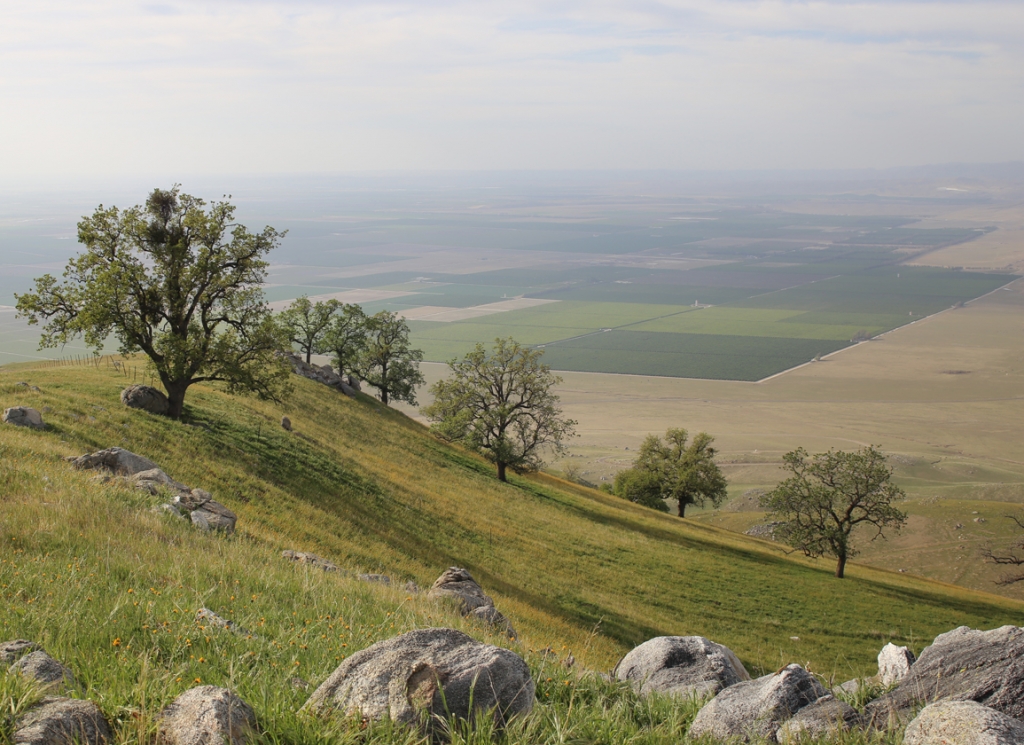
Typical Tehachapi terrain opening into flat valley land | Jill Williams

Swaps was born somewhere on the property Mar. 1, 1952–reports range from in a stall under Ellsworth's watchful eye to outside in a puddle away from any human intervention. The year he was born, the earth shook. Swaps was a mere four months old when a devastating earthquake measuring somewhere between 7.3 and 7.7 on the Richter Scale flattened much of the tiny town and killed 12. The population at the time was fewer than 2,000.

Ellsworth eventually sent Swaps south to be broken and to race, but he continued to raise Thoroughbreds in Tehachapi. Swaps, of course, was the second of an eventual four California-breds to win the Kentucky Derby and had a storied career that included six world records.

The fellow Hall of Famer Nashua will always be inextricably linked with Swaps, but they actually only met twice and it was a draw. Swaps beat Nashua in the Kentucky Derby. Nashua beat Swaps nearly four months later in a match race at Chicago's Arlington Park. They never met again on the racetrack, but the two would eventually stand side by side at Spendthrift Farm.

Swaps ended his career abruptly in October, 1956, when he seriously fractured a rear leg. Fitzsimmons, Nashua's trainer, sent Tenney a special sling used to raise and lower the horse. The sling was credited with helping to save his life.

A deal was struck with John Galbreath of Darby Dan Farm in Lexington for half of Swaps, with the original agreement calling for Swaps to ship back and forth between California and Kentucky each year. Swaps did stand his first season at Ellsworth's farm in Chino, but Galbreath reportedly visited and was taken aback by the functional yet Spartan and decidedly non-Kentucky-like facilities. The next year, Ellsworth sold the other half of Swaps outright to Galbreath. The horse transferred to Darby Dan and never saw California again.

Ellsworth was derided publicly for selling his stable star. His response would not have won him any sympathy in today's world of social media: “I was criticized by some people for selling Swaps out of the state and all that. They said it was lack of affection for a horse that had won me all that money. They just don't know. I sold Swaps for $2 million to Mr. Galbreath because it was a case of necessity for me. I couldn't afford to keep him. But fondness is not the right word anyway. I had no more fondness for Swaps over the rest of my horses than I have fondness for one of my five children over the other four.”

Swaps at Spendthrift in his later years | Getty Images

Swaps would sire three U.S. champions, all in his initial crops: Chateaugay, who emulated his sire with a Kentucky Derby win and only missed the Triple Crown by a second in the Preakness to Ellsworth and Tenney's Candy Spots; the grand filly Affectionately, whose 18 stakes wins included the Spinaway at two and the Vosburgh against males at four; and Chateaugay's full-sister Primonetta, who was the first foal by Swaps to be born and whose nine black-type wins included such luminous races as the Alabama and Spinster.

Unfortunately, Swaps didn't exactly set the world on fire with his sire sons, but he has made a lasting impact with his daughters. Primonetta was named Broodmare of the Year in 1978, but that was only the beginning. A number of blue hens–including Fall Aspen, Toussaud, Numbered Account, Glorious Song, and Take Charge Lady–have Swaps on their dam side. Through their sons and daughters, Swaps will live on in pedigrees for a very long time. Swaps moved to Spendthrift for the last five years of his career and died in 1972 at age 20.

As for Tehachapi, in late 1969, Ellsworth sold his ranch to Benquet California Corporation for a planned subdivision. A residential community was developed with a golf course and named Stallion Springs. Few concrete reminders remain of Swaps or Ellsworth in Tehachapi, but Stallion Springs is littered with streets named with racing in mind. Names like Tanforan Drive, Tim Tam Place, Man o' War Drive, Bimelech Court, Hialeah Drive, Busher Way, Kelso Court, and more remain. It's a safe bet that most of the people living on Bowie Street don't know Bowie was once a racetrack, nor that those on Shut Out Place know that Shut Out won the 1942 Derby and Belmont Stakes, and still fewer on Stymie Court know that great horse's Hall of Fame credentials. Those of us who do smile when we drive by and let our hearts be warmed by memories of the greats while so far removed from the heart of the Thoroughbred industry.

“Some of Ellsworth's ranch buildings lasted for many years after he was no longer active in the area,” said Hammond. “Some of these were on property later owned for many years by actor Jack Palance. As large agricultural operations of row crops–almost entirely organic greens, carrots, cabbages, etc.–became active in [the valley] in the 2000s, I believe that the last of those buildings were removed.”

Ellsworth himself, of course, had a famously ruinous end to his 40-plus years in racing. In 1975, Ellsworth's Chino ranch was seized by the state of California when over 100 horses were found neglected and severely malnourished on the property. Among the perished was Iron Reward, the 29-year-old dam of Swaps who had been named Broodmare of the Year in 1955.

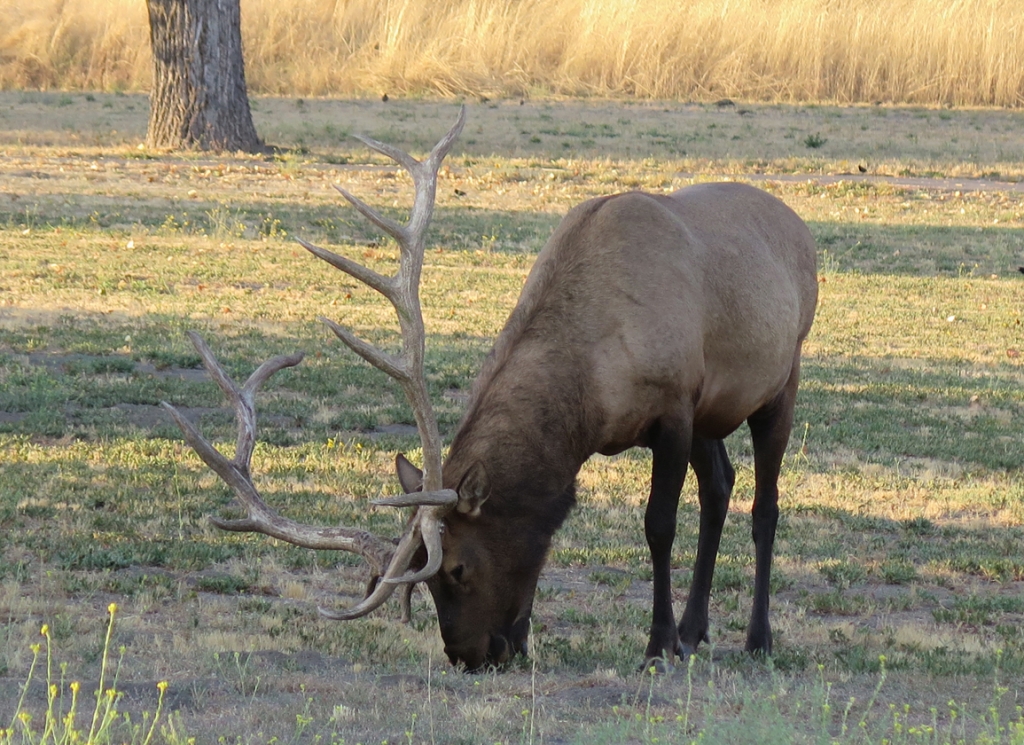
A descendant of one of Ellsworth's elk | Jill Williams

The Ellsworth name didn't leave a lasting impression in Tehachapi, other than a footnote in history. However, Ellsworth did change the landscape in one crucial way. In the mid-60s, in one of his many ventures, he brought around 400 Rocky Mountain Elk from the Yellowstone area to his ranch, reportedly with the intent of increasing the herd and eventually charging visitors to hunt them.

From the start, the elk project didn't go well. A number died during shipping and the animals originally failed to thrive in their new home. Ellsworth had them housed in a 640-acre enclosure, but the numbers had dwindled to approximately 200 in 1967 when a storm blew down a massive oak tree and damaged the tall fence surrounding them. The majority escaped and today, nearly 55 years later, large bands of elk roam all over Tehachapi mountains. The cows and calves tend to stick together at higher elevations, but bachelor herds are a frequent sight all over the local valleys. They loll in the local ponds during summers. Gardens, lawns, and lawn decorations are no match for their appetites or brute strength, but they remain a magnificent sight in front yards and in open spaces. More than one resident in the area has had been tardy to an appointment as elk are in no hurry when crossing local roads.

Swaps himself? There is no marker in Tehachapi commemorating the great champion. There is no record of exactly where he was born or in exactly which fields he spent his early years before leaving his hometown for a Hall of Fame career. His name is instead relegated to a small street, just off Seabiscuit Way and just over a mile removed from Nashua Court. For the record, the stretch of Swaps Court exceeds Nashua Court by several lengths.

The post Chasing Ghosts: Swaps appeared first on TDN | Thoroughbred Daily News | Horse Racing News, Results and Video | Thoroughbred Breeding and Auctions.

Source of original post

Verified by MonsterInsights
