Half To Mozu Ascot Debuts at Tokyo

In this continuing series, we take a look ahead at US-bred and/or conceived runners entered for the upcoming weekend at the tracks on the Japan Racing Association circuit, with a focus on pedigree and/or performance in the sales ring. Here are the horses of interest for this weekend running at Chukyo and Tokyo Racecourses. Sunday's headliner at headquarters is the G3 Negishi S. over 1400 meters, the local lead-up into the G1 February S. going a mile on Feb. 19. The talented Lemon Pop (Lemon Drop Kid) leads a four-pronged US-bred assault on the Negishi S.:

Saturday, January 8, 2023
4th-CKO, ¥11,850,000, Newcomers, 3yo, 1400m
MOZU AKABOSU (c, 3, Quality Road–India, by Hennessy) is the latest to the races out of his dual graded-stakes winning dam, whose son Mozu Ascot (Frankel {GB}) was a dual-surface Group 1 winner in Japan, having taken out the Yasuda Kinen at a mile on turf and the February S. on the dirt (see below). The Feb. 18 foal is also kin to SW 'TDN Rising Star' Kareena (Medaglia d'Oro), dam of recent Cash Run S. runner-up Padma (Tapit). India's stakes-winning half-sister Pilfer (Deputy Minister) is an outstanding producer in her own right, having accounted for MGISW To Honor and Serve (Bernardini); the latter's Grade I-winning full-sister Angela Renee; and SW & GISP Elnaawi (Street Sense). Also engaged are Lambent Light (Hard Spun), produced by a Keeneland-sourced half-sister to Japanese dirt demon Espoir City (Jpn) (Gold Allure {Jpn}); and Hosho Rusty (Goldencents); a half-sister to SW and recent Keeneland November HORA grad Liam's Dove (Liam's Map). B-Summer Wind Equine LLC (KY)


4th-TOK, ¥11,850,000, Allowance, 3yo, 1600m
PARAIBA TOURMALINE (f, 3, Malibu Moon–Private Jet, by Smart Strike) was pounded down to 4-5 favoritism for her Oct. 30 debut over this course and distance and made no mistakes, kicking home a five-length winner (see below, SC 5). The Mar. 1 foal is out of a full-sister to two-time Eclipse Award and five-time Grade I winner Lookin At Lucky and a half to MGSW Kensei (Mr. Greeley) and multi-jurisdiction GSW 'TDN Rising Star' Shahama (Munnings). Bought back on a bid of $70,000 out of the 2021 Keeneland September sale, Paraiba Tourmaline was hammered down to Katsumi Yoshida for $450,000 at last year's OBS March Sale. B-Stonestreet Thoroughbred Holdings (KY)


6th-CKO, ¥14,880,000, Allowance, 3yo, 1400m
CELADONITE (JPN) (f, 3, Mendelssohn–Celadon, by Gold Halo {Jpn}) makes her second career to the races after opening her account with a smart 1 1/4-length graduation over this track and trip Sept. 24 (video, SC 10). The April-foaled bay, who carries the Silk Racing colors, is the second Japanese winner for her well-traveled dam, who is also responsible for the outstanding sprinter Copano Kicking (Spring At Last), a three-time winner at group level in Japan–including the 2019 Negishi S.–and a dramatic winner of the Riyadh Dirt Sprint on Saudi Cup night in 2021. B-Northern Racing


Sunday, January 29, 2023
6th-TOK, ¥11,500,000, Newcomers, 3yo, 1800mT
GUN WOLF (c, 3, Gun Runner–Loure, by A.P. Indy) is a half-brother to SW Do The Dance (Discreet Cat) and to Randonnee (Blame), a 3-year-old listed winner at this venue back in 2018, placed three times at group level and beaten just 3 1/2 lengths behind the legendary Almond Eye (Jpn) in the G1 Shuka Sho. A maternal grandson of French Group 3 winner Loving Pride (Quiet American), Gun Wolf hails from the extended family of Sovereign Award winner Negligee (Northern Afleet). Gun Runner is the sire of four winners from his six Japanese starters to date. B-Winchester Farm (KY)

The post Half To Mozu Ascot Debuts at Tokyo appeared first on TDN | Thoroughbred Daily News | Horse Racing News, Results and Video | Thoroughbred Breeding and Auctions.

Source of original post

KTFMC Meeting: Equine Veterinary Changes, Implications for Farm Managers

by Sara Gordon and Katie Petrunyak

LEXINGTON, KY-The Kentucky Thoroughbred Farm Managers Club (KTFMC) held its first meeting of the year on Tuesday at Keeneland. The event was conducted jointly with the Kentucky Association of Equine Practitioners (KAEP) and the over 200 in attendance represented both organizations. Members of the Godolphin Flying Start and Kentucky Equine Management Internship programs were also on hand.

Recent changes and trends in the equine veterinary field were a focal point of the evening, along with topics including equine litigation and liability, navigating equine veterinary practice changes and the equine veterinarian shortage.

KTFMC President Gerry Duffy said their board brought up the issue of the equine veterinary shortage as a potential topic for their monthly meeting and from there, they partnered with the KAEP knowing that the subject would be relevant to both organizations.

“We know that the vet-farm manager relationship is so important and we have been hearing statistics about how they're struggling to get equine practitioners and of the ones they get, there's a high degree of partition,” Duffy explained. “We thought it would be a good topic to discuss at the meeting and when we got talking to the KAEP, they were having a meeting focused on equine veterinary litigation and liability so we thought, why not bring the two together?”

A 'Q and A' session on the Horseracing Integrity and Safety Act (HISA) was also conducted with HISA's Director of Equine Safety and Welfare Dr. Jennifer Durenberger and HISA Representative Marc Guilfoil, bringing forth a host of questions on the new responsibilities that those overseeing horses outside of the racetrack would take on if and when HISA comes into authority.

Evolving Landscape of Equine Insurance Coverage

Equine attorney Mike Casey of Casey Bailey & Maines, PLLC, based in Lexington, was the first speaker to the podium, leading a discussion on the evolving landscape of equine insurance coverage and the particulars of filing a claim under those policies.

Casey emphasized the importance of the relationship between vets and farm managers, particularly when it comes to how the vets document interactions with their patients and handle subsequent care when called out to the farms. This is all information that is not only necessary for those directly connected to the horse, but also required when it comes to instances of filing a claim, such as equine mortality, with an insurance agency.

Common issues that arise involve how often the vet visits the patient, varying whether the visits are routine or for a specific health issue, which correlates with the problematic pressure to prescribe medication without examining the patient first.

“It is critically important to make sure when you're administering medications that you have that temporal visit with the horse,” said Casey.

He also touched on the growing issue of using medication on a horse that it was not originally prescribed to.

“I probably see that more today, in the last two or three years, than the last 10 years before.”

All of these issues were weighed against what the insurance company would be looking for when handling a claim, which always leads back to the importance of maintaining precise, updated documentation. Medical records must include enough detail that anyone checking on the horse should be able to know exactly what their health status is, what treatments they have received in the past and how things should be handled for that particular patient going forward.

“Farm managers need to call the vet and make sure they see the horse the next day. It'll hopefully avoid a catastrophic outcome and it is in compliance with regulations that we know will have heightened scrutiny as we go to HISA, or as KAEP redrafts regulations,” said Casey.

When dealing with mortality insurance claims, farm managers should take the time to read through the entire policy in order to understand what is expected of them when dealing with the insurance company. In that same vein, all communication with the designated representative of the insurance company should also be documented, to avoid any issues when filing a claim down the road.

Casey explained why understanding any negating factors, such as instances of failure to provide improper care, is crucial. His example touched on use of a medication on a horse that it was not prescribed to, which could fall under the realm of an “intentional act” of improper care. In most cases, “proper care” is defined after the fact.

“We want to be able to connect the prescription to the horse, to the vet's visit, to prevent application of the unauthorized medication claim,” he said.

Communication and proper documentation are the key points when it comes to vets and farm managers abiding by regulations, maintaining the proper care for the horses in their charge, and ensuring that in the case of any insurance claims filed, everything is presented properly to guarantee a seamless process.

According to Casey, there is no such thing as too much communication, using the example of emailing the insurance agency a summary of the vet's visit for annual vaccinations to prove his point. Farm managers must also understand that a vet isn't going to report directly to the insurance agency in the case of a claim, so they must maintain their own day-to-day records as well.

“We've got to establish a dialogue for this industry, [when it comes to] what is reasonable, proper and the routine method of doing business. It is important that insurers play a role in this,” said Casey. “It's too easy to use the sins of others in the industry to say, 'That's why we have a heightened medication claim.'”

As he concluded his presentation, Casey reiterated the importance of ensuring all treatment decisions and medications are being administered based on the physical examination of that horse.
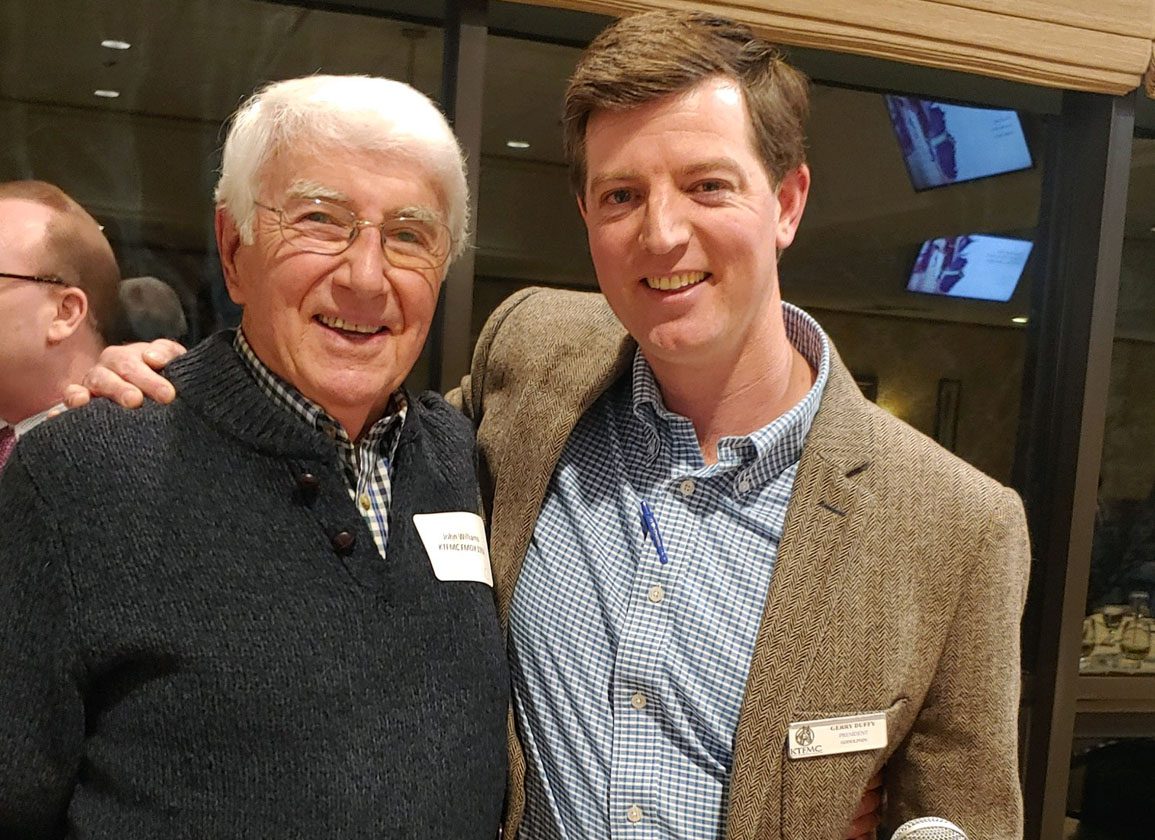
 

KTFMC President Gerry Duffy with former president John Williams | KTFMC

Equine Practitioners Discuss Vet Shortage

While most meeting attendees were aware of the equine veterinary shortage, the statistics shared by Hagyard's Dr. Luke Fallon were staggering.

Fallon said that according to a recent survey conducted by the American Association of Equine Practitioners, by 2030, equine medicine will need over 5,000 veterinarians to meet the growth in demand. Currently there are approximately 3,650 practicing equine veterinarians in America.

Additionally, of the 3,300 veterinary graduates each year from U.S. schools, only 1.3% will enter the equine profession directly. While 4.5% will enter an internship program, 50% will leave the equine profession within five years.

“If you do the math, the shortage of equine veterinarians is already here,” Fallon said. “Why are equine vets leaving the profession? Burnout is one of the key factors. It is a demanding job with long hours and low starting salaries compared to small animal jobs, which often include a signing bonus as high as $200,000 for new graduates.”

Fallon explained that many young students enter veterinary school with the dream of becoming an equine practitioner, but turn to small animal medicine because it is a more logical step financially. He said that equine veterinarians usually start at between a third and half of the initial salary of a small animal veterinarian.

Fellow Hagyard veterinarian Rhonda Rathgeber joined the conversation to discuss a few of the new initiatives Hagyard is working on to encourage veterinary students to consider a career in the equine industry.

Hagyard has enhanced their recruitment efforts by hosting student weekends to show how their facility operates and share details about their externship program. Although the initiative has been hurt in recent years due to the pandemic, it has led to increased numbers in their externship program.

“We are up to 150 externs this season, so if your veterinarian has an extern or a student with them, please be patient,” Rathgeber advised. “We've done a lot of work to get them to come and see what it's really like.”

Hagyard has also increased their outreach through college visits. Last year, they visited a third of the veterinary colleges in the country. Additional recruitment efforts include a podcast, their participation in the annual Opportunities in Equine Practice Seminar hosted by Rood & Riddle Equine Hospital and also hosting their own undergraduate seminars for pre-vet students.

Jim Heird, PhD, rounded out the session to discuss one promising step toward overcoming the shortage. Heird is a member of the advisory council for Lincoln Memorial University's Equine Veterinary Education Program (EVEP), which provides an accelerated, six-and-a-half year path to a Doctor of Veterinary Medicine degree. Students go through the undergraduate program at LMU and as long as they maintain a 3.35 GPA, they are automatically accepted into the school's veterinary program.

The EVEP places an emphasis on their students developing hands-on horsemanship skills. Students will work on-farm summer internships during their undergraduate years and then will intern at clinics during their summers in the veterinary program.

Heird said that LMU produces more equine veterinarians than any other school in the country.

“When I think about my career, I don't know of anything that I've done that has as much impact on the future of this industry than this program could have,” he said. “That's why I'm so passionate about it.”


HISA's Director of Equine Safety and Welfare Dr. Jennifer Durenberger and HISA Representative Marc Guilfoil

Concerns for Consignors and Managers Brought to Light During HISA Q and A

The evening concluded with a focus on HISA, where attendees were given the opportunity to ask Durenberger and Guilfoil questions. Pertinent to those in attendance, many questions focused on the regulations for those dealing with horses covered under HISA, outside of the track, such as consignors at the sales or farm managers handling lay-ups at the farm.

Though HISA has already released handbooks for racetracks, racetrack maintenance, regulatory veterinarians, attending veterinarians and trainers, Durenberger did say that handbooks for groups such as farm managers, consignors and off-track vets were in the works.

In the meantime, she emphasized that it would be the responsible party's job to update any records related to a “covered horse” in the HISA online portal, as those records would not be required until the horse returned to the racetrack. In those cases, the responsible party would more than likely be the trainer.

Further concern was expressed for clarifying who the responsible party would be, depending on different situations when the horse is not at the track, and specifying the time requirements for submitting any updates to a horse's medical record. Durenberger assured those asking these questions that further details would be provided, in hopes of clearing up any misunderstanding.


For almost 100 years, the KTFMC has helped build community and camaraderie among farm managers while also working to find solutions for challenges that these managers face. Their current officers are President Gerry Duffy (Godolphin), Vice President Adrian Wallace (Coolmore), Treasurer Charles Hynes (Coolmore), Secretary Molly Harris (Shawhan Place) and Sergeant-At-Arms B.G. “Scooter” Hughes (Hughes Racing Stable). The club boasts over 500 members and hosts a number of annual charitable fundraisers including a golf scramble, a trail ride, a 5k run, and more. For more information on the KTFMC or to apply for membership, visit www.ktfmc.org or email info@ktfmc.org

The post KTFMC Meeting: Equine Veterinary Changes, Implications for Farm Managers appeared first on TDN | Thoroughbred Daily News | Horse Racing News, Results and Video | Thoroughbred Breeding and Auctions.

Source of original post

Eclipse Award Ceremony to be Broadcast Live on FanDuel TV and RTN

The 52nd annual Eclipse Awards will air live on FanDuel TV and Racetrack Television Network (RTN) Thursday from The Breakers Palm Beach in Florida. The Keeneland red-carpet show will begin at 6:30 p.m. ET, with the ceremony following at 7:30 p.m. ET. The evening will culminate with the announcement of the 2022 Horse of the Year.

The ceremony will also be streamed live on multiple outlets including: NTRA.com, americasbestracing.net, bloodhorse.com, equibase.com, and NTRA's Youtube channel.

The post Eclipse Award Ceremony to be Broadcast Live on FanDuel TV and RTN appeared first on TDN | Thoroughbred Daily News | Horse Racing News, Results and Video | Thoroughbred Breeding and Auctions.

Source of original post

The Week In Review: For Syndicate Partners, What’s In A Name (Or Ten)?

Right now within TDN's Top 12 rankings for the GI Kentucky Derby, seven horses are owned by multiple-entity partnerships. One syndicate maxes out at 10 individual owners, another at eight.

If the horses from those larger partnerships (or other syndicates-there are plenty of them and they are growing in number worldwide) make it into the Derby field, they won't have to worry about getting the satisfaction and distinction of seeing their names in print as owners. But that's only because as a courtesy, Churchill Downs takes the extra step of hiring a graphic designer to rework the traditional program page for America's most historic and important horse race so that no owner of a Derby runner gets left out.

Technically, that practice is at odds with a Kentucky regulation that limits the number of individual owners who can appear on the printed program page to five. At a meeting last week of the rules committee of the Kentucky Horse Racing Commission (KHRC), commission staffers and industry stakeholders tried to take a first pass at updating that rule so that every member of a syndicate (or at least more of them) might get recognized as listed owners in all Kentucky races, not just on Derby day.

“I've been approached by several ownership groups that we make room for more names,” said KHRC commissioner Charlie O'Connor. “As syndicate groups in this country are becoming a big deal, [people] who invest their money in the horse business want to see their name on a program.

“These ownership groups and syndicates are spending a large amount of money in Keeneland and Fasig-Tipton and all the sales houses around the world, and I think it's a fair thing for them to ask for their name to be on the program, and I think that we should be able to accommodate it without any huge, big issues,” O'Connor said.

Others in on the discussion thought so too. But it turns out there are practicality limitations and potential unintended consequences that come into play if the KHRC paves the way for more individuals to get inked into ownership lines.

As for the existing rule itself, KHRC chief state steward Barbara Borden explained it this way: “Currently, our regulation says more than five individual persons shall not be licensed as owners of a single horse. That's why we have limited the number on the program to five. It goes on to say if more than five individual persons own interests, then they shall name one person to be the licensed representative.”


Signator | Chelsea Durand

Still, even within that parameter of five, the ownership line on a Kentucky program does get crowded. Several stakeholders at the meeting referenced the trouble being related to a 200-character limit that is a requirement of the Equibase system. The number for that data field was selected some time ago, well before the proliferation of partnerships in roughly the past decade, and it was once reasonable to assume every ownership entity would fit within that amount of space.

But that equates to just 40 characters per syndicate member if five owners are listed, and even then, to make everything fit, the characters are often squished together without spacing to the point where, as Borden said, the line is “illegible” to anyone trying to decipher the program.

“Part of the problem is two things,” Borden said. “First of all, the owners that want to see their names, they might know their name is on the program. But you can't read it, and neither can anyone else. And the other thing is, the reason we put the ownership on the program to begin with, is for public disclosure. So if it's not legible because we have too many names or the font is too small or whatever, we're defeating our purpose of listing the owners at all.”

Frank Jones, Jr., a KHRC commissioner who chairs the rules committee, wondered if it would be feasible to include a “side document” in the program that would fit all the names in full, while the program page itself got printed in a less cluttered way.

Anna Seitz, who works with Fasig-Tipton and with international syndicates, said that in Australia, “they list all the names. They just do smaller fonts. I know it makes a huge difference. Those owners, that's part of the reason they buy in, because they want their name on there.”

Gary Palmisano, Jr., the executive director of racing for Churchill Downs, Inc., said his company is “all for” syndicates. “But just understand that it is space-limited” and the issue is a “bigger-picture problem” than just learning to deal with the limitations of 200 characters.

“We live this every year with the Derby,” Palmisano said. “Obviously, in the Derby, every owner partnership wants to see their names. Equibase currently doesn't have the capability of putting in more than 200 characters. So we have to physically, manually, white-out portions of the owner [line, and then string together] the text, and try to put it in [with everyone listed].”

But if the rule got changed to list more owners, Palmisano cautioned, “tracks every single day are going to have to have a graphics design person, as we do for the Derby, [to] recreate the program line. [That task] is certainly something that takes our team, manually, a lot of time to do for the Derby program.”

Palmisano continued: “Right now [the rule] says five [owners are the maximum listed]. With the racetracks, assuming Equibase can help us with the language, we can figure out the program piece. We're already actively engaging with Equibase to try to figure out the program piece. But I think the [rules] committee, more so than looking at the program piece, should take a hard look if it should be five, eight, seven, ten [owners listed]. Because that helps us frame what we need to do with Equibase.”

O'Connor said 10 names might be the sweet spot, because he's seeing many partnerships now constructed at the 10% buy-in level aiming for 10 syndicate members.

Borden said that brings up another issue related to disclosure.

“This takes us back two years ago when we had partnership forms, which we no longer require,” Borden said. “Every syndicate would have to report to us all the participants in the syndicate.”

While the partnership forms might raise the unwelcome prospect of more paperwork for everyone involved, Borden said there is an upside to those forms that relates to better transparency.

“We currently don't always know the exact ownership of every horse, so that would probably be a bonus for us,” Borden said. “But it would entail us being advised of all the ownership and the [percentages each entity owns].”

But, Borden said, no matter what expanded number the rule night eventually state, common sense inevitably has to intervene.


Gulfport | Coady Photography

“At some point there has to be, in my opinion, a limit,” Borden said. “It's not infinity. If 100 people own a horse, we can't put 100 names on there.”

Keeneland's vice president of racing, Gatewood Bell, raised another potential red flag related to numerous owners being listed: Although Kentucky has recently loosened its rules regarding coupled mutuel entries in an attempt to bolster field sizes, a single owner still can't run two horses in the same race if it excludes another owner's horse from getting in. So what if one individual was a small-percentage owner in one syndicate and owned another horse either outright or as part of a second partnership? How would preference be fairly determined?

“You wouldn't want to discourage the owners from joining these syndicates and also having horses on their own,” Bell said.

Borden pointed out that any overlapping ownership in a single race, even a tiny percentage, still counts as an owner having an interest in two horses.

The committee ended up not proposing or voting on any rule change. Jones, the committee chair, said the entire issue needed more study, but that it would likely be brought up again in the near future.

“The more you listen, the more you see how complicated a problem this could become,” Jones admitted.

The post The Week In Review: For Syndicate Partners, What’s In A Name (Or Ten)? appeared first on TDN | Thoroughbred Daily News | Horse Racing News, Results and Video | Thoroughbred Breeding and Auctions.

Source of original post

Verified by MonsterInsights