Letter to the Editor: Armen Antonian

The “Quick Fix” of Synthetics is Not the Answer

Horse racing has been down the path of synthetics before at Santa Anita, Del Mar, Keeneland, etc. Much time was lost, approximately a decade ago, with a focus on changing surfaces as a panacea for horse racing breakdowns. We now know there are other causes for horse breakdowns that are more prevailing. The greatest single cause of racing deaths has to do with pre-existing conditions of the horse, and only in particular instances is the surface itself the primary reason for horses breaking down while racing. Synthetics have found a role to play in the Industry but racing on synthetics exclusively means to change the sport itself in a fundamental way: from breeding, to handicapping, to the aesthetic beauty of competition–the reasons we are all fans of horse racing. And, changing to synthetics will not appease the critics if that is the motivation to do so.

But statistics show that horse racing deaths are less on synthetics than either dirt or turf. Surely safety must be the main focus with racing today. Yes, safety must be a central focus but there has to be some perspective. Horses also die in nature. The thoroughbred industry cannot be expected to prevent ALL deaths of horses and a comparison must be made as to how often and how horses die in nature to reach a fair, concise view of horse racing. Such a comparison, of course, is extremely conjectural. There are no thoroughbreds in nature and not many other horse breeds in nature today at all. Experts from many areas would have to weigh in on such a comparison.

In other words, the approach to the issue of horse racing deaths in general, that is, how the question is posed, is false. So too is the case for synthetics falsely stated. Are we to believe that horses somehow have more trouble competing on dirt and turf than fabricated material? Biology and evolution would initially say otherwise. Similarly, are we to suppose that the breeding of thoroughbred horses is inherently producing unsound animals? Again, general evolutionary changes of such a magnitude would take time. To make such an argument, geneticists would have to be consulted to ascertain that thoroughbred breeding practices are actually producing inherently unsound horses. But first things first. Looking mainly into the track surface and or scrutinizing breeding operations are not the places to begin when investigating horse racing breakdowns.

Back to the statistics. Statistics don't lie. More horses break down on dirt or turf than synthetics per Jockey Club figures. But statistics don't always give answers either. Indeed, the overall sample size in the Jockey Club figures in the aggregate is large but the fact that the number of dirt races were about 7 times more than synthetic races is a cause for pause in a comparison.  Sample sizes are usually uniform in the scientific method. And when looking at individual tracks per year, the sample size is quite small when considering dirt races only. A track can thus vary markedly from year to year in horse fatalities as the Jockey Club statistics indicate.

And the sample has to be RANDOM.  Horses that are selected to compete on synthetics are not randomly chosen. That is, the two populations: horses that run on dirt and horses that run on synthetic are not uniform. So the synthetic numbers for horse fatalities that are generally lower than for dirt fatalities may or may not be because of the surface. The fact that both are samples of thoroughbreds is not rigorous enough to make a valid comparison. The sample population has to be random. A random sample also compensates for genetic variation in a species. The best argument for synthetics in terms of the data comes from Gulfstream Park in 2022. At Gulfstream, there were about 7000 starts on synthetic with one fatality whereas there were about 6000 starts with 8 fatalities on dirt. At least the number of starts were comparable at the same track for each surface but again, horses were selected by trainers for various reasons to race on synthetic rather than dirt. Better comparison of the two surfaces–but still not a random sample of the horse population at Gulfstream and one year is not nearly enough to draw any serious conclusions.
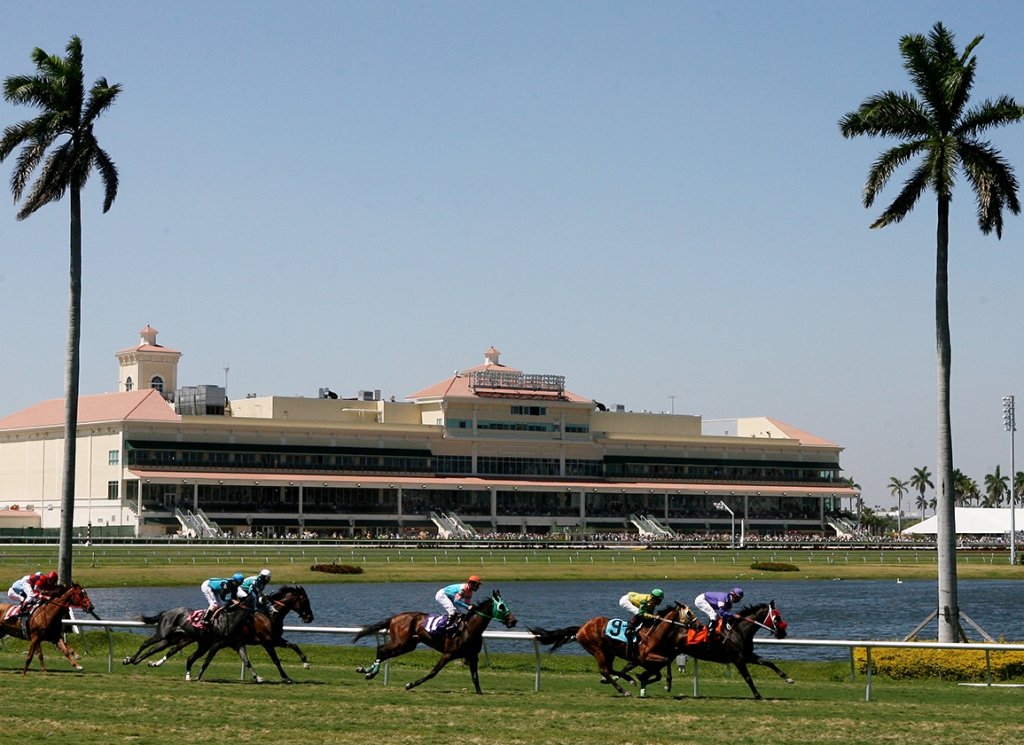
Action at Gulfstream Park in Hallandale Beach, Florida | Bill Denver/EQUI-PHOTO

Any glance at aggregate statistics for analysis would have to consider figures after 2019 after the implementation of new safety protocol stemming from the racing deaths at Santa Anita that year. But even here, with a seemingly logical approach to the data on racing breakdowns, a comparison is problematic. There are inexplicably low dirt rates of fatalities (say below 1 per 1000) before 2019 with dirt racing at various tracks that, in other years, had higher rates of about 2 per 1000. Such variability calls into question any definitive conclusion about track by track breakdowns relating to surface only.

What we do know is that Del Mar, Santa Anita and Keeneland have had remarkably low rates of fatality on dirt the last 2-3 years. For example, Keeneland had 3 deaths from 2020 to 2022 in almost 5000 starts or about 0.6 per 1000. Del Mar had none from 2021 to 2022 with almost 4000 starts. Such figures compare favorably with the lowest synthetic figures. Given these Keeneland and Del Mar figures it is a stretch to say that dirt racing is inherently or significantly more dangerous than synthetic racing. The question does remain: are these rates extendable over time? If the safety reforms in horse racing continue and are enhanced, the chances are they can be.

What we can say with some assurance is that all horse racing death rates are going down from year to year. The average rate of horse death for 2022, in an industry where safety reforms have not been sufficiently generalized, was 1.25 deaths per thousand. Still, it is too early to draw conclusions about horse racing deaths (especially in the wake of the recent spate of breakdowns at Churchill) until the new protocol is agreed to and generalized throughout the industry and a number of years with such protocol in place has passed. The hard work of putting in the safety measures is just beginning.

Horses run slower on synthetics than dirt. Is running fast then a problem? There are many misconceptions here. The issue is not speed but how often a horse is asked to race at high speed. Here the veterinarians can chime in to assist trainers with their training and racing schedules. A dialogue should ensue on best practices. A horse can race more often if it is running easily. A horse in a grade I race cannot race as often as winning at that level usually requires maximum effort. So comparisons by racing fans of one horse's schedule to another are not valid. Each horse is different both in terms of circumstance and genetic variation and trainers must be more in tune with their vets moving forward not just on a horse's ailments and therapeutic medication but on their racing schedule itself.

–Armen Antonian Ph.D

The post Letter to the Editor: Armen Antonian appeared first on TDN | Thoroughbred Daily News | Horse Racing News, Results and Video | Thoroughbred Breeding and Auctions.

Source of original post

Keeneland Library Director Ryder Retiring, Ferraro Named Successor

Keeneland Library Director Becky Ryder will retire as of Oct. 31, 2023, following better than a decade at the helm of the Thoroughbred information repository and public research facility, and Roda Ferraro, who formerly served as Head Librarian at Keeneland Library and recently curated its popular The Heart of the Turf: Racing's Black Pioneers exhibit, has been named her successor. Ferraro will serve as the incoming Library Director effective immediately and will work alongside Ryder as she transitions to retirement this fall.

Ryder began her career as a college student working in the Music Library at the University of Virginia. She moved to Lexington for Library School at the University of Kentucky and soon became Head of Preservation Services at the UK Libraries, where she served for 18 years before joining Keeneland. Among the highlights of her tenure as Keeneland Library Director, Ryder oversaw the conversion of a manual card catalog into an online catalog system, which offered the opportunity to implement the Library of Congress shelving system. She initiated the Daily Racing Form Preservation Project while at the University of Kentucky, and with help from interns from UK's School of Information, Keeneland Library continued to make progress toward moving its extensive DRF collection online. Ryder established a framework for Keeneland's Digital Library and hopes to launch the collections by fall of 2023.

“During my career, I've had the good fortune to have had positions that I truly loved: music, books, photographs, travel, book and paper conservation, digital library development and the rich history of Thoroughbred racing,” said Ryder. “I have to say that the 13 years working with the Keeneland family have been the very best in my professional lifetime.”

In her new role, Ferraro brings more than 20 years of experience leading, assessing and promoting library, museum, research and educational services, highlighted by her work with Keeneland Library and the National Museum of Racing and Hall of Fame in Saratoga Springs, New York, since 2014.

“I am grateful to be back home at Keeneland Library,” Ferraro said. “I have connected the public, students and faculty to research and education services at several libraries, museums and universities, but I have never worked with patrons as dedicated and passionate as those I am privileged to engage with every day at Keeneland Library. It has been a joy to build relationships with industry and community partners over the past 10 years, and I look forward to cultivating new collaborative efforts with industry stakeholders as we move the Library forward.”

Said Keeneland President and CEO Shannon Arvin: “Keeneland Library's role in preserving Thoroughbred racing's storied history and making it accessible to fans worldwide is incredibly important to Keeneland. Becky and Roda have both been dedicated stewards of this legacy, using technology, innovation and creativity to advance the Library's goal of being a true public service institution. We thank Becky for expertly guiding the Library through a decade of key expansion and preservation efforts and look forward to continued growth, particularly in education and outreach, under Roda's oversight.”

The post Keeneland Library Director Ryder Retiring, Ferraro Named Successor appeared first on TDN | Thoroughbred Daily News | Horse Racing News, Results and Video | Thoroughbred Breeding and Auctions.

Source of original post

The X-Ray Files: Tom McCrocklin

The TDN sat down with 2-year-old consignor Tom McCrocklin for this first offering in a new series presented in cooperation with the Consignors and Breeders Association (CBA). Through conversations with buyers and sellers, the series looks to contribute to the discussion on radiograph findings and their impact on racetrack success.

Tom McCrocklin, who was represented this spring by graduates in both the GI Kentucky Derby and the GI Kentucky Oaks, as well as by a pair of million-dollar juveniles in the sales ring, admitted his approach to vet work varies greatly whether he is shopping for a racehorse prospect or for a potential pinhook prospect.

“It's a very clear distinction when I buy a racehorse for myself or I buy a prospective pinhook horse,” the Ocala horseman said. “With the racehorses, I have a pretty good feel of what I can and cannot live with anymore. I feel like I've got my brain wrapped around what young horses can live with and move on with and be racehorses. And then I have the other category of pinhook horses where I know I will have to make buyers and buyers' vets on the other end happy. Then it doesn't matter what I think and what I feel like I know. It matters what they think and what they want.”

McCrocklin said veterinarian scrutiny of the horses in his 2-year-old consignments has only become more stringent in recent years.

“The diagnostics done on the sales grounds pre-purchase are off the charts,” he said. “I will give you a perfect example. The genie is out of the bottle now with ultra-sounding and ultra-sounding so many structures. These vets are all on a kick now where they want to ultrasound eight suspensory branches and four tendons and four proximal suspensories, which is a lot of soft tissue structure. The long and the short of it is this, in this age group, 2-year-olds in training, under pressure, breezing, very few are going to have pristine ultrasounds. They are almost all going to have some commentary; all ranges of everything from swelling to fiber disruption to actual tears. And they are learning as they go–just like me as a consignor–that we are going to get to where we can't sell many horses if the vets are going to expect perfection.”

McCrocklin purchased Kingsbarns (Uncle Mo) for $250,000 at the 2021 Fasig-Tipton Saratoga sale and sold the future GII Louisiana Derby winner and Kentucky Derby runner for $800,000 at the 2022 Fasig-Tipton Gulfstream sale. And he is co-owner of GIII Gazelle S. winner and Kentucky Oaks runner Promiseher America (American Pharoah). He said the proof of the vet report lies in the performance of horses like those on the racetrack.

“I compare the ultrasounds to their race records,” McCrocklin said. “I personally had a filly in the Oaks this year and I personally sold a horse that ran in the Derby this year and they both had soft tissue pathology at the 2-year-olds in training sale. They were both given 30-60 days after the sale and they both wound up being fine. A lot of very good, sound racehorses have significant radiographic and ultrasound pathology. They have it at the 2-year-old sale and they have it throughout their racing careers and a lot of them are very sound horses.”

He continued, “I had this conversation with Bob Baffert. 'I tell you what, you pick the 10 soundest horses in your barn–not the 10 best, but the 10 horses that you perceive to be the soundest ones. And you go through those 10 horses and you X-ray everything and you ultrasound everything and do everything these guys are doing at the 2-year-old sales and it will blow your mind what those horses have on radiographs and ultrasounds. You will not believe what you find. And the first thing you are going to say to me is the same thing I am going to say to you at my consignment. I don't know what to tell you, I've been training this horse for six months and he's never had a bad day and he's never had a gram of bute, he's never taken a bad step, he's never worn a bandage. And here you come with all of your machines and when you are done, I want to start crying.'”

Once McCrocklin buys a yearling in the fall, he will spend the rest of the year and early spring working with the youngster. That experience gives him a unique perspective on both the horse's potential and his limitations.

“So many of these horses on all ends are being bought by agents,” he said. “These guys are really bright and they are good horse buyers. I am in no way criticizing them for the decisions they make, but one distinction between us is that I am in my horse laboratory every day in my barn. I put my hands on horses and I am training horses and I am putting young horses under significant pressure to buy them in September or October and make a 2-year-old in training sale in March. They show up in September, October and August and they are on the buying end. And they come back in March, April, June and they are on the buying end again. What gets lost along the way is everything that happens on a daily basis in the six to eight months in between. And there is a significant amount of knowledge and education that comes with that process.”

Asked for specific examples of issues with yearlings that will knock them out of his pinhooking portfolio, but not necessarily his racing stable, McCrocklin said, “Subcondylar cysts in cannon bones–basically a hole in the cannon bone that you are never going to be able to sell as a 2-year-old–subcondylar cysts in a stifle, which would basically be a femur. I can live with those horses because I've trained so many of them that they are fine. But you take that horse to a 2-year-old sale and you are dead, you're absolutely dead. So I can't buy them anymore.”

McCrocklin's biggest vexation, he said, was the variance of opinions on throats.

“When we're looking in a horse's throat with a scope, everyone has a different opinion,” McCrocklin said. “Some people like this, some people like that. On these real popular horses, you can have 10 to 20 scopes and I can have 10 guys come in and say, perfect, perfect, perfect and then the 11th vet comes in, a really reputable vet, and says this horse flunks miserably. It is not black and white, it's far from it.

“But here's what I can tell you, again, as a horse trainer, not as a buyer, not as a seller, I have a lot of horses that scope fine and they can't breathe and I have horses that scope like shit and they breeze great, never made a noise, they get their air, they don't make noise when they are breezing. Again it's very mysterious because we keep those vet books at our consignment and it says Grade I, everybody loves it, and I'm thinking I've been training this horse for eight months, this horse can't breathe. The only way to identify those horses that scope great at the barn, but can't breathe is what we call a dynamic scope where we put it on them and we actually view what's happening in their throat while they gallop and or breeze. And we see a lot of crazy things happen in these throats that are good at rest and the horse can't tolerate training. And then we have horses that can't fully abduct, they can't open their arytenoids all the way to clear their airway, but they've never made a noise and they don't have exercise intolerance. And they breeze great.”

McCrocklin's advice to shoppers is to find a vet who knows what's a deal-breaker and what might not hinder a horse's performance on the track.

“The big-picture message is that there are definitely not parallel lines between racing performance and vet work,” he said. “There is a lot of gray in there. What I tell people is get yourself a very experienced–not just a good vet–but an experienced vet that has a body of work and says, 'Look, I've seen a lot of these horses and they can live with this,' and he also has a body of work and he says, 'Look, I've had a lot of these and none of them make it.'”

The post The X-Ray Files: Tom McCrocklin appeared first on TDN | Thoroughbred Daily News | Horse Racing News, Results and Video | Thoroughbred Breeding and Auctions.

Source of original post

Bucchero Filly, Vino Rosso Colt Earn Bullets at OBS Saturday

A filly by Bucchero (hip 999) became the first of the week to work a furlong in :9 3/5, while a colt by Vino Rosso (hip 1072) turned in the day's fastest quarter-mile breeze of :20 4/5 during the final session of the under-tack show for the Ocala Breeders' Sales Company's June Sale of 2-Year-Olds in Training Saturday in Ocala.

Consigned by Britton Peak, hip 999 is out of stakes-placed Imperial Strike (Imperialism). The filly was bred in Florida by Wendy Lee Christ.

Hip 1072, a supplement to the original catalogue, is consigned by McKathan Bros. Sales and worked his quarter-mile bullet right at the start of Saturday's session of the under-tack show.

“He prepped really good for us over here, so I was expecting him to breeze well,” said Kevin McKathan. “We backed him up to a quarter. He's a big, stretchy two-turn horse and I thought that would suit him best. He worked really well and he galloped out huge. He went out in :32 flat and :44 and change. And he came back in good shape and vetted good.”

The chestnut colt, bred by Ken and Sarah Ramsey, is out of stakes winner Deanaallen'skitten (Kitten's Joy) and was purchased by McKathan for $115,000 as a weanling at the Keeneland November sale.

“Really, I wanted a Vino Rosso,” McKathan said of the colt's initial appeal. “I thought he was a really classy horse and I liked a lot of his foals. So I wanted to get my hands on one. I found [hip 1072] way up on the hill at Keeneland in Book 4 or 5. He was hid out up there–Ramsey was selling him. He was a little backwards, but when I saw him, I just said, 'I need to own him.' We paid well for him and he's been a super colt all the way through.”

The youngster was entered in last year's Keeneland September sale and Fasig-Tipton October sale, but was withdrawn from both. He worked at OBS April before being withdrawn from that sale as well.

“The plan when we first bought him as a weanling was to flip him as a yearling,” McKathan said. “And then it got so tough to buy yearlings, especially for myself, and he was such a nice horse that we just decided to keep him. He was in the April sale and he breezed there. He kind of breezed average–he breezed in :10 1/5–and I knew he was a lot better colt than that if I stretched him out and gave him a better run at a little further distance, so that's what we did.”

McKathan continued, “He's the kind everyone needs. He's a two-turn horse and when they pull him out on the shank, they will love him. He's leggy, stretched out with a long neck. He's a beautiful horse.”

Asked how he found conditions throughout the six sessions of the under-tack show, McKathan said, “I believe it was as good as we could get it. We always struggle with that last set because as the track heats up, that's the toughest there is. But horses were still able to get over it. I think the weather was pretty good for us–I've seen it much worse in June. So, overall, I think the track was good. If you could get in the first or second set, the horses seemed to breeze well throughout there. It got to be a little bit more of a struggle through the third. That's just always how it's going to be.”

The OBS June sale will be held Tuesday through Thursday with sessions beginning daily at 10 a.m.

The post Bucchero Filly, Vino Rosso Colt Earn Bullets at OBS Saturday appeared first on TDN | Thoroughbred Daily News | Horse Racing News, Results and Video | Thoroughbred Breeding and Auctions.

Source of original post

Verified by MonsterInsights