The apartment glistens with the quiet discernment of its owner. Lexington spreads below the great windows and balcony, its urban grid seamed green by the many old trees that endure downtown. In somewhat the same way, amid all the artwork, the gleaming décor, Scott Heider draws on Nature to explain his love of this business.
He gestures towards a rose in a vase. “That's the best analogy, you know,” he says. “Beautiful, but it doesn't last forever. I look at the wonderful broodmares we've been blessed with–these living, breathing creatures–and they're the same. That's part of what makes it so alluring, so intoxicating. Because it's about persistence.”
He remembers what his father used to tell him, and his brother: “Nothing worthwhile is easy, boys.”
Not, he acknowledges with a smile, something you necessarily wanted to hear when young.
“But for sure, as you mature and experience life lessons, you see that it's true,” he says. “If something's given to you, it's probably not going to mean as much.”
He points to shelves displaying some of his racing trophies.
“But I can promise you… That Park Hill? The Debutante, at the Curragh? These are things that I can't tell you how much they mean to me. That's why you do it.”
Both those Group races were won by fillies trained in Ireland by Joseph O'Brien–instructive samples, then, of a program that manages to combine a rigorous focus on quality (barely a dozen mares between Kentucky and Ireland) with an unusual range of application. That is no less than we should expect, perhaps, in one whose own perspectives and engagement have uncommon breadth by the standards of our insular sport. We should duly take heart that for all his passion for art and film, all his success as a real estate developer, nothing animates Heider quite like the animals that bring him here from his principal residence in Omaha.
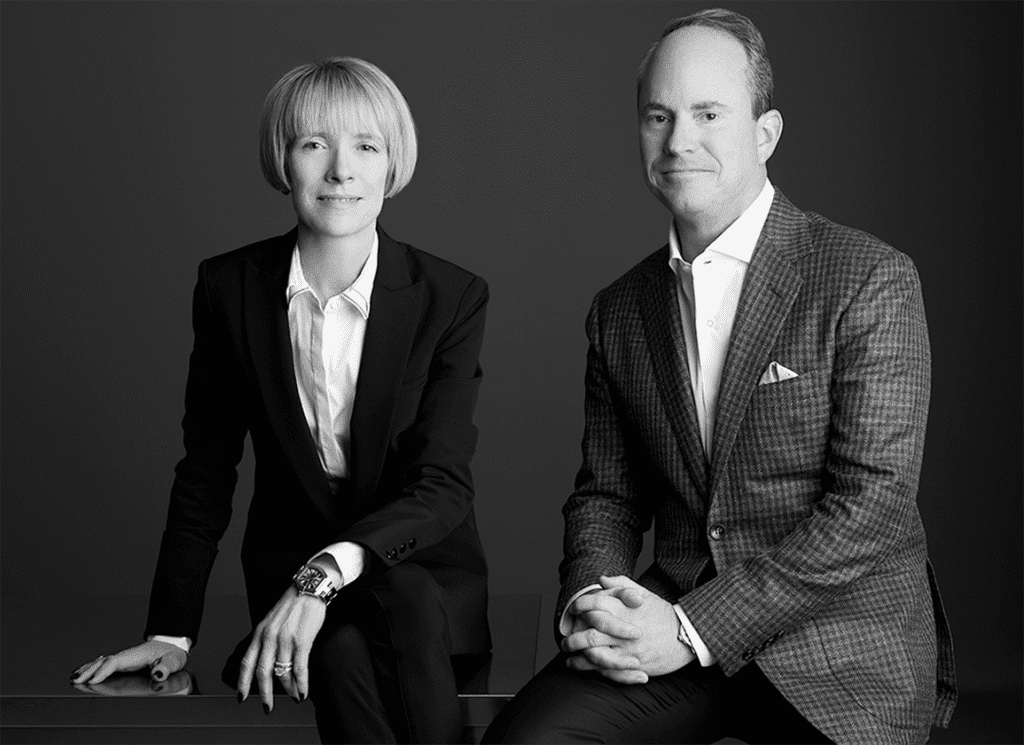
Cindy and Scott Heider | courtesy of The Heider Family
“My wife and I love cinema,” he says. “In fact, we just got back from the Telluride Film Festival. But I have never seen anything like the Thoroughbred industry. Art, film, these are wonderful things. They can fill your soul, stimulate your mind, hopefully open you to things that you didn't think about or believe before. As my Jesuit friends say, 'Always be open to growth.' So those things are important to me. But the Thoroughbred business? To me, it's just absolute, unlimited possibilities.”
True, he feels that some of these have not been adequately realized. He is dismayed, for instance, that we cannot achieve the same media traction for Cody's Wish (Curlin) as for less edifying news from the racetrack.
“We have such a unique, beautiful, unbelievably passionate industry,” he reflects. “Sometimes I think we don't know how good we have it. There's so much potential.”
In his own case, the magic was first ignited by boyhood visits to Ak-Sar-Ben. During high school and college summers he even worked there as an usher and mutuel teller. Attending the University of Southern California allowed Heider to sample Santa Anita and Hollywood Park, another level again from Nebraska-breds. And soon after he had launched his own career in business, father and son were also exploring this avenue of pleasure together.
First a friend introduced them to the veteran trainer Lyman Rollins. “And that,” says Heider, “was the luckiest thing in the world–because Lyman was just an upstanding guy.”
In 1987 they bought a $14,000 yearling colt from TaylorMade by To-Agori-Mou (Ire), a miler imported from Europe but pretty much a disaster at stud.
“And, as the racing gods would have it, that yearling turned out to be a Californian champion sprinter that won the Hollywood Turf Express three years in a row,” says Heider.
Answer Do, who also won three graded stakes, raced six seasons.

“Back then you'd race until September, October, and then you'd turn them out and bring them back in March,” Heider recalls. “You just stopped, let Mother Nature do her thing. And they lasted forever.
“Anyway, because of Answer Do, we came across all these wildly interesting people that were around at the time: Allen Paulson, John Mabee, Margie Everett, R.D. Hubbard. And we realized that you could put Allen Paulson, founder of Gulfstream, together with a jockey, a trainer, a groom—and everybody would just want to talk horses. It didn't matter what your background was. This was the great leveler, and that's a beautiful thing.”
The Heiders could not have got off to a better start; nor, of course, a more misleading one.
“When that horse finally retired, we spent probably six or seven years trying to find one that could run a third as fast!” says Heider ruefully. By that stage, however, they were hooked. “And, in hindsight, it became a really important bond with my father. I was getting married, having a family, life takes over. But boy, did we enjoy our time traveling around the country together.”
Losing his father in 2015 confirmed Heider in his hope that he might yet share a similar journey with his own children, Grant and Courtney, both recent college graduates. However their interest proceeds, Heider has long felt grateful for the indulgence of their mother Cindy–right back to when she ordered a wedding cake in the shape of a chocolate horse head, iced with a Lukas white bridle.
“As a lot of people in this business know, when someone's horse-crazy, their spouse has to learn to live with it,” Heider says. “But God bless my wife, she has learned to like it, especially the breeding. And she's very involved in the philanthropic side. In the horse business we've found some really talented people and organizations that might be relatively small, but that are definitely punching above their weight and making a real difference.”
These “small but mighty” operations include the Eddie Gregson Foundation, New Vocations, Bluegrass Farms Charities and, most recently, Stable Recovery.
“If you're fortunate, you're born into a situation where you're going to get a couple opportunities to right mistakes,” Heider observes. “But a lot of people don't get that opportunity. And I think the Thoroughbred industry is uniquely positioned to work with some of these folks–not only to give them a second and third chance, in a profession, but because horses are therapeutic. Some of the programs created for children are amazing. At first, they're scared to death of these animals, but just a few days later you see a remarkable bond develop. And it's the same with some of the people that have been incarcerated, or that have other life challenges.”
But if privilege brings duty, do we also owe a certain obligation to the breed itself: to consider its best interests, in how we try to make a living? Or is that a luxury in such a precarious walk of life?
“The Thoroughbred industry is a pretty decent microcosm for society,” Heider replies. “For sure, we have people that every day come into work, do a great job, and you know what, they've got bills to pay, they've a family to raise. They might be struggling day to day. But I think those of us in a position to do so can hopefully lead by example, and be involved.”
Accordingly he renounces the question that dictates so much commercial breeding: “What have you done for me lately?”
“We have a lot of stallions that would have been successful if given a chance,” he remarks. “That shorter-term mentality unfortunately permeates every aspect of the business. But then we're in a disposable society. Everybody leases a car, everybody replaces their phone every couple years. But this business is different, or should be anyway. Because the bloodlines that we're entrusted with go back 100, 200, 250 years.”
To that extent, he implies, it's not so much a question of who can afford to do the right thing as whether anybody, in the longer term, can afford not to?
“To me, do the right thing means: be respectful to the horse,” Heider specifies. “And to those working with them. The commercial market's going to have its influence. I'm all for the people that want to find the next stallion: there's plenty of risk, and we need that investment, we need to put those horses in the proper hands to determine their potential. But I think there's a limit. Because we want people to play this game long-term, right?”
The Heider program, then, is all “long ball.” One example has been his cultivation, over recent years, of a transatlantic presence. Whenever he's asked what drew him to Ireland, Heider always ends up—besides the heritage and horsemanship–by pointing to the passion and sheer caliber of the people he deals with. Certainly his admiration for the O'Brien family is not confined to their extraordinary professional accomplishment. But nor did he embrace the experiment merely in some altruistic spirit of adventure: Heider is clear that diversification of bloodlines is not just wholesome for the breed in general, but can also benefit his stable in particular.
“We have a young mare at Mill Ridge, Zofelle (Ire) (Zoffany {Ire}),” he explains. “A Grade III winner here, she ran second in the [GI] Matriarch on her final start. She's beautiful, and from the family of Listen (Ire) and Sequoyah (Ire) [both Group 1 winners by Sadler's Wells]. The kind of thing that I could just lie awake thinking about! But I didn't send her back to Ireland when her racing was over. This spring she had her first foal by Into Mischief, and I bred her next to Not This Time.”

Zofelle | Lauren King
Heider views such stallions as influences for brilliance, rather than any particular surface or distance. Conversely, the class and soundness of the mare's family can also transcend its recent European setting.
“I have no doubt that she's going to throw something on dirt along the way,” Heider vows. “If you look back to the '50s, '60s, '70s, the transfer of blood from Europe to the United States, and vice versa, has taken place for a long time. There's been far less lately, but now we're seeing Justify throw some brilliant horses in Europe. I don't know how many others are out there doing it. But again, it's about trying to do the right thing–in this case, about invigorating the breed.”
Heider stresses that he still loves the dirt racing on which he was raised. At some stage, however, he would enjoy testing convention. Had he bought out his partners in Mia Mischief (Into Mischief), for example, he would have been mighty tempted to have her bred in Europe. (As it is, of course, she was sold to Stonestreet.) “So I'm just as intrigued by having Irish mares over here as by maybe sending something the other way,” he says. “Time will tell whether it's going to look brilliant, or whether people end up saying, 'What's wrong with this person?'!”
Some aspects of the program remain perfectly orthodox. Heider likes his trainers to develop fillies with pedigree, such as the $750,000 daughter of Nyquist and GI Kentucky Oaks winner Believe You Can (Proud Citizen) bought from Airdrie at Keeneland in September, with a view to promotion into the broodmare band. But that, again, is laying up rather than trying to drive the green.
“I was raised in the investment business,” Heider remarks. “And you'd probably think that I'm always looking at the quotes in the Wall Street Journal and Financial Times, checking my phone all the time. I do read the financial papers every day, but really don't pay any attention to daily or weekly fluctuations in values. Those don't matter to me because I'm not selling today or tomorrow. I'm more likely adding to existing positions over time. It's a share in the business that I own. If you're fortunate to own a piece of a really good business, you don't listen to what the next fad is. You make decisions only to benefit the business. You let good grow.”
Sure enough, he isn't going to fret about which stallion or nick might be hot today and abandoned tomorrow. “We don't care about any of that,” he says. “I want good, reproducing female families. If the mare has racing ability, even better.”
Heider shows a catalogue page for which he's responsible, and accepts that he invited market wariness with a stallion prone to produce a turf horse. But he felt the match ideal, both physically and in terms of the sire's versatility and temperament.
“Because a brilliant horse is what you're looking for, right?” he says. “Doesn't matter if it's turf or dirt, short or long. I think people like John and Tanya Gunther, who I have so much respect for, get that. They understand long ball, without a doubt. It's tough. A lot of times you stand at the plate and miss but, my goodness, they've bred more than their share of amazing horses. So, no, we really don't breed for a market darling. We breed to improve a family. Eventually, the page will prove out.”
One of his most cherished examples is the dynasty of Jude (GB) (Darshaan {GB}).
“Through four generations, you lose track of all the Grade I performers,” he says. “Well, that's because somebody nurtured it. That's because of Richard Henry. And that, I can tell you, is what you do in business as well. You hire the best people, you keep the best close to you. That's our approach in everything we do. It's never about quick returns. We'll give Flying the Colors, a beautiful young War Front granddaughter of Jude, every opportunity to shine. She's in Ireland, in foal to Night of Thunder, and she's returning to the States this fall to be covered by Uncle Mo. We are committed long term to that Coolmore family, and I will move a mare like her if I see it may benefit her.”
Yet even doing it this way soon fills the present moment with fresh cycles of excitement.
“You want to get me going?” Heider asks with a chuckle. “Just ask me about A New Dawn (Ire) (Zoffany {Ire}), who's a granddaughter of Cherry Hinton (GB) (Green Desert), and I'll tell you about her Kingman (GB) yearling filly that's going to Joseph, or her Wootton Bassett (GB) colt foal. Or our 3-year-old Gun Runner filly, Stunningly, that broke her maiden this summer at Saratoga. I like the balance we have going on. There'll be some interchangeable parts here, some moving back and forth. Time will tell how it all works out. But it's all long-term thinking, and that's what excites me. It's what I know best.”
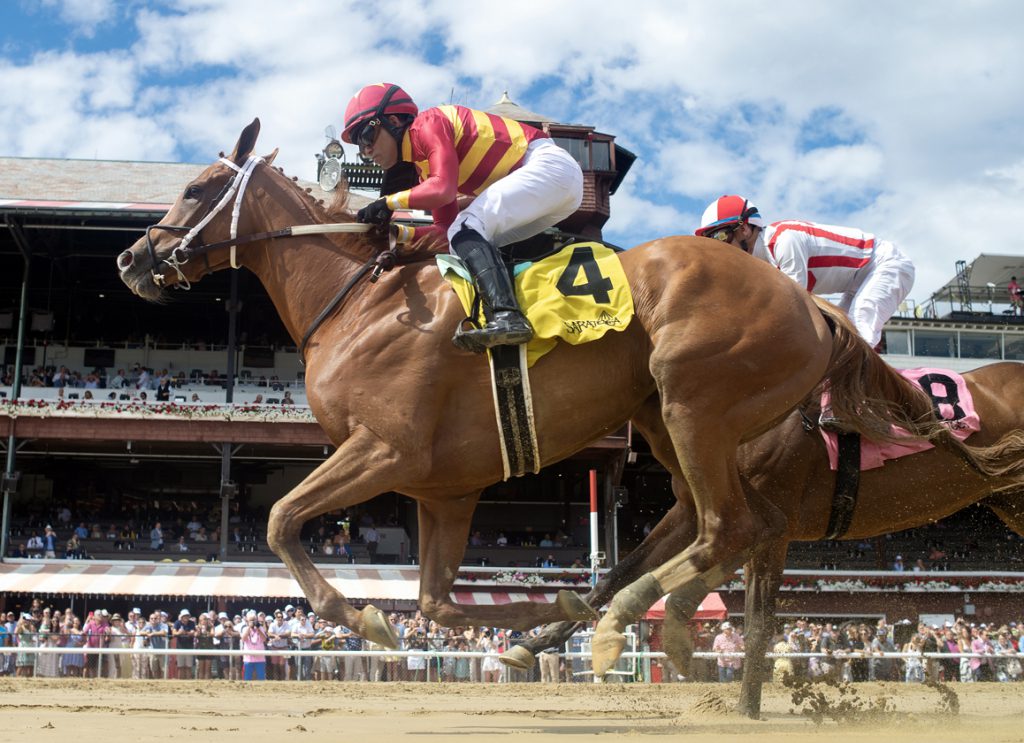
Stunningly | Sarah Andrew
Yet while his ultimate legacy remains an unknowable horizon, each step on the way emulates the one that first embarked Heider on this journey.
“In the end, for me, it's the same thing as it was day one,” Heider says. “That love and respect for the horse. But I think our true job in this sport is to leave it better than we found it. Now, that may mean trying to improve the breed: introducing new blood, sounder blood, faster blood. Or it may mean a gentleman like Ron Winchell saying, 'I'm going to make Kentucky Downs something like the Cella family has done at Oaklawn.'
“That's long ball. I can relate to that, in the investment world. But then we have everything else. The families on the farms, on the backside. The horses, after their track careers are over. So, if nothing else, by the time I'm ready to run my final furlong, I hope people don't say, 'Boy, he had fast horses,' or, 'He raced Mia Mischief; and he did this and that in Ireland.'
“What I hope they say is, 'There's somebody that tried to do the right thing; tried to improve the sport itself, including the folks that participate and dedicate their lives to it, especially those individuals that maybe don't get nearly enough attention or support.' In our own small way I hope we can leave this incredible game, that we all love so much, a little better than when we found it.”

The post Keeneland Breeder Spotlight: Heider Happy Playing The Long Game appeared first on TDN | Thoroughbred Daily News | Horse Racing News, Results and Video | Thoroughbred Breeding and Auctions.
Source of original post
