Hemp Meats, a beef farm and butcher shop, is a family business now into its sixth generation. In fact, it's the oldest of its type not just in Maryland, but in the whole country. So you could say that Gary Hemp is accustomed to taking the long view. But something remarkable has just happened, really out of nowhere.
“About two weeks ago,” Hemp says. “That's when I got this call from Lexington, Kentucky, which is one I don't see too often.”
The voice on the other end of the line introduced itself as belonging to Steve Castagnola of Taylor Made Farm. He just wanted to draw Hemp's attention to the fact that a foal out of the Speightstown mare he had bought for only $7,000 at Keeneland a couple of winters ago had been given an entry in the GIII Holy Bull S.
Hemp told Castagnola apologetically that he simply hasn't the time to keep on top of all that stuff. Though in his late 70s, he's still working hard to ensure that the Hemp Meats legacy remains as venerable for the next generation as it had been for his own. It was founded way back in 1849, so 2024 brings up its 175th anniversary. A few years ago, another family of butchers made contact: they'd done the research, hoping to prove themselves the oldest in the game, only to discover this outfit in Jefferson that had been at it even longer.
For Hemp, moreover, there's also a sense of heritage about the small Thoroughbred breeding program—currently comprising six mares, and shared with his wife Robin—that has in modern times operated alongside the one raising beef cattle. Because this originated with his father, Bill.
“We bought and sold cattle down the East Coast, and used to have a trucking business too,” Hemp explains. “But we're just a small, family operation, and it got to be stressful. So the doctor said to my dad, 'Why don't you try something a little different?' Well, every so often he would go to the track, and he knew people from buying cattle that had horses, so he started out with two mares. I was the stable boy. That was back in the late '60s. And I'm still doing the same thing today.”
They launched their Thoroughbred stable with the help of family friend S.O. Graham in Virginia.
“He had a lot of horses,” Hemp explains. “So we got a good bloodline from him. My dad did very well. Mostly in Charles Town, but we also did Laurel, Pimlico, Penn National, Delaware. Didn't have any superstars, but he did win a couple of West Virginia Futurities. I'm still trying to catch him, as far as wins, don't know if I ever will or not. He didn't have computers, any of that. He did it all by going through the books. But he was pretty good at it, and he's the reason why I'm able to do it too.”
That said, when his father died in 2003, Hemp pretty well had to start over. The old man had been down to a last mare from the original Graham line: she'd won an allowance and was all set to win another when she broke down on the final turn. So Hemp found a couple of local mares, and started to build up again. Just as his father had been indebted to Graham, so Hemp speaks warmly of succeeding Virginian breeders: O'Sullivan Farm, Cyndy and John McKee, and above all James W. Casey.
“They all treated me so well,” he says. “Mr. Casey helped West Virginia racing like no person I ever knew. He was very kind: helped me out with some broodmares, really kept me going.”
A few years ago, Hemp bought a mare by Speightstown at Keeneland. She produced some good types until unfortunately coming up with a huge colt, and proving unable to survive the complications. So when he looked through the catalogue for the 2021 November Sale, back at Keeneland, his shortlist of replacements included another daughter of Speightstown. Baroness Juliette had only won a maiden claimer at Prairie Meadows, but she was out of a Medaglia d'Oro half-sister to Siphonic (Brz) and had youth on her side, six years old and carrying her third foal (by Mor Spirit).
“I liked that breeding on both ends,” said Hemp. “I work on pedigrees almost every day a little bit, always trying to learn a little more, and I'd picked out about eight or 10 altogether. And actually I didn't even go down there. With this family business, you can't just leave any time. So I was watching the sale online.”
“I was sure that I would get outbid on that mare. I was waiting for somebody to throw something up there [against his $7,000 bid], but they didn't. I thought, 'There's no way…' And then they called and said, 'You got her.' I really couldn't believe it. I guess Mor Spirit wasn't doing much. But I thought it was a deal, personally. I thought I got very lucky.”
Nor did he change his opinion when she stepped off the lorry.
“I loved her right off the bat,” he says. “I have mares from around here, and that's okay. But when you see these mares coming from Kentucky? She stood out straightaway, you could just see the class.”
Hemp liked the colt she delivered, too, and then bred her back locally. She has a yearling filly by Golden Years, and she's now pregnant by a son of Into Mischief named Cancun. That cover may not do a great deal for her value, as a late entry for Fasig-Tipton's current digital sale, where she sells as Hip 40 (click here) in the sale which runs through February 20. But here's where we need to rewind to that call from Lexington.
In fact, we need to go back a good bit farther than that. Because the team at Taylor Made have had a connection to this mare tracing back to 2020, when their young gun Not This Time was hitting that bump in the road nowadays faced by any stallion pending his first runners.
“Yes, he was in that tricky fourth year,” Castagnola explains. “Often we're having to cut deals on stallions even in their second and third years. So Not This Time didn't have a huge book of mares for his fourth.”
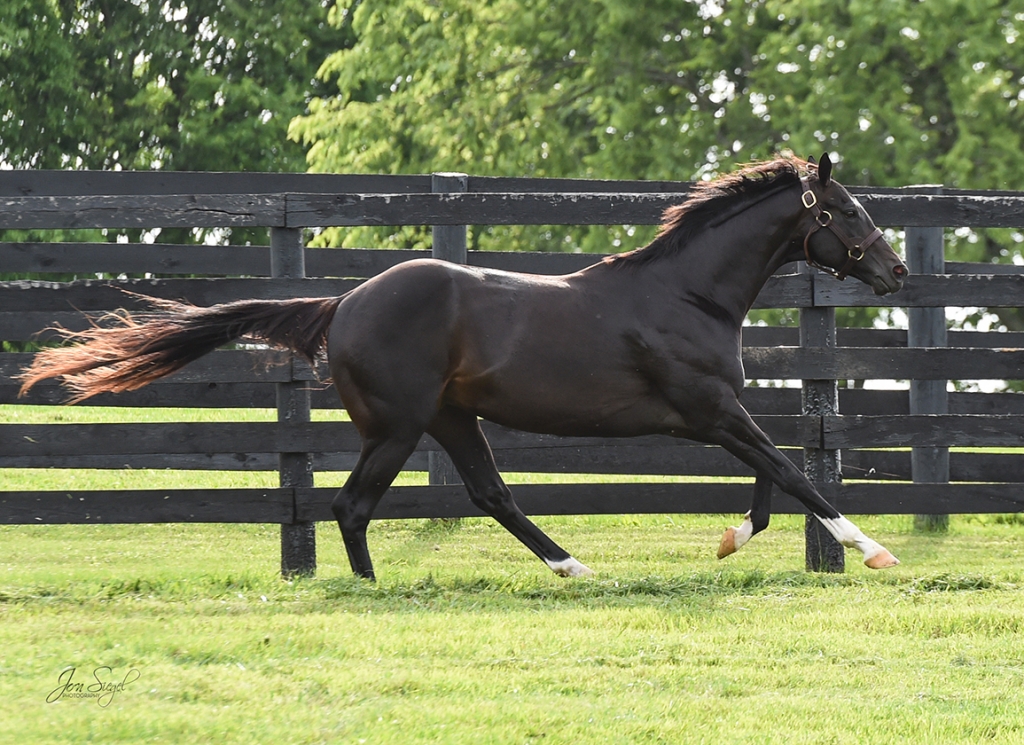
Not This Time | Jon Siegel
In the circumstances, then, everyone could be a winner when the Albaugh Family Stable–the Iowa-based program that had raced the horse–donated a Not This Time season to an auction for their home state's Thoroughbred Breeders and Owners Association. The successful bid of $6,850 was made by MAMAS Thoroughbreds, which included ITBOA president Steve Rentfle.
At the time this partnership had custody of Baroness Juliette. They'd bred her first foal, an Outwork colt that never made the track. But after Not This Time's debut crop made a flying start, they were able to sell his Iowa-bred son for $40,000 to Hartley/De Renzo at the 2022 Keeneland September Sale.
He was sent into training with Jose D'Angelo, and Castagnola monitored his progress with interest: second on debut at Gulfstream last September, he then stretched out to win by nearly seven lengths over a mile, earning a crack at the Mucho Macho Man S. on New Year's Day.
“He got a terrible trip, he was hard to handle, I just looked at it as possibly a throw-out race,” Castagnola says. “And so when he entered back in the Holy Bull, that's when I reached out to Gary and just made him aware that, 'Hey, you own the dam of this horse.'
“In the end he scratched that day, because the trainer felt he needed one more work, and kept him for the [GIII] Sam Davis. And he proved correct in making that move.”
Did he ever. For this colt is No More Time, who dominated the race throughout at Tampa Bay Downs last Saturday.
“Gary and I had stayed in touch through the week,” Castagnola says. “He and his wife were actually on vacation, and he literally walked in the door as they'd run the race. I called him up and told him, and he was almost in disbelief.”
Hemp candidly acknowledges his inexperience with this kind of opportunity, and he's grateful for the counsel he has received. Castagnola laid the options before him.
“You could cash in now,” he said. “I can get her supplemented to this Fasig-Tipton digital sale. We have the resources here to execute that late entry and get everything lined up. The second option is maybe to sell 50 percent of the mare, take some chips off the table and stay in for any upside. Or you can just ride it out, breed her back to Not This Time and then offer her in November.”
Hemp pondered for a couple of days and then decided to strike while the iron was hot. Because, actually, it's even hotter than most people will have realized. For Baroness Juliette's dam counts among her siblings not only the Grade I winner Siphonic but also his full-sister Lady Siphonica, who had surfaced just a week previously as second dam of Mystik Dan, winner of the GIII Southwest S.
“Obviously being by Speightstown out of a Medaglia d'Oro mare, this mare is herself extremely well-bred,” Castagnola notes. “But it's always nice to see new activity, and her son not only sits sixth on the Derby points list but is virtually tied with a horse right under her second dam. [Mystik Dan has one point extra, on 21, enough to put him third overall.] So that will give two rooting interests for the new owner of this mare.”
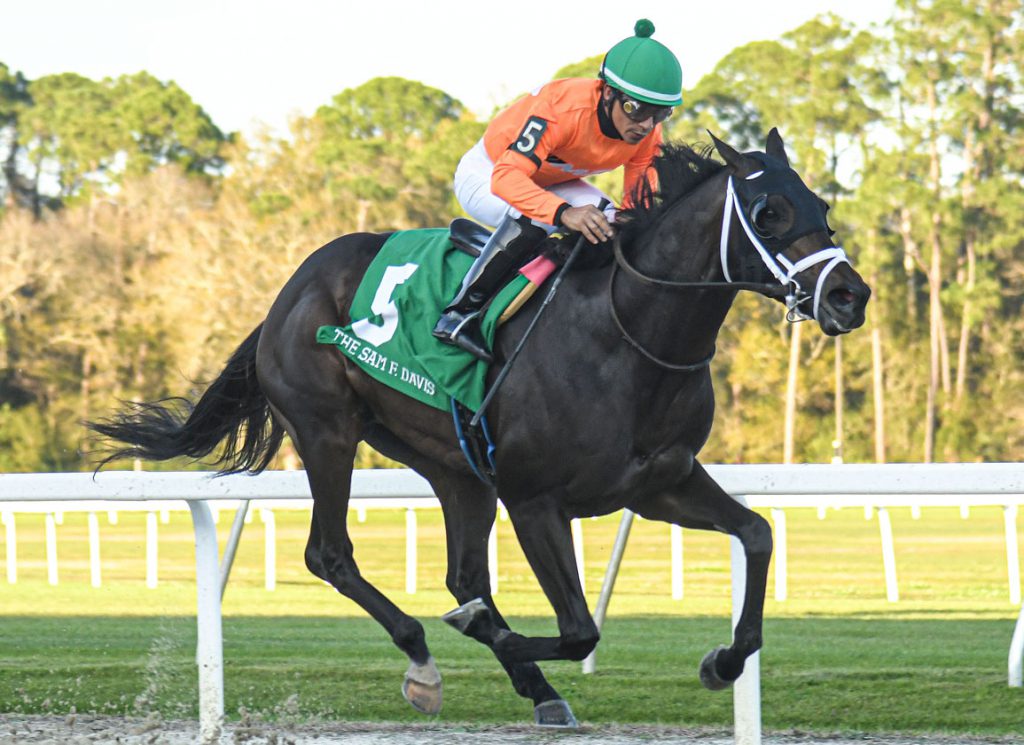
No More Time | SV Photography
Whoever that turns out to be, Castagnola is naturally hoping that Baroness Juliette might return to Not This Time this spring.
“And we hope that it turns out that she'd then be carrying a full sibling to a Kentucky Derby winner!” he says.
He emphasizes that Not This Time has elevated his fee tenfold to $150,000 without yet having launched a single runner conceived even at $40,000.
“This is the only active sire with an Eclipse champion on both dirt and turf,” he remarks. “Yet he's done it all from his first four crops, all bred at $15,000 or less. The thing is that he now has both volume and quality. His 2-year-old crop is a really big one, and every year the quality of his mares has just got better and better. Last breeding season, his comparative index was second only to Gun Runner. Having done so much with the sort of mares that we just took to try and fill his book, his future is certainly looking very bright.”
Obviously the Not This Time team are now in a position to pick and choose his partners.
“And we're fortunate that, having seen his first four or five crops, we know what kind of mare fits him physically and genetically,” Castagnola says. “Obviously we're overrun with applications, and we've really focused on getting mares that we think will fit him. Our guys do a lot of recruiting, reaching out to people that have the type of mare that we'd like to get him.”
Not This Time could scarcely have made a more auspicious start to the new season, welcoming none other than Goodnight Olive (Ghostzapper) for her maiden cover on his first day of trade.
He's certainly come a long way since the charity cover that has put an Iowa-bred on the Derby trail. Having stumbled into the slipstream of a stallion turning everything to gold, then, Hemp is feeling as dazed as he is blessed.
“Everybody's trying to help me out here, because nothing like this has ever happened to me,” he marvels. “There's always so much going on with our business here, and I'm getting older, so I can't keep up with everything. I knew she had an Outwork the first time, but when I found out that she had one in a prep race, wow. And then Steve called and said, 'Well, he not only just ran, he won it.' I know he's not mine, but I almost can't describe the feeling of watching that colt go wire to wire, how it gets your adrenaline going.”
Hemp will have another decision to make with the Mor Spirit colt he acquired in utero.
“I'm considering putting him in a 2-year-old sale,” he admits. “But then again, I raised him and I like the racing, too. I only have one other 2-year-old, a filly by a West Virginia sire called Redirect. And I do like this colt. You never know, he could do pretty well.”
But while Baroness Juliette has introduced him to exciting novelties, Hemp has always been at home with an environment that calls for the same instincts of stockmanship as those that underpin the long survival of the family farm.
“The genetics are a big part of both,” he says. “And you always have to upgrade. That's why I try to get these broodmares from Kentucky, when I can. You have to keep moving forward. You just sit in one spot, it'll be done. I'm the fifth generation in our business, and I've upped the level of what we sell.
“We don't gouge prices. We always try to treat customers like we'd want to be treated, and I'm very particular about quality. It's not like we're selling a TV or computer. Mother Nature has the last call in our business. The beef that we buy in, it's the best we can get, to the best of our knowledge; and what we raise on the farm, it's all choice to prime grade. I don't feed growth hormones or antibiotics. Everybody that knows me, knows that we try to do it right.”
Having put three daughters through college, Hemp concedes that “not many girls want to be meat carvers,” but his nephew represents a sixth generation in the business. Not that Hemp or his wife are anywhere near quitting, despite each experiencing significant health hurdles in recent times.
“All those years standing on concrete cutting meat, for six, eight hours, plus doing the cattle on the farm, it pretty much wears on you,” Hemp admits. “I got arthritis, and then I had a fall, broke my neck and back and hip. At the hospital they told my wife I would probably never walk again. I had to learn how to do everything. But I'm up and going, I'm lucky. The last time I had my hip done, they said I could go home next day. The guy looked at me and said, 'You some kind of a freak or something?' I said, 'No, I'm just doing what you told me to.' Because that's just kind of the way we were raised.”
If that ethic has underpinned half a century of working life, it has proved no less useful with the Thoroughbreds that have also been on the scene throughout.
“I was doing actually pretty well with them and then COVID came and, boy, I tell you, I came close to throwing the towel in a couple times,” he says. “I'm still struggling to get things turned around, but this mare now might help me pull it out. I don't know if I deserve it or not, but it's just really nice being able to experience something like this. It makes you feel like you've maybe done a little something correct. My dad was tough. They were all tough, they were hard, they pushed their butts. You didn't back talk or anything. But he would love this. He'd be very proud.”
Castagnola sums it up well. “There's nothing I love more than this kind of story,” he says. “First of all, the kind gesture of the Albaugh family in donating the season. As a result, an Iowa breeder made a $40,000 sale. And then, for Gary and his wife, things have been hard the past couple of years. The racing gods, the universe, however you want to describe the way some things happen in our world, that may not be by chance: I just think it's a beautiful thing. And it couldn't be happening to a nicer guy.”
“I'm just a small-town dude trying to do what I can,” Hemp says. “I do study the pedigrees a lot. And I'm still trying to learn. But this is all new to me. It's pretty overwhelming. She's a good-looking, well-bred mare. But I guess I just got lucky, if you want to know the truth.” He pauses and chuckles. “Some old farm boy got lucky.”
The post No Better Time To Buy A Derby Mare appeared first on TDN | Thoroughbred Daily News | Horse Racing News, Results and Video | Thoroughbred Breeding and Auctions.
