Smaller, But Still Super: Eddie Kenneally

The concept of the super trainer is by no means a new phenomenon in horse racing, but the huge stables run by super trainers have undoubtedly changed the landscape of the sport in many ways, from the backside to the racing entries. Are super trainers bad for the sport?  Are there any benefits for an owner in using a “smaller” trainer? We asked these questions and more to a few trainers who may not be considered super trainers in terms of their stall numbers, but they have made the most of the horses they're given to build competitive racing stable over their careers. 

Growing up in Ireland, Eddie Kenneally's favorite day of the week was when his father would take him to visit their local steeplechase track. Now a multiple Grade I-winning trainer, Kenneally looks back and pinpoints those days at the track as defining moments in his life when he developed his love for the horse at a young age. After nearly 30 years of running his own operation, the Kentucky-based trainer has developed two million-dollar earners–2007 G1 Dubai Golden Shaheen winner Kelly's Landing (Patton) and 2016 GI Stephen Foster H. victor Bradester (Lion Heart). This year, he earned his 1,000th career victory and was represented by GI Bruce D. S. winner Point Me By (Point of Entry).


KP: How did you first get involved in horse racing?

EK: I grew up in Waterford in Ireland and my dad was a big fan of steeplechase racing. He would take us to the local races at least once a week. That's when I first got a liking for horses and racing. We grew up on a dairy farm and we always had some horses there that my dad would break and train, so I grew up riding from a very young age.

I was fortunate enough to get my first real job in the industry working for one of the leading pinhookers in Europe with Tim Hyde at Camas Park Stud. He has a great reputation and I spent a few years doing yearling prep and breaking for him. He was connected with Pegasus Stud Farm in Lexington so I was able to come here for a work experience program in 1987. I loved the Lexington area and decided that I wanted to stay. I worked at Pegasus for a year and then galloped horses for Rusty Arnold at Keeneland.

After I spent a year with Rusty, I had an opportunity to become an assistant for Tom Skiffington, who was one of the leading trainers in New York at the time. It was a great education and I learned a lot from him. Through the exposure I got as an assistant, I decided to start training on my own in 1993.

For the first few years, we started out pretty small. It took a while to get established. I was spending my summers in Kentucky and winters in New Orleans and we were holding at about 12 to 15 horses for the first six or eight years. The business wasn't growing as big as I had hoped and the success hadn't really happened as much as I had hoped.

Eventually we had an opportunity to start working for Jack Lally of Summerplace Farm, who had a really nice horse named Kelly's Landing (Patton). That horse helped propel my business to the next level. At around the same time we started to train for Ron and Ricki Rashinski of Homewrecker Racing. They had a filly named Bushfire (Louis Quatorze) who won three Grade I races for us and was an Eclipse finalist as a 3-year-old. We still train for both of those clients today and they really helped get my career off the ground along with longtime client Joe Sutton, who had Grade I winner Bradester (Lion Heart) with us a few years ago.

KP: How many horses are normally in your stable?
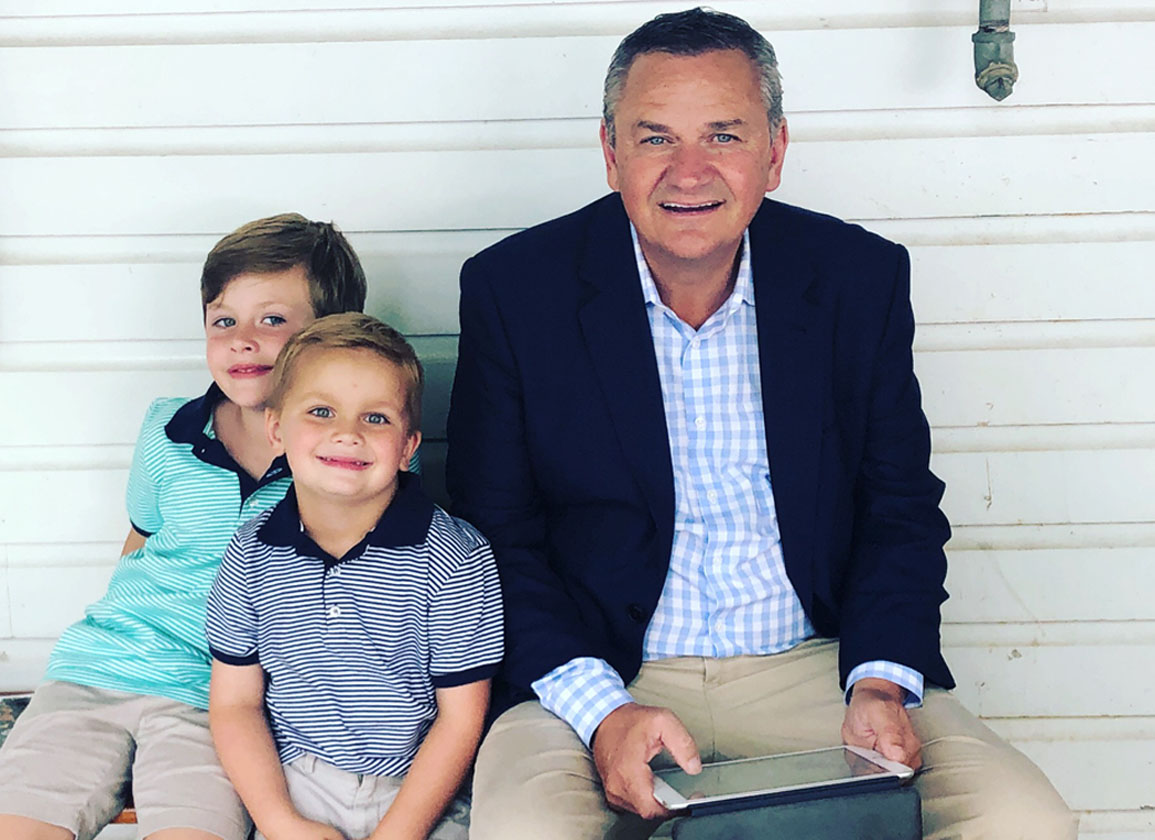
Eddie and Catherine Kenneally have two sons, Vincent and Liam | photo courtesy Eddie Kenneally

EK: We're at a comfortable number now because I am spending a lot of time with my two young kids. They play a lot of baseball so I have a lot going on with family. Our stable has been at about 50 head for the past few years. We have about 20 at Keeneland and 30 at Churchill Downs, so we have two divisions and two assistant trainers, Kelly Wheeler and Kevin Glodowski, who are a huge part of our operation.

Six or eight years ago, we would have had closer to 70 horses, but 50 is a good number for where I'm at right now. About five years ago, I decided to discontinue my New York division. I've scaled back a little bit and we don't spend nearly as much time in New York, partly because we decided to stay closer to home and also because the purses have increased dramatically in Kentucky. I probably could have more horses if I wanted to, but this number works for me.

KP: What do you believe makes your stable unique?

EK: I'm very hands on. I'm on the road a lot between Louisville and Lexington all year and I like to be at the barn every day. I look forward to going out every morning, but it's hard work and I think a person needs to stay on it. You can't get complacent and you need to be willing to put in the time to maintain it.

We've had some good people work for us in the past who have gone on to have their own success. Tom Morley is in New York now and Brendan Walsh spent a few years with us as well. I take pride in the fact that we've had some good people who have come through and go on to do very well.

KP: What do you believe are the benefits for an owner in using a “smaller” trainer?

EK: Obviously, the smaller trainers aren't going to win as many races because they don't run as many horses. So you aren't going to get as much exposure as with a guy who has 10 times more horses than I do. But I don't envy any of [the larger outfits].  I say good for them for having 300 or 400 horses. 50 works well for me and we have some great clients who appreciate what we do and we certainly appreciate them.

I think that the clients of super trainers might not get the same opportunities because for every condition, their trainer may have several horses and will probably only end up running one of them. For instance, if you have a turf maiden filly, the trainer might have 20 of those when the race comes up but they're only going to run one or two. The owners of the other horses will have to just wait for their turn. So it wouldn't work for me. I think we can give better customer service with a smaller operation like ours.

KP: Do you think super trainers are bad for the sport?

EK: A lot of the stuff that goes on in this game is out of our control. This is out of my control so it doesn't matter what my opinion is about it. If some guys have a lot of horses, then good for them.

KP: What do you enjoy most about your job?

EK: I enjoy waking up every morning and being hands-on with every horse in my barn, getting to know them and develop them. Being self-employed and having my own business allows me to have flexibility where I can spend time with my kids and my wife. Sure, I have to get up in the middle of the night to go to work, but I've been doing that a long time and I've adapted to it.

KP: What is the most frustrating aspect of your job?

One of the most frustrating things with the state of racing in this country at the moment is how penalties are not equal for violations of the same sort in different states. Violations and penalties are not implemented in the same way and the testing and rules are different in every state.

When we get under uniform rules, I'm hopeful that will take away some of the frustration and maybe establish a more level playing field because I do think it's not quite as fair as it could be. The penalties are not harsh enough for the people who can't abide by the rules and it's frustrating for someone like me who has never had a suspension to run against people who are multiple offenders and continue to bend the rules when there's no real incentive for them to stop.
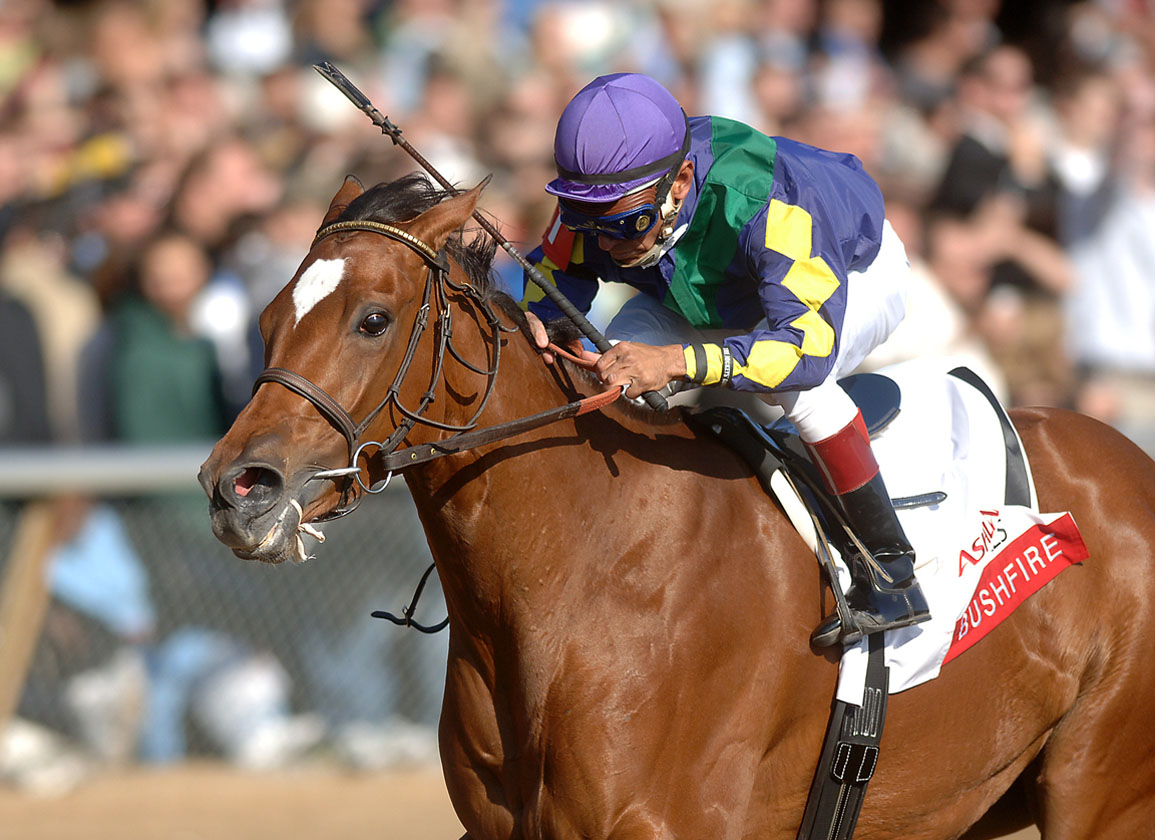
Bushfire wins the 2006 GI Ashland S. and later goes on to claim the GI Acorn S. and GI Mother Goose S. | Horsephotos

KP: Do you think the Horseracing Integrity and Safety Act (HISA) would help achieve the uniformity you mentioned?

EK: I think uniformity would be great if it could be implemented, but I think it's going to be a tough process going from where we are right now to where that is up and running and achieving what it is set out to accomplish. In theory, it sounds good and hopefully we'll be able to get there, but it won't be easy.

KP: Earlier you talked about when you first set out on your own and your stable was very small. What advice would you have for younger trainers who are just getting started and hope to establish a stable like yours someday?

EK: The advice I would give to younger people who want to train is that the key is to try to get around someone who is successful that they look up to and admire. Spend the time working as an assistant for long enough that they can get enough contacts and experience before they begin to train. The game has changed a lot and I think communication is vital. For young people starting out, I would recommend to travel and go to another country to work in racing and see as much as you can before you start training on your own. Put in the time beforehand and it will benefit you down the road.

KP: What horse do you look back on as one you will always remember for having one of the biggest personalities? 

EK: The first horse that comes to mind is a filly called Girls Know Best (Caleb's Posse). I claimed her in partnership, which is something I do with a large portion of my stable, with Brian Chenvert. She won over half a million in purses after we claimed her, winning three stakes and placing in about seven others. She was just a filly who was rock solid and tried hard every time. She was around the barn for quite some time and was often on her toes. She was just a really fun filly to be around.

Another horse would definitely by Kelly's Landing. He was such a dude. He was very particular and definitely wasn't nice to everyone, but we go along great and he eventually became my stable pony when he retired from racing.

To nominate a trainer for this ongoing series, email katiepetrunyak@thetdn.com. General criteria: Multiple graded stakes-winning trainer, fewer than 300 starts this year, has trained for over 20 years and accumulated no more than approximately $50 million in career earnings. 

The post Smaller, But Still Super: Eddie Kenneally appeared first on TDN | Thoroughbred Daily News | Horse Racing News, Results and Video | Thoroughbred Breeding and Auctions.

Source of original post

Track Record-Holder Nashville Returns From Year-Long Layoff This Friday At Oaklawn

Whitmore won the biggest sprint race Nov. 7, 2020, at Keeneland, but Nashville won the fastest.

Now, more than 13 months after setting a 6-furlong track record on that Breeders' Cup undercard, lightly raced Nashville is scheduled to launch his comeback in an allowance sprint Friday afternoon at Oaklawn for Hall of Fame trainer Steve Asmussen and co-owners WinStar Racing and China Horse Club.

“It's just kind of a starting point,” WinStar President/CEO and racing manager Elliott Walden said Wednesday morning. “We want to get a race in him and see where we are. It looks like a good spot. There's some competitive horses in there and it will give us a good barometer.”

Nashville is among seven horses entered in the 5 ½-furlong eighth race, which has a $102,000 purse. Probable post time is 3:46 p.m. (Central). Nashville, to be ridden for the first time by Florent Geroux, drew the rail and is the 7-5 program favorite.

Nashville hasn't started since suffering his first career loss in the $300,000 Malibu Stakes (G1) for 3-year-olds Dec. 26, 2020, at Santa Anita. Charlatan, who captured the first division of the $500,000 Arkansas Derby (G1) earlier that year at Oaklawn, won the 7-furlong Malibu, with Nashville finishing fourth, beaten 8 ¼ lengths.

“It's been a long road,” Walden said. “Sometimes, horses make you wait.”

Walden said Nashville had a small ankle chip removed following the Malibu. After resuming training last May, Walden said the 4-year-old son of Speightstown – Breeders' Cup Sprint winner and champion sprinter in 2004 – came up “a little off behind” and he was sent home.

“Nothing major, but had a couple of starts and stops this year,” Walden said, adding Nashville returned to Asmussen Sept. 10 and “hasn't missed a beat since then.”

Nashville has a long string of workouts at Churchill Downs and a half-mile maintenance breeze Monday morning at Oaklawn in advance of his comeback. Also entered in Friday's race are multiple stakes winner Mr. Jagermeister, the speedy Firecrow and Hollis, an allowance winner at 5 ½ furlongs last April at Oaklawn. Nashville dazzled in his first three career starts, winning by a combined 24 ¾ front-running lengths.

“You're always concerned about a layoff, but Steve knows how to handle these horses,” Walden said. “He said he's ready. Just looking forward to getting him back.”

Nashville posted Beyer Speed Figures of 91 for an 11 ½-length debut victory in September 2020 at Saratoga, 103 for a 9 ¾-length first-level allowance victory in October 2020 at Keeneland and 102 for a 3 ½-length victory in the $125,000 Perryville Stakes for 3-year-olds about a month later at Keeneland.

Under perennial Oaklawn riding champion Ricardo Santana Jr., Nashville won the Perryville in a track-record 1:07.89 after setting fractions of :21.54 for the opening quarter and :43.87 for a half-mile. The surface was fast. Oaklawn-raced A.P. Indian set Keeneland's previous 6-furlong track record (1:08.43) in the $250,000 Phoenix Stakes (G2) in 2016.

Roughly four hours after the Perryville, the first race on the card, seven-time Oaklawn stakes winner Whitmore captured the $2 million Breeders' Cup Sprint (G1) to secure an Eclipse Award as the country's champion male sprinter. Whitmore's winning time over a fast track was 1:08.61.

“We debated whether to go into the Breeders' Cup off of two starts,” Walden said. “Just felt like it was not a fair thing to do, to run a 3-year-old against top sprinters and older horses that had more experience and everything, so we opted for the path of least resistance. But after he ran, and ran so fast, I'd be lying to you if I didn't tell you there was a hint of: 'I wish we had run in the Breeders' Cup Sprint that day.' ”

Nashville has won 3 of 4 lifetime starts and earned $175,200. He was purchased for $460,000 at the 2018 Keeneland September Yearling Sale.

The post Track Record-Holder Nashville Returns From Year-Long Layoff This Friday At Oaklawn appeared first on Horse Racing News | Paulick Report.

Source of original post

Keeneland’s 2022 January Horses Of All Ages Sale Catalog Now Online

Keeneland has cataloged 1,516 horses – broodmares and broodmare prospects, yearlings and horses of racing age along with stallions and stallion prospects – for its 2022 January Horses of All Ages Sale, which will present four sessions from Jan. 10-13.

The January Sale catalog is available online at Keeneland.com. Print catalogs are scheduled to be delivered the week of Dec. 20.

“Given the dynamic markets we've seen in September and November, the January Sale will offer breeders another terrific opportunity to acquire quality broodmares and broodmare prospects in advance of the breeding season,” Keeneland Vice President of Sales Tony Lacy said. “Additionally, horsemen with an eye toward the race track can shop a nice selection of short yearlings and horses of racing age to round out their orders.”

For the January Sale, Keeneland once again will offer online and phone bidding to accommodate buyers who cannot attend. More information for prospective buyers, including accessing the Keeneland Sales Portal, can be found by clicking here.

Sale schedule

The four sessions of the January Sale all begin at 10 a.m. ET. The sale schedule is as follows:

Book 1 on Monday, Jan. 10 and Tuesday, Jan. 11.

Book 2 on Wednesday, Jan. 12 and Thursday, Jan. 13.

The entire November Sale will be livestreamed at Keeneland.com. TVG2 will feature live coverage of the first two days of the sale, and the entire sale will be shown on the Watch TVG App.

Successful stallions represented

A number of prominent stallions and emerging young sires are represented in the January Sale catalog with in-foal mares and yearlings. Among them are mares in foal to Kentucky Derby Presented by Woodford Reserve winner and Horse of the Year Authentic, the leading covering sire at the November Breeding Stock Sale.

Additional covering sires include American Pharoah, Audible, City of Light, Constitution, Ghostzapper, Gun Runner, Hard Spun, Into Mischief, Justify, Kitten's Joy, Liam's Map, Medaglia d'Oro, Mendelssohn, Munnings, Speightstown, Street Sense, Twirling Candy and War Front.

Also cataloged are broodmares carrying the final foals by Bernardini, English Channel, Laoban and Malibu Moon.

Yearlings in the catalog include those by stallions whose first weanlings were popular at the November Sale. Sires include Audible, Catalina Cruiser, Mitole, Omaha Beach and Vino Rosso.

Other cataloged yearlings are by such popular stallions as American Pharoah, City of Light, Constitution, Ghostzapper, Good Magic, Gun Runner, Hard Spun, Justify, Liam's Map, Medaglia d'Oro, Mendelssohn, Munnings, Not This Time, Nyquist, Practical Joke, Quality Road, Speightstown, Street Sense, Twirling Candy, Uncle Mo and War Front.

Regal Glory, Juju's Map among graduates

With her win in the Nov. 28 Grade 1 Matriarch at Del Mar, Regal Glory became the latest Grade 1 winner of 2021 to represent the January Sale as a graduate. She sold as a horse of racing age at this year's January Sale as did Country Grammer, who won the G1 Hollywood Gold Cup in May.

Additionally, several horses offered as yearlings at the January Sale captured graded stakes in 2021: Grade 1 winner Dr. Schivel (Bing Crosby), Juju's Map (Darley Alcibiades) and Point Me By (Bruce D.); Grade 2 winner Cilla (Prioress) and Grade 3 winners Bizzee Channel (Arlington), Informative (Salvator Mile), Major General (Iroquois), Mnasek (UAE Oaks Sponsored by New Jaguar F-Type) and Sainthood (Pennine Ridge).

The post Keeneland’s 2022 January Horses Of All Ages Sale Catalog Now Online appeared first on Horse Racing News | Paulick Report.

Source of original post

Economic Indicators: Record Breeders’ Cup Handle Leads Slight Wagering Increases In November

Equibase, North American racing's official database, released Monday its November 2021 statistics for the industry's economic indicators, including field size, wagering, and other data, along with year-to-date and 2019 and 2020 numbers. The database distributes 2020 and 2021 numbers and includes 2019's data for comparisons to pre-COVID-19 pandemic numbers.

Led by a record handle at the Del Mar-hosted Breeders' Cup World Championships on Nov. 5 and 6 ($183,260,127, a two-day record for the championship event), November's total wagering numbers were up 7.40 percent over the same month in 2020. Part of the reason for the increase could be the return of in-person attendance to the Breeders' Cup, which was severely restricted at Keeneland in 2020.

When Del Mar last hosted the Breeders' Cup in 2017, it posted a then-record handle of $166,077,486. The new mark is 10.4 percent higher than that.

Compared to 2019, this November's handle was only 0.62 percent higher, though average wagering per race day sustained a solid 12.04 percent bump between November of 2019 and November of 2021.

Though purses and race days are both up over 25 percent from the same month in 2020, average daily wagering saw a sharp decrease of 17.33 percent, while the year-to-date figures for average wagering are also down nearly 10 percent. That contrasts sharply with the numbers from 2019, which put average wagering up over 20 percent from the first 11 months of 2019 to the same period in 2021.

The discrepancy could be explained by the increased attention horse racing experienced during the harshest months of the pandemic in 2020; this year's return to a more normal sports schedule and in-person activities could definitely play a role in where wagering dollars have been spent.

November 2021 vs. November 2020
Indicator November 2021 November 2020 % Change
Wagering on U.S. Races* $961,813,331 $895,546,532 +7.40%
U.S. Purses $117,678,625 $92,095,830 +27.78%
U.S. Race Days 291 224 +29.91%
U.S. Races 2,440 1,945 +25.45%
U.S. Starts 18,782 16,236 +15.68%
Average Field Size 7.70 8.35 -7.79%
Average Wagering Per Race Day $3,305,200 $3,997,976 -17.3`3%
Average Purses Per Race Day $404,394 $411,142 -1.64%

YTD 2021 vs. YTD 2020
Indicator YTD 2021 YTD 2020 % Change
Wagering on U.S. Races* $11,409,728,296 $10,171,153,164 +12.18%
U.S. Purses $1,106,048,142 $812,236,796 +36.17%
U.S. Race Days 3,821 3,073 +24.34%
U.S. Races 31,415 25,692 +22.28%
U.S. Starts 230,147 203,122 +13.30%
Average Field Size 7.33 7.91 -7.34%
Average Wagering Per Race Day $2,986,058 $3,309,845 -9.78%
Average Purses Per Race Day $289,466 $264,314 +9.52%

2019 Comparisons:

November 2021 vs. November 2019
Indicator November 2021 November 2019 % Change
Wagering on U.S. Races* $961,813,331 $955,843,009 +0.62%
U.S. Purses $117,678,625 $115,756,315 +1.66%
U.S. Race Days 291 324 -10.19%
U.S. Races 2,440 2,730 -10.62%
U.S. Starts 18,782 21,839 -14.00%
Average Field Size 7.70 8.00 -3.78%
Average Wagering Per Race Day $3,305,200 $2,950,133 +12.04%
Average Purses Per Race Day $404,394 $357,273 +13.19%

YTD 2021 vs. YTD 2019
Indicator YTD 2021 YTD 2019 % Change
Wagering on U.S. Races* $11,409,728,296 $10,326,096,192 +10.49%
U.S. Purses $1,106,048,142 $1,101,605,086 +0.40%
U.S. Race Days 3,821 4,173 -8.44%
U.S. Races 31,415 34,038 -7.71%
U.S. Starts 230,147 254,992 -9.74%
Average Field Size 7.33 7.49 -2.21%
Average Wagering Per Race Day $2,986,058 $2,474,502 +20.67%
Average Purses Per Race Day $289,466 $263,984 +9.65%

* Includes worldwide commingled wagering on U.S. races.

The post Economic Indicators: Record Breeders’ Cup Handle Leads Slight Wagering Increases In November appeared first on Horse Racing News | Paulick Report.

Source of original post

Verified by MonsterInsights