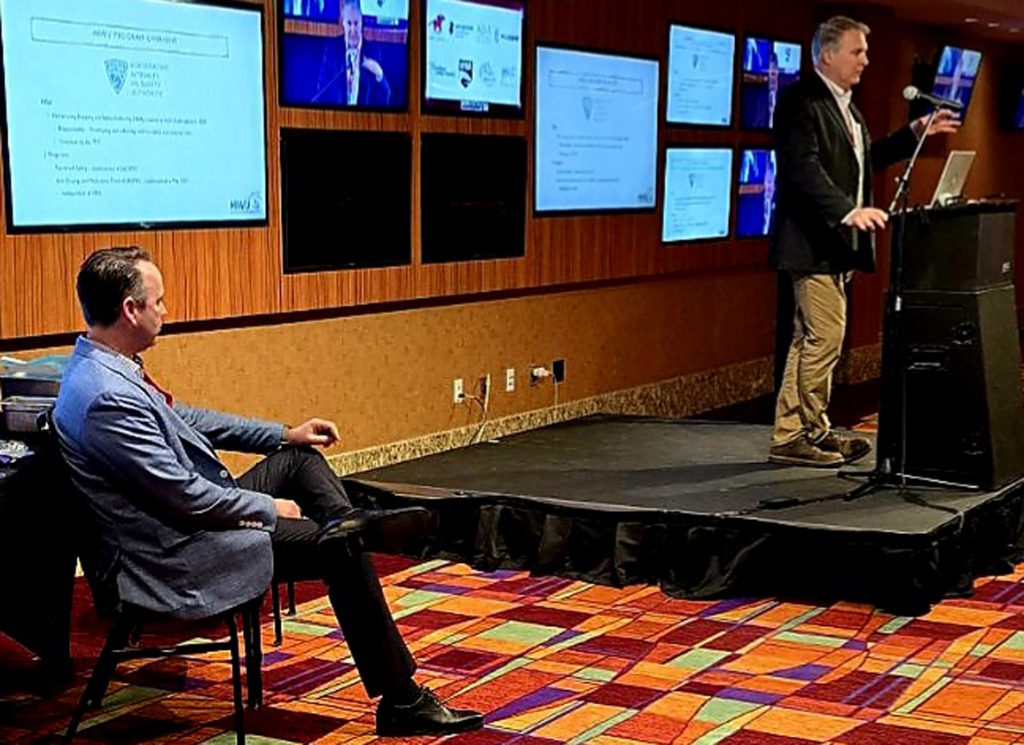
If the crowd at Light Up Racing's first community event in Lexington, held Feb. 26 at Fasig-Tipton, was any indication of the support behind the industry's new grassroots initiative, the number of attendees at their second event held Tuesday, Mar. 5 at Keeneland only solidified that.
Over 300 people, spanning across all aspects of the Thoroughbred industry, gathered in Keeneland's Limestone Café to learn about how their own voices and platforms can be used to collectively transform negative opinions about racing into positive messaging through accurate information, transparency, authenticity and professional language.
Building on what she shared during the inaugural event, which covered six critical concepts that can help industry members reshape the public's perception of horse racing, presenter Vicky Leonard discussed turning challenges into opportunities through strategic communication and social media engagement.
“We can use the collective insights of everybody here and the deep knowledge that you all have. You have amazing stories, you know the industry better than anybody, and we can use that to ensure that the content we're putting outside of the industry is more creative than it ever could be if you weren't living it and breathing it,” said Leonard. “Of course, it's going to be more trusted. You guys have the voice that will be authentically representing the industry.”
In 2022, Leonard's Australian-based marketing agency Kick Collective launched Kick Up For Racing. Inspired to establish something similar stateside, Price Bell, Roderick Wachman, Jason Litt and Dr. Jeff Berk spearheaded the launch of Light Up Racing late last year.
With a foundation based on four key pillars of transparency, awareness, community and accountability, Light Up Racing offers three levels of engagement: network, community and cohort.
Beginning at the first tier, members within the Light Up Racing network will have access to resources via email and the initiative's website that will equip them with essential resources, key messages and talking points to address any difficult questions.
Light Up Racing's website has culminated a bank of common questions from the public regarding aftercare, racetracks, racing and welfare, and answers to those questions based on scientific research and expert vet advice. The website's research hub also provides access to various relevant scientific studies that can help in these responses.
“We just need you to be an educated advocate for the industry, in person and online. We want you to be our eyes and ears out there. When you spot something and you're not comfortable responding, let us know. And we also need you to share our information,” said Leonard.
From there, involvement would be expanded to the community level, which aims to bring together a social network of 1,000 industry members and supporters to combat misinformation about the industry with timely, educated responses, while also distributing positive racing content.
“Social media is where inflammatory content gets the most engagement, so people who are often quite irrational tend to get the most limelight and that's a little bit challenging and it's pretty scary. But you don't need to get in a tit-for-tat argument,” said Leonard. “It's just about responding to things that are completely incorrect with what is correct. When you've done that once, or perhaps clarified something once more, you don't need to get involved again.
“It's really important that people who are only there for the comments do see that there's been an educated response to a piece of misinformation.”
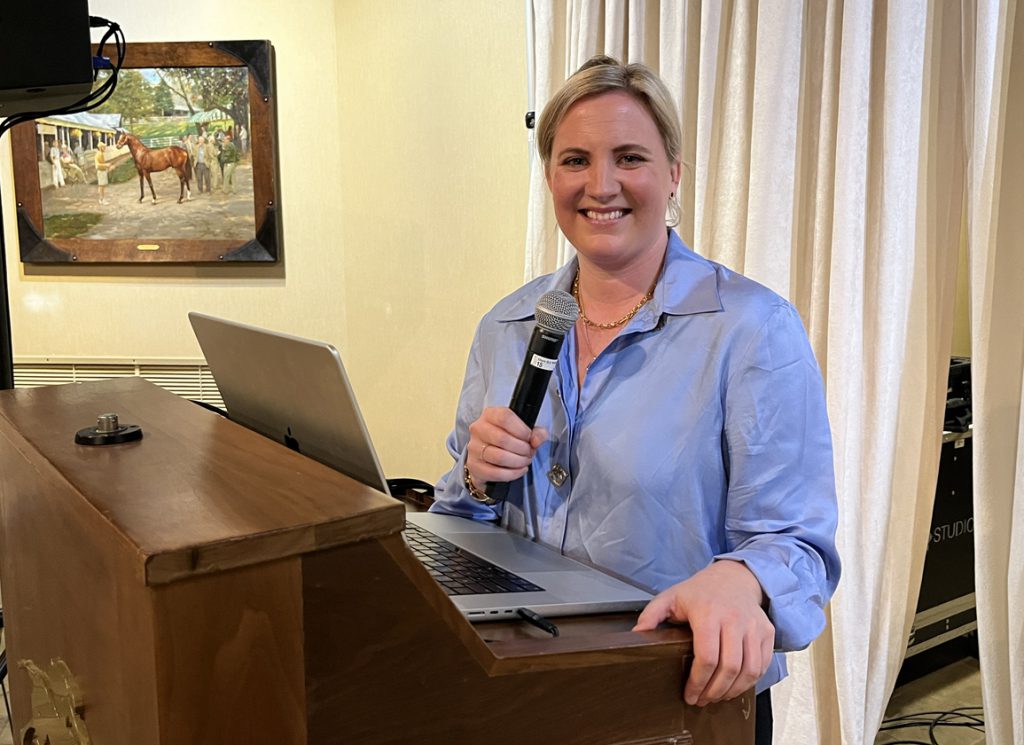
Light Up Racing's Vicky Leonard | Sara Gordon
Diving deeper into how best to handle any contentious conversations concerning the industry, Leonard encourages approaching from a mindset of curiosity, not defensiveness. She suggests using two important questions–'What makes you think that?' and then, 'Where does your information come from?'–in response to someone who poses a difficult question in order to discern what their value system is and how best to address the question.
Outside of those interactions, Leonard encourages every industry member to simply be more cognizant of the language they use when discussing the industry. Though many phrases or terms are easily understood internally, they can take on a whole new meaning when heard by someone outside of the industry.
“In the media too, we can also be a bit relaxed. We use terms like 'breaking its maiden' or 'breaking from the barriers,' and again, we don't realize that people that don't know the industry well, it's actually a poor way to be putting our sport out there,” she said.
Continuing on, the top tier would be the cohort, which Leonard explained would be the most time-consuming level of involvement. Within this level, Light Up Racing aims to establish a group of 100 people who have gone through official social media and media training.
The goal is to establish and support a team of people willing to become authentic influencers, forming a grassroots network of spokespeople for the industry.
“When a crisis happens, we don't just always have to turn to our CEOs. If we have the right people in the grassroots, you're always going to be far more trusted than somebody being told that they have to do that interview,” said Leonard. “Our job is to empower you, but ultimately, you have to do it. Whilst we can give you all the tools in the world and the strategy, along with giving you the support and the resources, we do need you, the people in this room, to make sure that it works.”
Outside of providing the resources for those industry advocates to be able to address the media, Light Up Racing hopes to inspire all industry members to use their personal experiences and share that on social media, giving the public a 'behind-the-scenes' look at everyday life in the racing industry. Online content that 'pulls back the curtain' not only garners an audience, but educates that audience as well, which in turn organically improves public perception.
“The time of looking towards just the elite has passed. We really look for relatable people in everyday life. People who know someone in an industry, even if just on social media, are far more likely to trust that industry,” said Leonard. “What's vital with social media is that authenticity trumps perfection. We need to stop worrying about being perfect and start being real.”
Light Up Racing is developing a curriculum that will be released in the next couple of weeks as they bring together their first group of 20 people, based out of Kentucky, to go through the media training. They will do five of these training sessions over the next several months based in different areas.
A full recording of the two community presentations will be available online. To learn more about Light Up Racing and how you can get involved, visit LightUpRacing.com.
The post Light Up Racing Aims To Change Industry Narrative appeared first on TDN | Thoroughbred Daily News | Horse Racing News, Results and Video | Thoroughbred Breeding and Auctions.