Zoffany’s Sakheer Impresses With TDN Rising Star Display

KHK Racing's once-raced 2-year-old colt Sakheer (Ire) (Zoffany {Ire}–Shortmile Lady {Ire}, by Arcano {Ire}), who shaped with a deal of promise when posting a debut second going six furlongs at Windsor last month, was a class above his rivals in Thursday's Auction Finance EBF Novice S. over the same trip at Haydock and attained 'TDN Rising Star' status with a mightily impressive display of raw power. Swiftly into stride for an early advantage, the 1-2 favourite was untroubled from halfway and extended clear in hand to easily rout Acai (Ire) (Kodi Bear {Ire}) by six lengths. The Roger Varian trainee is engaged in Newbury's Sept. 17 G2 Mill Reef S. and the G1 Middle Park S. at Newmarket one week later.

“He ran a great race first time out, he picked up and finished well clear of the third,” commented winning rider David Egan. “We wanted him to have a nice debut, he learnt a lot and came from behind. I expected him to take a step forward and, from halfway, I knew he was a class above the rest. It's been a great job by everyone at home to get him here and to get his win. To do it like that was impressive and the feel he gave me was even more impressive. I don't think I've had an easier race, in any sort of race, since I've been riding. He has a big price tag, he's got some big entries coming up and there is a lot more in the tank. Horses like this make our jobs easier, he's a classy individual and very exciting.”

Sakheer, who was the highest-priced lot when knocked down for €550,000 at this year's Arqana Breeze-Up sale, is the fifth of seven foals and third scorer out of a half-sister to G3 Prix de Meautry winner Indian Maiden (Ire) (Indian Ridge {Ire}), herself the dam of G3 World Trophy victrix Maid In India (Ire) (Bated Breath {GB}) and the dual stakes-winning G3 Prix de Ris-Orangis runner-up Love Spirit (GB) (Elusive City). The February-foaled bay is a half-brother to multiple Group-winning GI Beverly D. S. third Lemista (Ire) (Raven's Pass), a yearling colt by Exceed And Excel (Aus) and a weanling filly by Sea The Stars (Ire).


3rd-Haydock, £10,000, Nov, 9-1, 2yo, c/g, 6fT, 1:11.20, g/f.
SAKHEER (IRE), c, 2, by Zoffany (Ire)
1st Dam: Shortmile Lady (Ire), by Arcano (Ire)
2nd Dam: Jinsiyah, by Housebuster
3rd Dam: Minifah, by Nureyev
(80,000gns Wlg '20 TATFOA; $65,000 RNA Ylg '21 KEESEP; €550,000 2yo '22 ARQMAY). O-KHK Racing Ltd; B-Drumlin Bloodstock (IRE); T-Roger Varian. Lifetime Record: 2-1-1-0, $9,337. Click for the free Equineline.com catalogue-style pedigree.

The post Zoffany’s Sakheer Impresses With TDN Rising Star Display appeared first on TDN | Thoroughbred Daily News | Horse Racing News, Results and Video | Thoroughbred Breeding and Auctions.

Source of original post

CBA To Hold ‘Deal or No Deal’ Event Ahead of KEESEP

The Consignors and Commercial Breeders Association Inc. (CBA) will stage their fourth 'Deal or No Deal' event on the eve of the 2022 Keeneland September Sale from 4:30-6 p.m. It will take place at the Paddock Chalet next to the East Gate entrance at Keeneland, just up the hill from the sales pavilion. Keeneland will provide food and drink and live racing will be streamed from Kentucky Downs.

The 'Deal or No Deal' series kicked off last year, first at Fasig-Tipton in July and then again at Keeneland in September. In question-and-answer format, prospective buyers are granted access to industry professionals who share their experiences with veterinary findings in young horses.

Panelists will be asked questions about the impacts of various X-ray findings on performance. The participants include veterinarians Dr. Mark Cheney and Dr. Bob Hunt, European pinhooker Brendan Holland of Grove Stud, 2-year-old in training consignors Niall Brennan and Susan Montanye and trainer Todd Pletcher.

The post CBA To Hold ‘Deal or No Deal’ Event Ahead of KEESEP appeared first on TDN | Thoroughbred Daily News | Horse Racing News, Results and Video | Thoroughbred Breeding and Auctions.

Source of original post

September Snapshot of Stallion Scene

by Chris McGrath & Stefanie Grimm

It's all the trees I feel guilty about. That, and the postman's lumbago. But while many people nowadays complacently compress the world's biggest yearling auction onto a digital device, a stubborn few of us will always prefer scribbling notes on the dog-eared pages of a paper catalog.

Whichever your preference, of course, you will do well to avoid wearing out the soles of your shoes during the Keeneland September Sale–not to mention other reserves, in morale or finances. Before you start appraising individual hips, however, it might be worth attempting a wider panorama of the sale.

Because their relative representation, across what is unarguably the most comprehensive of all marketplaces, provides an interesting measure of the current balance of power among Kentucky stallions.

We've divided the sale into three sectors: Book 1, for the elite tier; Books 2 and 3, for a version of that elusive “middle market”; and Books 4, 5 and 6. Pretty crude, clearly. Many horses in Book 2 will have far more in common with their Book 1 peers than with anything in Book 3; and some in Book 4, equally, will be different class from Book 6. But, look, it's just one snapshot; a picture drawn in clumsy brushstrokes, not a draughtsman's pencil. We'll just demarcate stallion representation across the two weeks, and see what–if anything–turns up.

The first thing to remember is that catalog distribution is never a simple, scrupulously neutral assessment of merit. The sales company has to work with consignors, and consignors with their clients. The freshman, for instance, needs to be given his now-or-never platform. Same with the proven elite: bury a six-figure cover in Book 6, and you might as well send the creature in towing a plow.

There are some consignors, equally, who remain adamant that a certain type of yearling will do better if relegated to stand out from the crowd at a lower level. Whether or not that strategy is justified, it obviously backfires in an exercise like this one.

Besides, the market will nearly always end up more or less obeying the cover fee. That's certainly true of spending, especially on new sires, no matter how loudly agents claim simply to be assessing the flesh and blood in front of them. Much the same can be expected, then, when inspectors and consignors try to anticipate the market. Even so, perhaps we can find one or two stallions that deserve an extra rosette.

Quality Tells in Book 1

There's an immediate caveat here, in that some of the best yearlings of the crop have already gone under the hammer at Saratoga. As we've already stressed, however, this is just one moment in time and by no means definitive. It was tempting, indeed, to combine Book 1 with Fasig-Tipton's Select catalog. But Book I does at least give an undiluted elite flavor.

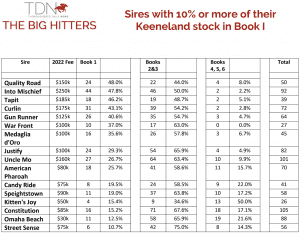
The table below is ranked according to the percentage of stallions' September entries to have gained admission to Book 1, down to a ratio of one-in-10.

There's an unsurprising correlation between Book 1 footprint and fee. But the six-figure club has internal competition all of its own and, while the proportion of his Book I stock is only a scintilla higher than that of Into Mischief, there's no mistaking the statement made here by Quality Road.

Because this is a very important stage in the career of a stallion now in his prime at 16. This crop was conceived during his single season at $200,000, in 2020, a second consecutive hike after he had been catapulted from $70,000 to $150,000 the previous year. City Of Light had driven the initial rise before joining his sire at Lane's End in 2019, his swansong success in the Pegasus being promptly followed that year by other Grade I scores for Dunbar Road, Roadster and Bellafina.

Their sire has since reverted to $150,000, but it's obviously a great sign that he has managed to get very nearly half his September stock into the two showcase sessions. His first six-figure covers, in 2018, resulted in a spectacular juvenile, Corniche, and if that colt has since proved a source only of frustration, then the gap was helpfully filled this summer by a graduate of the previous crop, Bleecker Street, in the GI New York S. at Belmont.

Quality Road has already sold a $1.8-million filly this summer at Saratoga, where his four other hips reached $700,000, $350,000, $205,000 and $575,000 (RNA). Having worked his way up from a base of $25,000, it was vitally important for Quality Road to match his billing once promoted to the top echelon. So far as the Keeneland inspectorate and the consignors are concerned, at any rate, that seems to be pretty much what he's doing.

Nowadays, of course, Into Mischief stands alone in terms of his fee and, having exponentially advanced his record with the quality of his books, he accommodates no fewer than 90 of his 92 September entries in the first three of the six books. Tapit and Curlin, long established at this level, also house over 40 percent of their September stock in Book 1, and the phenomenal young sire Gun Runner has now also tipped that mark.

Having had 11 in Book 1 last year, the Three Chimneys champion is now up to 26. He has, moreover, already sold a couple of standouts from his third crop at Saratoga: a colt bought by White Birch Farm and M.V. Magnier topped the whole sale, at $2.3 million, while the latter gentleman also signed for another at $1.4 million. And remember that Gun Runner was only elevated to the six-figure bracket this spring.

The star of the next intake, Justify, has also consolidated well; while we should remember that Constitution remained no more than $40,000 when conceiving the 16 yearlings (of a whopping 105 in the catalog) that have made the elite book.

Beach Making Waves on Debut

Among the debutants at the sale, Omaha Beach stands apart with an impressive Book 1 ratio of one-in-eight. With two-in-three then surfacing in Books 2 and 3, moreover, he looks well positioned to maintain his early momentum as top rookie.

He dominates the table below which is restricted to Kentucky rookies with more than 15 yearlings in the September Sale.

Having processed 10 of 13 so far offered at other auctions, at an average $268,882, Omaha Beach has jumped pretty flamboyantly through every hoop so far. Even on the top fee of the intake, he looked fair value at his introductory fee and Spendthrift have meanwhile been characteristically aggressive in keeping him in the game.

Audible managed to get four into Book I, having already sent seven yearlings to Saratoga. He has punched weight with a significantly bigger proportion in Books 2 and 3 than all bar Omaha Beach.

The only other newcomers to break into Book I, with one apiece, are Catholic Boy, Vino Rosso and Preservationist. I'm a huge fan of the latter, who was launched against a fairly steep commercial slope, so he deserves congratulation for getting hip 179 into the premier book off a $10,000 cover. This colt must be pretty special, in the circumstances, so y'all get down to Barn 12 and take a look! The dam is a half-sister to a Grade II winner/Grade I runner-up and has already contrived graded stakes winners by Creative Cause and, wait for it, Haynesfield.

Don't be alarmed by how many of these freshmen will be doing the bulk of their trade in the second half of the sale. That's pretty standard for many established sires, and we all know how vital sheer volume is to the launch of these fellows. And it can't be reiterated enough that this is just one fleeting glimpse of one market, however big. Budget stallion Flameaway, for instance, hit one out of the park at Saratoga at $425,000.

All these horses have to do now is run.

Grass is Greener

One real paradox is the deference the U.S. market will show to turf stallions based in Europe, while giving so little commercial oxygen even to the most eligible imports to Kentucky.

A number of European stallions surface in this catalog, mostly with a single shot. Given American activity at the breeding stock sales in recent times, most of these yearlings were presumably imported in utero with their dams. And, curiously, they have all been given a ticker-tape reception.

Galileo (Ire), Frankel (GB) and Kingman (GB) unsurprisingly get the Book 1 limelight for their respective samples. No Nay Never, as a thriving son of Scat Daddy, fields four–one in Book 1, the rest in Book 2. But even stallions that maybe aren't so well known in Lexington get full respect: Bated Breath (GB), Calyx (GB), Study Of Man (Ire) and Wootton Bassett (GB) all field their solitary offerings in Book 2. Caravaggio, himself since imported to Kentucky, has been followed over the water by four from his last European crop and all but one are accommodated in Book 2.

Stoking the Embers

When a stallion is pensioned, or sold abroad, or lost prematurely, vendors always anxious about his residual stock being ruthlessly abandoned to fend for themselves. With the marketing teams no longer putting their shoulders to the wheel, these hapless animals tend to be left to fend for themselves. It's a tribute to pure quality, then, if they retain prominence in the catalog–as, for instance, when Arrogate sells three-in-four of his final crop in the first half of the sale.

They are all collector's items, after all, but the same is true of just three yearlings salvaged here from the final crop of Tiznow. Surely it would be rash to leave town on Friday without at least checking out this trio of colts. Hip 1195 is out of a mare whose son by Tiz Wonderful won a Belmont maiden and the GIII Sanford S. on his only two starts; and the second dam is half to a French Classic winner. Hip 2011 demands a look regardless, simply because you must never miss a visit to Crestwood's consignment. And hip 2090 is out of a Storm Cat mare (herself daughter of a Grade I winner) that has previously produced a multiple graded stakes-placed Listed winner by Tonalist.

Noble Mission (GB), meanwhile, sadly proved too well named, having failed to prise open the eyes of myopic Kentucky breeders before the Japanese cannily rehomed Frankel's brother. Predictably enough, 10 yearlings from his final Kentucky crop have been dumped towards the end of the second week, but I shouldn't be at all surprised if there was a gem or two lurking there.

Among those sires still persevering against neglect, you'll find some chastening names with a bare handful coming under the hammer. Several haven't been given anything like an adequate chance, but they're in trouble enough as it is and we won't make things worse by drawing attention to specific examples.

But it's too poignant to pass over the fact that the pair responsible for the first and third past the post in last year's Kentucky Derby, Protonico and Oxbow, can, respectively, muster just two yearlings and one. Let's hope both earned some renewed attention this spring, and might yet return from the brink.

Oxbow must obviously share the plaudits for Hot Rod Charlie with the dam of that heart-warming racehorse: Indian Miss, after all, had already produced Mitole by Eskendereya. Yet Oxbow would surely be amazed to learn that even $1.6 million was insufficient to get her latest colt, by Into Mischief, to his reserve at Saratoga!

Hats off the Middle Men

Here's a club you can be proud to join; one that shows you have done what it takes to achieve a viable niche in Kentucky.

The table below probes the very marrow of the market. It excludes the absolute elite, which for present purposes we'll define as those (featured in Table A) whose Book 1 footprint represents 10% or better of their September stock. It also leaves out the freshmen, who are a case apart and duly treated as such in Table B. And it cuts off at 40% representation in Books 2 and 3. Believe me, that's a true badge of distinction.

You may well think it depressing that even some of these rock-solid operators must sell half their September stock in the second half of the sale. But all you have to do is think of your favorite stallion that might be eligible for this table, only he's nowhere to be seen. A quick, back-of-the-catalog calculation on his distribution will teach you due respect for these guys.

And, above all, for Ghostzapper. What an unbelievable shape we find to the distribution of his yearlings in this sale: just three in Book 1, but just four in Books 4, 5 and 6. And 33 crammed into Books 2 and 3! That is what I call a stallion you can set your clock by.

There are quite a few other veterans in this group, the odd pensioner, and indeed sadly a couple that have left us altogether. Conversely there are also one or two younger guns, notably Not This Time, who are laying strong foundations for the leap into that one-in-10 Book I echelon as the ageing sires in that group fade.

True, some of these are still riding that initial commercial wave, their longevity at this level contingent on the deeds of stock now venturing onto the racetrack. But I tip my hat to anyone who can keep less than 25% of his trade out of Books 4 through 6, as has Munnings in maintaining his model rise.

If only the “middle market” truly represented the middle of the road! Wherever you find yourself this September, mind the traffic–and good luck.

The post September Snapshot of Stallion Scene appeared first on TDN | Thoroughbred Daily News | Horse Racing News, Results and Video | Thoroughbred Breeding and Auctions.

Source of original post

Unsung, but Vital: ‘The Johnny Burke Treatment’

Anyone else who had trained this many Grade I winners–there's barely space for their photographs in the barn office–would by now be knocking at the door of the Hall of Fame. But how many even know the name of Johnny Burke? How many know his cheerful, friendly face or the store of experience that draws together so many evocative names, on two legs and four, of his own and past generations?

As an adolescent, Burke was the first person ever to sit on the back of Midnight Court, subsequently winner of the 1978 Cheltenham Gold Cup. Four decades later, he took an unsung role in the success of Mystic Guide (Ghostzapper) in the G1 Dubai World Cup, having welcomed the horse into his care as rehab trainer for Godolphin. In between, Burke has accumulated memories and expertise that makes it a true privilege to intrude on his company, in the apt seclusion of the auxiliary stabling below the Rice Road perimeter of Keeneland racetrack.

“I'm just a small cog in a big wheel,” he protests. “My crew here, when the horses have gone back to the trainers, they're all in here screaming at the TV. That's what I love to see.”

This determined effacement of his own role will not be shared by anyone else in the American branch of Sheikh Mohammed's racing empire. Talk to the trainers, talk to the team at Jonabell, and you'll often hear grateful reference to how Burke has redeemed the potential of priceless animals. Since hiring him in 2006, they have been able to rotate a constant floating population–seldom more than 30, but by now around 2,000 in aggregate–of horses that need to regroup or reset.

“We're very fortunate that we have trainers who catch things early,” Burke says. “But, of course, stuff happens with horses that's unavoidable, and a lot of young horses will have setbacks. With those, there's still a lot going on: they're still growing, still learning. But with all of them, ideally, you want them to graduate back out of this barn so that their progression can continue. They obviously all come here for a reason: maybe a soft tissue, a bit of surgery. And you're never sure if that might have left an impression. So my philosophy would always be, besides physical rehab, that they'll often need to get their confidence back as well. That was always a big thing with my old man: their confidence.”

Ah, yes, the old man. Like so many Irishmen of his generation who have found a niche in the American industry, Burke benefited from a hardboot upbringing with a strong steeplechasing flavor. Indeed, when he lost his father three years ago, the whole sport in his homeland lost a precious connection. Mick Burke had been the last living apprentice of Vincent O'Brien's Clashganniff era. In his youth, he had schooled Cottage Rake.

So far as his son is concerned, however, the key phase of Burke, Sr.'s varied and colorful career was his service as private trainer to Viscount Petersham (later Earl of Harrington) on Richmond Stud in Co Limerick. This was where Burke was raised, and where he was first hoisted onto big, rangy steeplechasers when no more than 12 years old.

Burke will never forget the first piece of work he ever rode.

“Upsides with dad,” he recalls. “No helmets. I would have been about 15. We went into this big stubble field, we weren't really supposed to be in there, and the old man said, 'Right, just get a hold of him and sit quiet.' And we just winged it up that hill. Some buzz. I'd never felt anything like it. After that, it was all I wanted.”

One of the raw young horses Burke helped his father to break had been bought cheaply for the boss from Toss Taaffe: by Twilight Alley out of a mare named Strumpet.

“And actually I was the first person across his back,” Burke says. “We broke him at Richmond and Dad ran him a couple of times. I think he just gave him a run in a maiden hurdle first up, in Down Royal, and might have got 'called in' over that! And then he went to Mallow and won a bumper.”

That earned Midnight Court a place in the Tom Costello nursery. Around that time, however, Petersham decided that he was being driven out of Ireland by taxes, and sold up for Monte Carlo.

“So the question was what should they do with the Twilight Alley horse, over at Tom's?” Burke recalls. “So the old man got in touch with Fred Winter, picked him up at Shannon airport, and they went out to look at the horse. I think the guvnor [i.e. Winter] might even have popped him over a pole. Anyway the deal was done, the horse went over to England as a novice, and won the Gold Cup the next season.”

Burke himself would end up following Midnight Court to Uplands, after first becoming one of many compatriots indebted to Dr. Michael Osborne's course at the Irish National Stud.

“It's funny how many people come from the jump game and end up doing the type of thing we're doing now,” Burke muses. “But I think all of us, in my generation, were at the last cusp of the old school. In those days the guvnor would come round evening stables, and you twisted in your doorways and stood your horses up. It just gave me a good grounding.”

Burke had absorbed his education so well that Osborne asked him back to the National Stud to assist the next intake as a yard foreman. And it proved to be some crop, that year: Niall Brennan, Eoin Harty, James Keogh, Jim FitzGerald, Sam Bradley, Michael O'Hagan.

There had, after all, been another dimension to Burke's education at home: he had worked with the yearlings at Dooneen Stud, an annex of Greenmount (since largely absorbed by Limerick racecourse) where the Stanhope family housed a number of fast stallions.

“Huntercombe, a Derring-Do horse, held the record for a long time at Longchamp,” Burke recalls. “When I was working at Winter's, there was a lad there who used to ride him on the gallops at [Guy] Harwood's. He said he was the only horse he ever had to work wearing goggles! They also had Pitcairn, who sired Ela-Mana-Mou out of Rose Bertin. I remember her when she came to Pampapaul at the Irish National Stud. He'd beaten The Minstrel in the Irish Guineas but was a terribly slow breeder. He bit her, she turned and kicked, and he whipped out of the way so quick that she caught me over the eye. We'd be sent into a different shed with Pampapaul, he might take two or three hours and hold everyone up. But then that Yellow God line was all very quirky.”

That's just one small sample of how Burke's reminiscences are strewn with names that make you want to stop him so that he can take you down the next warren of stories. But we can't keep him all day, so let's fast forward: through a couple of years in Australia, turning down an offer to stay on from C.S. Hayes because he hadn't yet experienced Kentucky; then coming to the Bluegrass in 1983, aged 23, and finding Lexington full of guys he knew from back home.

“Though most of the ones who'd done the [National Stud] course all ended up on farms,” he says. “And all along I had always been the one who wanted to wear a helmet, the one who would end up on the track.”

But not, crucially, the only one. An Australian student, Murray Johnson, had come here to become a trainer, and would one day saddle Perfect Drift (Dynaformer) to run third in the Kentucky Derby.

Johnson is now back in Australia, but Burke called him recently and said, “You know, next March it'll be 40 years since you and I were having a beer one night here in Lexington. And you said, 'Come on, let's go down to Keeneland in the morning and get on some horses.'”

Burke continues the story: “So I bought a helmet and a pair of cowboy boots, and Murray said that we should help out this guy, he needed a couple of riders. It happened to be Carl Nafzger's barn–and I ended up staying with him six and a half years. We banged heads a fair bit, but I hope we both brought something to the table. I was there until '89 and the last two or three years, I had his second string. He'd say, 'This horse needs the Johnny Burke treatment.' And he'd send it over to me to get it right.”

Which is, of course, pretty much the role Burke has today. In between, however, there still remained a fairly long and winding road, not without moments of doubt. Again, we'll have to compress the tale a little.

Having tired of the traveling circuit, met future wife Patricia, and applied for residency, Burke was next indebted to Niall Brennan for introduction to a couple of opportunities. First was a pinhooking venture for Hong Kong clients in Ocala, “back in the days when 11: was still a good move” at the 2-year-old sales. And then Brennan heard that Tony Foyt was looking for an exercise rider back at Keeneland.

That gave Burke a foot back in the Kentucky door, but he was still making do with some part-time work at Gainsborough when a guy he'd met in Ocala rang and said he had a horse too mediocre to remain at Jonathan Sheppard's stable. Would he maybe take it on?

“So Howard Battle gave me this one stall down here on Rice Road,” Burke recalls. “I used to come in and train this horse, go off and do my day's work at Gainsborough, and then come back in at four to feed him.”

Burke still only had one charge, albeit with a few more promised, when next renting 10 boxes at what is now the Kentucky Horse Center. The bank wouldn't loan him the money for his first month's rent, so Patricia paid from her nursing wages. Friends like Robbie Lyons and Padraig Campion stepped up to the plate with clients, and for 15 years or so Burke held his own, exercising most of the horses himself.

“We did okay,” he says. “Didn't run a lot of horses, but I made a living and was able to go home once a year and do a bit of hunting. And I trained a couple of winners for Sheikh Mohammed. Michael Banahan had said to Jimmy Bell, 'These fillies are fairly fit, why don't we send them down to Johnny and see if he can break their maiden and we'll get them bred as well.' So I ended up sending back a few with their win pictures and a 42-day certificate of pregnancy.”

But the fact was that Burke was now well into his mid-forties, there were now twins at home, and he took a couple of bad falls in trackwork.

“Hunting falls were all right, you were full of port!” he says. “But one day up at Paris Pike I got kicked in the sternum and ended up in the ICU. Every now and then I still feel it. That was telling me, there and then, that my time was coming up. And it was shortly afterwards that Jimmy Bell called to say Darley were thinking of a permanent rehab and pre-training yard at Keeneland. Luckily I had the sense to see I was never going to get a chance like this again.”

Ever since, Burke has enjoyed the ideal equilibrium between his employers' unprecedented blend of quality and quantity, on the one hand, and a stable that always permits him an intimate connection with his charges.

“All the trainers have their different ways, but we're all aiming at the same thing,” he says. “Everybody's tied in, and it's pretty fine-tuned now. You know how long it should take you to get back from a certain issue or setback. You're training horses, same as you ever did, but really nice horses. The methods are no different, but there's great satisfaction.”

He gestures to one of the many framed photographs.

“Look up there,” he says. “Music Note (A.P. Indy). What I call one of our first 'charter members.' First group that ever came in here: she'd had minor setback, she was a little bit in limbo. Five Grade Is! Sometimes you have to remind yourself where you are. You don't take anything for granted, by any means. But look, there's Girolamo (A.P. Indy). That's Dickinson (Medaglia d'Oro). This right here is Wedding Toast (Street Sense). She had a few quirks as a 2-year-old, got confidence in herself and turned the corner. There's a mare the boss had out of Uruguay, Cocoa Beach (Chi) (Doneraile Coourt). She and Music Note just had the misfortune of being around the same year as Zenyatta (Street Cry {Ire}). Maxfield (Street Sense), he had a couple of visits here.

“It's great getting a couple of works into these horses and knowing they're in a good place. Or, sometimes, getting a nice surprise. Every now and then a horse comes in that has never really played his hand. Training horses, it's a bit like playing poker. You give him a bit of a squeeze and he looks at you, and you look at him: yeah, I know where you're at. But generally I just try to get them back in the game. If they're not comfortable, they'll usually tell you. And if they are enjoying themselves, they'll soon tell you that, too.”

It's a world apart from his boyhood, Midnight Court, that stubble field. But it's the same world, too.

“I've dealt with them all,” Burke says. “The black types and the white types! And, to me, they're all going to teach you something. I tell the 'Flying Start' students that it's never cut-and-dried, never black and white. If you don't have that connection, don't get their aura, you're better off doing something else. I love walking round the barn when it's quiet. That's when you might just see something, might suddenly connect. Because it's always about what you do when they're ready–and you're not going to do that, unless you get in touch with them.

“I think Dad was quite proud when I called and told him they'd offered me a spot here. It was him who taught me always to do things right. Do it properly. Of course, it was a different era. But while it may sound corny, I won't ever be satisfied, going home, unless I've put in a day's graft. And, as you get older, you look back and think: you know, it's been a bit of fun.”

The post Unsung, but Vital: ‘The Johnny Burke Treatment’ appeared first on TDN | Thoroughbred Daily News | Horse Racing News, Results and Video | Thoroughbred Breeding and Auctions.

Source of original post

Verified by MonsterInsights