“The dumbest rule in racing.”
That's how attorney Bill Gotimer said TVG analysts have described New York's Commission Rule 4040.2 which reads: “No jockey, nor such jockeys' spouse, parent, issue nor member of such jockey's household, shall be the owner of any race horse. All horses trained or ridden by a spouse, parent, issue or member of a jockey's household shall be coupled in the betting with any horse ridden by such jockey.”
The rule has become a topic of discussion in recent weeks as Gotimer said it has recently begun hindering the business of his client, jockey Katie Davis, since her marriage to fellow rider Trevor McCarthy.
Davis married McCarthy in December 2020 and the couple shifted their tack from Maryland to New York. They were later informed that since their marriage, Rule 4040.2 would require the racing office to couple their mounts whenever they rode in the same race, whether or not their horses had the same trainer or owner.
McCarthy has gotten off to a swimming beginning in New York, riding 19 winners from 154 starters this year for mount earnings over $1 million, putting him well on his way to surpassing last year's total earnings. Davis, by contrast, has had just one win from 53 mounts so far, despite coming into the season off two strong years in Maryland. Just before their departure, McCarthy was a leading rider at Laurel Park, while Davis was seventh in the standings there.
Mike Monroe, current agent for Davis, and Gary Contessa, who had her book briefly after her move to New York, both agree that the rule has negatively impacted Davis's ability to get mounts. Both heard from trainers who had named Davis on their horses, only to take her off after they learned about the coupling rule. Media reports have indicated the racing office at Aqueduct has discouraged trainers from using Davis in races where McCarthy is already named, since it would not cause a coupling of what would otherwise be two betting interests in the race. The New York Racing Association has categorically denied that racing office personnel have exerted pressure on trainers not to use Davis.
“It's a stupid, stupid rule,” said Contessa. “It's absolutely ridiculous. When I was booking her, I had a trainer – I'll not say who – who's a bettor. Most trainers are lousy bettors, but they like to bet on their horses and this guy liked to bet. This guy gave me four calls for Katie and two or three days later he told me 'Gary I can't do it because I can't have these horses coupled. I want to get 10-1, I don't want to get 3-1.'
“On the racing office side, they're losing a betting interest and if you really evaluate betting races, losing one betting interest or gaining one betting interest earns or decrease that race by about $100,000 in wagers.”
Monroe said the rule does apply equally to Davis and McCarthy – if McCarthy is named on a mount after Davis, the trainer of McCarthy's horse will be informed that they will be coupled with Davis's mount – but McCarthy is booking mounts so quickly that he's usually named first. Monroe admits the mounts Davis has gotten have not done as well as they would have hoped, but is confident the coupling issue is the primary reason her career has stalled in New York.
“All we're really asking for is a fair shake, a level playing field. It's not a level playing field right now,” said Monroe. “We all know the racing office is having a difficult time with a shortage of entries, but that should not impact Katie Davis' status of being named on a horse. That's what we're trying to bring out here.”
Where did this rule come from?
Although Rule 4040.2 has become a target of complaint for Davis and her supporters recently, the New York State Gaming Commission told Gotimer it has been on the books since at least September 1974.
Though the rule is negatively impacting a female rider in 2021, a letter from New York State Gaming Commission executive director Robert Williams points out the rule is not written to only apply to female riders. It's true however, that the rule (logically) seems to have come about after women became licensed by New York state, which happened in 1969. And Monroe and Gotimer point out that the rule is going to naturally be unevenly impactful towards which ever spouse has less career momentum.
“There's going to be a day when you face this question with same-sex spouses,” said Gotimer.
Part of the reason the rule about married jockeys may have seemed dormant for the past 47 years is that there have been relatively few instances where married jockeys have tried to ride against each other in New York. The closest comparable case in recent memory may be Jose Ortiz and Taylor Rice Ortiz, but Taylor said they never had the opportunity to find out how the rule may have impacted their careers.
Taylor and Jose were engaged for some months before their wedding in December 2016. Taylor said she didn't know about Rule 4040.2 and was planning to continue with her career as a jockey, but found out she was pregnant with the couple's first child shortly before the wedding, prompting her to retire. Taylor, who has many immediate and extended family members in the sport, said she knew that marriage could complicate things.

The Ortiz family as of 2017
“I had heard of my dad's generation had been married and they had conflicts, and I knew that if you're a jockey and you're married to a trainer, you have to ride for your significant other,” said Ortiz. “What Trevor and Katie are going through, I had no idea the extent of it.”
That doesn't mean that she can see the logic in New York's rule. After all, she points out, she rode for her aunt, trainer Linda Rice, on many occasions but also rode for other trainers in races where Rice was saddling an entry and was never coupled in those races. She lived with Ortiz for several months before their marriage – an arrangement that was common knowledge on the backstretch – and that did not result in the racing office coupling their entries.
During the summer, when many riders, trainers, and others descend upon Saratoga Springs from out of town, Taylor Ortiz said it's also common for family members and close friends to share rental houses, as Jose and Irad Ortiz have done in the past, and cohabitation hasn't resulted in entries being coupled.
“What's crazy to me is that the horse racing industry is so intertwined between family and marriage,” said Ortiz. “So we could have stayed engaged forever, but as soon as we sign documents saying we're married it's a problem for one of your rules? It doesn't make sense to me.”
In initial research, Gotimer said he could find no other rule currently on the books in other major American racing jurisdictions that places the same kind of restrictions on riders as the New York State Gaming Commission. Instead, he found that cases where states or tracks had restrictions on married jockeys and had subsequently removed them.
In 1998, married riders Harry Vega and Amy Duross were told by Suffolk Downs stewards they couldn't ride in the same race, but that policy was later overturned by the Massachusetts Racing Commission. When jockeys Angel Serpa and Carol Cedeno were married, they competed against one another on uncoupled horses in Florida.
“[The restriction is] based in two concepts, neither one of which are really acceptable,” said Gotimer. “One is that licensed parties in New York state, and in particular jockeys, can't be trusted. I think that's a wild insult to world-class athletes.
“I think the second point is that it's based on an anachronistic idea that one spouse controls another. I don't see that in racing, and I don't see that in New York.”
Gotimer said he has not been retained for the purpose of bringing any legal action against the commission, but is hopeful the two sides can reach some kind of agreement about improved rule language.
“The Commission has commenced an examination of the rule origin, the harm it sought to prevent, its present applicability, and in what manner the harm – if any – can be addressed by alternative means,” said commission spokesman Brad Maione. “Additionally, we are seeking to place the rule in context, considering how similar situations are governed in other regional racing jurisdictions, in larger U.S. racing states and in major international jurisdictions.
“The rule appears by its plain language to be integrity-based with neutral applicability, but we intend on undertaking a de novo review.”
The rule has impacts on jockey/trainer combinations, too
Though Rule 4040.2 has mostly been discussed in the context of its impacts to two married jockeys, it has also come up for married trainer/jockey duos in New York.
Rachel Sells, who has had her trainer's license since 2017, is married to jockey Jose Soñe and is based at Finger Lakes. When she takes a horse to a race at a New York Racing Association track, Soñe must either sit the race out or ride her horse – he cannot ride for a competing trainer. At Finger Lakes, she said they were initially told that Soñe could ride other trainers' horses running against hers, but his mount would be coupled with her horse if he did so. Sells pushed back.
“We had issues with the racing office a few times,” she said. “I'm not one to sit back and let things happen. I'm a very vocal person. One day I called the racing office after I was informed my husband got taken off a horse because I had a horse in the race and I let them know they were denying him the right to a living and that's illegal. You can't tell somebody not to ride him because it's going to make the body of the race smaller.”
Eventually, Finger Lakes changed its house rules on the issue.
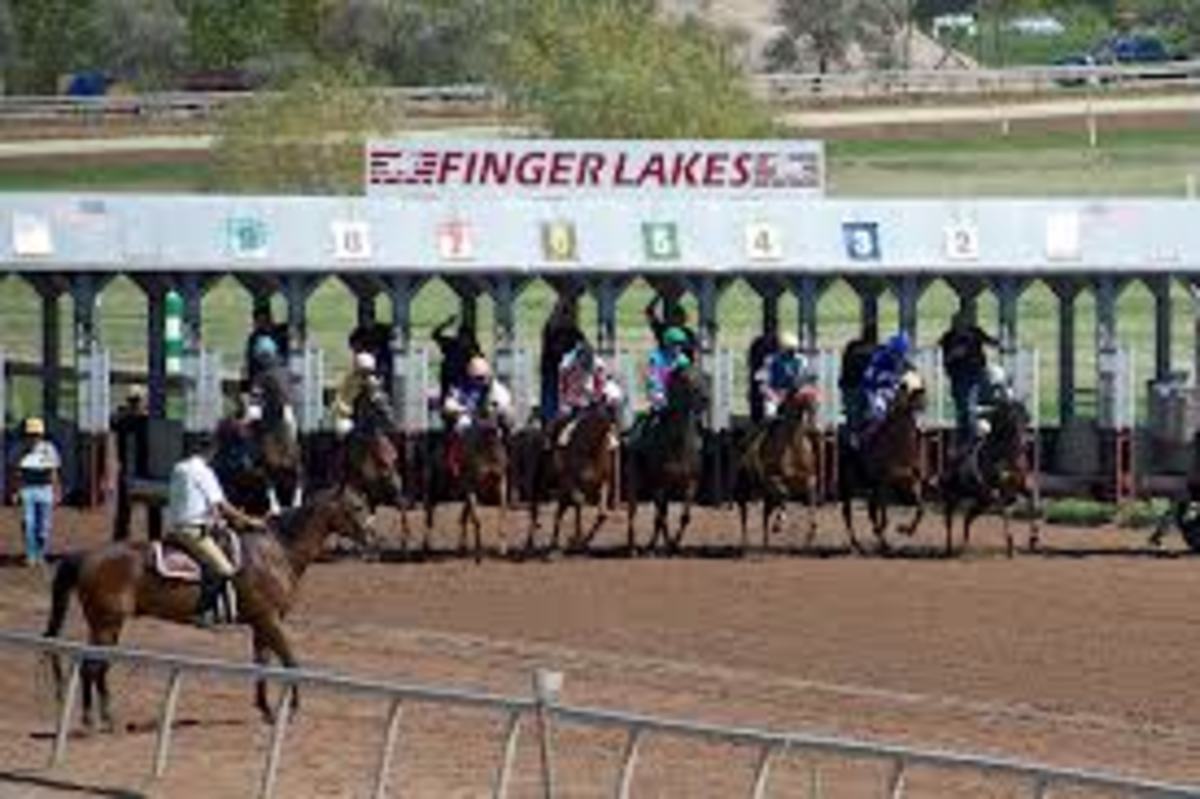
It's not a problem for Soñe to give first preference to Sells' horses, but for a rider with a wide client base, it might be. Taylor Ortiz pointed to the case of Rosie Napravnik, who had long been one of the go-to riders for Mike Maker when her husband, former Maker assistant Joe Sharp, opened his own training barn. Napravnik retired in 2014 upon learning that she was pregnant, not long after Sharp put out his shingle, so they didn't have much chance to find out how much her business may have been limited by the requirement that she give preference to Sharp's horses.
When saddling at her home base of Finger Lakes, Sells is still not permitted to own horses herself because she lives with Soñe, which she said has forced her to pass up great business opportunities. When she travels to a NYRA facility or anywhere out of state however, she encounters no problems running horses as both owner and trainer.
“For me, I could see if I do own a horse and I have a horse in the race, he has to ride that horse; I understand that,” she said. “But it's not even just for me. I have a groom who works for me and she's dating a jockey and wanted to buy a horse last year. I called the stewards and asked them about it and they said no, because she cohabitates with a jockey. It's not even just for trainers.”
Soñe doesn't ride as many races these days, though Sells said that's not because he has to give her first call as a trainer. Soñe has been a licensed rider since 2001 and while Sells said he will decide for himself when to hang his tack up, he isn't taking as many mounts as he once did.
“He's a lot more cautious on who he chooses to ride for,” she said. “At some point I do want him to be able to retire from riding and just come be with me and not have to worry about it.”
After all, being a jockey is a tough gig.
The post ‘A Stupid, Stupid Rule’: New York Restrictions On Married Jockeys Stifling Davis’ Business appeared first on Horse Racing News | Paulick Report.
Source of original post