Kirkpatrick & Co Presents In Their Care: As She Logs Miles Assisting Pletcher, Horses Are Home For DePasquale

Ginny DePasquale never imagined that experience as a well-traveled first-grader would prepare her to play an integral role in trainer Todd Pletcher's Hall of Fame career. Yet that is what happened.

Although DePasquale was born in Philadelphia, she did not remain there long since her father served in the Navy. Her first real introduction to horses occurred when she was three years old and there was a stable across the street from the base in Corpus Christi, Texas. She barely met her first-grade classmates at Corpus Christi before it was back to Philadelphia and on to Jacksonville.

“We traveled all around the country and halfway across the world with him,” DePasquale said.

Wherever they ventured, horses became something to cling to during a childhood in which change was the lone constant. She felt particularly fortunate after the family journeyed to Morocco because there was a stable on the base.

“I used to go to the riding stable all the time when we were in Morocco. I used to spend my days there,” she said. “If my mom was looking for me, she knew where to find me.”

There was never much doubt that DePasquale's career path would lead to horses. She began working with them after high school while raising two children, Kimberly and Darin. She maintained a farm in Pennsylvania for a time before making her way to Florida. A friend told her that Pletcher was looking for a foreman to oversee 25 to 30 horses at Hialeah Race Track.

Pletcher, after graduating from the University of Arizona and working for six years as an assistant to legendary D. Wayne Lukas, had struck out on his own at the end of 1995. DePasquale knew little about him; he knew less about her. They took a chance on each other.

“At the time, you don't know,” she said. “I was so lucky.”

Pletcher got so lucky, too. As his financial backing strengthened and he began to oversee high-caliber stock, the need increased to send them far and wide in pursuit of black type and lucrative purses. Who could he trust to accompany them, to make sure their needs were met and they were made to feel at home in strange surroundings?

DePasquale became the woman for the job – and relished every minute. New people, new places, new things? Old hat for her.

“I always liked to travel. There were times I was gone every single weekend. I'd fly home, unpack, re-pack and was gone again,” DePasquale said of the intense schedule she followed for her first 15 years or so with Pletcher.

With DePasquale returning home with one victory after another, Pletcher rattled off four consecutive Eclipse Awards as the leading trainer in North America from 2004-07. He has an unmatched seven Eclipse Awards overall in addition to two Kentucky Derbies, three Belmont Stakes and 11 Breeders' Cup wins. He smashed the record for purse earnings with more than $413 million – and counting.

Pletcher, 54, emerged as an obvious choice for voters in his first year of eligibility for the National Museum of Racing's Hall of Fame. He constantly emphasizes the importance of DePasquale and others. He knows he had so many helping hands in receiving the sport's greatest accolade.

“You can't even quantify how much a bunch of people have contributed, especially the assistants,” Pletcher said. “I've been blessed to have some really good ones, some great ones that have been with me for a long time and some others who have branched out on their own and done very well.”

DePasquale, who declined to reveal her age, currently oversees horses that were left behind after the summer meet at Saratoga Race Course so they could continue to train there. She will move to Florida in November. Pletcher typically maintains a robust operation in South Florida at Palm Beach Downs as he perennially vies for honors as the leading trainer at Gulfstream Park's Championship Meet.

Communication among assistants is critical to the sustained success of what has become a massive operation. Tristan Barry remained with DePasquale in Saratoga. Byron Hughes is at Belmont Park. Anthony Sciametta reports in from Florida.

“If everybody is trying to work independently of each other,” DePasquale said, “nothing would get done.”

Every assistant reviews every horse with Pletcher every day.

“He has an unbelievable memory,” DePasquale said. “He knows the horse, the sire, the dam, what race they were in, what horses were in the race against them. Just amazing.”

She never considered moving on.

“He's so easy to get along with,” she said of Pletcher. “In all the years, I've never heard him raise his voice to anyone.”

DePasquale has considered retirement, but it is hard to break away from such a strong team, so many good horses and so much success. She begins each year by saying she would like to work one more season. She has said that for some years now.

Tom Pedulla wrote for USA Today from 1995-2012 and has been a contributor to the New York Times, Los Angeles Times, Blood-Horse, America's Best Racing and other publications.

If you wish to suggest someone as a potential subject for In Their Care, please send an email to info@paulickreport.com that includes the person's name and contact information in addition to a brief description of the individual's background.

The post Kirkpatrick & Co Presents In Their Care: As She Logs Miles Assisting Pletcher, Horses Are Home For DePasquale appeared first on Horse Racing News | Paulick Report.

Source of original post

Kirkpatrick & Co Presents In Their Care: The Assistant Trainer With His Own Eclipse Award

Not many assistant trainers have an Eclipse Award to show for their efforts. Darren Fleming does.

Steve Asmussen, his boss and an Eclipse winner in 2008 and 2009, ordered replicas made for Fleming and fellow assistant Scott Blasi to emphasize how much each means to the success of his powerhouse barn.

The bronze statuette took on added meaning for Fleming, Asmussen's longest-tenured assistant, on Aug. 6. Fleming saddled Shanghai Dream for the sixth race at Ellis Park and watched him make a stirring last-to-first charge in the six-furlong, $19,500 race that allowed Asmussen to tie Dale Baird for the all-time lead in North American victories with 9,445. When the mark fell to Asmussen at Saratoga Race Course the next day, it fulfilled a seemingly outrageous goal the trainer had outlined to Fleming decades before.

The two young men were having lunch in the late 1980's when Asmussen expressed his ambition. “I want to be the best. I want to win more races than anybody,” Asmussen told Fleming. “I want to be the leading trainer ever.”

Fleming could not quite believe what he was hearing. “I took it in jest a little bit,” he said. “But he wasn't kidding.”

Fleming began galloping horses for Asmussen, who was then still finding his way as a trainer, before joining him full-time approximately 20 years ago as an assistant. With each passing season, he came to appreciate how serious Asmussen was about making an indelible mark on the game.

Darren Fleming's Eclipse. Photo courtesy of Fleming

Fleming said of the record they now build on almost daily with a far-flung stable: “That was the goal the whole time. It's always been mentioned. In the last year, year and a half, it just kept coming closer and closer.”

The more Fleming got to know Asmussen, the more he realized that anything and everything was possible for him.

“He has an intensity level that is second to none,” Fleming said. “Like he says, 'Everything matters.' He goes to work every day with the same intensity as the day before. And that is what he expects from everybody, from the top to the bottom.”

Fleming also brings tremendous passion to racing. His father, William, was a jockey. Kerry, his wife of 30 years, received an inkling of what she was getting into on Thanksgiving Day, 1985. Soon after the meal ended, her future husband excused himself.

“I have to leave,” he told her. “I have to go water the horses.”

“It's Thanksgiving,” she reminded him.

“Well, the horses don't know it's Thanksgiving,” he responded. And he was off.

Fleming and Asmussen get along so well because of the drive they share. Fleming acknowledged that he is “probably a workaholic.” On a recent day, he and Asmussen already had spoken four times before 10 a.m. Fleming currently oversees 40 horses at Ellis Park and another 40 at Remington Park as part of an operation that numbers approximately 300 horses. Asmussen receives updates and provides instructions on every horse every day.

Fleming admits that it can be challenging to keep to Asmussen's torrid pace.

“Everybody has a tired day or a tired weekend,” he said. “But the rewards you get from racing outweigh everything. It's fun winning.”

Although loyalty can be fleeting in racing, Fleming never seriously considered leaving.

“It just feels natural by now. It's like walking,” he said of his position. “I don't think I could ever work for anybody else. Everything he does makes sense. If I was working for other people, some of the things they do just don't make sense for me.”

There are times when Asmussen makes the game look easy. Fleming knows better.

“I see what a tough game it is. I see how quick the tide can turn,” he said. “I get to be around most of the top horses at one point or another. It's just a great experience.” They produced the Horse of the Year on four occasions. Two-time honoree Curlin (2007-08) was immediately followed by the magnificent filly Rachel Alexandra in 2009 and later by Gun Runner (2017). Other than the Kentucky Derby, there are few major races the barn has not won.

Asmussen and his wife, Julie, foster a family atmosphere that contributes to success. Kerry and Julie shared babysitting duties when they were starting their families. Fleming had each of Asmussen's three sons work under his tutelage at one time or another.

“We are family,” Kerry said.

In another nod to Fleming and Blasi, Asmussen named his middle son Darren Scott.

“Everything we've gone through together, we got here collectively. What we've learned, we've learned together, from each other,” Asmussen said. “It's a beautiful feeling to have everybody pulling on the same end of the rope all the time.”

Perhaps some corporations could learn from Asmussen's business model.

[Story Continues Below]

“Steve treats them right, pays them right, appreciates them,” Kerry said. “It's such a fair deal all the way around.”

Asmussen has always understood that a trainer can only be as good as those he employs. “It makes everything we've done possible,” he said. “It's improved the small things and made the biggest thing possible.”

Even when the biggest thing of all was once hard to fathom.

Tom Pedulla wrote for USA Today from 1995-2012 and has been a contributor to the New York Times, Los Angeles Times, Blood-Horse, America's Best Racing and other publications.

If you wish to suggest someone as a potential subject for In Their Care, please send an email to info@paulickreport.com that includes the person's name and contact information in addition to a brief description of the individual's background.

The post Kirkpatrick & Co Presents In Their Care: The Assistant Trainer With His Own Eclipse Award appeared first on Horse Racing News | Paulick Report.

Source of original post

Kirkpatrick & Co Presents In Their Care: Anne And Joe McMahon Celebrate 50 Years Of Raising Good Horses, Staying Close To Nature

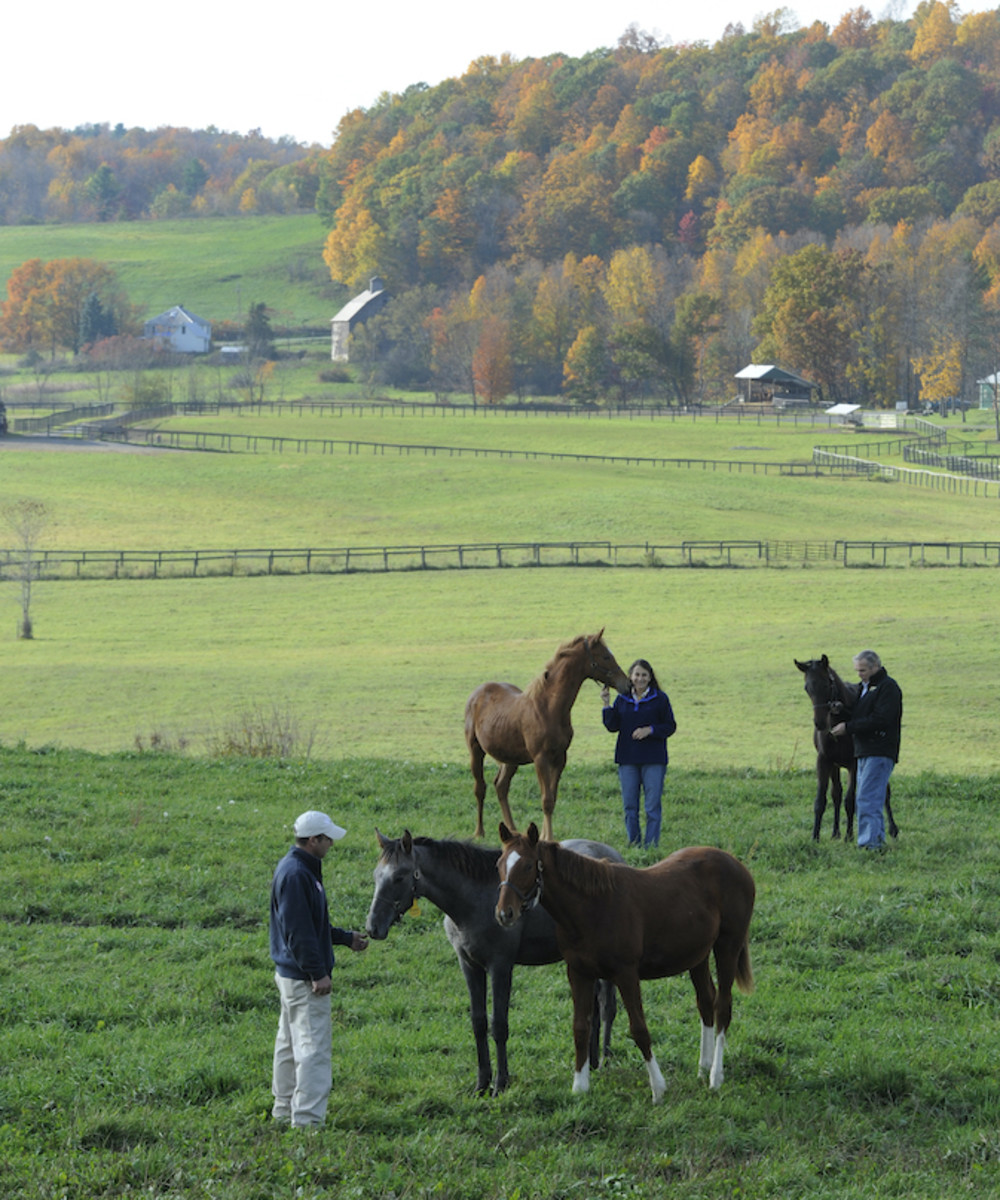
McMahon of Saratoga Thoroughbreds has grown exponentially since Anne and Joe McMahon established it with a couple of broodmares in 1971, expanding from 90 to 600 acres that nurture approximately 250 horses.

And it all started with Christmas trees.

The initial tract of land the newlyweds purchased near Saratoga Race Course was filled with Christmas trees that yielded much-needed income. They also sold eggs and pigs and raised much of their own food to bolster their fledgling horse operation.

“We didn't have much money because we spent it on the horses,” said Anne, recalling those lean early days. She is 70, three years younger than her husband.

They initially thought in modest terms, eager to start a family and indulge the passion for Thoroughbreds that brought them together.

“I never imagined in my wildest dreams it would be this big,” Joe said. “We thought we could have a small boarding operation here and raise a few horses of our own to sell or to race.”

The establishment of the New York State Thoroughbred Breeding and Development Fund in 1973, when combined with the McMahons' relentless work ethic and their emphasis on staying close to nature, elevated the operation to unimagined heights. It did not hurt, either, that the farm became celebrated as the birthplace of 2003 Kentucky Derby and Preakness winner Funny Cide.

The annual sale of Christmas trees eventually created space for pastures and more. Hay and soybeans are grown on site. The McMahons mix their own feed.

“To make this all work,” Joe said, “we had to do it on an economic scale we could afford.”

All five children – John, Mike, Jane, Kate and Tara – assist in some way. Quality is emphasized in every aspect. “If you go beyond the basics of good feed, good grass, good pasture, then you've gone a whole long way toward developing a good horse,” Joe said, adding, “We try to do the basics really well.”

Jane, a farm manager, marvels at how far that philosophy has taken them.

“The older I get, the more I appreciate what they've done,” she said. “They really had no connections in the industry and they really had to put their back into it every single day for 50 years. They didn't just walk in and buy the kind of bloodstock you need to be successful. They didn't have that kind of money.”

Great care was taken in building a 14-person staff. “We're still small enough that our employees are our friends,” Anne said. “If they're not nice people, they're just not here.”

They would prefer a larger crew. Help can be hard to find.

“It certainly is a big issue. People are making money to stay home,” Joe said, referring to substantial ongoing government payments stemming from the pandemic. “We find it very difficult. I don't know anybody in the business who is not complaining about the same thing. We cannot get help.”

McMahon of Saratoga took its cue from famed Claiborne Farm in staying close to nature. “We buy into the fact that they are animals. They need to be happy. They are not going to be happy living in a stall. That is not a natural place for them to be,” Joe said. “They need to be outside as much as they can be.”

He believes the reward for doing that far outweighs the risk.

“You put 10 or 15 yearlings together, they are going to play. They are going to fight. They're going to be tough on each other,” Joe noted. “But that's how they develop. In our opinion, that's what makes them good horses. It works. I can tell you it does.”

John, Anne and Joe McMahon with some of the young horses raised at McMahon of Saratoga Thoroughbreds

The farm stands Central Banker, New York's runaway leading sire and a son of crack sprinter Speightstown. Thirty-nine of Central Banker's first 78 runners were winners this year with earnings of more than $2.6 million.

The McMahons' claim to fame will always be that they raised Funny Cide, a son of Distorted Humor. When he was foaled on April 20, 2000, there was nothing then or in his early days to suggest he would become special. Beyond a sturdy frame, he was an unremarkable foal. He brought only $22,000 when he went through Fasig-Tipton's New York Preferred Yearling Sale.

Funny Cide made great strides after he was acquired by Sackatoga Stable, a Saratoga Springs-based partnership that turned him over to well-respected trainer Barclay Tagg.

“When they get as successful as Funny Cide, it's like your kid becoming President,” Joe said. “It's beyond anything you could imagine.”

[Story Continues Below]

Anne and Joe watched in disbelief as the gelded Funny Cide pulled a surprise in the Kentucky Derby and added the Preakness. Those thrilling moments never fade.

“When you have a horse run in a big race like that and he wins it, there is nothing like it,” Joe said. “I wish for every breeder that they would have a good horse because there is nothing like it.”

And it all started with Christmas trees.

Tom Pedulla wrote for USA Today from 1995-2012 and has been a contributor to the New York Times, Los Angeles Times, Blood-Horse, America's Best Racing and other publications.

If you wish to suggest someone as a potential subject for In Their Care, please send an email to info@paulickreport.com that includes the person's name and contact information in addition to a brief description of the individual's background.

The post Kirkpatrick & Co Presents In Their Care: Anne And Joe McMahon Celebrate 50 Years Of Raising Good Horses, Staying Close To Nature appeared first on Horse Racing News | Paulick Report.
Source of original post

Kirkpatrick & Co Presents In Their Care: Secretariat And Sweat Taught Reid Everything She Knows

If only she knew then what she knows now. That may be Virginia Reid's only lament as she reflects on her 49 years at the racetrack.

Reid, the wife of veteran Parx-based trainer Robert “Butch” Reid, is widely known as “Ginny.” She was only 19 when friends persuaded her to leave a job as a waitress in upstate New York to seek employment at Belmont Park. She never anticipated the great adventure that awaited in 1972.

Lucien Laurin hired her as a hotwalker, and she soon became acquainted with an exciting 2-year-old named Secretariat. She accompanied the blossoming superstar and his legendary groom, Eddie Sweat, on a memorable van ride from New York to Maryland for the Laurel Futurity. Predictably, Secretariat rewarded their time and toil with an eight-length romp, ensuring a happy, if bumpy, ride home.

Reid quickly came to admire Sweat.

“He was an amazing groom,” she said. “He loved his horses. He always had some kind of treat for his horses.”

She soaked up as much knowledge as she could.

“He taught me so many things about how to groom properly and roll bandages,” Reid said. “He was an amazing guy. They don't make them like him anymore.”

In Secretariat, she observed class and professionalism at a tender age. He would let the world know on the countless days he was feeling good, but his former hotwalker cannot recall seeing him rear or waste energy.

“I don't think I ever saw him do anything that was unnecessary,” Reid said.

Various chores kept her in the Belmont barn when Secretariat and jockey Ron Turcotte completed their assault on the Triple Crown in 1973. Her jaw dropped as she watched on a small television in the tack room.

“I was amazed by how far in front he was. I couldn't believe it,” she said. “No horse had ever won that easily and he wasn't hitting him or anything. He just drew away.”

Reid and Hello Lover on a gallop

Reid was so young at the time, so inexperienced, that she could admits she could not comprehend the magnitude of ”Big Red's” 31-length romp in 2:24 while Turcotte searched in vain for competition. Her appreciation for one of the most magnificent individual performances, human or equine, has grown exponentially with time.

“I didn't have any idea how special it was when he won the Triple Crown. I was sort of green about it,” she said. “I didn't understand how important and special he was.”

She was so young she did not know what she did not know, especially when it came to assessing others. She married a jockey before she was 20. It was the worst mistake of her life.

“He was very abusive. I've still got scars,” she said, pointing to the jagged reminders of the blows to her forehead that she endured.

Nothing could sour her on racing, though. Her desire to form a greater bond with those she cared for led her to become an exercise rider in 1974.

“It's a communication with a horse that you can't explain,” she said.

She went on to work for such prominent trainers as David Whiteley and Jimmy Croll before her meanderings took her to Monmouth Park in Oceanport, N.J., in 1983. She would gallop horses in the morning and work as a waitress in the luxury suites in the afternoon to keep afloat financially.

That is where she met her future husband. After two weeks of riding for him, he invited her to lunch. They have been together ever since. They are immensely proud of their lone child, Whitney, a pediatrician at Children's Hospital of Philadelphia.

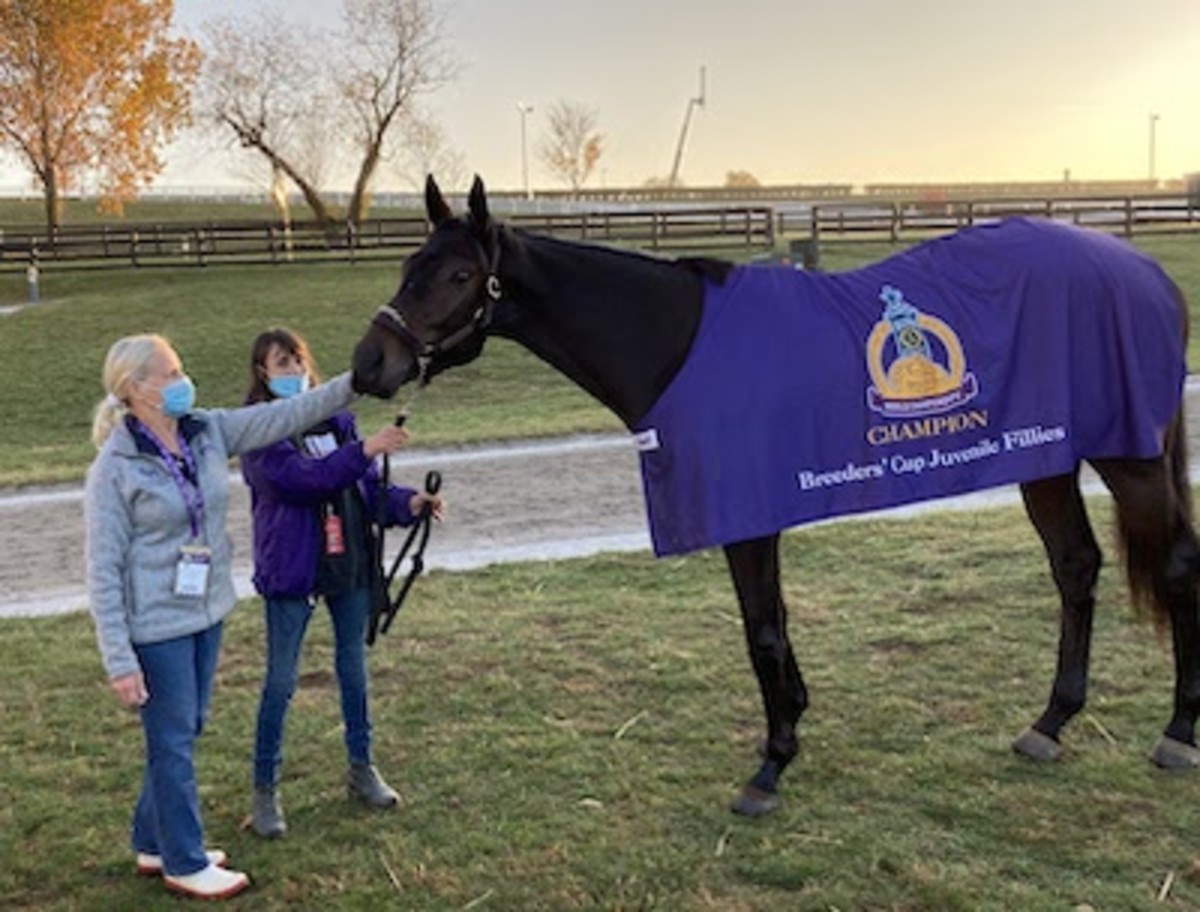
Reid and Vequist after the 2020 Breeders' Cup

They treat the approximately 25 horses in their barn, including 2-year-old champion Vequist, as if they are extended family. In taking a cue from Sweat, Reid never allows a day to end without distributing at least one cookie to each horse.

“My cookie bill is bigger than my feed bill, just about,” her husband joked. “No, it's worth every penny and the horses really appreciate the attention they get.”

 Reid no longer rides. She required a knee replacement. Worse still, she broke her back in two places in an accident at Parx in 2006, fracturing her eighth and eleventh vertebrae and barely avoiding a catastrophic injury.

“They said I was so fortunate that it broke outward,” she said. “Had it broken inward, I would have been paralyzed.”

Only Butch's protestations have kept her from resuming riding. Beyond that, she is invaluable on the ground. She is incredibly helpful with Vequist, who resented a male groom's handling early in her career.

“She was a high-wire act a little bit, especially as a 2-year-old. She wasn't the easiest horse to get along with. The guy  wanted to get a little rough with her and Vequist didn't like that too much,” Butch said.

Ginny took over with her gentle, soft-spoken, endearing manner. She and Vequist got along famously after a week.

“Through tender loving care and some cookies, they ended up making a good pair,” Butch said.

He gives much of the credit to his wife for Vequist's victory in the Breeders' Cup Juvenile Fillies. She oversaw the critical final preparations at Keeneland.

“We've been together almost 40 years. We pretty much know each other's thinking,” Butch said. “She certainly knows what I want to get done and we converse many times during the day to make sure that's all being carried out.”

While Vequist gears up for the Aug. 24 Cathryn Sophia at Parx, Ginny also rubs Mainstay, a 2-year-old half-sister to the Eclipse Award winner. They share the same dam, Vero Amore. Mainstay, in a four-and-a-half furlong debut on June 4 at Monmouth, broke her maiden by 7 ¾ lengths.

Mainstay is being pointed toward the Schuylerville (G3) on July 15, Opening Day at Saratoga Race Course. Reid will again provide the advance team, drawing on lessons learned from Sweat so many years ago.

Tom Pedulla wrote for USA Today from 1995-2012 and has been a contributor to the New York Times, Los Angeles Times, Blood-Horse, America's Best Racing and other publications.

If you wish to suggest a backstretch worker as a potential subject for In Their Care, please send an email to info@paulickreport.com that includes the person's name and contact information in addition to a brief description of the employee's background.

The post Kirkpatrick & Co Presents In Their Care: Secretariat And Sweat Taught Reid Everything She Knows appeared first on Horse Racing News | Paulick Report.

Source of original post

Verified by MonsterInsights