Kirkpatrick & Co. Presents In Their Care: Schosberg Always Answers The Call On Aftercare

Michael Sternklar shared two vignettes that say everything about Richard Schosberg's integrity as a trainer and his passion for Thoroughbred aftercare.

During their first meeting in 2005, an interview of sorts, Sternklar was blunt about how he wanted to proceed as a first-time owner. “I don't want to cheat. I care about the horses,” he told Schosberg. “If you have a different way of operating, I'll shake hands and wish you luck.”

Schosberg's face lit up in agreement and Clear Star Stable was born. It has gone on to include many successful years with its focus on New York-breds while growing to include 40 partners invested in approximately 14 horses.

The second vignette involves Saturday Appeal, a New York-bred gelding that Sternklar and Schosberg had campaigned successfully. Saturday Appeal, an earner of more than $300,000, was a shadow of himself when Sternklar spotted him running for a $4,000 claiming price at Camarero Race Track in Puerto Rico. He finished last of nine.

Sternklar was determined that Saturday Appeal should not be asked to give anything more on the racetrack. His 61st start needed to be his last. He called Schosberg and asked whether there was anything he could do.

When a horse is in need, Schosberg is not easily turned away. He quickly established a contact in Puerto Rico and arrangements were made to give exhausted Saturday Appeal the retirement he deserved.

In addition to training 16 horses, Schosberg serves as president of Take2/TAKE THE LEAD. The program, established in the autumn of 2013 to serve New York tracks, recently retired its 900th Thoroughbred. Schosberg also is on the board of the Thoroughbred Aftercare Association and is first vice president of the New York Thoroughbred Horsemen's Association.

There is not a call for help that he does not answer – and those calls keep coming. “My days are filled,” Schosberg said. “I could use a little more sleep.”

Why is he so committed?

“Because we need to,” he replied. “These horses give so much of themselves, racing and training, we owe it to them. They can't do it themselves and the industry generates enough revenue. A piece of that has to go to Thoroughbred aftercare.”

Schosberg went on, “The responsibility for proper, safe and purposeful aftercare – second careers – lies with the industry itself. And that doesn't just mean owners and it doesn't just mean trainers and it doesn't just mean horsemen's groups and the racetrack. Everybody who puts food on the table or puts gas in their vehicle because horses race has a responsibility to make sure those horses have a safe and proper retirement.”

Schosberg, 60, recognized the Thoroughbred's nobility and majesty while growing up on his parents' farm in Westchester County, N.Y. He can recall doing his homework while sitting in the stall of a mare preparing to deliver her foal. He graduated from Cornell in 1984, earning a degree in applied economics concentrating on animal science and equine studies.

Schosberg began training on his own in 1988, eventually overseeing Grade 1 winners Affirmed Success, As Indicated, Maria's Mon and Mossflower. He described Affirmed Success, winner of the Carter Handicap and earner of more than $2.2 million, as a “career horse.”

Trainer Rick Schosberg serves as president of Take2/TAKE THE LEAD and on the Thoroughbred Aftercare Alliance board of directors

Although he endures the travails of many trainers with small operations on the rugged New York circuit, he is widely respected. “Rick cannot make a slow horse run fast,” Sternklar said, “but he can make every horse run as fast as the gifts given to him or her. He's half veterinarian, half trainer, half therapist. I guess that's three halves.”

If anyone deserves such a description, it is Schosberg. He never stops.

“With him, horses have always come first,” said Andy Belfiore, executive director of the Florida Thoroughbred Horsemen's Association. “Even before aftercare became such an issue for horsemen, he was ahead of the curve on that. He always made sure his horses had a safe retirement. He even retired some of the horses he trained to his own property.”

Schosberg has done the heavy lifting in increasing the usefulness of Take2/TAKE THE LEAD. The program accommodated a high of 181 horses in its last fiscal year. Each horse is evaluated by a team of veterinarians to determine its medical needs and how to best prepare that horse for a second career. The transition process can cost anywhere from $3,500 to $5,000 per horse, depending on various factors.

“We make sure the horse has safety nets all along the way,” Schosberg said. “These horses are not going to fall through the cracks.”

Schosberg noted that the vast majority of an equine's lifespan will be spent after its final race. Second careers can range from dressage to police work to therapy. The usefulness of therapy programs is particularly encouraging.

“A lot of these programs are successful because horses feel your emotions,” Schosberg said. “They not only help with physical rehabilitation, helping with balance and stabilizing muscles and things like that for people who have physical challenges, but emotionally.”

Schosberg's favorite time of day comes when training hours are over, horses have cleaned their feed tubs and the daily chores are done. He will slip into a stall and sit quietly to observe in a corner, a man alone with his horse.

Tom Pedulla wrote for USA Today from 1995-2012 and has been a contributor to the New York Times, Los Angeles Times, Blood-Horse, America's Best Racing and other publications.

If you wish to suggest someone as a potential subject for In Their Care, please send an email to info@paulickreport.com that includes the person's name and contact information in addition to a brief description of the individual's background.

The post Kirkpatrick & Co. Presents In Their Care: Schosberg Always Answers The Call On Aftercare appeared first on Horse Racing News | Paulick Report.

Source of original post

Kirkpatrick & Co. Presents In Their Care: Lindsy Reed The ‘Right Hand’ Of Family Stable That Shocked The Derby

Lindsy Reed sensed trouble the instant the phone rang at approximately 1 a.m. on Dec. 18, 2016. When she heard her mother's frightened voice, she was sure of it.

“You need to get to the farm now. The barn is on fire!” Kay told her.

“Excuse me?”

“Get your ass to the barn!”

When Lindsy finally arrived at Mercury Equine Center in Lexington, Ky. – a facility that represented a  dream come true for her racing family – all that remained of one of three barns was a smoldering tin roof.

She shuddered at the sight.

“It was a feeling of my heart being ripped out of my chest. Right now, I get cold just talking about it,” Lindsy said. “Those horses, just because they're gone doesn't mean I don't remember them and I don't remember how much love they showed me and how much trust they had in me to protect them. And I couldn't do it that night because I wasn't there.”

She could not do anything to bring back the 23 horses — most of them yearlings — that perished in a fire attributed to a rare December lightning strike. Thirteen horses were saved. She committed herself to the future of the 60-acre farm by moving into a renovated house there.

Her father, Eric, was so heartbroken he wondered whether he could continue as a trainer. Much of his equipment and memorabilia were gone. Lindsy's determination and her willingness to be an all-day, everyday presence encouraged him to persevere.

This story, of course, took an unbelievably wonderful turn. Rich Strike, an against-all-odds product of the Reeds' love and devotion, staged a breathtaking rally for unheralded jockey Sonny Leon to win the May 7 Kentucky Derby at 80-1 odds. The former $30,000 claimer, 1-for-7 lifetime, had been in the throes of a five-race losing streak. Only 91-1 Donerail, in 1913, brought home the roses as a longer shot.

“It's shocking and it's exciting,” said Lindsy, 26. “It's great to let the world know that we're here. We're the little guys and we did what the big guys said we couldn't do. We don't have to have 400 head of horses to prove that.”

Eric, Kay and Lindsy continue to apply lessons taught by Eric's father, Herbert. “We put our horses first. We are always at their beck and call,” Kay said. “The main thing is the love for the horses.”

“Basically, she's my right hand,” Kay Reed says of daughter Lindsy

Many say that. The Reed family means it. So much so that they and owner Richard Dawson refused to yield to pressure and pulled another shocker. They spurned a Triple Crown bid to stick to their plan of running distance-loving Rich Strike in the mile-and-a-half Belmont Stakes on June 11.

Lindsy joined the family business in 2015, learning from the ground up and now ranking as an assistant trainer. She was a reluctant participant at first.

“I didn't think the horses were going to be my thing,” she said. “I was young and I was lazy and I didn't want to do the hard work. That passion kind of grew like a wildfire and didn't stop.”

It is impossible to imagine a more driven person. As a backup plan, she is studying medical administration through an online program offered by DeVry University.

“Sleep is invisible to me now, but it's worth it,” she said. “It's another achievement.”

She acknowledges that meeting horses' daily needs appeals to her much more than medical administration. She has become an integral part of Mercury Equine Center, which features 160 stalls, a 5/8-mile training track and an equine pool.

“Basically, she's my right hand,” Kay said.

Lindsy brings a youthful energy and a fresh perspective that energizes her parents. “She's always known about horses. The longer she works with racehorses, the more she's learning and sometimes teaching us new tricks,” Kay said.

Lindsy credits her mother with inspiring her. “She's taught me the seriousness and responsibility of it,” she said. “She's taught me if you want to be taken seriously, you have to act the role and you have to do it daily. She says, 'It's a male-dominated sport, but you're going to show the boys how it's done.'”

Lindsy is still young. Yet she must feel as though she has been through several lifetimes, overcoming tragedy to experience the ultimate triumph that hard-charging Rich Strike delivered.

“He's our phoenix, that's who he is,” she said. “He rose up from the ashes.”

Whatever the future brings, Lindsy will never forget that magical afternoon at Churchill Downs, when she stood beside members of her close-knit family and watched the unthinkable happen.

“I'll cherish it for the rest of my life. I was there the day my daddy proved you can do what you want to do,” she said. “You just have to believe in it.”

Tom Pedulla wrote for USA Today from 1995-2012 and has been a contributor to the New York Times, Los Angeles Times, Blood-Horse, America's Best Racing and other publications.

If you wish to suggest someone as a potential subject for In Their Care, please send an email to info@paulickreport.com that includes the person's name and contact information in addition to a brief description of the individual's background.

The post Kirkpatrick & Co. Presents In Their Care: Lindsy Reed The ‘Right Hand’ Of Family Stable That Shocked The Derby appeared first on Horse Racing News | Paulick Report.

Source of original post

Kirkpatrick & Co. Presents In Their Care: Riding A One-Eyed Rebel Toward The Kentucky Derby Dream

Trainer Ricky Courville never hesitated to send a young man to do a job that might typically be associated with an older person.

Kevin Moody of Cypress Creek Equine had made a last-minute decision to run Un Ojo in the Feb. 26 Rebel Stakes at Oaklawn Park. The Grade 2 Rebel offered a $l million purse and 50 Kentucky Derby qualifying points, enough to ensure a spot in the starting gate on the first Saturday in May. The stakes could not have been higher for Courville, a trainer who had never won a graded stake.

Still, the Louisiana-based conditioner could not possibly travel to Arkansas for the major Derby prep. He was tending to his wife, jockey Ashley Broussard, as she recovered from a broken leg. On the same day as the Rebel, he had one horse entered at Fair Grounds, another at Delta Downs. And, like so many outfits, his 31-horse operation was scrambling for help.

Courville never hesitated in assigning his son, 25-year-old Clay, to accompany Un Ojo to Oaklawn Park for the biggest race of their lives. If anyone could help the one-eyed gelding overcome long odds after a runner-up effort in the Feb. 5 Withers at Aqueduct, he felt sure it was Clay.

“I send him on the road with horses,” Ricky said. “He's responsible enough to do everything. He's reliable. I can trust him.”

Ricky knows that giving a young employee travel money can be risky business.

“You could send somebody his age on the road and they would not get up the next morning because they were at the bar or something,” he said.

Clay did, indeed, spend a largely sleepless night after the Rebel as he celebrated the warmest feel-good story the Derby trail has produced – Un Ojo's stunning half-length upset at 75-1. Forget about hurrying off to toast away the night with friends. He could not tear himself from the side of a New York-bred gelding that takes his name from losing his left eye in a paddock accident as a baby, leaving him with one eye.

“I was so proud of him,” Clay said, “I felt bad leaving him.”

To an onlooker, it would have been impossible to tell who was more amped, the seemingly impossible winner or his precocious handler.

“He was just wound up. He was excited,” Clay said. “He was jumping in his stall a lot.”

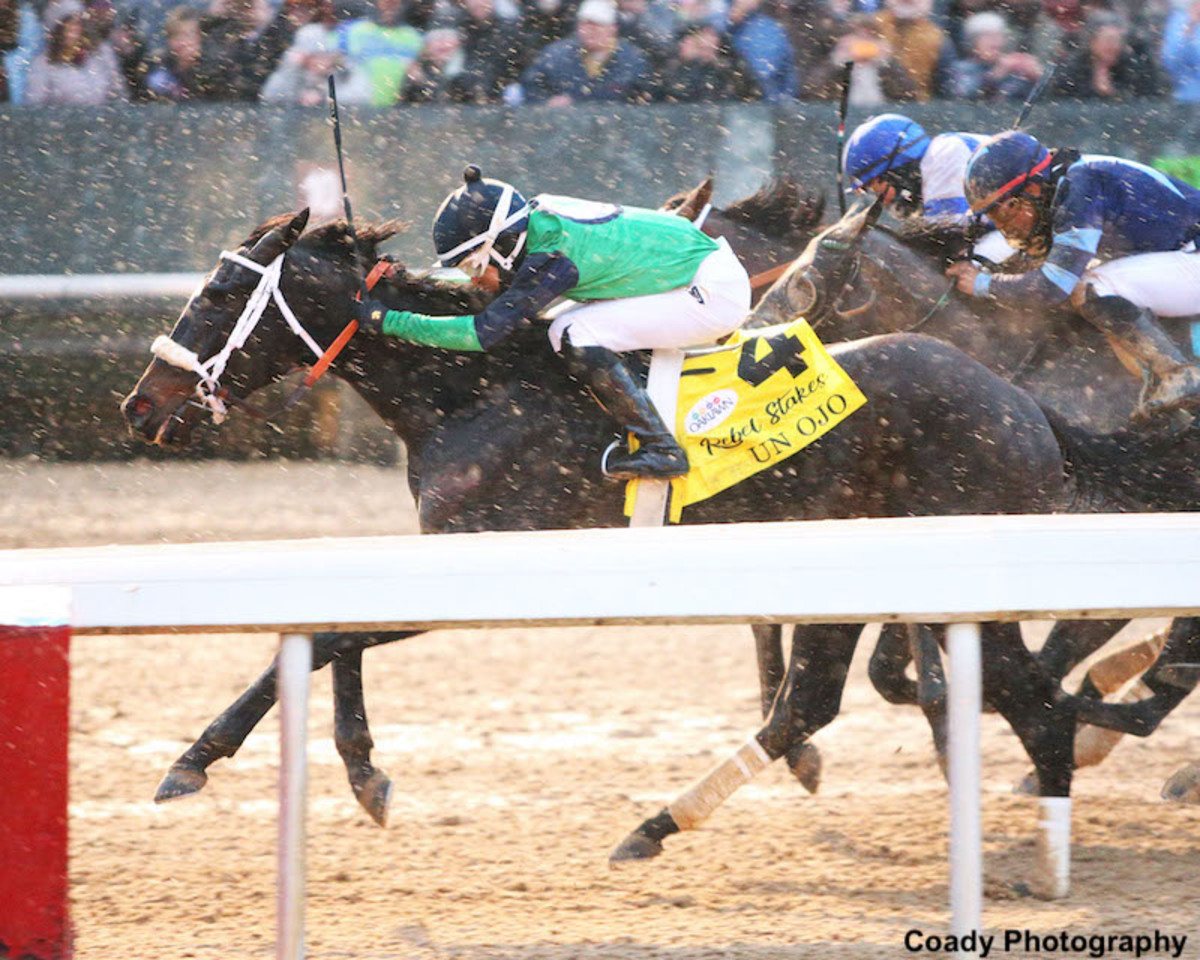
The one-eyed New York-bred, Un Ojo, rides the rail to a 75-1 upset in the Rebel under Ramon Vazquez

Clay might have been the only person who could have envisioned such success. He had worked closely with the son of Laoban from the start, breaking him and later galloping and breezing him.

“I pretty much give him all the credit on this horse,” Ricky said. “He kept saying, 'This is going to be a later horse. It's just taking him awhile.'”

The Rebel marked Un Ojo's second victory in six starts. After an inauspicious eighth-place finish in his Oct. 9 debut at Keeneland, he broke his maiden at Delta Downs a little less than a month later. The slow progress is understandable given the loss of one eye, a circumstance that led him to easily spook early in his career.

Still, Clay's confidence never wavered. He was taught at a young age how a good horse looks and acts.

“He's been coming with me to the barn since he was 4 or 5 years old,” Ricky said. “He just loved being with me at the barn, coming with me to the races.”

Like Un Ojo, Clay's young life has not been an easy road as he grew up in Carencro, La. His mother, Billie Joe, lost a decade-long fight with cancer in 20l6.

“It was tough,” he said.

He had hoped to emulate his father, who rode for 16 years before becoming a trainer in 2008. A growth spurt dashed that dream.

“When I turned l6 and it was time to start riding and get into it, I was starting to grow,” he said. “It would have been hard for me to keep my weight down.”

The 5'9″, 150-pound Clay fulfilled a goal his mother set for him by graduating from Carencro High School. Then he plunged into life at the barn, galloping horses and assisting his father in every way possible. When he rides a horse in the morning, he is able to pinpoint issues. He is equally effective on the ground, when he checks horses' legs.

He formed an especially tight bond with Un Ojo.

“He gets along good with him,” Ricky said. “It's like it's his little pet. It's his baby.”

Un Ojo has shed himself of his initial skittishness and settled in nicely.

“If you didn't know he had an eye missing and you walked into the stall on that side and touched him on the shoulder as you walked up to him, he don't flinch or anything,” Ricky said.

In the 1 1/16-mile Rebel, the gelding did not allow anything to faze him. Ramon Vazquez gave him a ground-saving trip before he outslugged Ethereal Road to the wire. Incredibly, the Courvilles and their one-eyed sentimental favorite were going to the Kentucky Derby when it was over.

“This is everyone's dream to make it there,” Clay said. “For it to actually be true, it can be reality, it's pretty awesome.”

This time, father and son will go together.

The post Kirkpatrick & Co. Presents In Their Care: Riding A One-Eyed Rebel Toward The Kentucky Derby Dream appeared first on Horse Racing News | Paulick Report.

Source of original post

Kirkpatrick & Co. Presents In Their Care: Riding Life Is Good Feels ‘Like You’re Floating In Air’

Amelia Green reached a crossroads in her young life four years ago. She was not sure whether she wanted to remain in the United States or return to her native Nottingham, England.

She was equally unsure about what the next step in her career should be.

Green had abandoned her attempt to establish herself as a jockey. The need to lose as many as eight pounds a day to make weight had become too onerous and diminished her quality of life. She knew she needed to take another direction.

But what?

“I kind of just hit a wall,” she recalled, “and wasn't sure what I wanted to do.”

Green confided in Michael McCarthy, a West Coast trainer who employed her as a freelance exercise rider. McCarthy, who had learned invaluable lessons as an assistant to Todd Pletcher, offered to contact his former boss about a potential cross-country move for her. She was instructed to call Pletcher at a set time the following day.

Green felt some trepidation as she prepared for what she anticipated would be a rigorous interview when she reached Pletcher, one of the preeminent trainers off all time with a record seven Eclipse Awards to his credit.

“Michael McCarthy put me in touch with you about a job,” Green began.

“Yeah,” Pletcher responded. “When do you want to come?”

Green, speaking outside one of Pletcher's barns at Palm Beach Downs in Delray Beach, Fla., laughs in recalling that life-changing conversation.

“I didn't know it was so easy to get a job with Todd Pletcher,” she said. “I don't know what Michael said to him. He must have said some nice things because I thought there was going to be an interview process.”

Undoubtedly, McCarthy strongly endorsed Green because it is generally not so easy to get a job with the demanding Pletcher and his highly-regarded operation.

Pletcher quickly came to appreciate the talent McCarthy sent his way. Green, 28, has become an integral figure in the barn's success as an exercise rider and traveling assistant.

“When Michael contacted me and told me she was very good, I took him at his word and he was certainly right,” Pletcher said. “She's terrific on a horse. She's very good on the ground as well. She's a hard worker, dedicated and focused on her career.”

When Green packed her Hyundai Elantra to drive from California to join Pletcher's string in Florida, she never imagined that trek would take her on the wonderful ride she is enjoying with Life Is Good. The ultra-talented 4-year-old is viewed as the horse to beat as he continues preparations for the $12 million Dubai World Cup on March 26 at Meydan Racecourse.

Life Is Good, winner of six of seven lifetime starts, followed an authoritative score in the Breeders' Cup Dirt Mile by dusting Horse of the Year Knicks Go by 3 1/4 lengths in the Jan. 29 Pegasus World Cup at Gulfstream Park.

Pletcher said of the pairing of the 5'5″, 122-pound Green and powerful Life Is Good: “He's a horse that can get a little too aggressive and she's done a great job of getting him to relax. She does a good job breezing him. They get along really well.”

Life Is Good receives superstar treatment. As part of the effort to help him to relax, he is the first horse to train at Palm Beach Downs.

“He kind of tells me what to do most of the time and I try to sit against him and try to ease him down a little bit,” Green said.

The son of Into Mischief would gallop all day if his rider permitted it.

“The last quarter of a mile, he'll try to grab you,” she said. “If he didn't do that at this point, I'd probably be worried. It's like he knows he's coming to the end and doesn't want to pull up.”

Green never carries a riding crop when she gallops Life Is Good.

“The power he has, everything he does is just so effortless,” she said. “You don't even feel his feet come off or hit the ground. You just feel like you're floating in air. I've never sat on a horse like it.”

When Green breezes Life Is Good, Pletcher maintains radio communication with her. Although she has developed a clock in her head, the bay colt does everything so easily that it would be easy to misjudge their speed if she did not have the trainer in her ear. She cannot recall a moment when she felt as though her mount was fatigued.

“Even at the end of a breeze, sometimes I end up at the three-eighths pole before I can pull him up,” she said. “He just loves what he does and he just wants to keep going and keep doing it.”

Green and Life Is Good experienced one worrisome moment as the sun rose at Palm Beach Downs when they encountered a coyote. Perhaps another horse would have been intimidated. Life Is Good wanted to give chase.

Life Is Good and Amelia Green accompanied by Hall of Fame trainer Todd Pletcher

The post Kirkpatrick & Co. Presents In Their Care: Riding Life Is Good Feels ‘Like You’re Floating In Air’ appeared first on Horse Racing News | Paulick Report.

Source of original post

Verified by MonsterInsights