Notable US-Breds in Japan: July 18 & 19, 2020

In this continuing series, we take a look ahead at US-bred and/or conceived runners entered for the upcoming weekend at the tracks on the Japan Racing Association circuit, with a focus on pedigree and/or performance in the sales ring. Here are the horses of interest for this weekend running at Hanshin and Fukushima Racecourses:

Saturday, July 18, 2020
5th-HSN, ¥13,400,000 ($125k), Newcomers, 2yo, 1400mT
KITTEN’S WALTZ (f, 2, Air Force Blue–Dance With Kitten, by Kitten’s Joy) is set to be the first Japanese starter for her sire and is the first foal out of a winning full-sister to dual GI Woodford Reserve Turf Classic hero Divisidero, who broke his maiden in his first career start going two turns over the Gulfstream turf course. Campaigning in the Carrot Farm colors, the dark bay is kin to a Shadai-bred yearling filly by Carpe Diem and a foal half-brother by Collected. Divisidero and Collected both stand at Airdrie Stud. B-Shadai Farm (KY)

12th-FKS, ¥14,360,000 ($134k), Allowance, 3yo/up, 1150m
BEST MAGIC (c, 4, Speightstown-Glinda the Good, by Hard Spun), a half-brother to champion and Hill ‘n’ Dale stallion Good Magic (Curlin), was a good second on his career debut and returns to the JRA circuit off a trio of dominating victories by a combined 18 lengths against easier at Nagoya on the NAR circuit. His dual stakes-winning and Grade II-placed dam is a half-sister to GSW Take the Ribbon (Chester House), the SW/GSP duo of Flash Forward (Curlin) and Flash Mash (Smarty Jones) and MSW Bright Magic (Prized). A $200K Keeneland September yearling, Best Magic blossomed into a $700K OBS April breezer. B-Stonestreet Thoroughbred Holdings LLC (KY)

Sunday, July 19, 2020
8th-HSN, ¥14,360,000 ($133k), Allowance, 3yo/up, 2200mT
AMERICAN SEED (c, 3, Tapit–Sweet Talker, by Stormin Fever) drops back into allowance company off a 12th-place effort behind the undefeated Contrail (Jpn) (Deep Impact {Jpn}) in the G1 Japanese 2000 Guineas Apr. 19. The $825K KEESEP yearling had finished in the top three in each of his prior four starts, including a third in the Listed Wakaba S. over this course and distance Mar. 21 (see below, gate 7). American Seed is a full-brother to SW & GSP Sweet Tapper and a half to MGSP Perregaux (Distorted Humor). Grade I winner Sweet Talker is a half-sister to three-time graded winner Silver Medallion (Badge of Silver). B-Courtlandt Farm (KY)


The post Notable US-Breds in Japan: July 18 & 19, 2020 appeared first on TDN | Thoroughbred Daily News | Horse Racing News, Results and Video | Thoroughbred Breeding and Auctions.

Source of original post

‘It Was A Ride, All Right’: Serrano Gets Himself Out Of Sticky Spot In Mountaineer Ride

Keivan Serrano is not someone who panics when he finds himself in a tight spot.

“One thing I learned is not to panic, because panic can make it a lot worse,” said the young jockey. “I go out there and there's no fear. The day that I'm scared to do what I do, is the day I need to stop.”

That's why, when he saw Side Tracked drift to the right out of the Number One gate in Sunday's third race at Mountaineer, he began weighing his options. At first, Serrano thought he could steer his colt, a maiden named Bungalow Flash, to the right to avoid the domino effect. Then he saw Just Doing to his outside, wandering toward him, and found himself squeezed between two horses and forced out of the tack.

“I thought I was going to fall,” he said. “To be completely hoenst with you, this is one of my main stables and I knew we had a really good shot to win the race. I was going to do everything I could to stay on this horse. The only thing I felt behind me was the eight horse, so I just sort of pushed off him and pushed back in[to the saddle].

“It was a ride, all right.”

Serrano said he was able to work his feet back into the stirrups while remaining mindful of the colt's mouth, not wanting to balance against the reins and check the horse.

In the end, his patience paid off – Serrano finished third, just a nose behind runner-up Juliano.

“I came into the race with all the confidence in the world in this horse,” he said. “Up until we did finish the race, I thought I was going to get the second.”

It isn't the first time he's used this move of pushing off a rival to pop himself back in the tack – just last year, he found himself in a similar position out of the gate in a turf race at Mountaineer and got himself righted again.

Cheating gravity is all in a day's work for Serrano, 22, who said he's living out a longtime dream of becoming a professional jockey. Growing up in Puerto Rico, Serrano said he always had horses and had hoped to go through the island's popular Escuela Vocacional Hípica, but found he ultimately didn't qualify. He moved to New York at the age of 18 and wandered the backstretch looking for someone to give him a job as an exercise rider. He had never galloped a horse before, but didn't mention that.

“I had never touched a racehorse in my life,” he said. “I went around telling people, 'Yeah, I'm an exercise rider.' I'd ridden horses before, just not racehorses. I'm 18, I'm thinking it's the same thing. I remember getting on horses and the first one I got on was a tank – big, tall. I had never been that high off the ground. Of course, it ran off with me. I didn't know what I was doing.”

That was in September 2016. Serrano later went to Ocala, as many aspiring jockeys do, to sharpen his skills with young horses just learning themselves. He got his license and began riding in March 2017.

Serrano said he learned to ride Thoroughbreds by feel. Horses were not a foreign language to him. As a kid, he studied jockeys on television and picked up a $100 horse to practice riding, honing his position as best he could from what he saw. By the time he got to New York, his sense of balance was well-developed, as was his sense of horsemanship.

Serrano said he still maintains contact with one particular four-legged teacher back home in Puerto Rico – a filly out of a mare he rescued when she was pregnant. The mare foaled uneventfully, but not long after that, things started to get complicated.

“At about two and a half months old, the mare started rejecting the foal and I had no idea why,” he said. “I finally pulled her away and started bottle feeding her until she could nibble on grass, on grain. She'd follow me around my hometown like a puppy. I could take her to the beach and run around, she'd jump in the water with me. That was pretty cool.

“Before I left Puerto Rico, I had five horses. I sold them all except her. I donated her to this place in San Juan where they could use her as a therapy horse for kids with special needs. I thought that was something she could fit perfectly in. I get updates on her — she's three now and she does her job very well.”

These days, Serrano can be found predominantly at Mountaineer, where his unconventional route to the saddle is paying off — he's the meet leader by earnings.

The post ‘It Was A Ride, All Right’: Serrano Gets Himself Out Of Sticky Spot In Mountaineer Ride appeared first on Horse Racing News | Paulick Report.

Source of original post

Analysis: Fasig-Tipton Racing Age Sale Marked Latest Chapter Of Lengthy Zayat Stables Dispersal

The dismantling of Zayat Stables' equine stock in order to pay off a multi-million dollar trail of debt has spanned months of public and private transactions, and the latest stop on that road once again proved that the perception of value can vary wildly between a seller and the marketplace.

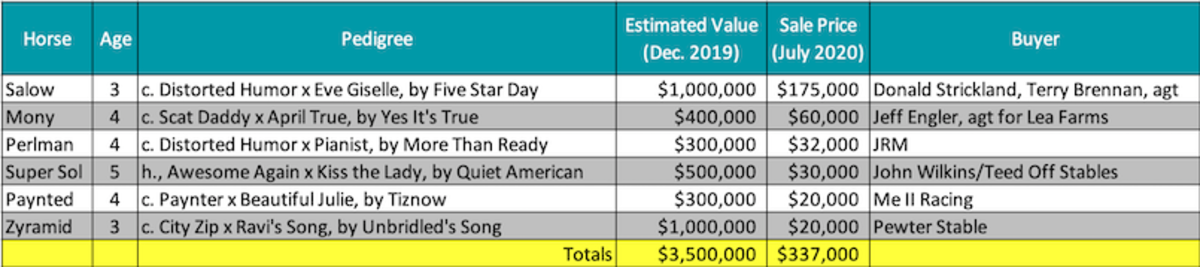
Six horses under Zayat ownership were offered Monday at the Fasig-Tipton July Horses of Racing Age Sale, bringing a combined $337,000.

The same group of six horses were valued at a combined $3.5 million in an assessment of owner Ahmed Zayat's equine holdings submitted to creditor MGG Investments in mid-December 2019 as a liquidation plan to pay off a $23-million loan and stave off a lawsuit. MGG ultimately filed suit in late January over allegations that Zayat had defaulted on the loan, and Zayat's equine operations were placed in the hands of a third-party receiver to maximize income for paying off creditors through racetrack earnings and liquidation of the stable.

A lot can happen in seven months to fluctuate the value of a Thoroughbred, and assigning valuation to a horse is far from an exact science, but bringing in 9.62 percent of assessed value through the sale ring is a remarkably wide gap in opinion.
In comparison, six Zayat horses were offered in February at this year's Fasig-Tipton Kentucky Winter Mixed Sale with an estimated value of $1.9 million, and just four of the six finished above reserve for a combined $366,000 – about 19 percent of the estimated total. One mare, offered in-foal to American Pharoah, accounted for $310,000 of that total amount.

Though the chasm between hopeful assessment and market reality for the July offerings was Grand Canyon-sized, the explanation for the far-flung differences goes far beyond the extremely generous valuations.

First, there is the issue of timing. One method of assessing value to a Thoroughbred is through income projection – basing their worth on their opportunities to achieve in the future as much as what they already have achieved.

This is the most apparent among the July offerings in Salow and Zyramid, a pair of colts who were 2-year-olds at the time of the assessment. Both colts are well-bred, meaning a stallion career would be easily attainable with a few graded stakes wins, especially on the Triple Crown trail or in the Triple Crown races themselves. Every 2-year-old in December is a potential lottery ticket with a few fortunate bounces, and their respective seven-figure values reflect that potential.

Fast-forward to July, and many of the doors that were open seven months ago are now closed, as many of the elite 3-year-old races have been run. Even with the Kentucky Derby and Preakness Stakes pushed back into the fall due to COVID-19, the opportunity to become a Triple Crown winner already left the station without either horse even in the gate for the race, and past form suggests a monumental jump in form would be needed to join the elite in their class.

Salow, a 3-year-old son of Distorted Humor, was ultimately the centerpiece of the Zayat slate at the July sale, going for $175,000 after winning on debut in a Gulfstream Park turf race on July 3. Zyramid, on the other hand, has been winless since last year's Saratoga meet and sold for $20,000, tied for the lowest of the group.

Though his value took a hit due to the opportunities that are no longer available to him, Salow was the rare horse in the Zayat dispersal to offer some semblance of blue sky on his resume, with his 2 3/4-length debut win.

This brings about the second point toward the price gap in the dispersal offerings – the horses didn't do much to help themselves in the time between the assessment and the sales.
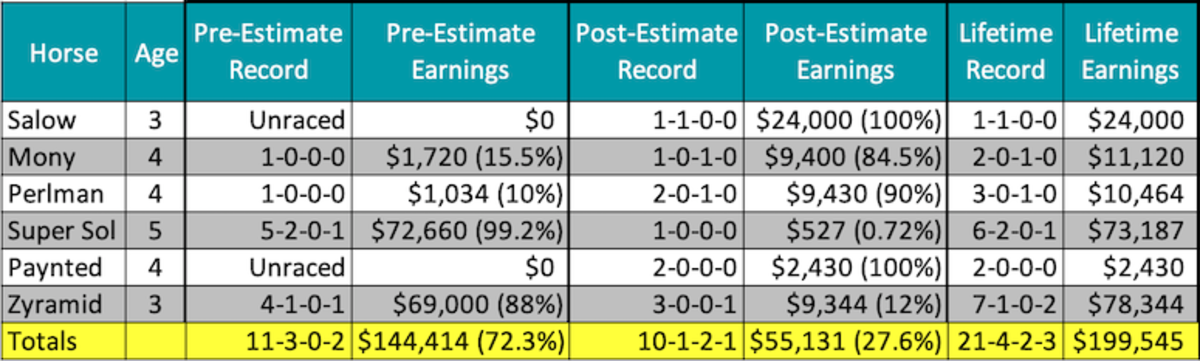
None of the horses were stars before or after the December assessment, but just 27.6 percent of the six horses' combined $199,545 in career earnings at sale time came after the assessment. This is with two of the horses being unraced at the time of the valuation, and another two having raced just once. Four of the six entered the sale as maidens. Whether an assessor is basing their valuation on comparative value with other horses with similar resumes or by earning potential, the projection is going to take a dive as the spring rolls into summer.

This was most apparent in the case of Super Sol, a 5-year-old Awesome Again horse who was valued at $500,000 in the December assessment. It was a generous figure for a horse with no black type whose only start of 2019 came on Jan. 6, and he just made his 2020 debut during the recent Keeneland summer meet, where he finished last in an optional claiming race.

Working in his favor was a bit of back class. The horse won two races in a row in Southern California during his 3-year-old season, breaking his maiden by four lengths and taking a Los Alamitos Thoroughbred meet optional claimer by three lengths.

Super Sol went on to sell for $30,000.

Zyramid also had one of the longer resumes of the group, winning once and making 88 percent of his lifetime earnings before the December assessment. He was tried in the Grade 2 Saratoga Special Stakes and G3 Iroquois Stakes, but finished well off the board on both occasions. His 3-year-old season started with a distant third in an Oaklawn Park allowance, followed by far-back out-of-the-money tries at Oaklawn and Lone Star Park.

Salow was the only horse in the group to earn five figures post-assessment, making $24,000 for his maiden score. That victory alone made the colt the fourth-highest earner for the Zayat Stables operation in 2020.

Rounding out the group were Mony, Perlman, and Paynted, a trio of 4-year-old lifetime maidens who were valued from $300,000 to $400,000 in December, and sold at a high point of $60,000 (Mony) and a low of $20,000 (Paynted).

Mony, a son of Scat Daddy, has shown the most upside of the group. In addition to being a son of Scat Daddy, whose foals have become increasingly scarce and sought after following the sire's untimely death and the Triple Crown success of son Justify, Mony most recently finished a gaining second in a Gulfstream turf maiden special weight on July 5.

One final factor that's important to note in the review of the dispersal against its original valuation is intent.

Several of the horses pointed for the July sale in the December assessment have since been sold privately, including River Boyne, who found new owners after winning the G2 San Gabriel Stakes in January. He was valued at $750,000 in the assessment, at which point, River Boyne had never won a graded stakes race.

There is a strong likelihood that the horses that were pointed toward the July sale and made it all the way to the ring were ones where attempts to move on from them privately were unsuccessful. In that case, the open market becomes the most efficient way to turn the horses into cash, even if it's for pennies on the dollar from where they were appraised.

The post Analysis: Fasig-Tipton Racing Age Sale Marked Latest Chapter Of Lengthy Zayat Stables Dispersal appeared first on Horse Racing News | Paulick Report.

Source of original post

Will Take Charge Shuttling To Uruguay For Southern Hemisphere Season

Champion Will Take Charge will shuttle to Haras Phillipson in Uruguay for the 2020 Southern Hemisphere breeding season, the South American publication Turf Diario reports.

Will Take Charge, a 10-year-old son of Unbridled's Song, stands the Northern Hemisphere season at Three Chimneys in Midway, Ky., where he was most recently advertised for a fee of $15,000.

He is the sire of three crops of racing age, highlighted by Grade 1-placed Manny Wah, Grade 2-placed High Regard and Sweet Diane, and stakes winners Kim K, Great Sister Diane, and Cashcheckorcharge.

Will Take Charge is out of 2013 Broodmare of the Year Take Charge Lady, a multiple Grade 1-winning Dehere mare whose other runners of note include Grade 1 winner Take Charge Indy and winner Charming, who is herself the dal of champion Take Charge Brandi and Grade 1 winner Omaha Beach.

On his own accord, Will Take Charge won seven of 21 starts for earnings of $3,924,648. He earned the Eclipse Award for champion 3-year-old male in 2013 off a campaign that included scores in the Grade 1 Travers Stakes and Clark Handicap, the G2 Pennsylvania Derby and Rebel Stakes, and the non-graded Smarty Jones Stakes. He also finished second in that year's Breeders' Cup Classic.

Will Take Charge came back at four to win the G2 Oaklawn Handicap, and finish in the money in the G1 Santa Anita Handicap, Stephen Foster Handicap, Donn Handicap, and Whitney Stakes.

The post Will Take Charge Shuttling To Uruguay For Southern Hemisphere Season appeared first on Horse Racing News | Paulick Report.

Source of original post

Verified by MonsterInsights