ARCI Strengthens Model Rule Restrictions On Crop Use, But Declines To Limit Strike Count

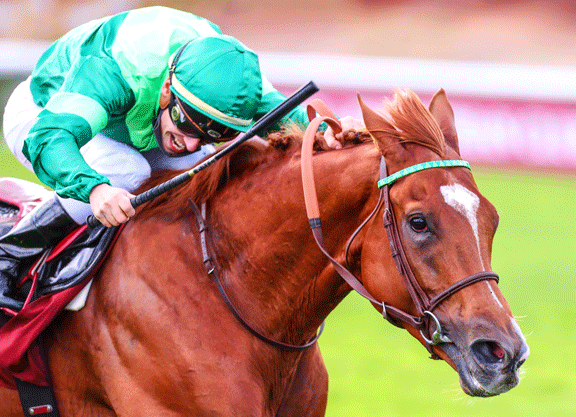
Jockeys will be prohibited from using the riding crop more than two consecutive times before being required to wait three full strides in order to give the horse a chance to respond under an expanded Model crop Rule adopted by the Association of Racing Commissioners International (ARCI) last week.

The modified rule tightens restrictions already in place but clearly says that any use of the crop to “urge” the horse must be limited. The new RCI Model Rule continues to rely upon the judgement of the Stewards as to when to impose sanctions, but is clear that using the crop more than two consecutive times or not waiting three full strides before reuse is to be regarded as a rule violation.

The RCI did not include an overall strike count in the actual rule but did approve corresponding guidelines to advise officials that use of the crop more than six strikes during the race is something to be assessed. The RCI Board did not want to remove the authority of the Stewards to exercise judgement based on the specific instances of the race but did want to provide guidance as to when to start questioning the possibility of overuse.

“If our accredited Stewards cannot judge when a jock has crossed the line then perhaps they should not be in the stand,” said former jock and racing official Doug Moore who is Executive Director of the Washington State Racing Commission and Chair of the RCI Rider and Driver Safety Committee.

“If the officials fail to exercise their responsibility in this matter then the feeling at the meeting was that the matter must be reviewed up top in assessing someone's job performance and deciding whether to keep them on.”

“Several years ago we changed the riding crop requirements to rely upon poppers which provide an audible stimulation to the horse in addition to the visual one of showing the horse the crop,” said RCI Chairman Tom Sage. “As a result, it is extremely rare to find a horse with evidence of crop misuse coming in off the track.”

“In helping to protect the horse we may have created an opposite impression with the public as they now hear the noise coming from the crops,” he said.

RCI President Ed Martin noted that testimony from the Jockey Club as to public perception was taken to heart and the regulators found it compelling to help address that by defining clearly what the chance to respond should be.

“The image of someone wailing away on a horse coming down the stretch is not a good one for a sport struggling to assert a positive image. But controlled and limited use with three full strides to respond was something the regulators believed would help mitigate that,” he said.

There was resistance to putting a hard strike limit in the Model Rule to emulate what Maryland and Delaware have enacted. Some jurisdictions felt that it would be deemed arbitrary and not withstand legal challenge in their states. Others questioned the “magic” of the number 6, asking why not 5 or 7 or 8? The collective wisdom was to use a strike limit as a guideline and leave the judgement in the hands of the officials as every case is individual, especially when you consider different track lengths.

There was universal agreement that any abuse of the horse in any way must be severely addressed. The RCI committees intend to develop progressive penalty guidelines in this area in the coming months to ensure that multiple violations are deterred across the system.

“We appreciate the input we have received on this issue from countless individuals and organizations like Breeders Cup, the Thoroughbred Safety Alliance, the Jockey Club, the AQHA, the Jockeys Guild and our regulatory veterinarians,” said RCI Chair Tom Sage.

“We believe we have found a balance that protects the horse, mitigates perception problems, and maintains the essence of a sport where every horse runs its best in every race,” he said.

FULL TEXT OF THE ARCI RIDING CROP MODEL RULE

Adopted 12/4/2020 – changes underlined.

  (7). Use of Riding Crop

(a)    Although the use of a riding crop is not required, any jockey who uses a riding crop during a race shall do so only in a manner consistent with exerting his/her best efforts to obtain a maximum placing that affects purse distribution or wagering pools.

(b)    In all races where a jockey will ride without a riding crop, an announcement of such fact shall be made over the public-address system.

(c)    No electrical or mechanical device or other expedient designed to increase or retard the speed of a horse, other than the riding crop approved by the stewards, shall be possessed by anyone, or applied by anyone to the horse at any time on the grounds of the association during the meeting, whether in a race or otherwise.

(d)    Riding crops shall not be used on two-year-old horses before April 1 of each year.

(e)    The riding crop shall only be used for safety, correction and limited encouragement, and be appropriate, proportionate, professional, taking into account the rules of racing herein.  However, stimulus provided by the use of the riding crop shall be monitored so as not to compromise the welfare of the horse.

(f)    Use of the riding crop varies with each particular horse and the circumstances of the race.

(g)    Except for extreme safety reasons all riders should comply with the following when using a riding crop:

    (A)   Initially showing the horse the riding crop, and/or tapping the horse with the riding crop down, giving it time to respond before using it; 

    (B)   The riding crop shall not be used more than twice in succession and the Having used the riding crop, giving the horse must be given a chance to respond before using it again;

          i. Chance to respond” is defined as at least three complete strides and one of the following actions by a jockey:

            1.   Pausing the use of the riding crop on their horse before resuming again; or

            2.   Pushing on their horse with a rein in each hand, keeping the riding crop in the up or down position; or

            3.   Showing the horse the riding crop without making contact; or

            4.   Moving the riding crop from one hand to the other.

    (C)   Using the riding crop in rhythm with the horse's stride.

(h)    When deciding whether or not to review the jockey's use of the riding crop, stewards will consider how the jockey has used the riding crop during the course of the entire race, with particular attention to its use in the closing stages, and relevant factors such as:

    (A)   The manner in which the riding crop was used

    (B)   The purpose for which the riding crop was used

    (C)   The distance over which the riding crop was used and whether the number of times it was used was reasonable and necessary

    (D)   Whether the horse was continuing to respond.

(i)    In the event there is a review by the Stewards, use of the riding crop may be deemed appropriate in the following circumstances:

    (A)   To keep a horse in contention or to maintain a challenging position prior to what would be considered the closing stages of a race,

    (B)   To maintain a horse's focus and concentration,

    (C)   To correct a horse that is noticeably hanging,

    (D)   To assure the horse maintains a straight course, or,

    (E)   Where there is only light contact with the horse.

(j)    Prohibited use of the riding crop includes but are not limited to striking a horse:

    (A)   On the head, flanks or on any other part of its body other than the shoulders or hind quarters except when necessary to control a horse;

    (B)   During the post parade or after the finish of the race except when necessary to control the horse;

    (C)   Excessively or brutally causing welts or breaks in the skin;

    (D)   When the horse is clearly out of the race or has obtained its maximum placing;

    (E)   Persistently even though the horse is showing no response under the riding crop; or

    (F)   Striking another rider or horse.

(k)    After the race, horses will be subject to inspection by a racing or official veterinarian looking for cuts, welts or bruises in the skin. Any adverse findings shall be reported to the Stewards.

(l)    The giving of instructions by any licensee that if obeyed would lead to a violation of this rule may result in disciplinary action also being taken against the licensee who gave such instructions.

ARCI Riding Crop Guidelines for Stewards

In addition to the rule restricting crop use to two consecutive instances before giving a horse the opportunity to respond as defined as three full strides:

  • A jockey may use a riding crop in an underhand position on the hind quarters or shoulder without the wrist rising above the shoulder during a race prior to the final 1/4 mile of the race; or with both hands on the reins to tap the horse on the shoulder.
  • A jockey may use the crop as necessary to control the horse for the safety of the horse and rider.
  • A jockey who elects to use a riding crop for limited urging, except as permitted above, should not use the crop more than six times during the race.

The post ARCI Strengthens Model Rule Restrictions On Crop Use, But Declines To Limit Strike Count appeared first on Horse Racing News | Paulick Report.

Source of original post

Wednesday’s Insights: Bernardini Filly From Family of Speightstown Debuts at Gulfstream

4th-Gulfstream Park, $50K, Msw, 2yo, f, 7f, post time: 2:03 p.m. ET
VINTAGE STYLE (Bernardini), produced by a half-sister to champion sprinter and top sire Speightstown (Gone West), gets her career started for owners R. A. Hill Stable and Gatsas Stables and trainer George Weaver. The full-sister to G1 Emirates Airline Al Maktoum Challenge Round 3 winner Capezzano, drawn widest of all in post six and listed as the 5-2 morning-line favorite, was a $150,000 KEESEP yearling.
TJCIS PPs

The post Wednesday’s Insights: Bernardini Filly From Family of Speightstown Debuts at Gulfstream appeared first on TDN | Thoroughbred Daily News | Horse Racing News, Results and Video | Thoroughbred Breeding and Auctions.

Source of original post

Keeneland Catalogs 1,588 Horses For 2021 January Sale

Keeneland has cataloged 1,588 horses for its 2021 January Horses of All Ages Sale, which will include dispersals of Sam-Son Farm, Paul Pompa Jr. and Spry Family Farm during the four sessions of the sale, to be held Jan. 11-14.

Keeneland will continue to offer online and phone bidding to enable buyers to participate in the January Sale remotely while employing onsite COVID-19 protocols similar to those used during its two recent auctions.

January Sale catalogs are available online at Keeneland.com. Print catalogs are scheduled to be delivered by Dec. 22.

The catalog consists of 808 broodmares and broodmare prospects, 697 newly turned yearlings, 78 horses of racing age and five stallions or stallion prospects.

Sam-Son Farm, a multiple Eclipse Award- and Sovereign Award-winning breed-to-race operation based in Ontario, will offer 21 broodmares in foal to Accelerate, American Pharoah, Bernardini, Candy Ride (ARG), City of Light, Distorted Humor, Hard Spun, Into Mischief, Kantharos, Kitten's Joy, Lookin At Lucky, Malibu Moon, Munnings, Omaha Beach, Speightstown, Street Sense, Twirling Candy, Uncle Mo and War Front. They include:

  • Danceforthecause, a daughter of Giant's Causeway who is the dam of Grade 1 winner Say the Word and Grade 2 winner Rideforthecause and is in foal to Twirling Candy;
  • Deceptive Vision, a Grade 2-winning, Grade 1-placed mare out of Canadian champion Eye of the Sphynx and a full sister to Canadian champion Eye of the Leopard who is in foal to War Front;
  • Fun in the Desert, a Distorted Humor mare who is a half-sister to Deceptive Vision and Eye of the Leopard and is the dam of Canadian champion Desert Ride, by Candy Ride (ARG). She is carrying a full sibling to Desert Ride; and
  • Southern Ring, a Grade 3-winning, Grade 2-placed daughter of Speightstown in foal to Into Mischief.

Hill 'n' Dale Sales Agency, agent, will handle 46 horses cataloged in the Dispersal of Spry Family Farm. They include:

  • 11 mares, including seven in foal to Ghostzapper, Speightstown, Maclean's Music, Midshipman and Take Charge Indy;
  • 10 foals of 2020 by Creative Cause, Ghostzapper, Maclean's Music and Tapiture;
  • Nine foals of 2019 by Lea, Maclean's Music and Temple City; and
  • 16 racing or broodmare prospects by such sires as Uncle Mo, Frankel (GB), Invincible Spirit (IRE), Medaglia d'Oro and Kodiac (GB).

As previously announced, the 39 horses in the Complete Dispersal of the late Paul P. Pompa Jr., Lane's End, agent, are broodmares, foals of 2020, horses of racing age and broodmare or stallion prospects. Click here for more information.

“This year's January Sale is especially deep because of the Sam-Son, Paul Pompa and Spry Family Farm dispersals, which offer one-of-a-kind opportunities to obtain breeding and racing stock from established, successful operations,” Keeneland President-Elect and Interim Head of Sales Shannon Arvin said. “These dispersals further enhance the January Sale's reputation for being a source of quality broodmares prior to breeding season and a popular market for newly turned yearlings and horses of racing age.”

Each session of the January Sale will begin at 10 a.m. ET. The auction will be streamed live on Keeneland.com.

TVG2 will feature live coverage of the first two days of the sale from 10 a.m. until 7:30 p.m. The entire sale will be shown on the Watch TVG App.

Online, Telephone Bidding Available

Remote bidding options at Keeneland sales integrate directly with the live auction experience in real time, just as if a buyer were standing in the Sales Pavilion.

Buyers who plan to attend the January Sale or participate in the auction remotely should register for an account and establish credit within the Keeneland Sales Portal. Keeneland recommends doing so two weeks before the sale.

Online bidding: Buyers may watch a real-time video view of the live sale and bid simultaneously from Keeneland's online bidding platform accessible through their accounts in the Keeneland Sales Portal.

Phone bidding: Buyers can use the Keeneland Sales Portal to participate in bidding on horses in the January Sale by phone. Please notify Keeneland at least 24 hours prior to bidding. A Keeneland representative will call back prior to the bidding.

The Keeneland Sales team is available to answer any questions about expanded bidding options and the January Sale. Please contact Director of Sales Accounting Brent Hacker at 859 288-4231 or bhacker@keeneland.com.

Sire power represented

The 2021 January Sale features broodmares in foal to a number of established sires and promising young stallions, including American Pharoah, Bernardini, Candy Ride (ARG), City of Light, Constitution, Distorted Humor, Ghostzapper, Gun Runner, Into Mischief, Justify, Kitten's Joy, Malibu Moon, Mastery, Medaglia d'Oro, More Than Ready, Not This Time, Nyquist, Quality Road, Speightstown, Twirling Candy, Uncle Mo and War Front.

The auction also offers opportunities to purchase the first yearlings by such sires as Accelerate, Always Dreaming, Bolt d'Oro, City of Light, Collected, Good Magic, Good Samaritan, Justify, Mendelssohn, Mo Town, Oscar Performance, Tapwrit and West Coast.

Additional yearlings in the catalog are by American Pharoah, Arrogate, Bernardini, Candy Ride, Constitution, Distorted Humor, Empire Maker, Frosted, Ghostzapper, Gun Runner, Into Mischief, Kitten's Joy, Malibu Moon, Medaglia d'Oro, More Than Ready, Not This Time, Nyquist, Practical Joke, Speightstown, Tapit and Uncle Mo, among others.

Graduates perform well in 2020

Leading the 2020 stakes winners who were cataloged as yearlings at the January Sale are Grade 1 winners Dr. Schivel (Runhappy Del Mar Futurity) and Mucho Gusto (Pegasus World Cup Invitational Presented by Runhappy), Grade 2 winners Skywire (Eclipse and Autumn), Wells Bayou (Twinspires.com Louisiana Derby) and Weston (Best Pal) and Grade 3 winner Toinette (Wilshire).

Beau Recall (IRE), who won the 2020 Churchill Distaff Turf Mile (G2), was offered at the January Sale as a horse of racing age.

The post Keeneland Catalogs 1,588 Horses For 2021 January Sale appeared first on Horse Racing News | Paulick Report.
Source of original post

Sottsass Keeps Zerolo’s Oceanic Ahead of the Fleet

The trade winds, in the clipper age, blew west to east. But horsepower has reversed the flow; and for many years one of the most skilled navigators, for European horses to America, has been the debonair Michel Zerolo of Oceanic Bloodstock.

The cargos are more contested nowadays, he says, with a lot of sharp traders driving up prices. But the fact is that Zerolo recently scaled a new pinnacle, with the G1 Prix de l’Arc de Triomphe success of a Deauville yearling bought for an American patron. Sottsass (Fr) (Siyouni {Fr}), moreover, is a sibling to the very first horse he found for Peter Brant, Sistercharlie (Fr) (Myboycharlie {Ire}), imported to win seven Grade Is in America.

Zerolo has made a useful habit of landing running with his most important clients. In that respect, in fact, perhaps the pivotal moment of his entire career came at Fasig-Tipton’s July Sale of 1982, when he introduced himself to a trainer who had just begun to build on a reputation initially established through claims and gambles.

“I saw him there, in Hawaiian shirt and flip-flops, and he looked a cool guy,” Zerolo remembers. “I was a kid, but he had no pretense about him and gave me his number.”

Bobby Frankel probably needed reminding of that conversation when Zerolo telephoned with a horse from Europe, but a deal was done.

Trainer Bobby Frankel with his dog Happy at Saratoga | Horsephotos

“And actually he was a decent animal, I think he won a stake at the Fair Grounds,” Zerolo recalls. “But then the second one I sold Bobby, we struck gold. In those days Adrian Maxwell would come to Florida in the winter with a string of horses that were all for sale. And in that group was a Sheikh Hamdan cast-off, a 3-year-old called Al Mamoon (Believe It). He was the horse that got it all started, really.”

In Frankel’s care, Al Mamoon won five graded stakes and also chased home Cozzene (Caro) in the GI Breeders’ Cup Mile. From that point, Zerolo regularly supplied the great man with ammunition.

“Bobby was a huge factor, in that he just made you look good,” Zerolo says. “He was incredible. You gave this guy some, okay, maybe not average horses, but you give him a ‘B’ horse, or even a ‘C’, and it became an ‘A-plus’. And he was just a gambler from Brooklyn. But do you know what Bobby had? He loved animals. Remember when he didn’t show up at the Breeders’ Cup, because his dog was ill? And when Exbourne (Explodent) foundered, Bobby stayed with him hours and hours. He had that respect for animals; everything was for the horse.”

Zerolo had started out thinking that he might become a trainer himself, but believes now that he would have lacked due patience. As it was, Frankel determined one of the defining tenets of his strategy.

“I’ve always made it a rule of thumb that if I cannot buy the best horses, or the best-bred horses, at least I’m going to put them with the best trainers,” Zerolo says. “Because it’s only a matter of getting an introduction, and your client being able to pay whatever it takes to be there. And that’s a huge help.”

At the time he approached Frankel, Zerolo had only recently gone solo after being introduced to the bloodstock market as American liaison for French agent Frédéric Sauque.

“Frédéric was driven by success, by work; a very inventive, very creative man,” Zerolo says. “It was interesting, because it was the first time in my life I actually made money. All of a sudden I thought, ‘This is an easy game.’ I soon learned that wasn’t the case.”

Nonetheless, he had found his metier. It had been quite an odyssey already. His grandfather had moved to Algeria as a young surgeon, and Zerolo was born and spent his earliest years there. But he has only the dimmest memory of the family’s flight, in 1962, during the War of Independence.

“Basically we left with suitcases, and that was it,” he recalls. “We left everything. It was a very dirty war, like those wars always are. Members of my family were killed. We did feel let down by the French government.”

They settled in Toulon, but the upheavals that shaped the young Zerolo were not over. He was at boarding school in the Massif Central when the radical unrest of 1968 brought everything to a standstill for three months.

“So we were all stuck at this school, with nothing to do,” Zerolo says. “There was no petrol, trains would stop. The teachers couldn’t get in, so we were pretty much left to our own devices. It was magic for us. I must say I was a terrible student anyway. But close by there was a riding academy, and that’s how my passion for horses started.”

Zerolo at his Capucines consignment at Arqana | Zuzanna Lupa-Arqana

The connection was instant, for all that he had no kind of pedigree for horses. His father had entered the family profession, as a surgeon; and while his mother would occasionally ride at their grain and palm oil estates, in the south of Algeria, that was all. Yet soon Zerolo was riding eventers.

“I think it starts with the love of the animal, there’s no doubt about that,” he says with a shrug. “After that, it’s something you either have it or you don’t. And it’s observation, too. I don’t know that I was born with an instinct. You’d like to think so, but mainly you learn by your mistakes-because you make lots of those.”

The door to Thoroughbreds was opened by teenage vacations with his grandparents at Pau. One day a friend there raised a pertinent question: why were they paying to ride at the academy, when they could get paid to ride at the training centre over the street? That transition sowed the seeds for Zerolo, after military service, to begin his Turf vocation in earnest at a stable in Chantilly. Stints followed on stud farms in Ireland and then Kentucky, culminating at Spendthrift. The farm was in its late 1970s heyday, with that paragon John Williams lighting a path for the countless horsemen who have since spread his illumination, as man and horseman, through the industry.

“Rick Nichols was assistant manager, there was Steve Johnson, Allen Kershaw, so many people meanwhile very successful in their own right,” Zerolo recalls. “I was there with Gerry Dilger, Robbie Lyons, all those guys of my generation. And, in the stallion barn, I was there when JO Tobin retired, when Seattle Slew retired; when Affirmed arrived, Caro arrived. John was an incredible mentor to all of us, because he had such a work ethic. He was driven like noone I’ve ever seen. He took on Spendthrift, turned it around and made it what it was.”

As already noted, he first branched out into bloodstock with Sauque; but he also remembers with gratitude the support of Edward Seltzer. “Ed gave me lot of latitude,” he recalls. “He let me learn by experience, and by making mistakes. Such an interesting fellow, both in racing and in breeding.”

As he became established professionally, Zerolo was also putting down some domestic roots-in Miami, with a first wife who already had a couple of children. “All I needed was a dog!” he says. “It anchored me down. But I have always made regular trips back to Europe, maybe every five to six weeks. In fact, today I would say I have more and more of a foothold in Europe-so much so that I think I’m actually going to reverse the poles, and base myself primarily in France.”

His portfolio, after all, has long had its center of gravity there. Very soon after getting started, for instance, he entered partnership with Eric Puerari in the Haras des Capucines; and meanwhile, along with Marc de Chambure, they also developed the European Sales Management draft, dependably one of the elite consignments at the Tattersalls breeding stock sales.

“I was interested in breeding and Eric, who was born into it, really opened my eyes,” Zerolo reflects. “It started gradually. At first it was just an idea of buying and selling horses, trying to build towards the next level. And then an opportunity came to buy into a farm. I don’t know that we really sat down and planned anything: at that age, you don’t really think about it, you run with it. And European Sales Management was the same, a partnership born through opportunity and friendship. There was an economy of scale, and it has worked very well.”

Zerolo and his partner in Capucines, Eric Puerari | Zuzanna Lupa-Arqana

But the trademark of Oceanic Bloodstock itself has become the recruitment of European turf horses eligible to raise their earning power in the United States. Zerolo points to Juddmonte as the blueprint, noting how you need only look at a typical Juddmonte pedigree to find a second or third dam that started out with Sir Henry Cecil, say, or Andre Fabre, before being transferred to Frankel in California.

With Frankel, the trust was such that if the horse passed the vet, Zerolo would be told: “Okay, send me the horse and send the bill to so-and-so.” His owners were so awed by Frankel that none ever declined, except in the famous case of Starine (Fr) (Mendocino). Zerolo kept a stake as she overcame her obscure pedigree to win in Frankel’s own silks at the Breeders’ Cup, where she has now featured as second dam of a winner two years running.

Before Brant came aboard, Zerolo’s principal ally in this kind of enterprise was Martin Schwartz, with the likes of Stacelita (Fr) (Monsun {Ger}) and Zagora (Fr) (Green Tune). But no less crucial was Chad Brown, identified by Zerolo as “a natural successor” to Frankel (whom he had served as assistant). Yes, Brown gained momentum for his own career from the association; but he also confirmed Zerolo in his belief that half the battle is having the right trainer on your team. The other half, a client with sufficient verve and commitment, was where Schwartz came in.

“Marty gave me great opportunities for a long, long time,” says Zerolo gratefully. “He was one of the very few men operating at that level. He’s in the high-speed, high-testosterone finance world. So he needed a sort of a release for his energy: he loves to bet, he loves action, but he has no interest in breeding whatsoever.”

Brant, on the other hand, is fascinated by the whole, acorn-to-oak process. In his initial stint on the Turf, uniquely, he bred both sire and dam of a Kentucky Derby winner, Thunder Gulch (Gulch).
“In those days, he was the young, successful, adventurous man with his cousin Joe Allen,” Zerolo recalls. “All those good horses he was buying, whether dirt or grass, his mindset was the same: let’s go for the best. He’s a fascinating man; a renaissance man. He has led a fascinating life and whether you talk about art, or politics, or horses, he always has a very interesting opinion. And he’s challenging, too: he keeps you on your toes. He does his homework.

“Anyway, after he had disappeared for 20 years, and came back, I reintroduced myself and he said, ‘If you see something interesting, give me a call.’ And yes, the very first call was Sistercharlie. I happened to be at Saint-Cloud when she won a conditions race. Her turn of foot was spectacular. So I called Peter. It took a little bit of time to register, and by that time she had won a Group 3, so she obviously became more expensive. But then she ran in the [G1] Prix de Diane, and should have won, so already there could not be too many doubts about what we’d done.”

And so the dominoes began to fall towards an Arc winner. Sistercharlie’s half-brother had to be on the inspection list at the Arqana August Sale of 2017, and Brant authorized a bid of €340,000.

“I was fortunate that Peter gave me enough credit,” Zerolo says. “That’s always the critical element of the equation, the funds! I mean, he was not cheap. But he was a very good-looking horse. Not particularly like Sistercharlie, actually: he looks very much like his dam.”

Sottsass | Scoop-Dyga

Once again, much has hinged been the genius of a trainer. “Full credit to Jean-Claude Rouget who basically, in his own quote, had to lose other races in order to win the Arc,” Zerolo says. “That took a bit of explanation, to get Peter on board. I think the only time we collectively took a stand with Jean-Claude was that Sottsass would run in the [G1] Irish Champion Stakes. I think Jean-Claude was going for a classic French preparation, but we thought the horse needed a bit of a kick in the ass. That race really woke him up. But Jean-Claude is an extraordinary trainer, a great judge and a born horseman. I mean, he’s won eight Classic races in seven years, something like that.”

Zerolo, naturally enough in view of his success, operates within the orthodoxies: he doesn’t export European horses to run on dirt, instead content to exploit a lack of depth in American grass breeding. He refutes the objection that dirt and turf horses may be more versatile than we allow.

“If it’s not on the page, it doesn’t exist,” he argues. “When you look at a pedigree and you see grass, grass, grass, it’s a grass horse. It’s a different animal, physically. You need a more athletic horse, one who’s lighter on his feet. On dirt you need a strong horse: I mean, they have to dig themselves out from that stuff. Mechanically, it’s a different thing.

“But it is true, going way back when I first started in this business, that we imported a French horse called Perrault (GB) (Djakao {Fr}), who was as grassy a horse as grass could be. And first start on the dirt he wins the Hollywood Gold Cup. But he was built like a bull.”

The paradox is that while the right blood still can’t get commercial traction among American breeders-Zerolo describes standing a grass stallion in the U.S. as “nearly impossible”–the turf program is thriving, ever more competitive and respected. That, of course, is partly down to the efforts of importers like Zerolo and his rivals. But he feels the industry needs to heed the logic and follow through: with a turf Triple Crown, for instance; and a recognition that the training habits passed down through the generations may literally have run their course.

“I don’t see the future of American racing with training horses on the racetrack,” he declares. “I know it’s a big statement. But I think training centers are the way of the future. I think that’s why Peter Brant bought Payson Park. The logistics in America make it difficult. But I think the ‘all-American’ trainer, who would have 20 webbings, five forks, five saddles, and three exercise riders, there’s going to be less and less of that. It’s sad in some ways, yes. But we’re in the era of the super trainers.”

Yet whatever European practice might be usefully emulated here, Zerolo still feels that the Old World must also look to its laurels.

“I think you can safely say that today you will find the world’s best racehorses in Japan,” he suggests. “There’s been a haemorrhage of good pedigrees from America to Europe, and then lately from America and Europe to Japan. So the poles have shifted. It’s incredible what the Yoshida family has built up. I have watched them all along, because I was sort of competing against them in the early 2000s, when buying expensive fillies for Mr. Schwartz. They were pretty much my only competition for good racehorses; not necessarily horses with fantastic pedigrees, but good racehorses with decent pedigrees.”

Even so, his own trade route is more imitated than ever. To a degree, he’s become a victim of his own success. But few others in the business could be so comfortable, so adaptable, in straddling this cosmopolitan market-a natural consequence, perhaps, of that peripatetic, nomadic upbringing.

“Yes, maybe it takes me to my roots,” Zerolo says with a laugh. “But it’s all about opportunities. Before, horses were a lot cheaper. There were very few people doing it. Today there’s less and less slack. There are a lot of talented young men and women making it extremely competitive. Before, you used to be able to buy a Group 3 winner in Europe, and were almost assured, if you went to Bobby Frankel, that it would become a Grade I horse. Now it’s very rare, that magic order: find me a well-bred filly, a Group 3 horse that can run. I used to be able to pick up the phone and call 10 people. Now you have to look at Listed horses, you have to downgrade a little bit.”

Hence the importance of the Arc: raising the bar higher yet. Zerolo is still at the helm, the rest still sailing eagerly in his wake. After all, even for the best, this business remains a constant puzzle.
“Yes, and a constant punishment as well,” he says. “Because as you know, you’re wrong more often than you’re right.”

That’s the same for every horseman, of course. What makes the difference is not just how often you get something right, but how right you get it. And the launch of a €30,000 stallion at Coolmore, 32 years after Al Mamoon went to stud, suggests that Zerolo is still steering a course others will try to follow.

The post Sottsass Keeps Zerolo’s Oceanic Ahead of the Fleet appeared first on TDN | Thoroughbred Daily News | Horse Racing News, Results and Video | Thoroughbred Breeding and Auctions.

Source of original post

Verified by MonsterInsights