Hilltop Bio Launches Strydaflex For Equine Joint Health

Hilltop Bio is pleased to announce the official launch of Strydaflex, a revolutionary product in equine joint health. Hilltop Bio produces the most technologically advanced, convenient and consistent room-temperature regenerative therapies available on the market today.
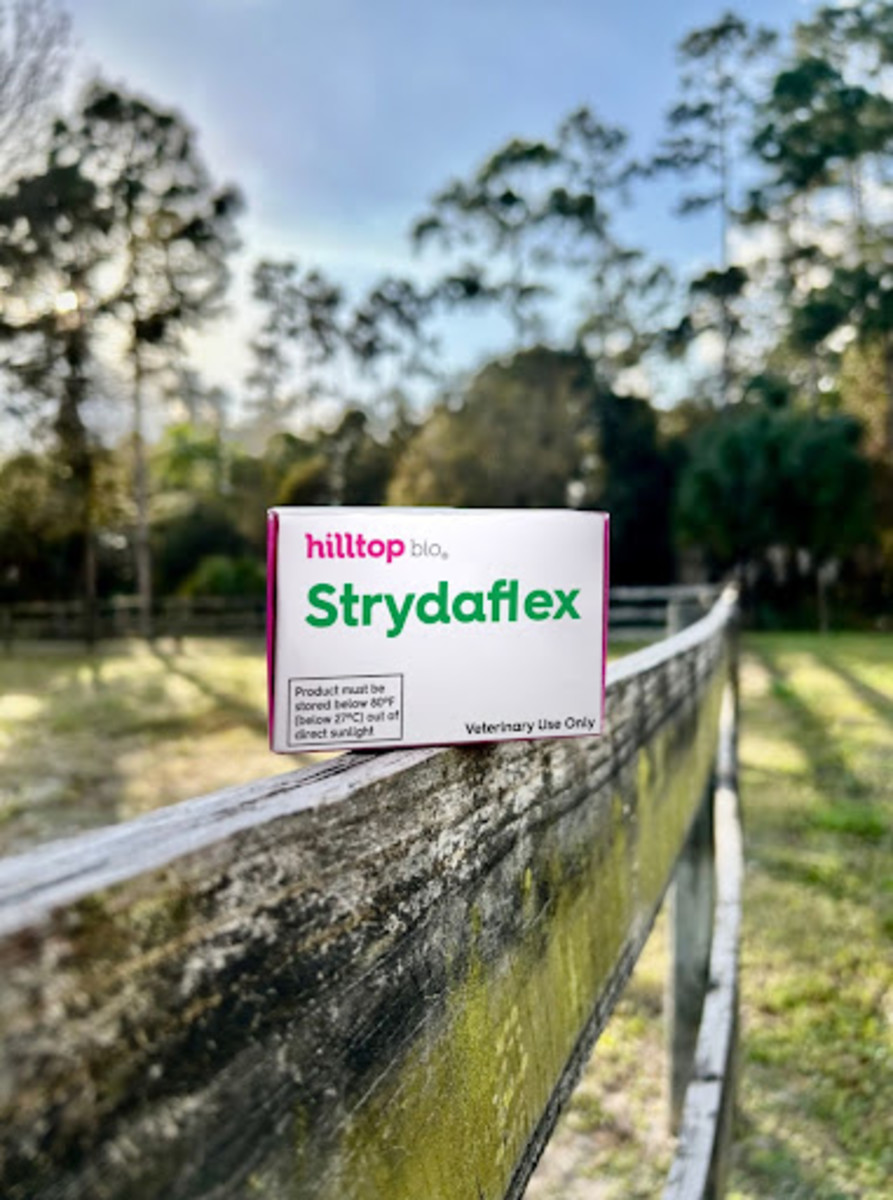
“Because joint issues are one of the most common problems plaguing equine athletes, we've devoted extensive R&D to formulating a joint therapy that not only reduces inflammation, but also helps repair damaged tissue,” said Hilltop Bio CEO, Amanda Drobnis. “We're excited to introduce Strydaflex for equine joints, a game changer for equine veterinarians and their patients. Strydaflex joins our existing line-up of room-temperature regenerative therapies that includes Regenaflex-RT for soft tissue injuries and Regenaflex-M for wounds and surgical implantation.

“As with our other products, Strydaflex is 100% natural and offers the unparalleled convenience of off-the-shelf stability for up to a year, whether that shelf is in your clinic or on your truck.”

Hilltop Bio has completed a pilot safety study on the original cold formulation and is currently conducting a follow up study for the lyophilized version. Initial data indicate that both versions appear to be well tolerated and have demonstrated positive outcomes in horses with clinical lameness.

Traditionally, corticosteroids have been the default treatment for joints because they are great anti-inflammatories. But a large body of evidence indicates that long-term and/or high volume use of corticosteroids can have a serious negative effect on cartilage cells, even to the point of cell death.

“Most of the autologous derived products, whether you're talking about an autologous conditioned serum, an autologous protein solution, PRP; all of those do a really good job of concentrating factors from the blood that you can administer intra-articularly,” said Dr. Dan Dreyfuss. “The problems are (a) you don't know what exactly is in there that's working, and (b) they're also concentrating pro-inflammatory cytokines that you're then putting in the joint. And that's not good for the joint.

“Being able to custom engineer these products for different uses is what, in my opinion, sets Hilltop apart from the rest of the crowd. And it's a really important distinction. Strydaflex has factors in it that are going to take an inflamed synovium, which is over producing pro-inflammatory cytokines, and quiet it down so that the Strydaflex, based on its characterization, is going to incite that synovium to become happier, healthier, and less inflamed. And in the process of doing that, the synovium will produce much better hyaluronic acid within the joint which will contribute to the overall health of the joint.”

Watch Dr. Dan Dreyfuss's full explanation on joint health and Strydaflex here.

The regenerative therapy industry has seen rapid changes in the last two decades. Technological and scientific advancements have empowered veterinarians to provide better care for their patients.

“Most veterinarians are familiar with using stem cell, PRP, IRAP, and ProStride options for soft tissue injuries,” said Drobnis. “What we're seeing in the scientific literature available today is that it's not just the stem cells that fix these injuries; rather it's the exosomes within those stem cells that have the proteins, growth factors, and cytokines as well as the cell-signaling power already available in the horse's body.

“At Hilltop Bio, we're focused on being the leader in the most technologically advanced regenerative therapy market. We're concentrating the exosomes into our formulations to work naturally with the horse's own immune system to up-regulate its healing power and fix itself with minimal scar tissue, reduced inflammation, minimal risk of infection and reduced re-injury rates.

“We're also offering a more consistent product in terms of proteins and growth factors compared to other modalities available on the market today.”

Top veterinarians like U.S. Show Jumping team vets Dr. Tim Ober and Dr. Heather Sherman of Steele & Associates have been using Hilltop products for a number of years.

“We have been using Regenaflex to treat suspensory ligament and check ligament injuries for the past three years,” said Ober. “We are seeing consistency in the healing response with good quality repair, and a much more consistent return to performance than with other regenerative approaches we have used.”

See Hilltop Bio's recent advertorial on Regenaflex-RT and Regenaflex-M here.

The post Hilltop Bio Launches Strydaflex For Equine Joint Health appeared first on Horse Racing News | Paulick Report.

Source of original post

Kentucky Strangles Outbreak: Total Of Seven Horses Across Three Premises Confirmed Positive

The Kentucky Department of Agriculture is continuing to monitor an outbreak of strangles which began with a 3-year-old Thoroughbred filly at the Thoroughbred Training Center in Fayette County, Ky., according to an update posted to the Equine Disease Communication Center's website on Saturday afternoon.

Last week, an epidemiologic investigation indicated the potential for strangles to reach a total of three facilities: the Thoroughbred Training Center, Keeneland Race Course, and Triple Diamonds Training Center on Russell Cave Road. One unnamed trainer housed horses at all three facilities.

Saturday's update revealed that a total of seven individual horses have been confirmed positive for the strangles-causing organism Streptococcus equi subsp equi. The Kentucky Department of Agriculture is continuing to monitor and test multiple horses under the care of several trainers at each of the three premises.

According to E.S. “Rusty” Ford, equine operations consultant for the Kentucky Department of Agriculture's Office of the State Veterinarian, no unauthorized persons are permitted to enter the quarantined barns at the three facilities. Horses in those barns are being permitted to train after regular training hours when other horses have cleared the racetrack. Ford said Monday that trainers are encouraged to teach staff good biosecurity protocols to avoid disease transmission between horses in the impacted barns in case additional horses begin shedding the .

Ford said horses that have tested positive have been removed from their barns and are isolating off-site. The horses that remain in their barns at the three facilities are those who have tested negative. Samples were taken from several of those horses Monday morning to see if their status had changed, and at least one more round of samples will need to test negative before the quarantined horses could potentially be released.

The full update from the Kentucky Department of Agriculture is as follows:

Premises 3: Results of the testing completed on the twenty-seven (27) horses at Triple Diamonds Training Center (aka Three Diamonds on Russell Cave Road) did identify two (2) additional positive horses. These horses were under the care of the same trainer having positives on premises one (1) and two (2). The two (2) positive horses and the trainer's other six (6) horses were all moved offsite to the private quarantine facility. Nineteen (19) horses under the care of a second trainer were all found negative. Horses in this affected barn will remain under quarantine, are being monitored daily for any signs of illness and will be resampled.
“Additionally, two horses for the single trainer that had originally tested negative by PCR the day they were moved offsite from Premises 2 (Keeneland), have subsequently been confirmed positive by culture on specimens collected from enlarged mandibular lymph nodes. The fact both of these horses were PCR negative on nasal pharyngeal washes collected at the time of departure from Keeneland, provides additional evidence and confidence the disease-causing organism, Streptococcus equi subsp equi, was not being shed at that time.
“Assessment of the exposed horses remaining on the three identified premises this morning found all horses to be bright, alert, eating and afebrile. We are continuing to review the health status of these horses daily and will be collecting additional diagnostic tests during the upcoming week.”

The upper respiratory disease commonly referred to as strangles is caused by Streptococcus equi subsp equi. Strangles is spread from horse to horse through direct contact. Horses can also contract the disease by coming into contact with contaminated surfaces. The disease is highly infectious.

For more information go to: https://www.equinediseasecc.org/strangles.

The post Kentucky Strangles Outbreak: Total Of Seven Horses Across Three Premises Confirmed Positive appeared first on Horse Racing News | Paulick Report.

Source of original post

Reining Show Sees An EHV-1 Positive, Leaving 14 In Quarantine

The National Reining Breeders Classic horse show in Tulsa, Okla., saw a positive case of equine herpesvirus late last week, according to Quarter Horse News and the Equine Disease Communication Center.

On April 17, a Quarter Horse was removed from show stabling and transferred to a nearby hospital due to progressing neurological symptoms. The horse, who was vaccinated for equine herpesvirus, was later euthanized. Oklahoma state officials got test results back on the impacted horse on the afternoon of April 20 and identified 14 horses that had direct exposure to the index case. Those horses were quarantined and isolated the same day, and will be released after at least 14 days and two negative tests that come at least a week apart.

The horses that shared the barn with the index horse received two doses of “an amniotic product to reduce viral shedding” and will have their temperatures monitored while they are quarantined.

Read our recent reporting on how an equine amnion product may be able to reduce the spread of EHV.

State animal health officials told Quarter Horse News the show had attracted horses from 22 different states, and as of Friday, they were in the process of contacting those states to determine whether those horses could go home under quarantine.

The show concluded on April 23.

Stay up to date with the latest information on this and other equine disease outbreaks via the Equine Disease Communication Center.

The post Reining Show Sees An EHV-1 Positive, Leaving 14 In Quarantine appeared first on Horse Racing News | Paulick Report.

Source of original post

Not In The Mood? Attitude And Under-Saddle Performance Linked

A horse that appears angry or unhappy in his stall may be trying to share that he's not really ready to be ridden. Horses in these moods often have choppier gaits and a negative attitude when working under saddle.

A study produced by scientists at the Universite de Tours in Nouzilly in France used 43 lesson horses to prove that improving a horse's overall welfare can improve his performance under saddle. The horses were used for advanced riding lessons in dressage, jumping, and eventing. They were ridden about six hours a week and turned out for only one hour each week in individual sand paddocks, reports EQUUS magazine.

The horses were observed in their stalls multiple times a day for six weeks and their behaviors were documented. The scientists were specifically looking for indicators that the horses were unhappy at being kept in a stall: aggression toward people, hypervigilance, stereotypic behaviors like cribbing or a depressive stance. The average number of observations for each horse was 90.8 over the six weeks. 

The head riding instructor was then asked three questions about each horse, with which she was familiar. The questions focused on how each horse went under saddle: if it was fearful, anxious, uncomfortable, or reluctant to go forward. 

The final phase of the study involved an expert rider working each horse in the same tack. The rider wore inertial sensors on her chest and lower back; the horse wore a sensor on the underside of his girth to measure torso movements. 

The rider did not know the horses or the behaviors they had exhibited. The ride was filmed and an independent assessor noted the behaviors that might indicate a negative attitude: head shaking, tail swishing and bolting. They also noted each horse's overall demeanor. 

The researchers analyzed the data and found correlations between behaviors that indicated negative emotions in the stall and under-saddle performance. More-aggressive horses had choppier gaits that also made the rider move more. Horses that were more withdrawn were more reluctant to move forward while being ridden.

[Story Continues Below]

The scientists concluded that the horse's welfare, and emotions, are reflected in their way of going. Effort to improve a horse's welfare may reduce a horse's negativity and result in better under-saddle performances. 

The team suggests that welfare changes may include more turnout and interaction with other horses. 

Read more at EQUUS magazine

The post Not In The Mood? Attitude And Under-Saddle Performance Linked appeared first on Horse Racing News | Paulick Report.

Source of original post

Verified by MonsterInsights