The horses in trainer Joe Davis' barn at Horseshoe Indianapolis don't just get standard hay in their nets each day. Throughout the afternoon, Davis or one of his employees opens the HayGain machine that sits at the end of his shed row and pulls out a warm, beautiful-smelling bale of freshly-steamed hay to fill their nets.
“I think it helps with bleeding,” he said. “They get so much dust with regular hay, and when it comes out of that steamer, it just smells great. And when it's fresh out of there, they really love it. It cuts down on dust and bacteria. We've had really good luck with it.”
Davis said he was inspired to change the way he fed the horses in his racing string after he assisted researchers at Purdue University on a study into equine airway issues. The study was one of two led by Dr. Laurent Couetil that was funded by the Grayson-Jockey Club Research Foundation.
At the beginning of his research into equine airway issues, Couetil was interested in learning more about what was then referred to as equine asthma, but is now more commonly understood to be inflammatory airway disease. Roughly 10 years ago, there was disagreement among veterinarians and researchers as to whether horses that frequently cough or struggle with breathing during exercise were experiencing low-grade infections or if they were reacting to dust or other irritants in the air – and where those irritants may be coming from.
Couetil studied the issue through the use of bronchoaveolar lavage, in which a scope is passed down the horse's airway into the lungs and fluid is rinsed through the lungs. The fluid is then extracted and the contents examined to measure what may be going on inside. Researchers learned that the more dust a horse encountered in its stall, the more neutrophils were found in the lavage. (Neutrophils are a type of cell associated with inflammation.) They also found that when measuring the dust particles horses encountered, it was the smallest particles that seemed to impact the most change. The most problematic particles for horses' lungs were less than four microns wide. (The average human hair is 50 to 100 microns in diameter.) So, the irritant was so small it couldn't be seen with the human eye but it could be sucked up deep into a horse's lungs.
Some lung washes also showed that horses had an increase in mast cells in their lungs (a cell typically associated with allergic reactions) when they were exposed to particles of betaglucan, which is a component of cell walls in plants and fungi. For Couetil, these two discoveries pointed to hay as a potential culprit.
Couetil and his research team created a machine that included sensors mounted around a horse's halter and pulled air into a pump attached to a surcingle around the horse's barrel. With the help of Davis, the team fixed the pump to horses six hours after their morning work and measured what types of particles came through the pump. They also did lung washes of horses and compared their findings with the horses' Equibase speed ratings in their race results during the time they were being measured.
“Unsurprisingly, the more inflammation in the lungs, the poorer their performance,” said Couetil.
[Story Continues Below]
Then, Couetil wanted to know whether trainers like Davis could control how much dust a horse was exposed to in their stall. With the help of Grayson's funding, Couetil constructed a study to measure dust exposure for horses eating regular hay, steamed hay, and haylage. While not commonly used for horses in the United States, haylage is popular in Europe, where many growing environments get lots of rain, making it difficult to fully dry baled hay. Haylage is chopped and ensiled, dropping pH and allowing the product to be stable enough for bagging and long-term storage.
“Importantly, when we did the lung washes and measured the inflammatory cells, we found a drop in neutrophil percentages in horses that were on steamed hay or haylage,” said Couetil. “The effect was more pronounced with haylage, even though they decreased dust exposure about the same. With haylage, they were already lower at three weeks and they were almost at normal limits by six weeks, whereas the effect with the steamed hay kind of plateaued.
“A lot of people think that the bedding or track surface are the culprits for dust exposure, but we showed your feeding program can make a difference.”
Davis found the results so compelling that when the study was over, he asked HayGain if he could hang onto the hay steamer. Even though it requires a little extra man power to take bales in and out, he thinks it's worth it.
“We'll steam five bales a day and then set them out and feed them morning and night,” Davis said. “I've got a guy who hangs around the barn in the afternoon. It takes about an hour to steam one, so he'll put it out up and down the aisle. Then they're good for about three days.”
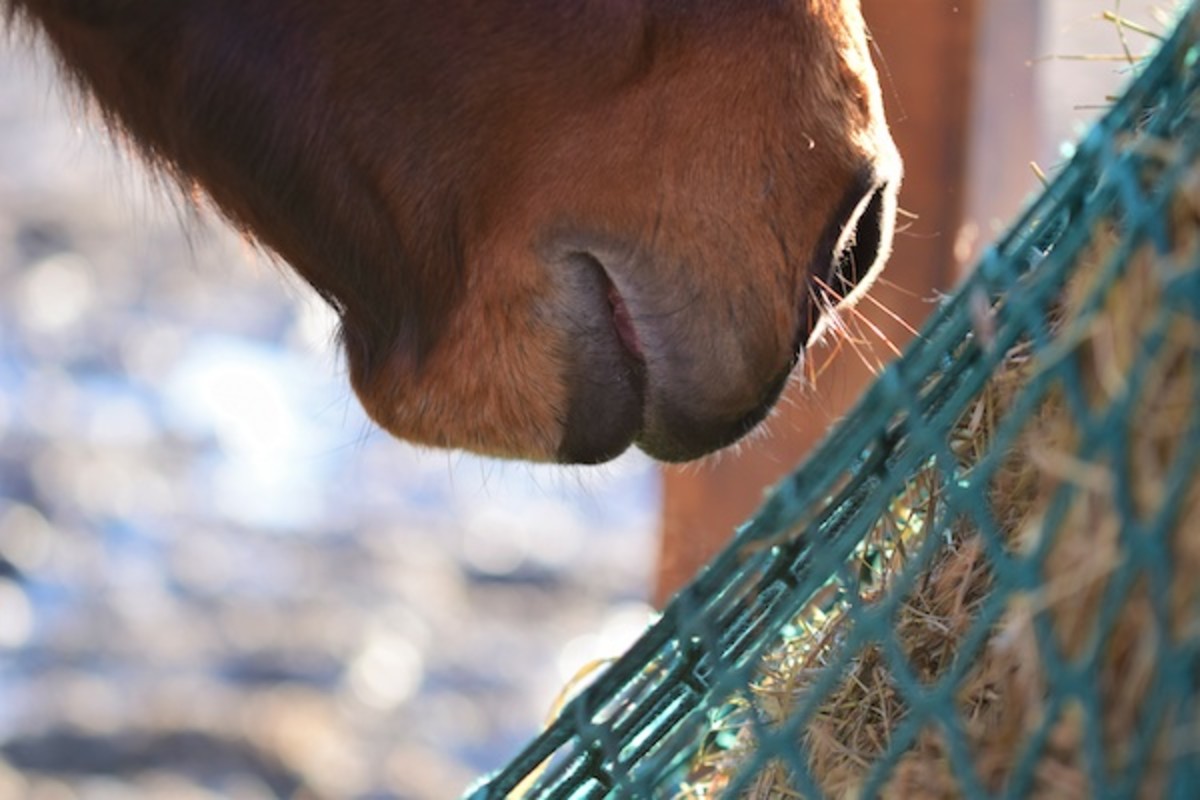
Davis wasn't as sold on the performance of the haylage; it was only available from one supplier in Indiana, and he said some of his horses weren't interested in eating it. Couetil knew that many horsemen prefer horses to graze from a net or slow feeder, rather than use lower-dust hay pellets or haylage. Besides encouraging steaming, he wondered what else he could suggest to horse owners to help with horses who could be sensitive to airway irritants.
Couetil considered that perhaps the haylage had been successful because it's known to be a good source for omega-3 fatty acids. This lipid is a component of all diets and is believed to have anti-inflammatory properties. Many performance horses' diets are high in omega-6 fatty acids because they consume so much grain; omega-6s are pro-inflammatory. Horses need to have some pro-inflammatory mediators in a diet to effectively mount an immune response, but omega-3s may balance out the impacts of excessive omega-6s in a horse's diet.
In 2020, Grayson funded a third project for Couetil's team, allowing them to test whether fish oil, a known source of omega-3s, could have an impact on airway inflammation for horses. The team made up unlabeled packets, some of which contained fish oil and some of which contained corn oil as a placebo, and asked trainers to add them to their racehorses' feed. This study included horses from Santa Anita, Gulfstream, Ruidoso, and Horseshoe. Again, they measured dust exposure and did lung washes.
Couetil said he's still analyzing that data because the COVID-19 pandemic slowed down collection, but so far it seems the fish oil could have proven his theory right.
“Just those packs of fish oil were enough to decrease airway inflammation in those horses,” he said. “That's very exciting to us because now you have alternatives.”
Davis was so compelled by these results that he now gives fish oil to selected horses he knows struggle more with airway inflammation during exercise or racing. It's not a cheap feed additive, but the horses seem to like it (despite the smell) and he believes it makes a positive difference.
“I had one horse we put on it and he was a bad bleeder and had breathing issues anyway,” recalled Davis. “We put him on the fish oil and he ran three super races while he was on it. I could tell a big difference in him.”
The experience of working with researchers and seeing lung wash results has Davis thinking harder about EIPH or other respiratory issues when a horse turns in a disappointing performance.
“On the lung wash they diagnosed a couple horses that had bled farther in there. That helped me a lot, giving me a heads-up on a couple of them I couldn't tell,” he said. “We do a lot more scoping when we think there may be a problem. I do more diagnostic stuff that way [than I used to].”
All of it was possible thanks to the support of the Grayson-Jockey Club Research Foundation, which funds research that benefits horses of all breeds. Since its foundation in 1940, the organization has given more than $40 million to underwrite more than 426 projects at 45 universities. Grayson-supported research has changed the way owners, farm managers, trainers, and riders of all disciplines manage horses in times of wellness, illness, or injury. Find out more about its current projects here.
The post Research In Action: Purdue Studies Convinced Trainer To Steam His Horses’ Hay appeared first on Horse Racing News | Paulick Report.
Source of original post
