One morning at Saratoga last summer, a 2-year-old colt lost his rider on the way to the track. After a jaunt around the barn area, he was caught and apparently seemed none the worse for wear, so the pair of them continued on with the work that had been planned for them by the colt's trainer. Both came back to the barn, and for a while, all seemed well. It was until late morning the staff began suspecting something was wrong.
“With some fractures, horses can be sound immediately after they fracture – it's when the adrenaline calms down and they cool out that they can be lame at the walk,” said Dr. Luis Castro of Tiegland, Franklin and Brokken. “We've seen horses come back from racing, even win, and cool out and become lame.”
(Castro requested we keep the trainer and the horse's Jockey Club registered name confidential.)
Dr. April Downey, a fellow veterinarian at Teigland, Franklin and Brokken, was called to take a look at the horse. She noticed a lameness in one leg – the other seemed a little abnormal, but not worrisome – and suggested a set of radiographs. Even she wasn't prepared for what she saw in the films.
“The horse had two medial condylar fractures that were spiraling up the leg – left and right front,” said Castro. “I've been doing this a while and I can't remember ever seeing that, to be honest. Condylar fractures are pretty common; medial condylar fractures are less common but not unusual. To see both [legs] at the same time is very unusual.”
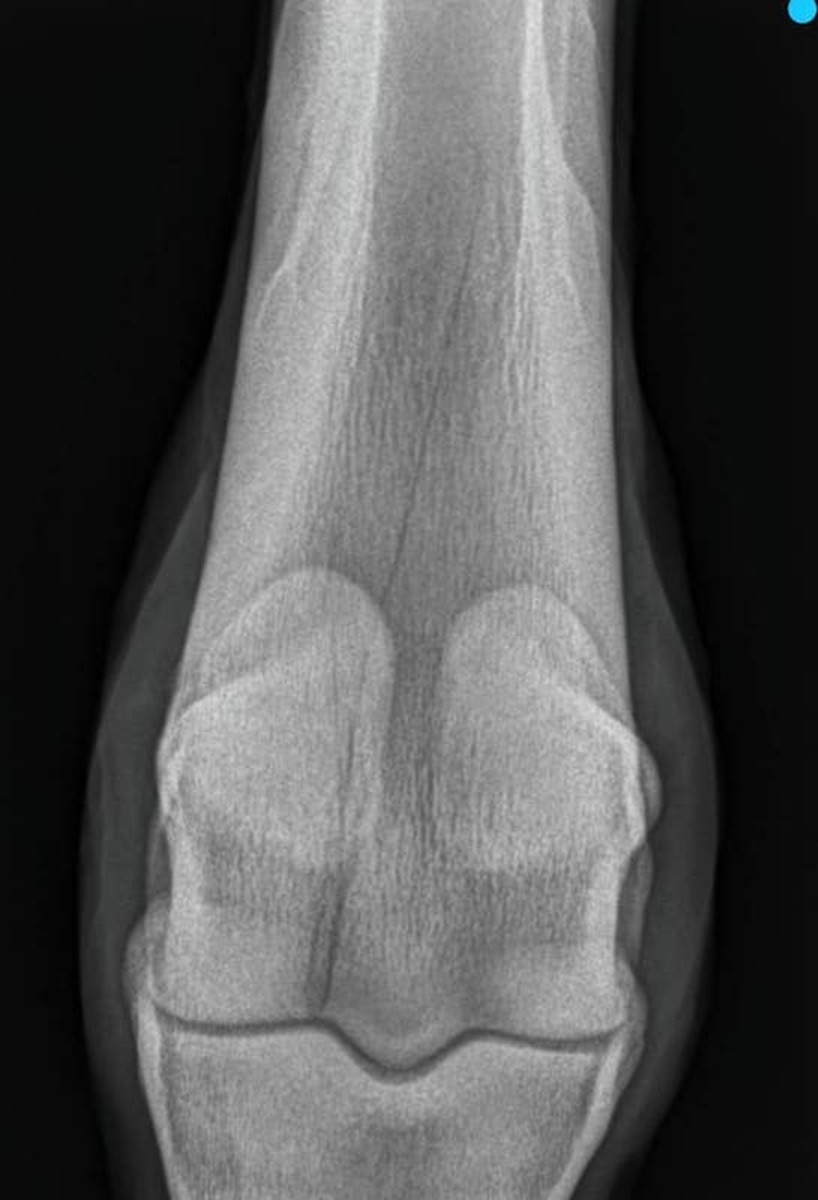

“The spiraling fractures that happen medially are in danger of breaking apart pretty easily. They end up going all the way up to the knee and just kind of unraveling. The lateral condylar fractures really don't do that, and that's the one you see more commonly.”
'Medial' refers to the inside of the leg, meaning the horse's fractures started around the ankles and traveled up the insides of each front leg. Spiral fractures are so named because they're the result of a twisting force or impact. In this horse's case, the spiral fractures travelled up the center of the bony column of the cannon bone.
At the time, Castro said he would have given the horse less than a 50 percent chance of survival. The fact the horse had fractures in both legs that could easily worsen was one problem. The horse would have be moved to an equine hospital in order to undergo surgery, inviting more risk. Then there was the risk involved in that surgery – these fractures do best with a plate and sometimes as many as eight screws, but unlike other types of fractures, the biomechanics of the leg can mean the fractures are at risk for further separating if the horse were to take an awkward step when recovering from anesthesia. Then there would be a long recovery with a lot of stall rest, with no room for a misplaced hop of enthusiasm from the young horse.
It wasn't one mountain, but an entire range he would need to get over to survive.
The horse's owner looked at the odds and the expense and wasn't convinced, requesting the horse be euthanized. Castro said he hesitated.
“This horse was kind and he was quiet,” he said. “The best thing about the entire story is that he was the perfect patient. He took care of himself and knew what was going on. I was trying not to euthanize the horse and to give him a chance.”
With very little time to figure out a solution, Castro bought the horse for $1 and a promise not to race him. It was not Castro's habit to buy patients in need, and now he had to figure out what to do with his new horse. He got on the phone and started calling anyone he knew in the area – veterinarians, horsemen – who may be able to help.
In an ideal world, he knew the horse could have undergone a procedure to insert a plate, followed by a pool recovery. A water recovery allows a horse to recover from anesthesia in a weightless state, ensuring they are completely awake before they get back on their feet. Not only was that program expensive, the closest one was at the University of Pennsylvania's New Bolton Center, a five-hour drive away.
Castro reached Dr. Patty Hogan of nearby Hogan Equine, who suggested it may be better to stay close to home and undertake a less complex procedure. Hogan connected Castro with Dr. Katie Dern at Rood and Riddle's Saratoga division and suggested they think about a different type of surgery which could be done standing – meaning, the horse could be heavily sedated and locally anesthetized but not fully unconscious. Dern was game to try what was called a “salvage procedure.”
Rather than inserting a large plate into each leg to stabilize it, the theory was a couple of screws at the base of each cannon bone, combined with a special type of cast up to the knee, could keep everything in place while the top part of the fracture healed.
It was new territory for both Dern and Castro, but they agreed it was the horse's best chance. Castro remembers holding his breath all through the drive from the barn to the clinic and through the procedure.
“It was a bit of a hair-raising situation,” said Castro. “They walk the horse from the stall to the exam room. Dr. Dern is on her knees in front of this tranquilized, blocked horse and she drilled two screws in each leg and he stood there like a champ. Did not move an inch.”
But that didn't mean he was out of the woods yet. Castro knew recovery was contingent on a lot of “ifs.”
“If the two screws hold, if the horse is a calm patient, if no complications occur, you have to put a cast that you cut into a clam shell. You have to create a system where you basically change the bandage underneath and tape it back together, and he's got to stay calm through the whole thing. Oh, and he's got two of them.”
Initial bandage changes went well, and it became clear the horse was ready to leave the hospital, but he also still needed intensive care from the veterinarian team. It made sense to have him back at the track, where Castro and his colleagues could easily check on him frequently, but all horses on the property had to be affiliated with a licensed trainer. Castro again got on the phone and found himself calling longtime client Chad Brown.
“I told one of my clients, Chad Brown, the story and he said, 'Just put him in one of my stalls,'” said Castro. “Chad gave us a stall, a groom, feed, bedding and never batted an eye.”
The veterinary team popped by to check on the horse four or five times a day. Every three days, the team gave him a dose of sedative and walked him carefully to the wash rack for his casts to be untapped, dressings changed, and reattached with self-sticking bandage. And every time, he walked gingerly, quietly, and as if he really had no idea what all the fuss was about.
“Looking back on it, we probably needed [the sedative] more than he did,” joked Castro. “We kept thinking, 'If this horse gets loose, it's all over.' The only thing that wasn't worried was the horse.”
The colt laid down during the day, which Castro was comfortable with since unlike an anesthesia recovery, he could get up with his full sense of balance and alertness.

Gryffin in his new home. Photo courtesy Dr. Luis Castro
It took months of those bandage changes, first at the track and later at Three Ponds Farm in nearby Mechanicville, N.Y. To Castro's amazement, the horse's temper held and his bones slowly healed. When it came time to rehome him, the horse didn't have to look far for his new owner. Paige Montanye, assistant to Castro, had fallen in love with the patient colt and adopted him, renamed him Gryffin, and sent him to Legacy Horse Company in Wyoming, where he now spends his days with a herd of others cantering through open country. Castro said Montanye hasn't yet decided what his future will hold, but it's a bright one.
“This is the crazy thing—that horse is completely sound, and the radiographs are completely normal,” he said. “He doesn't have any arthritic changes in the films that I saw. As far as I'm concerned, he can do anything he wants. Ironically, he could even race, but we have no intention of racing him. He's not just a 'pasture pet' anymore.”
Gryffin's case is one of Castro's most improbable recovery stories in nearly 30 years of practice – and a good reminder that sometimes all a horse needs is a chance.
The post Thanks To Team Effort, OTTB Beats The Odds Against Two Serious Fractures appeared first on Horse Racing News | Paulick Report.
