Induced Lactation in Mares: A Viable Option, Free Of Nurse Mare Foals

A newborn foal in need of a nurse mare is never a desired scenario. Regardless of the reason, to avoid hand-raising an orphan, a nurse mare is necessary. The nurse mare industry is controversial because it produces orphan foals when the mare is taken away from her own foal.

Learn more about nurse mares and their foals from this 2013 Paulick Report feature.

There is another answer, and that is inducing lactation in a mare. While this is a technical procedure that needs specific treatment, veterinarian oversight and the right mare, it can give one foal a chance at life while not leaving another orphan foal behind.

Overview of the Procedure

First, the right mare has to be chosen. According to Dr. Patrick McCue, DVM, PhD, Dipl. ACT, professor specializing in equine reproduction at Colorado State University (CSU), the potential nurse mare must have been pregnant, developed a mammary gland, given birth and lactated at some point in her life. Very importantly, she also has to have a good personality and have been a good mother.

McCue notes that induced mares do not produce colostrum. If the newborn foal did not receive enough from his natural mother, colostrum needs to come from a different source. That is vital for the health of the foal, so McCue always checks the IgG level (the amount of immunoglobulin type G, an antibody) of the orphan and supplements with colostrum or plasma if necessary.

Lactation is regulated by prolactin made by the anterior pituitary, but prolactin itself is not available as a commercial treatment in horses. However, prolactin secretion can be modulated by administration of a dopamine antagonist such as domperidone. Domperidone blocks the receptors that dopamine binds to, allowing prolactin levels increase, and the mare comes into milk.

Research shows pretreating mares with estrogen prior to domperidone therapy resulted in higher prolactin levels. After four to six days of domperidone therapy, there is usually enough mammary gland development to start hand milking, which promotes even more milk production.

Once the mare has enough milk, the new foal can be introduced. This is usually three to five days after hand milking starts, or seven to 10 days after the beginning of domperidone therapy. While all this is happening, the foal needs to be fed with milk replacer. McCue advised to limit foal handling so that the foal doesn't bond with people and will eventually bond with the nurse mare.

Introducing the mare and foal is definitely a tricky time. McCue uses a prostaglandin protocol to establish the maternal bond in the mare. The mare will usually develop an intense interest in the foal. He recommends having the foal hungry so it will instinctively search for the mammary gland. Once the foal latches on, they step back and watch the behaviors to make sure all is well. He does note that despite all the efforts, occasionally the process does not work.

Filling a Need

Bronwyn Watts of ColdSpring Nurse Mares has spent her life devoted to horses. Born and raised on a working horse farm in the Blue Ridge Mountains of Virginia, she was a professional groom in the three-day event world for 15 years.

After hearing about the controversial nurse mare industry, she was motivated to do something about it.

“It struck a nerve with me,” she said. “How can it be that we do not have a more ethical way of providing such a vital service to the equine breeding industry?”
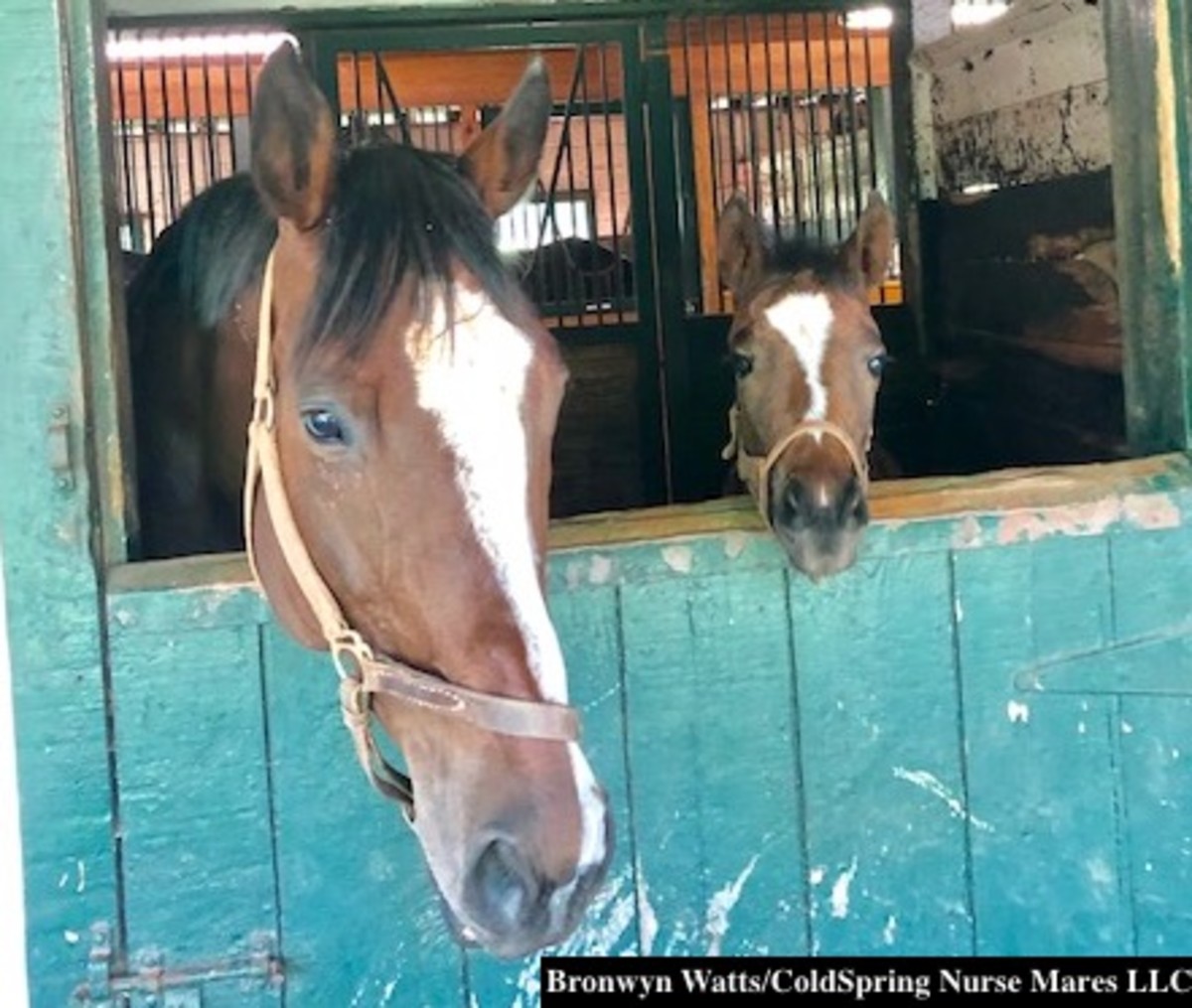
A mare and foal matched through ColdSpring

After that, she began researching hormone induced lactation, determined to start her own hormone induced nurse mare program. Two years ago, ColdSpring Nurse Mares, now based in Ocala, Fla. and Lexington, Ky., was founded. While many people associate nurse mares with the Thoroughbred breeding industry, Watts emphasizes that they serve all breeds.

The farm does all the work, which takes much of the pressure off the foal owner.

“Our mares are ready to go starting the middle of January,” Watts said. “We deliver the mare to the foal, and we handle the pairing process to ensure it is done in a professional, controlled and safe manner, resulting in a 100% success rate.”

In their first two years, they have successfully paired 52 mares to orphan foals all over the southeast and mid-Atlantic regions.

Pros and Cons

There are no real physical, clinical or pathological drawbacks for the nurse mares. They are happy being a mom, and a mare can still be bred even while nursing. There are no adverse issues with the mammary gland and no real downside to therapy.

“ColdSpring Nurse Mares provides an innovative and vital service to the equine community while also bringing awareness and action to the problem of equine over population,” said Watts. “Our program allows us to save three lives by not producing throw away foals, giving the ultimate nutrition and proper socialization skills to an orphan foal, and repurposing older broodmares who often find themselves in less than desirable situations once they no longer can conceive.”

One Farm's Story

Western Venture Farms in Waukesha, Wisc., is a large boarding facility with mostly pleasure riders. Several years ago, barn owner Tammie Roeber accepted a starving Arabian mare with a severe sinus infection along with her one month old foal. After lots of time and care, and two sinus surgeries, the mare, named Haleena, and foal recovered and were doing well.

One boarder brought in a pregnant Quarter Horse mare who was severely lame from untreated laminitis, navicular syndrome, and infected frogs. They were able to manage the mare through her pregnancy, but after she foaled a filly, she foundered and retained a portion of placenta. Unfortunately, she couldn't be properly treated without endangering the foal.

Roeber and the mare's owner needed to try something, so they thought of inducing lactation in Haleena. They talked with their vets about it and decided to give it a try.

It took four to five days for Haleena to start producing milk. Once the pair were introduced, they kept a very close eye on the mare and foal for two days to be sure everything was going well.

A ColdSpring nurse mare on the job

Fortunately, the process worked.

“The filly is wonderful,” said Leslie Sutherland, who works part-time at Western Venture. “It required a network to get it all done. You have to want to try, do the work, be diligent and have lots of good help.”

In the End

A new foal without a mother is a serious situation. The preference would be to find a mare who recently lost her foal if she is still lactating. If one is not available, inducing lactation is a viable option, and both ways are better than trying to raise a foal without a mother.

Stephanie J. Ruff, M.S., has been a freelance writer specializing in the horse industry for over 20 years, and was the recipient of the Sheikha Fatima bint Mubarak Ladies Darley Award for Outstanding Female Journalist in 2017. She blogs about her riding and writing life at www.theridingwriter.wordpress.com and lives in Florida with two horses, two dogs and two cats.

The post Induced Lactation in Mares: A Viable Option, Free Of Nurse Mare Foals appeared first on Horse Racing News | Paulick Report.

Source of original post

TRF Blackburn 2020 Horse Show Goes Virtual

Building on the success of the 20th Anniversary TRF Blackburn Horse Show hosted in 2019, the Thoroughbred Retirement Foundation (TRF) and the Blackburn Correctional Complex (BCC) will host a virtual edition of the TRF Blackburn 2020 Horse Show. A global audience will tune in to experience a compelling demonstration of horse-handling skills, equine knowledge and transformational impact of the TRF Second Chances Program.

Event Details:

  • Tuesday, Oct. 20, 2020
  • 8pm Eastern Time (one hour duration)
  • Streaming live on YouTube, Facebook and Twitter (Thoroughbred Retirement accounts)
  • No Tickets or RSVP Required. Details at: https://www.trfinc.org/event/blackburn2020/

“Last year, we welcomed the Lexington community to Blackburn to see the men and horses of the TRF Second Chances Program “in action” and the response was extraordinary,” Paul Saylor, Chairman of the TRF Blackburn Advisory Committee said. “This year we've re-imagined the Horse Show and will make the experience accessible to individuals across the country and around the world.”

“The awareness and understanding created by the 2019 Horse Show has had a powerfully positive impact on the TRF Second Chances Program at Blackburn”, shared Acting Warden Abby McIntire. “By bringing employers and business leaders to meet the men and horses at the Second Chances barn last November, we have significantly improved the impact of the program on the long-term future of the offenders in our program. We are optimistic about the impact of this year's event, and hope it will inspire even more engagement in the program across Kentucky and the country.”

As a direct result of the 20th Anniversary Horse Show, three graduates of the TRF Second Chances program have received job offers from employers in the equine industry. Thus far in 2020, despite the challenges of COVID-19, two program graduates have completed their sentences at BCC and re-entered society with jobs in hand. These men will share their stories within the TRF Blackburn 2020 Horse Show program.

A Collaborative Cross-Industry Effort

Notable support from Horse Show Media Sponsor, the Thoroughbred Daily News (TDN), and Workforce Development and Promotional Partners, the Kentucky Chamber of Commerce and Kentucky Equine Education Project (KEEP), have contributed meaningfully to the 2020 Horse Show. The TDN editorial team has undertaken the filming and production of the live-action demonstrations and interviews which will be presented on October 20th via Livestream. This in-kind support has made the 2020 Horse Show possible. Meanwhile, the Horse Show Workforce Development Partner, the Kentucky Chamber of Commerce (through the work of the Kentucky Chamber Workforce Center and KEEP) has facilitated invaluable connections with employers across the Commonwealth of Kentucky to promote fair chance hiring in the workplace and connect Kentucky's returning citizens with meaningful employment.

Sponsorship donations received for the Horse Show directly support the care of the 49 horses residing at the program at Blackburn. The 2020 Horse Show has been generously sponsored by Mary and Gary West, the Heider Family Foundation with supporting sponsorship from Churchill Downs, Godolphin and the New York Thoroughbred Horsemen's Association.

More than fifty Promotional Partners have joined the TRF to promote the 2020 Horse Show to their audiences. Several partners will be cross-posting the livestream event on their websites on October 20th and more than a dozen “watch parties” have been scheduled across the country and around the globe. This diverse team of individuals, nonprofits, membership organizations, racing partnerships and businesses are expanding the reach of the livestreaming event to more than 250,000 people through their social media networks.

Promotional Partners include: America's Pastime Stables, Amplify Horse Racing, Belmont Child Care Association, Bergen Stables, Brookledge Horse Transportation, Community Ecology Institute, Dark Horse Mercantile, Denali Stud, DV8 Kitchen, Fasig-Tipton, The Fletcher Group, Florida Thoroughbred Owners' and Breeders' Association (FTBOA), Groom Elite, Herringswell Stables, Horse Country, Impressions of Saratoga, Jaeger 2, Joanne Y. Pierce Fine Art, Kentucky Equine Education Project (KEEP), Kentucky Chamber of Commerce, Kentucky Thoroughbred Farm Managers Club (KTFMC), Lex on Tap, Making Strides Therapeutic Horsemanship, Inc., Maryland Horse Council, Maryland Equine Transition Services (METS), Midway University, New York Racing Association (NYRA), New York Horsemen's Association, National Museum of Racing and Hall of Fame, Old Smoke Clothing Co., Pierce the HeArt Lessons, Rainbow's End Racing Stable, Renaissance Equestrian Foundation, Retired Racehorse Project (RRP), Rood & Riddle, Semper Fortis Financial LLC, Spy Coast Farm, Stable Duel, Starlight Racing and StarLadies, Thoroughbred Aftercare Alliance (TAA), Thoroughbred Charities of America, VisitLex, WinStar Stablemates and numerous passionate individuals are also spreading the word to their personal and professional networks.

Horse Show Media Partners include: At the Races with Steve Byk, The Daily Racing Form (DRF), The Equiery, Equidaily.com, Going in Circles Podcast, Horseracing Nation, In the Money Media, StreamHorseTV, The Paulick Report, Thoroughbred Daily News (TDN) and Wire to Wire.

The post TRF Blackburn 2020 Horse Show Goes Virtual appeared first on Horse Racing News | Paulick Report.

Source of original post

Physical Therapy Returns Horses To Competition Ring More Rapidly

A horse that requires surgical intervention for a bout of colic isn't out of the woods as soon as he come out of anesthesia. His recovery period can be fraught with complications as his abdominal muscles have been damaged: the surgeon must cut through them to access the origin of the pain. This incision will alter the function of the skeletal muscles.

Drs. Hillary Clayton and Narelle Stubbs of Michigan State University have developed a series of physical therapy exercises that can be completed after the horse's surgery is complete to help strengthen the horse's core and back muscles. Dubbed the core abdominal rehabilitation exercise (CARE) program, the rehabilitation begins 30 days post-surgery and recommends four weeks of in-hand strengthening exercises. These exercises include lumbar lifts and limbering exercises that ask the horse to move his chin to his withers, chest, knees and fetlocks.

A study was done to determine if the CARE program allowed horses to return to work or to competition more rapidly than not implementing rehabilitation exercises post-surgery. Owners of horses that had had colic surgery between 2008 and 2017 were given the option of taking part in the CARE program. Those owners who chose to engage their horse in the program received a manual, DVD and schedule to follow. Horses that were alive one year after the colic surgery were able to be included in the study.

There were 62 total horses used for the study; 11 horses had completed the CARE protocol and 51 did not complete the program. Researchers reviewed each horse's medical records and sent out surveys asking about the horse's post-op care and progress. Questions included for how long the horse was on stall rest after surgery as well as the timeline on surgery, the beginning of work and the return to full training and competition. They were also asked how the horse was performing one year after the surgery.

Results showed that horses that participated in the CARE rehab program returned to work more quickly: On average within 60 days while the control horses returned to work in 90 days. CARE horses returned to full work in 75 days, versus the control horse's 120 days it took to return to full work.

The researchers concluded that the CARE protocol is beneficial post-surgery, but that it may also be helpful during any recovery that includes long periods of rest for the horse.

Read more at EQUUS magazine.

The post Physical Therapy Returns Horses To Competition Ring More Rapidly appeared first on Horse Racing News | Paulick Report.

Source of original post

Funds Granted For Follow-Up Study On Catastrophic Racehorse Injuries

Catastrophic injuries in Thoroughbred racehorses is a top concern for the industry and for its fans. That sentiment is shared by researchers at the University of Kentucky's College of Agriculture, Food and Environment, who are working to learn more about changes happening at the cellular level that might indicate an injury is present before it becomes career- or life-ending.

According to Allen Page, staff scientist and veterinarian at UK's Gluck Equine Research Center, a recently completed study submitted for review shows it is possible to identify several early markers for horses at risk of catastrophic injury, possibly allowing for intervention before those injuries happen.

In this initial study, Page and his colleagues analyzed blood samples from more than 1,000 Thoroughbred racehorses. The samples, collected by participating racing jurisdictions from across the country, have come from both catastrophically injured and non-injured horses in a quest to better understand if there are any red flags in horses that suffer a catastrophic injury.

Previous research showed that many catastrophic injuries occur in limbs with underlying and pre-existing damage, leading to the theory that these injuries occur when damage accumulation exceeds the healing capacity of the affected bones over time. As a result, researchers think it is likely there may be markers of this damage that can be detected prior to an injury.

The identification of protein biomarkers for these types of injuries has been explored in previous research with limited success. As a result, the group opted to focus on quantifying messenger RNA gene transcripts or markers, knowing that the results would likely be much more sensitive than measuring proteins.

“We are definitely encouraged by our findings in the initial study. Out of the 21 markers we measured, three of them show real promise as being able to predict injury,” Page said. “Since the ultimate hope is to develop a screening tool that can be used pre-race to identify horses at increased risk for injury, we anticipate adding multiple other markers with our new study that is just getting started.”

As part of their new study, Page and his colleagues plan to utilize RNA-sequencing, a relatively new technology, to expand their search to the approximately 22,000 protein-coding genes horses have. This will dramatically increase the likelihood that they will be able to identify additional markers for horses at risk of injury. They plan to do this by using the large number of samples that have already been collected, further leveraging their initial study and decreasing the amount of time it will take to complete their new study.

The new study has been funded by the Kentucky Horse Racing Commission's Equine Drug Research Council, which also funded the three-year initial study.

“A lot of the credit for these projects goes to the KHRC and the Equine Drug Research Council. Their willingness to fund our projects is really a testament to their interest in supporting innovative and novel ideas geared towards improving the safety and well-being of horses and riders,” Page said.

“I am pleased that the EDRC is able to continue to provide support for this important study and that Dr. Page is able to continue his work on finding ways to protect our equine athletes,” said David Horohov, chair of the UK Department of Veterinary Science.

Joining Page in the research from UK's Gluck Center are Horohov, Emma Adam, assistant professor, research and industry liaison, James MacLeod, John S. and Elizabeth A. Knight chair, and Ted Kalbfleisch, associate professor.

Read more here.

The post Funds Granted For Follow-Up Study On Catastrophic Racehorse Injuries appeared first on Horse Racing News | Paulick Report.

Source of original post

Verified by MonsterInsights