So far, we've followed writer, announcer, and Thoroughbred Makeover competitor Jonathan Horowitz in his journey to the 2020 (now 2021) event. This month, Jonathan's wife and trainer Ashley gives us her perspective on Jonathan and his OTTB partner, Cubbie Girl North.
“I think I want to compete next year.”
That's what Jonathan said to me in October 2017, 2018, and 2019. I get it. The environment at the Makeover is infectious. The camaraderie is amazing. There is nothing better than getting to watch the Makeover from the best seat in the house, the announcer's booth.
If you've been following the entire Thoroughbred Makeover Diaries series, you already know that Jonathan had just started riding a couple months before he announced the first Retried Racehorse Project Thoroughbred Makeover that was held at the Kentucky Horse Park in 2015.
I was there as well to see what it was all about. As a trainer of off-track Thoroughbreds (OTTBs) and a horse lover, I was instantly hooked. The difference between Jonathan and me is that I understood (at least a little more) first-hand what it all meant for all those competitors who were there that year. I loved watching the evolution of both his knowledge and understanding of what it took to ride at that competition.
When he made that statement to me in 2017 and 2018, I flat out told him, “No.” He was not ready to take on a fresh OTTB and have it ready to compete after only 10 months of training. I do need to take a moment and say that Jonathan very quickly became the most dedicated novice in learning all that there was to learn about riding, training, showing. Because he didn't know any better he thought, why not endeavor to learn eventing on OTTBs?
He bought my 2017 Makeover grad, Grand Moony, who was very successful in both Jumpers and Freestyle, and he learned to Event on her. She wasn't easy. There were many times he asked if he was in over his head or if she was really the right horse for him. Maybe she was, maybe she wasn't. But, she sure has taught him a ton in the last two and a half years, and she definitely is the right horse for him now.
I'm a little old school. I like throwing a young talent into the deep end…but with a lifeguard on the side just in case. That worked great for his evolution as a competitor, but as he's learned this past year, it's a whole different ball game when you're doing the training.
“I've found your horse!” I exclaimed as I was mindlessly scrolling through horse ads on CANTER's website in July 2019. A 3-year-old bay filly, of course that would be a good fit. In all honesty, when I was looking for a horse for Jonathan, I wasn't looking for what would be the easiest for him. I was looking for quality. I'm sure we could have easily found a horse that was a little older, had a little more experience, and most assuredly would have taken Jonathan down an easier road.
Unfortunately for Jonathan, that's not what caught my eye. Another thing about Jonathan, he's eternally trusting of all of my crazy whims. Of course, why not get a 3-year-old filly who only raced a few times?! This is one of the many reasons I love him.
I loved Cubbie's conformation. I loved that she had low miles. I could see that this horse had upper level potential. This is what an experienced trainer looks for, but for an amateur, it's a crapshoot. There was no hesitation from Jonathan. Maybe it was his naivete or his blind faith in me, but the next day, the process had been started for Cubbie to make her way to our Super G Sporthorses farm in Parker, Colo.
There are a lot of ways to approach the Makeover as an amateur. I knew that Jonathan was an idealist, thinking that things just simply work out. He had visions of how he and his beautiful horse would look, harmoniously riding together at the Makeover. But did he really know what it was going to take to get to the end goal?
Training horses is hard. It's not that every ride is or needs to be a battle, but it is a long process of ups and downs and a balance of steps forward and back. It is challenging and frustrating. Particularly with the rise of social media, there is so much out there on amazing successes. Everyone loves writing about the wins, the accomplishments, the moments in the spotlight. Those who train truly know what it has taken to get to this point. Jonathan did not.
Now, this is not a knock on Jonathan. You cannot fault someone for something that they simply do not know solely because they have not had the opportunity to experience it. As I have said before, Jonathan devoted his entire world to horses — to riding them, to understanding them, to building relationships with them. He spent countless hours watching me working with fresh, young OTTBs, getting them to be good citizens, and finding them good homes.
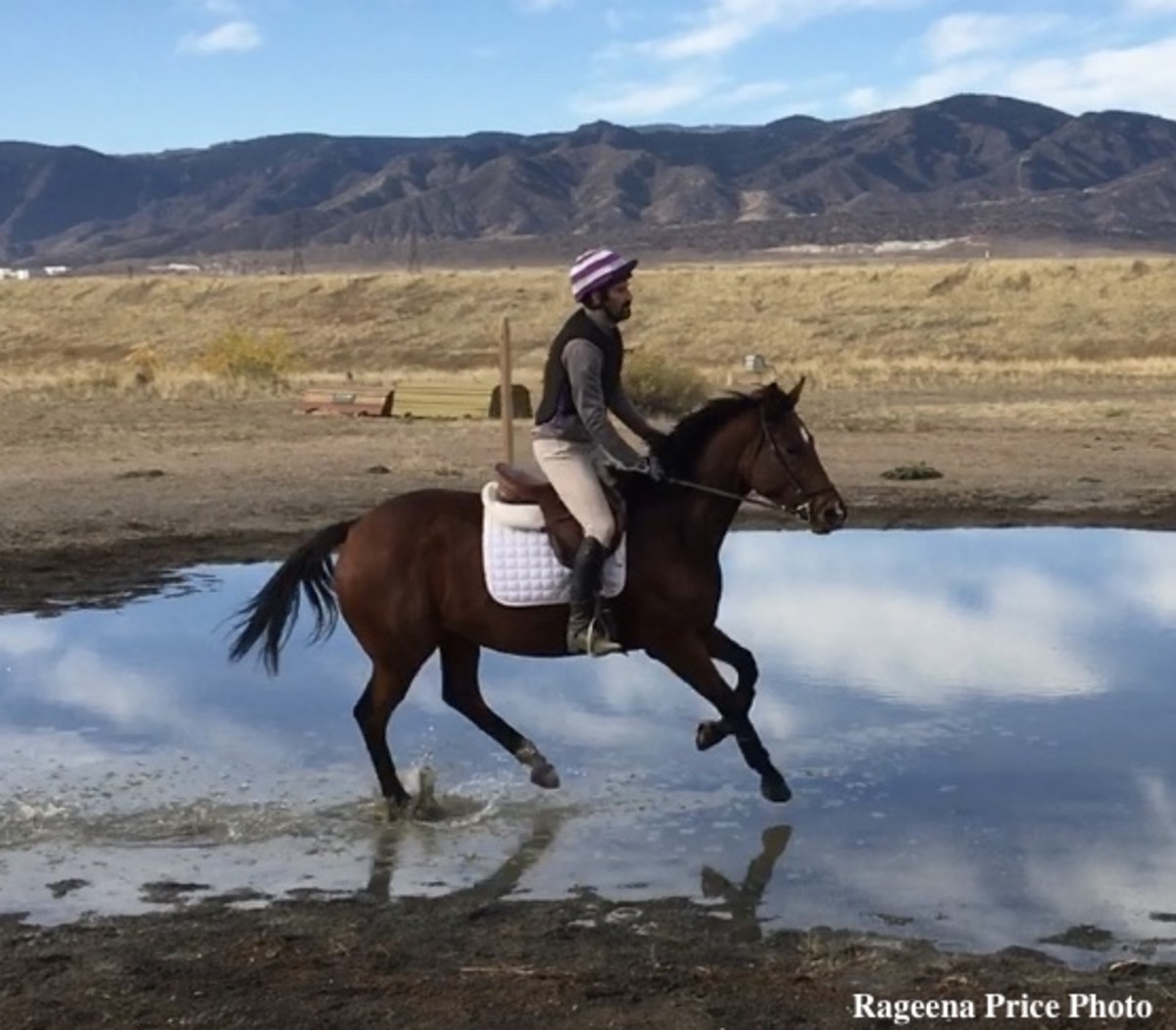
Jonathan Horowitz canters through the water at Spring Gulch with Cubbie Girl North.
The problem was, Jonathan thought because he had spent so much time studying and watching this “art” he could do it on his first try. Cubbie is a phenomenal talent. She has the potential and will be an upper level horse (barring unforeseen circumstances). However, those horses come with egos and opinions and, well, attitudes. Basically, Cubbie is not an amateur's horse.
Now, the problem with this is that I am adamant that I will not train this horse for Jonathan.
I have had the privilege of getting to ride and train with numerous top riders from multiple different disciplines within the equestrian sport—eventing, dressage, hunters, Arabian breed trainers, draft trainers—you name it. I am eternally grateful for all that I have learned from them, and it has helped me immensely. But, the most valuable thing that I have is the tens of thousands of hours of riding on my own and figuring it out. The mistakes are at least as important as the successes, but everything is logged away into a database for reference.
The feel comes at different times for different riders, but it is essential to bring out the true potential of any horse. Horses want to do the right thing. They do talk to us, but it is subtle at first. When you see a horse acting out, it has most likely already told you in their own way how it is feeling and/or what it needs from their rider. To truly train a horse you need to be able to receive this information.
Jonathan and Cubbie have extreme highs and lows, but that is inevitable when you have a novice trainer working with an incredibly smart and talented young horse. What I want everyone to take away from Jonathan's journey is that he is still out there, and he and his mare are moving up and making strides forward. This has not gone unnoticed. The trainers and riders in the area are watching him, and seeing him, and, my favorite part, rooting for him. He is out there every chance he gets trying to learn the language of his horse. It is an awesome journey to watch.
I have held to my standpoint that Jonathan will be the trainer of his Makeover horse, but that does not mean that I am not willing to step in and help. I step in when Jonathan is struggling to feel what Cubbie is saying and decides that it's not worth it for her to try anymore.
After 10 months of the pair working together, we have learned the pattern that about every three months I need to step in, hop on Cubbie a few times, and help open healthier lines of communication. So, I guess you can call Jonathan Cubbie's trainer, but I'm their therapist.
Ashley Horowitz's training experience spans from Arabians in Australia to Clydesdales in Virginia and everything in between. She is the head trainer at Super G Sporthorses in Parker, Colo.
The post Thoroughbred Makeover Diaries Presented By Excel Equine: What It Takes To Go From Rider To Trainer appeared first on Horse Racing News | Paulick Report.
Source of original post
