Researchers Eye Crabgrass As A Pasture Plant For Horses

A menace to landscape professionals and hobbyists everywhere, crabgrass has a reputation as a prolific weed. Because of this, few horsemen would ever consider it a desirable pasture plant. Rutgers University researchers recently reimagined its potential as a forage for horses by capitalizing on its strengths, namely robust growth in hot climates.

While all crabgrasses are warm-season annuals that thrive in the heat, improved varieties developed over the last decade are much different than their garden variety cousins. They germinate rapidly, grow quickly, and offer large-leafed, high-quality summer forage. With this as impetus, researchers theorized that new varieties of crabgrass would pair well with cool-season grasses that have a tendency to grow slowly in summer months, often called “summer slump.” The grass mix would allow for more total forage to be produced throughout the growing season.

To test this theory, two 3.7-acre rotational grazing areas, each divided into six sections, were used—one as a control plot (mixed cool-season grasses) and one as an integrated plot (crabgrass and mixed cool-season grasses). Researchers designated three grazing periods based on time of year: early (mid-May to mid-July), slump (mid-July to mid-September), and late (mid-September to mid-November). Three horses grazed each area during every period. Horses moved from one section to another within a grazing area when sward height became too low. Forage samples were analyzed for nutrient content prior to each rotation. The body condition of all horses was tracked monthly using the Henneke system of 1 (emaciated) to 9 (extremely fat).

How did the two plots fare? Researchers calculated that the integrated system produced 20,000 pounds of forage over the growing season, whereas the control plot produced nearly 14,000 pounds of forage, indicating that implementation of “an integrated rotational grazing approach incorporating the warm-season annual crabgrass may offer production advantages when compared to a traditional cool-season grass rotational grazing system.” Of particular note, the crabgrass performed well during the summer slump period, from mid-July to mid-September, just as the researchers hoped.

Both systems provided adequate nutrition to horses, as evidenced by the fact that all horses maintained moderate body condition throughout the study.

Good-quality pasture is a cost-effective feedstuff for horses, so it is best to maintain grazing areas as well as possible, including appropriate reseeding, fertilization, and weed control measures. If reseeding, work with a pasture specialist to determine the best species for your region.

“Horses are engineered to be efficient grazers. Depending on the season and pasture quality, many horses can meet, even exceed, their energy requirements when allowed to graze,” explained Catherine Whitehouse, M.S., a nutritionist with Kentucky Equine Research. “Some horses, because of metabolic disease, may not be able to graze freely, but many, many can. Grazing also satisfies social and exercise needs.”

For horses fed all-forage diets, appropriate vitamin and mineral supplementation is often necessary for optimal well-being. Choose a high-quality supplement manufactured by a reputable company, recommended Whitehouse.

*Weinert-Nelson, J.R., W.A. Meyer, and C.A. Williams. 2021. Yield, nutrient composition, and horse condition in integrated crabgrass and cool-season grass rotational grazing pasture systems. Translational Animal Science 5:1-18.

Reprinted courtesy of Kentucky Equine Research. Visit ker.com for the latest in equine nutrition and management, and subscribe to Equinews to receive these articles directly.

The post Researchers Eye Crabgrass As A Pasture Plant For Horses appeared first on Horse Racing News | Paulick Report.

Source of original post

Ongoing Veterinary License Dispute: Dr. Jeff Blea’s Request For Stay Denied

A Superior Court judge denied Dr. Jeff Blea a stay of the California Veterinary Medical Board's interim suspension on his veterinary license on Wednesday, according to bloodhorse.com.

Blea had filed a writ of mandate with the California Superior Court for the County of Los Angeles requesting the stay. The filing argued that in his role as the Equine Medical Director for the California Horse Racing Board, Blea does not perform veterinary work and therefore does not require an active license. The filing also argued that the suspension of Blea's license is invalid because the judge did not use a high enough standard of evidence to support her decision, stating that her findings “are not supported by the weight of the evidence, or by any substantial evidence, or at all.”

Judge James Chalfant denied Blea's stay request after concluding that Blea did not present “evidence of irreparable harm and has not shown that it would not be against the public interest to grant a stay.”

The California Horse Racing Board has remained steadfast in its support of Blea. Executive director Scott Chaney told bloodhorse.com Wednesday: “We're disappointed by today's decision, not that it was entirely unexpected. Great deference is given to state departments when they file accusations, and the Veterinary Medical Board was given that weight. But we're obviously still hopeful that when we have a hearing on the underlying accusations that he'll be exonerated.”

Blea is facing eight causes for discipline, according to formal “accusation” documents issued in late December. Blea's veterinary license was suspended at an emergency meeting held on Christmas Eve, and that suspension was upheld by Judge Nana Chin after a hearing in late January. During that formal hearing, deputy attorney general Elaine Yan, representing the medical board, argued that the allegations against Blea are violations of the veterinary medical practice act.

Meanwhile, Blea's attorney George Wallace argued that the allegations against the veterinarian do not meet the “extraordinary standard” generally required for the suspension of a veterinary license.

Dr. Gregory Ferraro, chairman of the California Horse Racing Board, called the action by the Veterinary Medical Board to temporarily suspend Blea's license an “unwarranted and unfair vendetta” that is “ill-advised and slanderous.” Ferraro said Blea has become a “pawn in a politically driven effort” to hurt horse racing in California. As a result of Blea having to be put on administrative leave from his post with the CHRB, Ferraro added, “the health and safety of racehorses are being compromised.”

Blea was placed on administrative leave by UC Davis, which appoints the Equine Medical Director for the CHRB, in mid-January. Drs. Heather Knych and Ashley Hill have been named acting equine medical directors and have been performing the statutory functions of the Equine Medical Director.

Blea was also removed from his role overseeing the investigation into the death of Bob Baffert-trained Medina Spirit, who dropped dead in December after completing a workout at Santa Anita. The equine medical director is not responsible for actually performing necropsies or testing biological samples on horses who die in racing or training in California or elsewhere. Those responsibilities go to veterinary pathologists and toxicologists — in California, those duties are contracted to UC-Davis, though some samples have been shipped outside California in this particular case. The equine medical director would be responsible for gathering reports and interpreting them for presentation to the board and to the public.

John Pascoe, executive associate dean of UC Davis's School of Veterinary Medicine, ultimately oversaw Medina Spirit's necropsy.

Read more at bloodhorse.com.

The post Ongoing Veterinary License Dispute: Dr. Jeff Blea’s Request For Stay Denied appeared first on Horse Racing News | Paulick Report.

Source of original post

Seeing The World Through One Good Eye

Watching my heart horse recover from the surgical removal of his right eye (an enucleation, I learned it's called) has been extremely humbling; Uno looked to me to lead, and I just didn't know whether I would have the right answers for him.

Yes, his name was Uno prior to the surgery. A 21-year-old Louisiana-bred whose race name was “One Good Eye,” this 16.3 hand gelding must have suffered an accident of some kind to his right eye prior to being named. 

The eye had a large, opaque scar in the center from the time I first met Uno in 2011, and as he aged it developed a cataract as well. Uno could see, the veterinarians said, since he'd close that eye if you waved your hand around in front of it. No one was sure just how much he could see, however.

That never stopped Uno from doing everything I asked of him, even if he occasionally (okay, often) became overly enthusiastic about the task. Uno raced 38 times with one win at Delta Downs, then had a lengthy career as a lead pony, a brief stint as an outrider's mount, and finally settled on three-day eventing as his true love.

Uno LIVED for cross country, even with his presumably limited vision. There were several times the pair of us left a stride out of a massive combination (sorry, coach!), and more than one occasion on which he tested the strength of my arms as we rocketed around a course. 

Unfortunately, Uno's enthusiasm has not allowed him to have the best of luck in terms of his physical health. As horses are wont to do, Uno decided that the ideal time to develop a nasty ulcer in that bad eye would be just before an ice storm was forecast for most of the state of Kentucky. Three visits from the vet, multiple trips to the barn each day to apply medication, and dozens of photographs sent off to an ophthalmologist later, I made the call to take him down to Rood & Riddle Equine Hospital in Lexington, Ky. before the storm made traveling impossible.

Equine ophthalmologist Dr. Claire Latimer diagnosed Uno with a corneal ulcer which had devolved into a ruptured descemetocele; the ulcer it had eaten all the way down to the third layer of the eye, then ruptured. After five days of intense treatment, he hadn't developed any of the vascularization that would indicate healing.

Options were limited, but due to Uno's already compromised vision we made the call to remove the eye completely. It turned out to be the right call; due to the old scar and cataract already on that eye, Dr. Latimer couldn't see that Uno had also managed to tear the lens of the eye (she found the tear after dissecting the eye post-removal). 

That tear would have severely impeded his healing ability, and likely left him in pain for months.

That said, I'll admit to being scared when we made the decision.

First of all, Uno is 21 years old, and adapting to a whole new set of visual cues at that age couldn't be easy. In addition, surgery at his age carries its own set of risks.

Second, it's not like I can sit down with him and explain what's about to happen, or to prepare him in any way.

Third, he's an extremely sensitive, reactive OTTB, so I just wasn't sure how he'd handle the transition. 

And finally, though he doesn't owe me a thing at this point in his life, I wondered whether Uno would ever be able to jump the way he loves again.

Dr. Latimer and the vet techs at Rood and Riddle Equine Hospital were amazing at handling him the first few days after the surgery, but I wasn't sure what to expect when I finally took Uno home. He had to be on stall rest for a few days, and that was sure to make my high-strung buddy even more sensitive than usual.

I needed to remember to move slowly around him and give him more time than usual to process, and especially to allow him to move his head and neck around and not trap him when he was scared and couldn't see.

To say I was amazed at how quickly Uno adjusted is an understatement. 

For the first week Uno was very jumpy on that right side, but he soon realized that I'd talk to him every time I stepped out of his line of sight, so he always knew where I was.

The first time I hand-walked him, we stopped at least 100 times to allow him to turn and see what his ears were telling him was on that right side. Once he realized I wasn't stopping him from doing so, he relaxed.

When I finally turned him back out in his pasture is when things really began to move in the right direction. Uno had lived in this field for the past 5 years, so he knows it well, and the freedom to gallop and play was the final piece to the puzzle.

Eight days after his surgery, I was grooming Uno on his right side and he turned his neck to bump me with his head. Instead of panicking the way he'd done the week before, he simply stood there and bumped me again, insisting that it was a good time for the cookies I had in my pocket.

A few days later I was able to start working Uno on the lunge line. We started to the left, practicing walking and trotting on voice commands, then changed direction so that his blind side pointed to me. 

He was so hesitant at first, but by being patient, keeping light, consistent pressure on the line, and quietly encouraging him forward, Uno quickly figured it out.

There is nothing so humbling as a horse's trust; he truly believes you when you tell him everything is okay.

Progressing to the first ride, Uno did have several moments of worry. Again, patience was the key to moving past those “scooting” moments, not stopping his need to move away but redirecting it so that he could see everything with his good eye.

By the fifth ride, when he bucked his way through the first canter circle, I knew my boy had regained his confidence. We've resumed trotting over poles on the ground, and given enough time to adjust to his new version of depth perception, I have no doubt he'll be ready to fly over jumps again soon.

I expected to learn about managing a one-eyed horse over the past month, but Uno also managed to teach me a little something about trust: it's a two-way street, one built on consistency and respect. 

He trusts me to lead, and I have to let go and trust him to follow that lead.

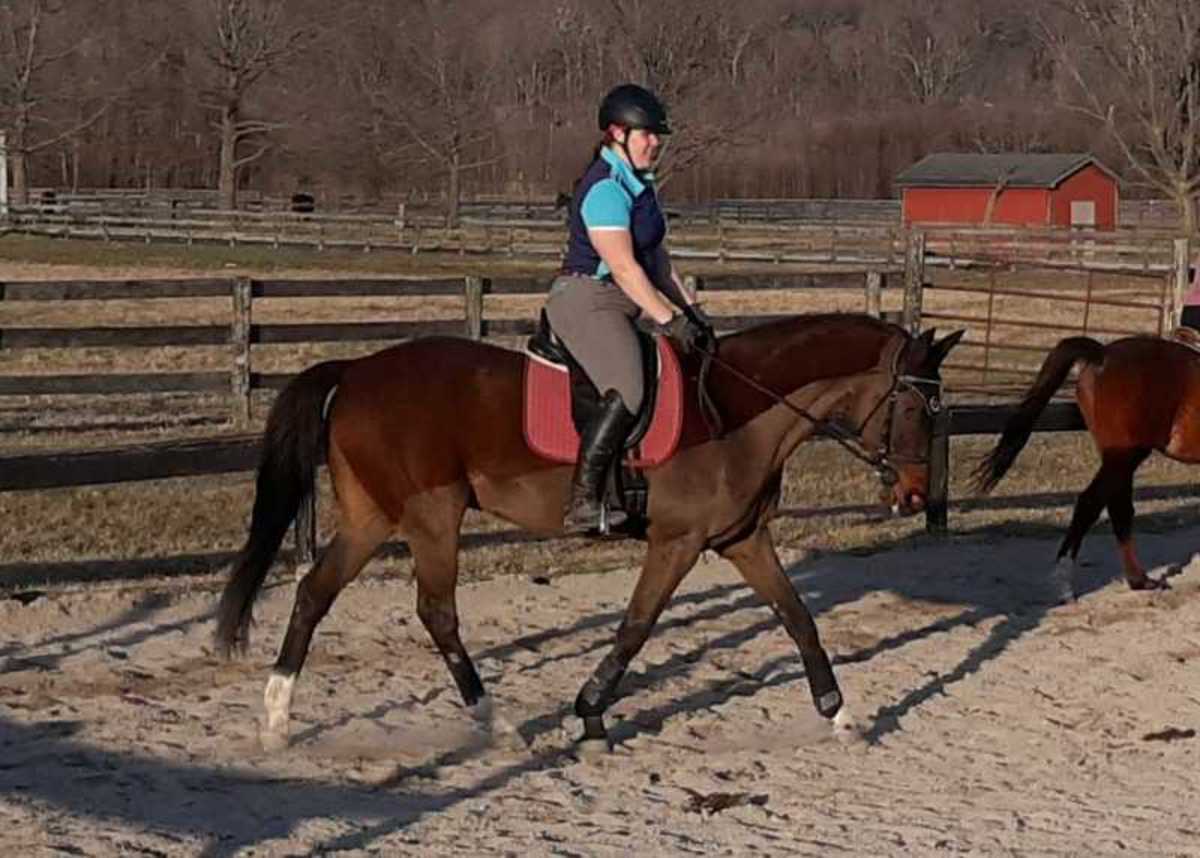
The author taking Uno for a spin just a month after his enucleation surgery

The post Seeing The World Through One Good Eye appeared first on Horse Racing News | Paulick Report.

Source of original post

Agenda Released For International Forum For The Aftercare Of Racehorses; Registration Now Open

The International Forum for the Aftercare of Racehorses (IFAR) has announced its lineup of speakers for its sixth conference, which will be held as a series of two virtual webinars on April 5 and 19 at 12 p.m. BST (11 a.m. GMT).

Each webinar will last approximately two hours. IFAR is partnering with the Japan Racing Association (Japanese Consultative Committee on Aftercare of Racehorses) to put on this year's event.

The conference theme of “Many paths – One goal” is reflected in the speakers and organizations represented in both sessions. The keynote address will be given by Annamarie Phelps, chair of the British Horseracing Authority. She will provide unique insights regarding the contemporary challenges facing racing and how aftercare has become a critical element for racing's future sustainability.

The lineup of speakers features experts addressing key topics including equine traceability, equine therapy, and veterinary science. A key highlight will include a Young Professionals Panel, where Australian racing presenter Caroline Searcy will explore the attitudes and views of emerging industry leaders regarding current and future aftercare strategies.

“We are delighted with the group of speakers we have compiled for this year's IFAR conference,” said Di Arbuthnot, chair of IFAR. “Between the formal presentations and allocated time for Q&A with our audience, the two sessions are sure to spark engaging conversations about Thoroughbred aftercare.”

The full program can be found below:

April 5, 2022

Moderator: Rishi Persad (U.K.)

Speakers:

  • Annamarie Phelps (U.K.) (Keynote): Chair, British Horseracing Authority
  • Di Arbuthnot: Chair, IFAR
  • Dr. Jeff Berk (U.S.): Equine Medical Associates PSC; Past President, American Association of Equine Practitioners
  • Dr. Meredith Flash (AUS): Lead Researcher, Australian Thoroughbred Wellbeing Project
  • Jock Hutchison (U.K.): President and Co-Founder, Horseback UK
  • Angela Schuster (AUS): Managing Director, Schuster Consulting Group

April 19, 2022

Moderator: Caroline Searcy (AUS)

Speakers:

  • Michael Drapac (AUS): Owner/Breeder
  • Dr. Adrian Farrington (H.K.): Executive Manager, Veterinary Clinical Services, Hong Kong Jockey Club
  • Kirsten Green (U.S.): Executive Director, Retired Racehorse Project
  • Jennifer Hughes (AUS): General Manager, Equine Welfare, Racing Victoria
  • Young Professionals Panel
    • George Broughton (U.K.): Trainee, Godolphin Flying Start
    • Harry Derham (U.K.): Assistant Trainer
    • Caoimhe Doherty (IRE): Co-founder, Treo Eile; Stud Manager, Forenaghts Stud
    • Natasha Rose (H.K.): Equestrian Affairs Project Manager / Retired Racehorse Unit Manager, Hong Kong Jockey Club
    • Elinor Wolf (U.S.): Trainee, Godolphin Flying Start

Both sessions are free, but registration is required. For more information about the conference agenda and to register, please visit internationalracehorseaftercare.com/virtual-ifar/. Recordings of each session will be made available on the IFAR website.

The post Agenda Released For International Forum For The Aftercare Of Racehorses; Registration Now Open appeared first on Horse Racing News | Paulick Report.

Source of original post

Verified by MonsterInsights