There are more than 100 species of milkweed in the United States, each species containing varying levels of different toxins. Whether a horse can be poisoned from eating milkweed depends on the species he has eaten and how much he consumes.
Milkweed that has narrow leaves attached to stems in whorls contain toxins that can affect a horse's nervous system, reports EQUUS magazine. These types of milkweed may be considered palatable to horses when green and also when dried in hay, says Dr. Anthony Knight of Colorado State University.
Most equine poisonings are associated with these species of milkweed (Asclepias subverticillata and Asclepias fascicularis).
Meanwhile, broad-leaved species of milkweed contain cardenolides, which can affect a horse's heart and cause sudden death. These types of milkweed are not as palatable to horses; a 1,000-pound horse would need to eat two to three pounds of the green plant to ingest enough to poison him.
If there is milkweed on the property a horse routinely grazes, it is worthwhile to take a sample to your local extension office for identification.
Owners of foals needing an operation for obstruction of the small intestine should be optimistic about the outcome, a new study shows. Knowledge of colic surgery survival rates is important to horse owners making surgical decisions.
Dr. Sara Erwin reviewed the records of surgical colic cases from five academic referral hospitals in the United States to directly compare foal and adult horse survival rates following colic lesion surgery. In the past, lower survival rates have been reported in foals than adults when the affected horse has severe colic lesions which obstruct small intestine blood flow.
The scientists assessed 41 cases of foals six months and younger and 105 cases of adults between two and 20 years old. They discovered that 24 of 25 foals (96 percent) and 66 of 75 adults (88 percent) who recovered from surgery for a strangulating obstruction survived to be discharged from the hospital.
The researchers noted that this could be related to case selection prior to referral or surgery or decisions made during surgery.
Sixteen foals had to be euthanized during their surgery (39 percent); 30 adults (28.6 percent) were euthanized during their procedure.
The scientists concluded that short-term survival in foals did not significantly differ from adults with comparable colics, so more optimism for colic surgery in foals may be warranted. The team notes that the study was limited by small sample size, lack of long-term follow up and incomplete medical and surgical records.
Several retired racehorses owned by HRH Queen Elizabeth II will be involved in a parade at Epsom on June 4, Cazoo Derby Day, as tribute to her contribution to the Thoroughbred racing and breeding industry.
Barbers Shop, a 20-year-old that placed in both the King George VI Chase and Hennessy Gold Cup, will be one of five of the Queen's horses at the event.
Barbers Shop was retired from racing in 2012 and became a show horse, bringing home championships from Hickstead and the Royal Windsor Horse Show multiple times. Barbers Shop is now retired from showing, but regularly participates in Retraining of Racehorses (RoR) parades. RoR is British Horseracing's official charity for the welfare of horses who have retired from racing.
Katie Jerram-Hunnable competed Barbers Shop and also shows First Receiver, a 5-year-old who last raced in 2020 at Royal Ascot.
Quadrille will also be in the parade; the retired racehorse is competing in dressage for Louise Robson. Robson also has the ride on Prince's Trust and Forth Bridge.
If you're a horse racing type with a Facebook account, you've probably seen the video.
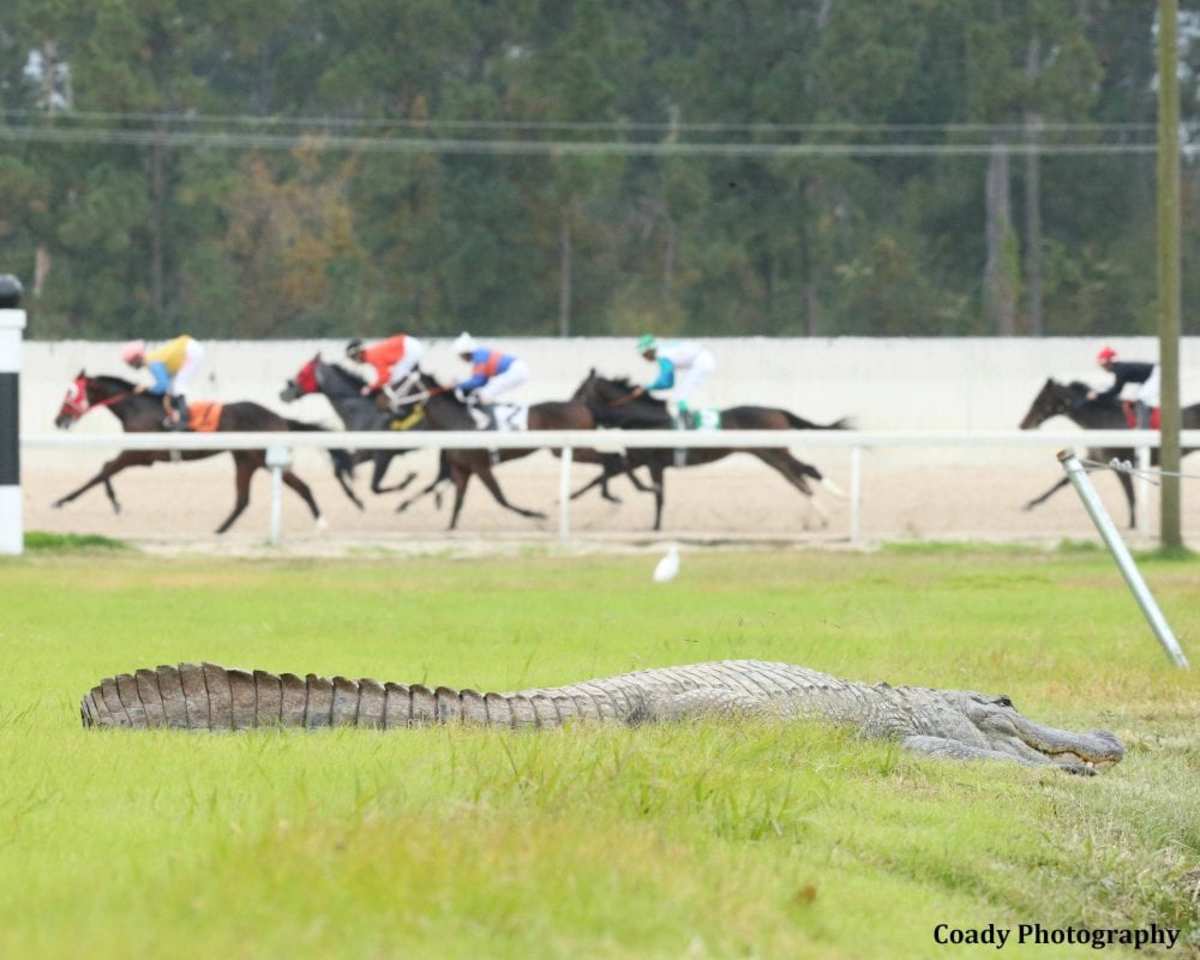
An alligator is seen ambling across the dirt path that goes through the infield at Delta Downs in Vinton, La. A nearby horse is understandably unsure what to make of the reptile, ultimately deciding to spin around as the handler tries to maintain control and get the horse to the paddock for an upcoming race.
The caption for the video, posted on Facebook by Joe Allen, an assistant trainer for Richard Lane, reads, “It's Marty's world. We just live in it.”
Marty is a decades-long tenant in the Delta Downs infield. Unlike many tracks, where horsemen walk their charges to and from the paddock around the turns of the track surface, Delta has a straight-line dirt path that splits down the middle of the infield, and separates a larger pond inside the first turn from a couple smaller ponds as the field turns for home.
Allen said that Marty tends to keep to himself on race day, but on that particular day, the alligator crossed the road during a high-traffic period of the card. He's much more likely to be seen crossing the path during morning training hours, when the walkway isn't in use.
“We were headed up to race, and he just came across the path going across to the paddock,” Allen said. “He got about halfway across, and he just laid down right there. I've been coming here for years and running horses, and to be honest, that's probably the first time I've had an experience like that.
“I didn't really know what to expect next,” he continued. “Is one of the horses gonna jump on top of me, or tear loose? An instance like that is definitely unusual for a horse. What horse can get used to an alligator of that size just crossing the path?”
Even though the horses didn't know what to make of the alligator, Allen described Marty as “the life of Delta Downs,” and the kind of living landmark that's known by practically anyone that visits or trains at the track.
With so much space that tends to go relatively unused in a racetrack's infield, it's not uncommon to see wildlife take up residence, and occasionally insert themselves into the race day. There are myriad instances of birds, rabbits, foxes, possums, and deer popping up in and around the races, but Louisiana's large gator population gives Delta a different kind of infield resident.
“He pretty much takes care of himself,” Allen said. “He lives in that big pond in the middle of the infield, and he's lived there for years and years. He pretty much just feeds off the fish in the pond. He doesn't bother nobody.”
Allen's video of Marty crossing the walking path has garnered attention from outlets both local and global. The video boasts more than 732,000 views on Facebook alone, with over 7,500 shares and over 1,000 comments.
“To be honest, I was leading the horse to go race, and I thought I'd just video this,” Allen said. “Then, it just took off. I wasn't expecting it to take off like that. I've never shared a video on Facebook and gotten that many views and shares. It's rather cool. My phone was just 'ding, ding, ding,' and people were sharing my video.”
An interested 'spectator' catches the races from the infield at Delta Downs
A few days after posting the viral video of Marty, Allen checked back in with an update on the social media sensation. He posted a screenshot of the Delta Downs simulcast feed with the gator lying down on the racing surface near the inside rail, with four minutes to post.
In 2016, the Delta Downs camera crew caught a gator, who may or may not have been Marty, that wandered onto the sloppy racing surface ahead of a race, and was examining the outside fence with three minutes to post. He made his way back toward the infield, but plopped himself down in the mud several feet away from the inside rail. As the horses made their way behind the gate, the gator finally got up and completed the journey.
If Marty doesn't feel like getting off the track himself, Allen said the track has an informal contingency plan.
“He's getting up in age, so most of the time, a couple of the valets will just shoo him away, but he don't move real fast,” he said. “Most alligators are rather fast movers, but he's up at the age where he don't really move fast.”