Widespread drought across the United States is causing many horse owners to supplement pastures with hay months earlier than usual. Locating hay that is suitable for horses – and affordable – can be challenging.
Dr. Daniel McEvoy, with the Western Regional Climate Center in Reno, Nev., told The Horse that most of the Western United States is in a drought, with the hardest hit areas being Eastern Oregon and the Four Corners area of Arizona, Colorado, New Mexico, and Utah.
Southern Nevada has been in a drought for the last 20 years and areas of the coastal Pacific Northwest and northern Idaho are also affected.
McEvoy said that many areas of the West got snow over the winter, which normally offsets some of the dry conditions, but when the snow stopped, things dried out rapidly, putting the area in an early drought. The remainder of the summer is expected to be hotter than average, which will place extra demand on the water supply.
It's not just the drought that has stressed hay suppliers; the rising cost of everything from fuel and fertilizers to tires and baling twine, not to mention supply chain disruptions, raise prices even higher. Oregon is short on water, restricting hay growers to watering just once and limiting cuttings to one – possibly two – in 2022.
In addition to all these stresses on the nation's hay supply, horse owners are competing with other livestock owners for hay – they, too, are having to feed hay earlier than is typical. Horse owners are encouraged to determine the amount of hay they need for the year and locate hay earlier, stocking up as soon as possible instead of waiting until the end of summer.
Old Friends, the Thoroughbred Retirement Facility in Georgetown, KY., lost two beloved retirees: multiple graded stakes winner Dumaani, who was 31, and European Champion Swain, who was 30. Both were humanely euthanized due to the infirmities of old age.
The stallions stood most recently at the Lexington-based Shadwell Farm, where they were originally pensioned. They relocated to Old Friends in the spring of this year as part of a downsizing of operations following the death of Shadwell owner, His Highness Sheikh Hamdan bin Rashid Al Maktoum, in 2021.
Bred in Kentucky, Dumaani, 31, raced for four seasons, from 1993 – 1996 and was no stranger to global travel: He had starts at Newmarket, Ascot, Nad Al Sheba, Tokyo, and the U.S., among others. A multiple graded stakes winner by legendary sire Danzig, out of the Lord Gayle mare, Desirable, Dumaani captured back-to-back runnings of the Grade 3 Keeneland Breeders' Cup Mile for owner Shadwell and trainer Kiaran McLaughlin, before retiring in 1996 with seven wins from 26 starts and career earnings of $1,079,098.
Swain, 30, was bred in Ireland by Sheikh Mohammed bin Rashid al Maktoum. The son of Nashwan out of the Key to the Mint daughter Love Smitten, Swain kicked off his career in France with a 5-race win streak, which included the G3 Grand Prix de Deauville Lancel at Deauville.
Owned by Godolphin, LLC and conditioned by Saeed bin Suroor, he was a Champion in both England and Ireland, and also placed in two Breeders' Cup events in the U.S.: the 1996 Turf (at Woodbine, where Old Friends retiree Alphabet Soup would capture the classic just a little while later) and the 1998 Breeders' Cup Classic, where he came third behind winner Awesome Again and runner-up Silver Charm, both of whom also retired to Old Friends. Swain retired from racing in 1998 with 10 wins from 22 starts and career earnings of $3,797,566
“It's always sad when we lose any of our wonderful retirees but yesterday was devastating,” said Old Friends President Michael Blowen. “The only solace is that farm manager Antonio Marin and Rood and Riddle's Dr. Ashton Broman recognized that both Dumaani and Swain were both in severe discomfort and the best thing for them–not for us–was to take the pain away. But the pain their deaths left behind has left a lasting scar on us,” added Blowen. “Even when you do your best it can't defeat mortality.”
An abandoned Caribbean colony unearthed centuries after it had been forgotten and a case of mistaken identity in the archaeological record have conspired to rewrite the history of a barrier island off the Virginia and Maryland coasts.
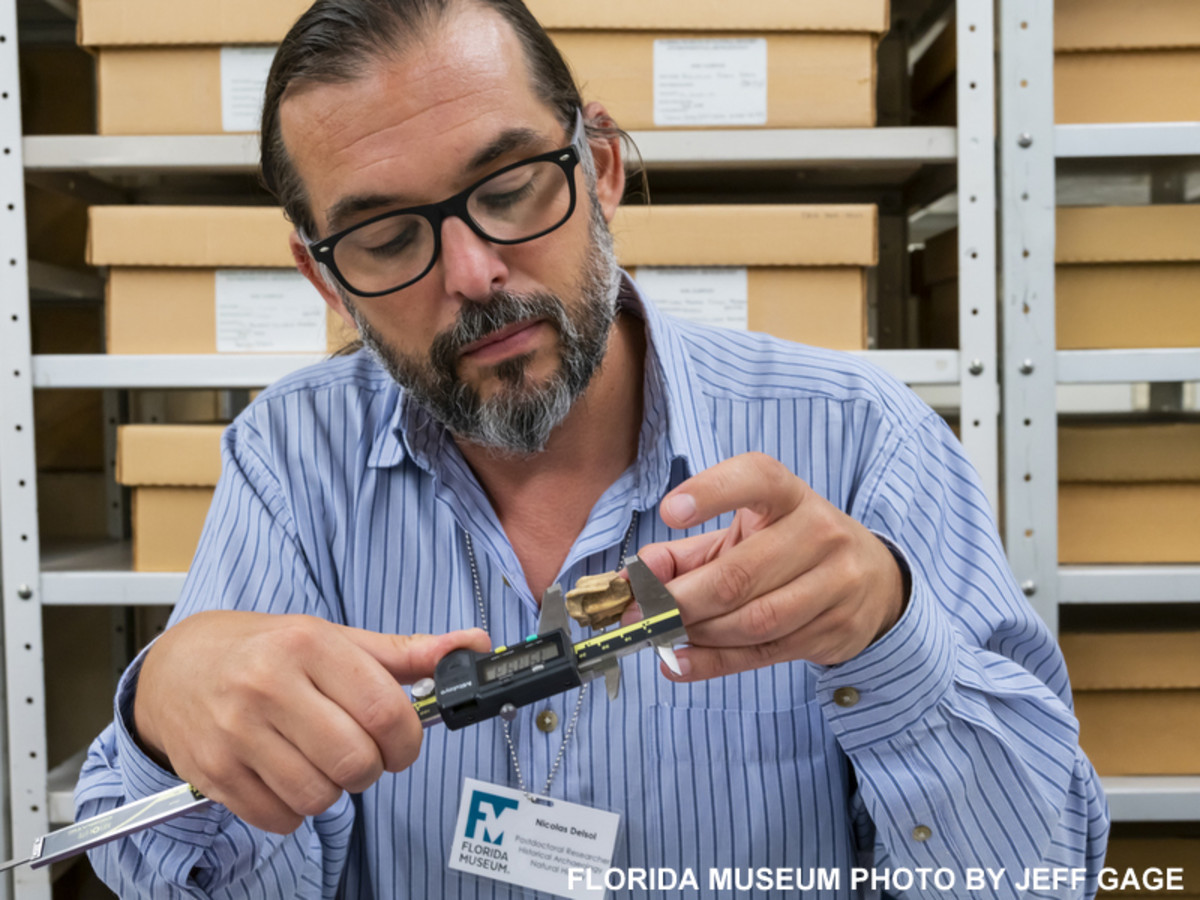
These seemingly unrelated threads were woven together when Nicolas Delsol, a postdoctoral researcher at the Florida Museum of Natural History, set out to analyze ancient DNA recovered from cow bones found in archaeological sites. Delsol wanted to understand how cattle were domesticated in the Americas, and the genetic information preserved in centuries-old teeth held the answer. But they also held a surprise.
“It was a serendipitous finding,” he said. “I was sequencing mitochondrial DNA from fossil cow teeth for my Ph.D. and realized something was very different with one of the specimens when I analyzed the sequences.”
That's because the specimen in question, a fragment of an adult molar, wasn't a cow tooth at all but instead once belonged to a horse. According to a study published this Wednesday in the journal PLOS ONE, the DNA obtained from the tooth is also the oldest ever sequenced for a domesticated horse from the Americas.
Nicolas Delsol was originally sequencing ancient DNA from cow teeth preserved in archaeological sites when he realized one of his specimens actually belonged to a horse.
The tooth was excavated from one of Spain's first colonized settlements. Located on the island of Hispaniola, the town of Puerto Real was established in 1507 and served for decades as the last port of call for ships sailing from the Caribbean. But rampant piracy and the rise of illegal trade in the 16th century forced the Spanish to consolidate their power elsewhere on the island, and in 1578, residents were ordered to evacuate Puerto Real. The abandoned town was destroyed the following year by Spanish officials.
The remnants of the once-bustling port were inadvertently rediscovered by a medical missionary named William Hodges in 1975. Archaeological excavations of the site led by Florida Museum distinguished research curator Kathleen Deagan were carried out between 1979 and 1990.
Horse fossils and associated artifacts are incredibly rare at Puerto Real and similar sites from the time period, but cow remains are a common find. According to Delsol, this skewed ratio is primarily due to the way Spanish colonialists valued their livestock.
“Horses were reserved for individuals of high status, and owning one was a sign of prestige,” he said. “There are full-page descriptions of horses in the documents that chronicle the arrival of [Hernán] Cortés in Mexico, demonstrating how important they were to the Spanish.”
In contrast, cows were used as a source of meat and leather, and their bones were regularly discarded in communal waste piles called middens. But one community's trash is an archaeologist's treasure, as the refuse from middens often confers the clearest glimpse into what people ate and how they lived.
The specimen's biggest surprise wasn't revealed until Delsol compared its DNA with that of modern horses from around the world. Given that the Spanish brought their horses from the Iberian Peninsula in southern Europe, he expected horses still living in that region would be the closest living relatives of the 500-year-old Puerto Real specimen.
Instead, Delsol found its next of kin over 1,000 miles north of Hispaniola, on the island of Assateague off the coast of Maryland and Virginia. Feral horses have roamed freely across the long stretch of barrier island for hundreds of years, but exactly how they got there has remained a mystery.
According to the National Park Service, which manages the northern half of Assateague, the likeliest explanation is that the horses were brought over in the 1600s by English colonists from the mainland in an attempt to evade livestock taxes and fencing laws. Others believe the feral herds descended from horses that survived the shipwreck of a Spanish galleon and swam to shore, a theory popularized in the 1947 children's novel “Misty of Chincoteague.” The book was later adapted to film, helping spread the shipwreck legend to an even wider audience.
Until now, there has been little evidence to support either theory. Proponents of the shipwreck theory claim it would be unlikely that English colonists would lose track of valuable livestock, while those in favor of an English origin of the herds point to the lack of sunken vessels nearby and the omission of feral horses in historical records of the region.
The results of the DNA analysis, however, unequivocally point to Spanish explorers as being the likeliest source of the horses on Assateague, Delsol explained: “It's not widely reported in the historical literature, but the Spanish were exploring this area of the mid-Atlantic pretty early on in the 16th century. The early colonial literature is often patchy and not completely thorough. Just because they don't mention the horses doesn't mean they weren't there.”
The feral herds on Assateague weren't the only horses to revert back to their wild heritage after arriving in the Americas. Colonists from all over Europe brought with them horses of various breeds and pedigrees, some of which bucked their bonds and escaped into the surrounding countryside.
Today, the U.S. Bureau of Land Management estimates there are roughly 86,000 wild horses across the country, most of which are located in western states, such as Nevada and Utah. Delsol hopes that future ancient DNA studies will help decode the complex history of equine introductions and migrations that occurred over the last several centuries and offer a clearer understanding of today's diversity of wild and domesticated horses.
Jessica Oswald of the University of Nevada, Reno; Elizabeth Reitz of the Georgia Museum of Natural History; and Brian Stucky, Kitty Emery and Robert Guralnick of the Florida Museum of Natural History are also authors on the study.
Funding for the study was provided in part by the National Science Foundation (DDIG 1930628) and the Fulbright Program.
The United States Equestrian Federation's Board of Directors recently approved the adoption of a Policy for the Prevention of the Manipulation of Competition, which will go into effect on Dec. 1, 2022.
Fantasy games and betting on equestrian sport are growing in popularity, and this Policy mitigates risks that could compromise the integrity and essence of sport. Included below is a short summary of the policy, including when and to whom it applies.
What is prohibited?
Under the policy, all competition manipulation is strictly prohibited. Violations of this policy include, but are not limited to:
Betting money (or items of monetary value) on a competition by Participants of that Competition;
Improper use of insider information by Participants, whether the Participant uses the information themselves or discloses it to an outside person/entity;
Giving and/or receiving a benefit in exchange for inside information, whether or not the inside information is actually exchanged;
Participant(s) acting with the intention to lose a Competition or part of it, or perform less than optimally (ex: “throwing a match”);
A Participant engaging in Match Fixing or Manipulating a Competition or encouraging any other Participant to match fix or otherwise manipulate a competition; and
Failure to cooperate with USEF investigation into possible violations of this policy.
Who is required to comply?
Any person belonging to one of the following categories is required to comply with the Policy:
Athletes participating in a Competition;
Athlete support personnel working with or treating Athlete(s) or horses participating in or preparing for Competition (and all other persons working with the Athlete(s) and/or horses);
Owners, shareholders, or interested parties in a horse in a competition;
Officials – includes licensed officials, any licensee, manager, or secretary of a Competition, any other Competition staff or those with an ownership interest in the Competition;
Those serving as volunteers or paid staff of the Federation or a Recognized Affiliate Association.
What happens when a violation occurs?
A violation or an attempted violation by a Participant may be investigated by USEF and subject to disciplinary proceedings pursuant to Federation Bylaws Part VII and General Rules Chapter 7.