I began this column in January 2020 because my goal was to go from announcing horses to riding them. (See “Horowitz's Unlikely Journey from Broadcasting to Riding Horses”) Specifically, it was to compete with an off-track Thoroughbred at the Retired Racehorse Project Thoroughbred Makeover.
Unfortunately, I did not get to compete in the 2020 Thoroughbred Makeover because the event was postponed due to the coronavirus pandemic and because it would have been too much to balance announcing and showing at the Mega Makeover in 2021.
So, in 2022, my goal evolved to something more ambitious and unique—competing in horse shows with a current racehorse, as well as helping gallop him into condition for his races. My wife, Ashley, also embraced the unique idea of simultaneously showing and racing a horse. She's been training horses off the racetrack for sporthorse careers for the last 12 years and got her racehorse trainer's license in June.
I shared the start of our cross-training adventures with the 4-year-old gray Arabian gelding AA Two Face (“Dos”) in my April column, “The Value Of Cross-Training For Racehorses.”
AA Two Face and I have since competed in three United States Eventing Association (USEA) recognized events, including qualifying for the Area IX Championships, and he has raced twice this season at Bally's Arapahoe Park.
His results:
- Sixth of 25 at the Starter level, while also fourth of four in the first ever Young Event Horse (YEH) 4-Year-Old competition in USEA Area IX at The Event at Archer in Wyoming in June (See “Arabian Racehorse Completes Two Eventing Shows, Now Back To The Track”).
- Fifth of 16 at the Starter level at the Round Top Horse Trials in Colorado in July.
- Fifth of seven in a 5 ½-furlong maiden race at Arapahoe in July.
- Fifth of seven in a seven-furlong maiden race at Arapahoe in August.
- On between those two races, competing in the USEA Area IX Championships held at Archer and finishing eighth of nine.
More valuable and important to me than the results, as well as the most rewarding part of writing these columns, are the lessons I've learned along the way. So, as Dos and I come to the end of our first season of eventing and racing together, here are a few of the bigger lessons, which I've chosen to introduce through the famous Mister Ed, who happened to be played by a part-Arabian horse named Bamboo Harvester.
Lesson 1: “A horse is a horse of course of course.” (lyrics from the theme song of Mister Ed)
Racehorses don't have identity crises once they finish racing. They're not like college graduates that have to remove the phrases “keg stand” or “beer pong” from their vocabulary. They're horses, albeit incredibly athletic ones, and there isn't this great moment of reckoning where they symbolically shed their skin and become a whole different animal once they've left the racetrack.
Also, what racehorses learn on the racetrack carries over to their next careers, and, for the most part, the foundational skills from racing are quite beneficial for other horse sports. An excerpt from my previous column “Looking Forward To 2022 With Hope For Ex-Racehorses”:
“By the time racehorses finish their racing careers, they will likely have travelled by trailer to multiple locations, been handled by many people, and been exposed to high-stimulation environments. They will have been ridden many times by different riders and, in the process, been asked to go through the different gaits of walk, trot, and canter and change leads. Perhaps of most benefit, a career in horse racing instills a mindset that a horse should go forward.”
Ashley and I were so impressed with AA Two Face as soon as we brought him from the racetrack to our Super G Sporthorses farm in Colorado last October. He came to us the day after his final race of the 2021 Arapahoe season. The day after that, we put our son, Chase, who was eight years old at the time, on the racehorse's back and led them around.
Dos was quick to pick up how to jump and other foundational skills necessary for the equestrian sport of eventing. At four years old this year, he was the youngest or tied for the youngest at every horse show in which he competed.
This all came together because Ashley, Chase, and I could build on the foundation Dos already had from his breeders, Garrett and Lisa Ford of Altitude Arabians in Durango, Colo., and his racing trainers, Nicole Ruggeri and her assistant Hector Castellanos. Castellanos came to visit AA Two Face at our farm one night in August. It was the first time he had seen Dos in person since last year. Dos immediately lit up, and the two of them hugged. The bond between Hector and his former racehorse warmed our hearts.
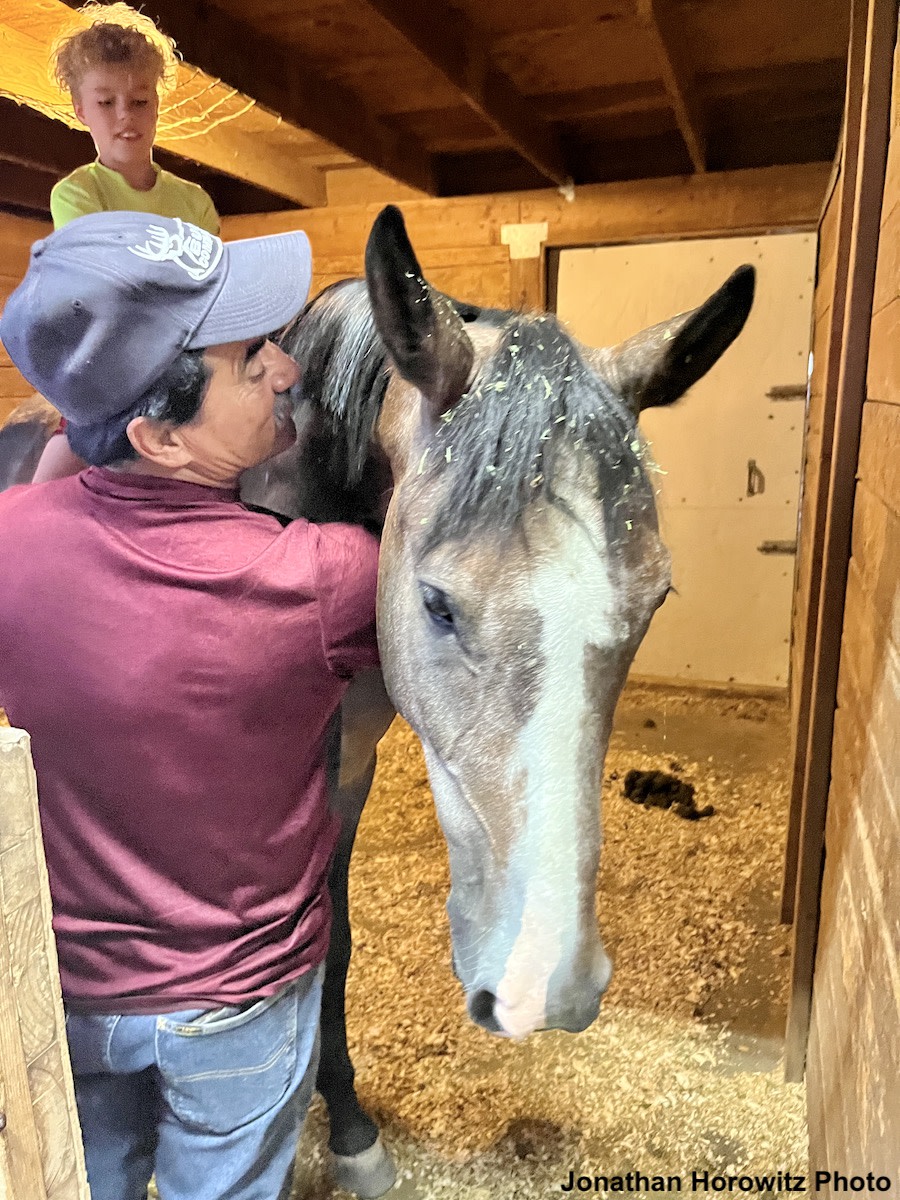
So, the lesson is that we weren't starting from scratch with AA Two Face, and nobody that gets a horse off the track ever does. It's disingenuous for any reseller of retired racehorses to take credit for how their horse is now able to walk-trot-canter and go over a tiny jump only thirty days after coming off the track and is now on sale for five figures because of how quickly they've accomplished this.
Racing connections should be given more credit and celebrated for developing their horses for careers outside of racing when that time should come. And, when that time comes, because racehorses don't immediately shed their identity when they exit the stable gates, these horses should be embraced for who they are.
AA Two Face was bred to race, comes from breeding lines with previous success on the track, and genuinely enjoys racing. So, we've allowed Dos to continue to be a racehorse. Granted, we're doing something particularly unique because of this by hauling him from our farm to the track to continue training and racing. However, for others, embracing that these are still racehorses can mean making sure their horses from off the track have a job, take on new challenges and goals, get handled regularly, get exposed to new environments, and are allowed to go forward because that's what they do.
Lesson 2: “Don't yell at me, Wilbur, I'm not your wife.” – Mister Ed
We've received so much love and support when bringing AA Two Face back to the track to race. We've also faced challenges.
Surprisingly, the most “yelling” has come from the people that we thought would have been closest to us and our biggest cheerleaders, some of the other trainers that race Arabians in Colorado. It's made us frustrated and sour and has us scratching our heads about how an industry that recognizes that it needs new people to survive would be so condescending and abrasive to those new people.
Don't get me wrong, the Thoroughbred and Quarter Horse trainers, jockeys, and owners in Colorado have been incredibly supportive. We're especially grateful for Kim Oliver and her assistant, Brett Heide. They've allowed us to stable Dos in their barn when he's been at the track and have shown Ashley and me the ropes about what it takes to prepare a horse to race—everything from organizing an official timed workout to entering a race to prerace inspections to saddling in the paddock.
However, we've learned a lesson about how protective some our “competition” can be of their turf. All trainers have a right to advocate for what's best for their individual horses, but there should also be some acknowledgment of the bigger picture. It's ultimately a lesson in the cognitive dissonance that horse racing must address in order to be a viable industry. On one hand, there's the sentiment that “we need change.” On the other hand, there's the pushback of “but, that's just how it is” when faced with change.
This season's Arabian racing program at Bally's Arapahoe Park has included only sprint races through the first two months of the three-month season. That seems absurd to literally everyone with some understanding that Arabians are known for their endurance. Certain trainers, with the endorsement of the Arabian breed rep, have told the racing office what Arabian races they would fill. We've been told to accept things the way they are, usually receive no response when asking the breed rep about what races will be written, or get left out of conversations about the organization of races entirely.
This season has been fraught with changes of which we weren't informed, such as shortening the distance of races on the morning of taking entries multiple times. These changes benefit the trainers that said they didn't start training their horses until right before the Arapahoe season started. However, it's pigeonholed all Arabians into being sprinters and running like Quarter Horses. Dos is not a sprinter, nor do we want him to run all out when the starting gates open.
It's tough being new to the game and trying to inspire changes for the betterment of the sport and the breed.
Lesson 3:
Wilbur Post: “Ed, what do you suppose made us do all that?”
Mister Ed: “I don't know, Wilbur. There are a lot of things in this world that can't be explained.”
Wilbur Post: “Well, what do you do about it?”
Mister Ed: “Nothing. Just enjoy it.”
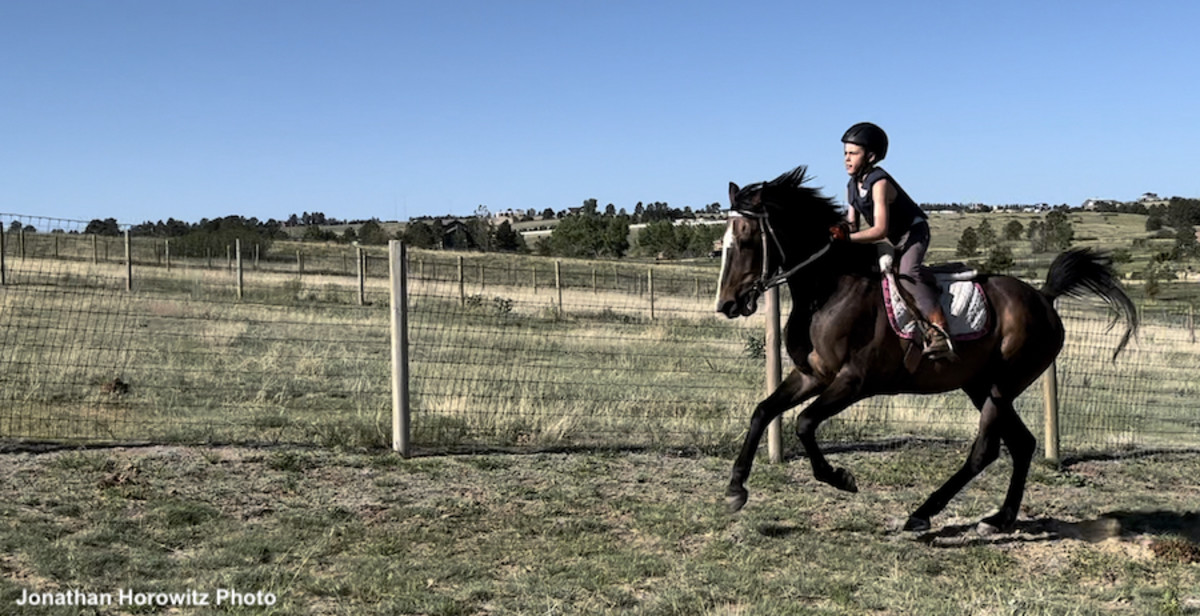
AA Two Face and I have gotten further than we could ever expect for a 4-year-old horse that's also race training. I'm also still learning how to be an effective rider for a young horse.
One of the reasons we've made it as far as we have is because we took the pressure off and had fun. We never focused on the results, but the results came because we took the pressure off, with placings in the top-quarter and then the top-third at our first two recognized events.
But then we found ourselves qualified for area championships, and my perspective changed. While I knew I shouldn't go down this path and kept trying to convince myself that I wasn't doing it, there became a desire to prove myself on this stage. I froze up during our dressage test and lost sight of the big picture. Dos didn't, and being the great young horse he is, he was ready to do whatever I asked him in the moment. And that wasn't much from me.
I took it hard, but it became a great lesson that the focus should be on how amazing it is to spend time with your horse, especially one as cool as Dos, and everything else is secondary. If you asked me if I thought I would be doing this all eight years ago before I started riding, I never would have imagined this, and I'm grateful to have found a new passion at the age of 30.
Granted it's not a lesson I wanted to learn on that stage and in that moment, but at the end of the day, I'm glad I did because it's not the last time we're going to be back there.
We got it together and finished on a high note with a great show jumping round. Being part of the Area IX Championships was a valuable and fun experience. We came home with a ribbon, and it meant a lot to have Chase present it to us during the awards ceremony.
Dos and I finished the @USEventing Area IX Championships on a high note with this show jumping round. Then, Dos made sure to let everyone know he's ready for his next race and, for any of the skeptics, he is, in fact, an Arabian. It also meant a lot to have Chase pin our ribbon. pic.twitter.com/QEuJj0XM3c
— Jonathan Horowitz (@jjhorowitz) August 23, 2022
I've learned so much from Dos. He's also become a great ambassador for the Arabian breed and Arabian racing. By continuing to race him while he's eventing, he's teaching a new audience about racing. People that have never been to a horse race have come to Bally's Arapahoe Park to cheer him on. You'd be hard-pressed to find a more popular maiden.
Getting to where we are has been unexpected, and I'm not sure what to do about the next steps.
“Nothing,” Mister Ed would say. “Just enjoy it.”
The post Horowitz On OTTBs, Presented By Excel Equine: Lessons Learned From AA Two Face…And Mr. Ed appeared first on Horse Racing News | Paulick Report.
