Study: Malnourished Horses Require Careful Refeeding

Feeding a malnourished horse is often much more involved than simply offering the horse an unlimited amount of feed until his weight and strength return. There are few nutritional studies that evaluate the refeeding and rehabilitation process, with even less information available explaining how the horse's metabolic function changes during the refeeding period. 

Dr. Sawyer Main of the University of Tennessee sought to assess the metabolite profile (called the metabolome) of emaciated horses as they go through the refeeding process. 

Ten horses that had been surrendered or sold at auction were used in the three-month study. Each horse was in good health, with normal temperature, pulse, and respiration rates, though they were malnourished. 

The first 10 days of the study were considered the critical care period for refeeding. The following 155 days were considered the recovery period. Horses were fed specific diets and blood samples were collected and analyzed throughout the study. 

The research team compared the metabolic profiles of the horses when they were malnourished and during the refeeding process. They found that there was a decrease in potentially toxic chemical compounds related to kidney, liver, and muscle function. Energy-related metabolites also changed as the horses were refed.   

Refeeding has a profound impact on equine rehabilitation, and care must be taken that the malnourished horses are fed in a manner that does not induce refeeding syndrome. Refeeding syndrome occurs when a starving horse is overfed, resulting in additional metabolic damage, specifically to the kidneys and liver, which are already impaired by malnourishment.  

They team concludes that a malnourished horse must be placed on a carefully tailored feeding schedule that slowly reintroduces nutrients so as not to inflict further metabolic damage. The scientists did find differences in metabolomes in younger and older horses; the metabolomes also differed by diet and sex.

Read more at HorseTalk

The post Study: Malnourished Horses Require Careful Refeeding appeared first on Horse Racing News | Paulick Report.

Source of original post

EDRC Considers Proposals To Identify High-Risk Runners Via Wearable Technology, Combat Equine Gene Doping

The Kentucky Equine Drug Research Council met via Zoom on Friday, Sept. 23, to consider a pair of research proposals aimed at improving racehorse welfare. The council will reconvene to vote on the following two proposals at a later date.

“Identifying Racehorses in Danger of Catastrophic Injury Through Analysis of Motion Sensor Data Collected During Training and Racing”

Dr. Warwick Bayly and Dr. David Lambert proposed that wearable technology be utilized during an upcoming race meet at Churchill Downs to develop a protocol by which horses at high risk for a fatal musculoskeletal injury are identified within five minutes of the end of a race, in a way that is both financially and logistically tolerable for all parties.

The technology was employed beginning at Saratoga in 2021 and continued at Belmont and Aqueduct, as detailed by Dr. Scott Palmer, equine medical director of the New York State Gaming Commission, during the Welfare and Safety of the Racehorse Summit this June. It consists of StrideSafe sensor which can be placed in the horse's saddle cloth, and measures acceleration in three dimensions. Each horse has a different pattern or “fingerprint” at high speeds that would be described as normal; the data becomes most useful when it can be compared to both a horse's normal pattern during races and morning workouts as well as a standard of “sound” horses.

Based on existing data, Bayly expects a study of 2,000 horses to generate 240 “red flag” horses, which may be at risk. The study would specifically look at those red-flagged horses that generate a welfare value of six or greater; in other words, horses whose data is six or more standard deviations away from the mean. Approximately 20 of the 240 red-flagged horses would be expected to have a welfare index of six or higher.

Dr. Sue Stover, professor of surgical and radiological science at the University of California-Davis, has long been one of the foremost researchers into catastrophic injuries in racing, bolstered by years of data gathered by the California Horse Racing Board. She's also the chair of the Horseracing Integrity and Safety Authority's racetrack safety standing committee and a member of the HISA board. She estimates that of those 20 with welfare indexes above six, 10 would require advanced imaging to be diagnosed (either nuclear scintigraphy or a PET scan). The study would provide a $1,500 subsidy to encourage such diagnostics.

The study would also include teaching regulatory veterinarians how to interpret the data generated by the sensor, and in knowing where to start looking at a horse if the lameness can't be seen with the human eye.

“Tackling Emerging Threats to the Kentucky Racing Industry by Development of an Equine Gene Doping Program”

Dr. Scott Stanley's proposal is aimed at working toward identifying the abuse of gene doping to enhance athletic ability in equines.

Human medicine is currently able to identify transgenes in humans; gene doping has been banned by the World Anti-Doping Agency since 2003 under the position that transgenes threaten the integrity of sports competition.

Among the potential applications of gene doping in equines are: increased muscle mass, shortened healing time, increased aerobic metabolism, and increased pain tolerance and overall endurance.

Stanley proposed a two-year project which includes two aims: first, to adapt the existing digital droplet PCR technology to identify equine transgenes, and second, to utilize the ddPCR to validate specific gene doping targets in horses.

The post EDRC Considers Proposals To Identify High-Risk Runners Via Wearable Technology, Combat Equine Gene Doping appeared first on Horse Racing News | Paulick Report.

Source of original post

TAKE2 Champions: Tavish, Gold Label Take Top Honors In New Careers

Between them, Cinthia McGreevy's Tavish and John Beebe's Gold Label made 55 starts at the track, winning eight times and earning a combined $269,456, but their athletic careers were far from over when they quit racing. Tavish has been named the TAKE2 High-Score Hunter Champion for 2022 after earning 2080 points over the season, and Gold Label racked up 1096 points to be crowned the High-Score Jumper Champion.

John Beebe, with 50 years of horsemanship under his belt, knows all about second careers beyond the racetrack.

“I rode show horses as a kid, but I left that behind when I was 15 to work with racehorses,” he reminisced. “I ran a Thoroughbred farm in Delray, but the owners passed away and the farm closed and I needed a job, so I went to work at the track.”

Beebe was an exercise rider and enjoyed a brief but successful stint as a jockey. He was the leading apprentice at famed Hialeah Park in South Florida back in the 1960s. But eventually he found his way back to the show world.

“I came back to it when my daughters started riding hunter/jumpers,” he explained. “That's how I got involved again.”

Beebe now runs Arlington Farms, the boarding stable partnered with top show barn Carriage Hill Farm in Delray Beach, FL. He has long been a supporter of the TAKE2 Second Career Thoroughbred Program, competing with Black Label in the TAKE2 Jumper division from 2014 through 2019. He has had Gold Label, who raced under the name Time Will Tell, since not long after the 9-year-old son of Malibu Moon ran his final race, a claiming event at Gulfstream Park in December of 2018.

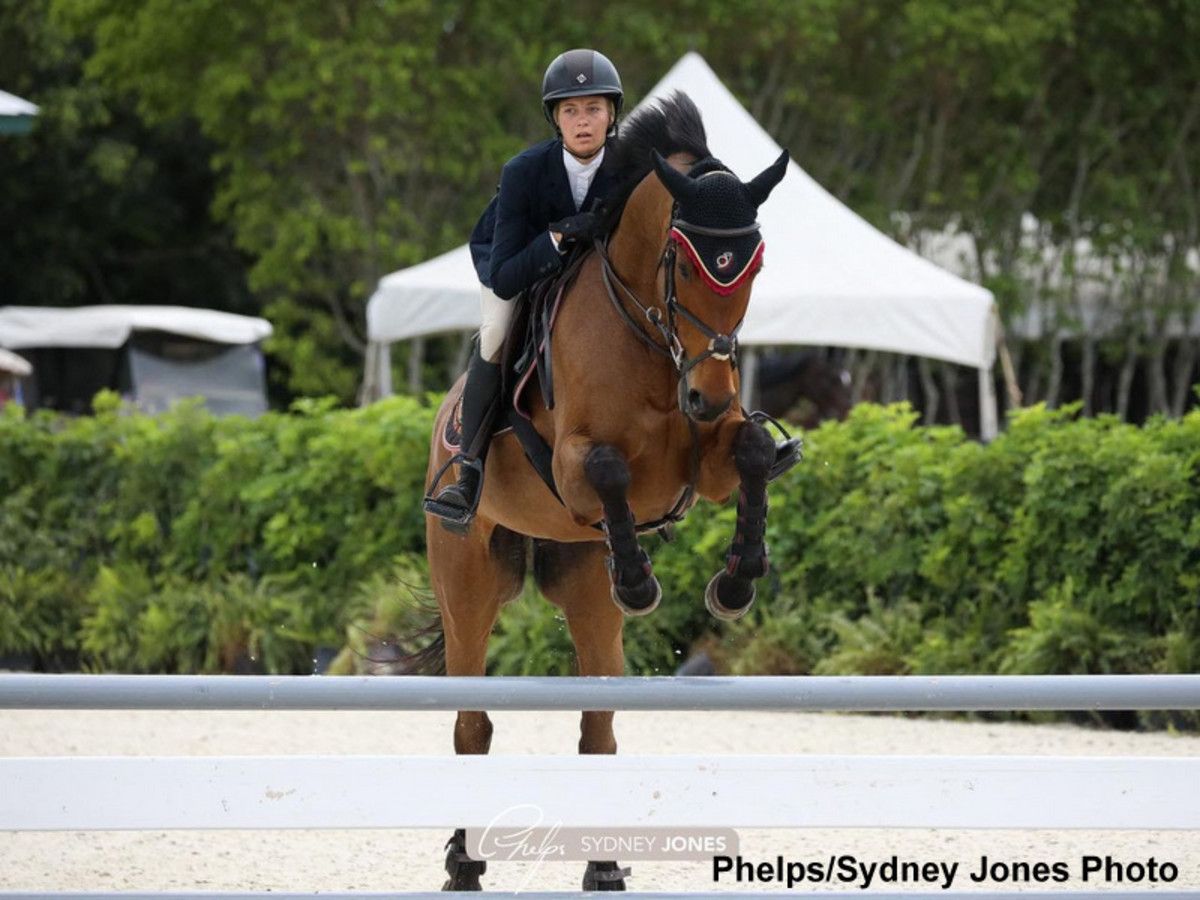
Gold Label and Meredith Gallagher

“We were looking for a horse, and the connections ran an ad for him right after he retired from the track,” Beebe said. “He had been injured and they were just starting him back; they were just going over poles with him. We went up to Ocala to see him and bought him and brought him back home.”

When asked what caught his eye about Gold Label, Beebe enthused, “He's pretty!” He added, “He's a good-looking horse and he has a great barn personality. I like Thoroughbreds, because they are more athletic than warmbloods, they are quicker on their feet.”

Gold Label started on the TAKE2 circuit in 2021 and just missed taking the High-Score Award, finishing just 16 points behind champion jumper Nine Links. He ran away with the title this year, leading reserve champion Untitled Storm by 394 points.

Beebe believes the TAKE2 Program is helping to raise awareness of the success of Thoroughbreds in the show ring.

“I think TAKE2 is helping to make Thoroughbreds more popular,” he said. “There was definitely more competition in the TAKE2 divisions this year than when we had with Black Label. Participation is picking up, and I'd like to see it become even more active.”

Tavish, a son of the great Giant's Causeway, is owned by TAKE2 Board member Cinthia McGreevy. The 9-year-old raced under the name Black Tavish, competing on the Kentucky circuit and also traveling to Indiana, Florida, and Louisiana during his 27-race career. He was retired to Second Stride, a Thoroughbred Aftercare Alliance-accredited organization in Crestwood, KY, in 2018, and found a loving adoptive home in Ohio, but tragedy struck.

“He ended up with trainer Aubrey Hunt Sears in Ohio, but his owner very unfortunately passed away,” McGreevy said. “Through friends and colleagues, we were steered in his direction. We had been looking for a Thoroughbred hunter, and we feel extremely lucky that all the pieces fell into place when we came across him.”

A native of Maryland, McGreevy was raised around Thoroughbreds.

“My father was an owner/trainer,” she explained. “I exercised mornings for my father and showed my OTTBs.”

In adulthood, the horses took a back seat to McGreevy's career, first as a model and actress and then as a high-powered realtor in South Florida. But 10 years after getting into real estate, she found herself drawn back to racing.

“I met my husband, bloodstock agent Tom McGreevy, in 2010 and he brought me back full circle into the Thoroughbred racing world,” she said. “We went to Saratoga and Lexington and Ocala for sales and races. Eventually, I started taking horses from Tom to retrain for second careers.”

Tavish is the third TAKE2 Thoroughbred League member to compete for McGreevy. The striking dark bay gelding got a late start last season and was 53rd in the standings but moved all the way to the top this year to best reserve champion Purely Grateful by 67.5 points. His owner credits trainer Debra Ward of Grassy Ridge Farm with the rise through the ranks.

“Debbie also grew up riding and competing on Thoroughbreds,” McGreevy said. “She is extremely talented and patient and truly takes her time to bring each OTTB we take on to their fullest potential.”

McGreevy also recognizes the innate talent of Thoroughbreds in general, and Tavish in particular.

“Tavish has a very balanced and rhythmical canter, he has a beautiful natural jump, and he is very brave,” she said. “He made our job easy. We were tasked with giving him the experience and confidence he needed for all his abilities to shine.”

McGreevy believes that the TAKE2 Program that she is so committed to gives retired racehorses the opportunity to show just what they can do after they leave the track.

“The TAKE2 program is so important,” she said. “It has allowed us to have a platform, especially because these horses did not start out in the hunter/jumper industry and are transitioning. The impact TAKE2 has had thus far is greater participation of Thoroughbreds at shows and, more important, fewer people excluding Thoroughbreds from their searches when looking for horses. We believe this is a huge step forward, and we are just beginning to see them emerge again in the 'A' rated show world. TAKE2 is a great stepping stone for many to move on to compete in other divisions and showcase their many talents after the track.”

The post TAKE2 Champions: Tavish, Gold Label Take Top Honors In New Careers appeared first on Horse Racing News | Paulick Report.

Source of original post

Multiple Group 1 Winner Limato Among OTTBs To Be Showcased At Newmarket’s Retraining Of Racehorses Parade

A parade of retired racehorses takes place in the paddock from 1pm at Newmarket on Saturday, Sept. 24, Juddmonte Day at the Cambridgeshire Meeting. The parade, kindly sponsored by Juddmonte, showcases six of the different disciplines that Thoroughbreds are retrained for and which Retraining of Racehorses (RoR) supports through the staging of competitions and classes.

For over 20 years Retraining of Racehorses (RoR) has promoted the versatility of the Thoroughbred and through its work, RoR has developed up an unprecedented demand for former racehorses in the wider equestrian market.

RoR annually stages over 40 separate competition series across 15 different disciplines exclusively for former racehorses, catering for all levels of ability, from grassroots to elite. The disciplines include dressage, endurance, eventing, polo, show jumping and showing. There are over 10,000 horses currently registered with RoR enjoying active and fulfilling careers after racing.

As well as developing an increased demand for former racehorses, RoR continues to provide a welfare safety net that ensures any racehorse in need of charitable support is quickly identified and suitably cared for.

For more information visit: www.ror.org.uk

Showing – LIMATO – ridden by Katie Jerram-Hunnable
10-year-old by Tagula, formerly trained by Henry Candy

Breeder – Seamus Phelan

After dressage, showing is the most popular second career activity for retired racehorses with over 5,000 registered on the RoR database as competitors in showing events. With the support of Tattersalls, RoR stages 170 showing classes exclusively for thoroughbreds annually nationwide from Aberdeenshire to Cornwall.

A former top-class sprinter and the winner of an amazing 14 of his 33 races, including the 2016 July Cup, Limato has been in the care of renowned showing producer Katie Jerram-Hunnable since he retired from racing in autumn 2020. Having settled into his new career, Limato is enjoying life in the show ring.

This year Katie and Limato qualified for the Tattersalls RoR Show Series Final at Hickstead, finished runner-up at the Royal Windsor Horse Show and won a class at The Jockey Club RoR National Championships at Aintree in August. His supportive owner Paul Jacobs continues to monitor and enjoy his progress.

Dressage – SAINT GREGOIRE – Ridden by Louise Robson
11-year-old gelding by Le Havre, formerly trained by Saeed bin Suroor

Breeder: S A Franklin Finance

Dressage is the most popular discipline for former racehorses and there is an extensive RoR program that caters for every level, from grass roots to elite. More thoroughbreds now do dressage each year than run in steeple chases under rules.

Representing dressage in the parade is Saint Gregoire. Originally trained and raced in France, where we won six times, he came to Louise Robson via the Godolphin Rehoming Program. Louise says he has a natural talent for 'dressage flare' and 'dance' and enjoys doing dressage to music classes the most.

He recently finished third at The Jockey Club RoR National Championships at Aintree in the Novice class and Louise says: “Saint Gregoire shows real potential for the higher levels of dressage, and I am really excited to see how far up the levels he will go. He is qualified for the British Dressage associate championships and Winter Regionals 2023 at Elementary level and will soon step up-to Medium level dressage.”

Endurance – ART MAURESQUE – Ridden by Hayley Gilmore
12-year-old gelding by Policy Maker, formerly trained by Paul Nicholls

Breeder: Michel Parreau-Delhote

Endurance riding is competitive long-distance riding, often across stunning countryside, and several former racehorses find their niche doing it. Distances vary from the entry level of 16km right through to elite level where horses will do a 160km in a day.

Art Mauresque enjoyed a successful NH career, winning nine races under Rules, before being retired in December 2020, after which Hayley Gilmore took him on. Initially, Hayley and Art Mauresque did a bit of everything, including show jumping and cross-country, but it soon became apparent that endurance is what he loved, so they started on their endurance adventure.

He qualified for the National Novice Championships in Lincolnshire and for the team RoR endurance championships in Wales. Hayley says: “Art Mauresque has really taken to endurance, and he enjoys going to new places. Next year our plan is to increase our distance and move up to open and maybe advanced, I am very much looking forward to that with this special horse.”

Eventing – MOUNT CONERO – Ridden by Hetty Keyes
14-year-old gelding by Fruits of Love, formerly trained by Mrs S J Stearn

Breeder: Paddy Walsh

Comprising three different disciplines, dressage, show jumping and cross-country, eventing is a demanding discipline, but one at which many former racehorses thrive, including at Olympic level.

Mount Conero was family owned and trained for a somewhat undistinguished point-to-point career. Retired aged nine, owner Penny Stearn decided to give her daughter Hetty the opportunity to see what Mount Conero could achieve in an alternative career.

Mount Conero quickly showed an aptitude for eventing and took to cross-country like a duck to water. He has competed at BE90 and 100 and has been placed nearly every time, with a highlight being third in the RoR Eventing Championships at Tweseldown. To date he has competed at 19 BE events and numerous unaffiliated events and has never had a fault cross-country. Hetty says, “Mount Conero really is a horse of a lifetime and he holds a special place in all our hearts.”

4. Polo – FINAL SPRING – Ridden by Chris Milton
9-year-old mare by Zebedee, formerly trained by Jim Goldie

Breeder: Miss Mary Davison

Polo has long been a second career option for former racehorses but the popularity of thoroughbreds in polo has increased in recent years. The best polo prospects tend to be smaller ex-flat horses and they are often mares.

In six starts, Final Spring only once managed to finish in front of another horse, but that has not stopped her being a success in her second career. She began her journey into polo in 2018 and moved to current rider Chris Milton the following year.

Now one of Chris's professional playing string, Final Spring is a powerful horse, not afraid to take contact in ride-offs, while always staying light and nibble on her feet through stops and turns. Chris says: “Final Spring has a wonderful nature, always keeping a level head on the field, and is a firm favourite on the yard. Next season Final Spring will continue her polo career with a view to playing better and better polo as her experience continues to grow.”

Show jumping – GAUL WOOD – Ridden by Debbie Heise
13-year-old gelding by Amadeus Wood, formerly trained by Tom Dascombe

Breeder: Patrick J Monahan

Requiring a stride pattern the opposite of that which a horse uses when racing, show jumping is not the easiest discipline for former racehorses to adapt to. However, many have turned their 'hoof' to it successfully.

Gaul Wood retired from racing in 2013 having won three races on the Flat. He arrived at Debbie Heise's in spring 2014 and the pair have since formed a fantastic partnership. They finished second in their first affiliated British Show-jumping class in July 2014 and have had consistent results ever since, with the highlight coming this summer when they won the 1m Open at the Royal International at Hickstead. They went on to win the RoR Bronze League at the BS National Championships in August

Debbie says: “Gaul Wood is everyone's favourite, full of personality and is a gentle kind soul. His previous owners are still in contact and love to watch his progress. He is our horse of a lifetime and we are privileged to have him.”

The post Multiple Group 1 Winner Limato Among OTTBs To Be Showcased At Newmarket’s Retraining Of Racehorses Parade appeared first on Horse Racing News | Paulick Report.

Source of original post
Verified by MonsterInsights
