First Standing CT Scanner Installed At Texas’ Equine Sports Medicine & Surgery

Content sponsored by Asto CT

One of the leading private equine practices in Texas, Equine Sports Medicine & Surgery (ESMS), has installed the first equine standing CT (Computed Tomography) scanner in the state. ESMS, which has one of the highest volumes of equine cases in the United States, is excited to add the Asto CT Equina® scanner to their full-service suite of equine veterinary services to improve patient outcomes and welfare. 

ESMS Veterinarian, Dr Chad Marsh, reflects on the technology's importance “Having a standing CT scanner onsite at ESMS greatly enhances our diagnostic imaging capabilities and provides a safer and more efficient alternative to traditional CT scanners which typically require horses to be placed under general anesthesia.  Whether using it for prepurchase exams, imaging complex lameness issues, or diagnosing neck or head issues, having a CT Scanner right here at the hospital will allow us to better diagnose and treat patients that before would have been referred somewhere else for advanced imaging. We are happy to partner with Asto CT to bring this cutting-edge technology to horse owners throughout Texas.” 

Standing CT technology has changed the face of screening and diagnostics in equine medicine. Safe, quick, high-quality scans have made this modality an accessible and effective tool for diagnosing pathology that cannot be detected on radiographs (image 1). The Asto CT Equina® scanner is currently being used by Racing Victoria in Australia to screen all horses entered into the Melbourne Cup, prior to them running to assist in early detection of potentially catastrophic injuries. 

ESMS services a high volume of western sport horses including running Quarter Horses, rodeo, and show horses. The installation of the Equina CT Scanner stands to provide owners with more information and improve the overall welfare of horses. Not limited just to sport horses, the Equina has beneficial uses to all equines, for head, neck and lower limb diagnostics. Indeed, one of the first patients of ESMS's new scanner was a famous hunter jumper. The patient's scan was completed in just 10 minutes from sedation to completed scan.

CEO of ESMS, Kirk Eddleman, comments, “This new CT scanner gives our own experienced team another powerful tool to use right here on site, offering clients peace of mind and helping to improve the quality of life for our equine patients. We are proud to be the first and only clinic in the state of Texas to have a standing CT scanner, and we encourage our colleagues at other practices to send in their cases and take advantage of this technology.”

Asto CT CEO, David Ergun, expresses his delight at ESMS adding the Equina scanner to their services, “We are excited to see this groundbreaking imaging technology move into such a high-volume veterinary practice. Several academic centres are already using the Equina, and it is great to see it in private practice as well. We know our scanner will be a valuable tool for the veterinarians at the clinic and it will benefit their many numerous patients. We're looking forward to the future, as we install  the Equina in clinics around the world.”

ESMS is welcoming patients to be scanned at their Weatherford clinic starting in November. More information can be found at https://www.equinesportsmedicine.com/. For more information on the Asto CT Equina visit https://www.astoct.com/equina.
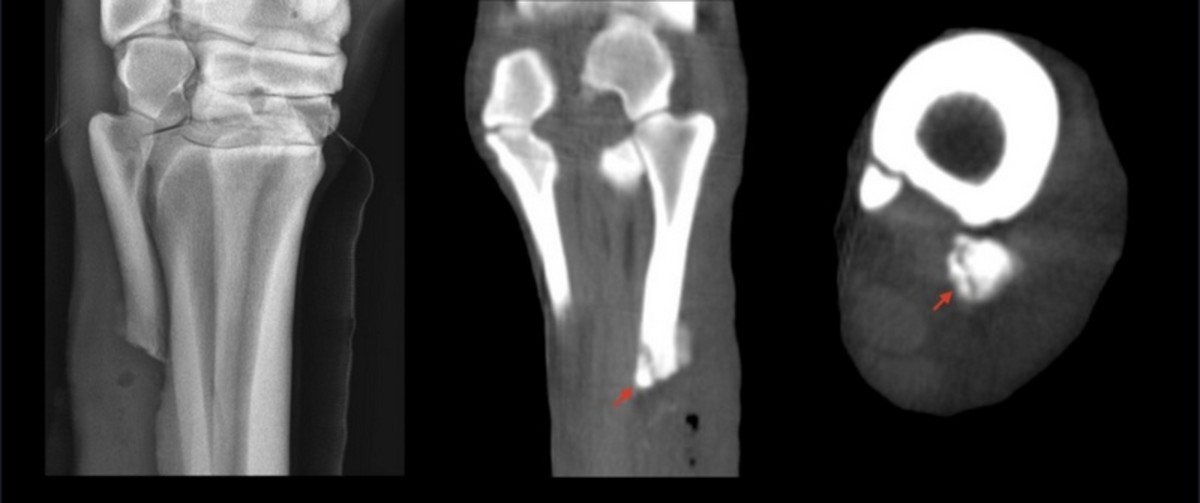
Axial fracture of proximal MTIV of right rear limb of a 2yr-old Quarter horse; undetectable by radiograph.

About Asto CT

Asto CT® was founded in 2015 as a result of a research collaboration between the University of Wisconsin-Madison (UW) School of Veterinary Medicine and the Morgridge Institute for Research.

Our team has a combined 100+ years of experience with deep expertise in medical product development and hands-on veterinary care. Our patented approach allows imaging of lower limbs and of the head and neck of a sedated horse in the standing position.

Asto CT was founded on the principle of offering safe, high-quality CT imaging to improve quality of life for horses and ensure peace of mind for owners. Our state-of-the-art equine CT scanner is customised to meet the needs of horses in a safe and comfortable environment for the animal.
More information can be found at www.astoct.com

The post First Standing CT Scanner Installed At Texas’ Equine Sports Medicine & Surgery appeared first on Horse Racing News | Paulick Report.

Source of original post

TAKE2 Donor Of The Month: TCA Is One Organization Helping Many

For more than 32 years, Thoroughbred Charities of America (TCA) has been on a mission “to fund and facilitate the support of Thoroughbreds and the people who care for them.” The grant-making organization has distributed more than $26 million to more than 200 Thoroughbred-related non-profits. The TAKE2 Second Career Thoroughbred Program is proud to be a TCA donee.

TAKE2 was awarded its first TCA grant in 2016, and has been a recipient every year since. In recognition of all it does for the organization and for the Thoroughbred industry overall, TCA has been named the TAKE2 “Donor of the Month” for October.

The TCA funding provided to TAKE2 has helped to expand second career opportunities for retired racehorses in the show ring, and has assisted in placing nearly 1,000 horses from the New York Racing Association tracks through TAKE2's sister program TAKE THE LEAD. These initiatives align perfectly with the TCA mission statement.

“TCA helps both horses and humans,” TCA Executive Director Erin Halliwell said. “We support health and social services for the backstretch and farm workers, and we also focus a lot of our efforts on aftercare. It's important to fund not only those organizations that take the horses from the track for rehabilitation, retraining and rehoming, but also to help the groups like TAKE2 that are actively working to create a market and demand for off-the-track Thoroughbreds among sport horse enthusiasts. Organizations like TAKE2 are a vital part of the equation.”

Over the last 10 years, the racing industry has become increasingly aware of the need to provide for Thoroughbreds even after their racing careers are over.

“Aftercare wasn't even a word 15 years ago,” Halliwell said. “It is a relatively new term in the racing lexicon. There's no doubt there is more work to be done, but it is staggering the progress we have made in the last decade. The Thoroughbred Aftercare Alliance has had a huge impact on racehorse retirement. Incentive programs like the Retired Racehorse Project, the Thoroughbred Incentive Program and TAKE2 are making incredible strides. The opportunities for retired racehorses and the value of off-the-track Thoroughbreds is trending up, and that's what we want to see.”

The seeds for TCA were first planted in 1990 by a group of racehorse owners in the Mid-Atlantic that included Herb Moelis, who passed away earlier this month, his wife Ellen, and the late Allaire DuPont. What started as a yearly dinner and auction of art and racing memorabilia at the Moelis' Candyland Farm in Delaware grew to include the annual Stallion Season Auction and, when the funds raised from the Stallion Season Auction closed in on $1 million in 1997, TCA was launched. It is now the charitable arm of the Thoroughbred Owners and Breeders Association (TOBA) and offers supporters a way to give to one organization while helping many.

“We're stronger together,” Halliwell said. “We see that in aftercare. There is so much collaboration and cooperation, we share ideas and experience. That's the kind of effort we need to push our mission forward.”

Help TAKE2 Celebrate 10 Years of Supporting Retired Racehorses!

Join the Cause: With the generous help of donors Len Green and the Green Group, Patricia Hurter, Kyle Emmich, NYTB/NYSTBDF, Michael Sternklar, and TERF, TAKE2's “Perfect 10” campaign has already raised $78,172, ahead of our goal of raising $10,000 a month for 10 months in celebration of our 10th Anniversary. We encourage members of the Thoroughbred Horse Racing, Show Horse and Sport Horse communities to follow our supporters' lead and honor the anniversary with donations of any size.

Post on Social Media: Throughout the campaign, TAKE2 will feature donors and surprise celebrity ambassadors on our social media platforms.  All owners of retired racehorses turned hunter/jumpers are also invited to share photos of their horses on TAKE2's FaceBookTwitter and Instagram accounts with the hashtag #TAKE2Happy10th.

To Make a Donation: Click here to make a donation today!  You can also donate by texting HAPPY10TH! to 44321.

TCA's mission is to fund and facilitate the support of Thoroughbreds and the people who care for them. TCA distributes grants to several categories of Thoroughbred-related nonprofits including rehabilitation, retraining, rehoming and retirement organizations; backstretch and farm employee programs; equine-assisted therapy programs; and research organizations.  Since its inception in 1990, TCA has granted over $26 million to more than 200 charities. TCA also administers the Horses First Fund, a fund started by LNJ Foxwoods in 2016 to provide emergency aid for Thoroughbreds in need. TCA is the charitable arm of the Thoroughbred Owners and Breeders Association (TOBA).

The TAKE2 Second Career Thoroughbred Program was the brainchild of then New York Thoroughbred Horsemen's Association (NYTHA) President Rick Violette Jr. NYTHA partnered with the New York Thoroughbred Breeders Inc. (NYTB) in 2012 to launch TAKE2, with the goal of creating more second career opportunities and making it easier to find new homes for retired racehorses. TAKE2 sponsors awards and prize money in Thoroughbred Hunter and Jumper divisions and supports Thoroughbred aftercare initiatives nationwide. The program has expanded quickly, from eight shows in three states in its first year to more than 370 horse shows in 23 states in 2021. To date, more than 2,000 Thoroughbreds have participated in the TAKE2 Program. A 501 (c)(3) nonprofit organization, TAKE2 is co-funded by members of the Thoroughbred industry around the country: New York Thoroughbred Breeding and Development Fund; Thoroughbred Horsemen's Associations in Illinois (through Galloping Out), Maryland (through Beyond the Wire), and Pennsylvania (through Turning for Home); and Ocala Breeders' Sales Company. TAKE2 is a 2021 TCA grantee. For more information, go to www.take2tbreds.com.

The post TAKE2 Donor Of The Month: TCA Is One Organization Helping Many appeared first on Horse Racing News | Paulick Report.

Source of original post

New Study Finds Horses Racing On Lasix At 62 Percent Increased Risk Of Sudden Death

A new study of data from the Equine Injury Database has revealed that horses medicated with furosemide (Lasix) on race day were at 62 percent increased odds of sudden death compared to horses that were not racing on furosemide.

Funded by the Grayson Jockey Club Foundation, the study was published by Dr. Euan Bennet and Dr. Tim Parkin on Oct. 20, 2022, in the Journal of the American Veterinary Medical Association. It examined the 4,198,073 race starts made by 284,387 Thoroughbred horses at 144 racetracks in the United States and Canada between 2009 and 2021; those numbers represent 92.2 percent of all official race starts during that period.

Of those nearly 4.2 million starts, 536 resulted in a horse's sudden death, an incidence rate of 0.13/1,000 starts. Sudden death was defined as any horse that was recorded as a fatality within three days of racing, along with one or more of the following fatal injury descriptions or (presumptive) diagnosis, as provided by each participating track to the EID: (1) sudden death (recorded as “SUD” in the EID), (2) pulmonary hemorrhage, (3) exercise-induced pulmonary hemorrhage (EIPH), (4) postexertional distress/heatstroke (PED), and (5) cardiac arrhythmia.

In total, the study examined 49 risk factors for sudden death, and found that 15 of those risk factors were significantly associated with sudden death, including horse age and sex, season and purse of race, race distance, and horses' recent history of injury and lay-up.

The most startling statistic was that associated with Lasix; of the 536 sudden deaths examined in the study, 518 were recorded as racing on the anti-bleeding medication. Only 18 horses suffering sudden death had raced without the medication. Researchers determined horses racing on Lasix had a 62 percent higher risk of sudden death than horses racing without it.

Study authors explained that 94 percent of starters in the recorded data raced on Lasix, so it is an extremely common risk factor and merits more research.

Become a Paulick Report Insider!

Want to support our journalism while accessing bonus behind-the-scenes content, Q&As, and more? Subscribe to our Patreon stream.

They wrote: “Identifying any potential causal link between furosemide administration and sudden death should be a priority. Furosemide administration, alongside water restriction, is common race-day practice for the management of EIPH and has been shown to also result in improvements in race performance. Although evidence supports the use of furosemide to reduce the severity of EIPH, the ethics of permitting any race-day medication is controversial and problematic for the sport.

“Furosemide is a diuretic and reduces the severity of EIPH by reducing blood volume and hence blood flow and pulmonary arterial pressure. The diuretic action results in a loss of sodium, potassium, and chloride into the urine and hence predisposes to electrolyte abnormalities. In humans, these electrolyte disturbances may predispose to arrhythmias and arrhythmic death. Therefore, it could be hypothesized that furosemide administration in horses may increase the risk of sudden death through fatal arrhythmogenesis.

“However, as the exact cause of sudden death (cardiac vs non-cardiac) was not determined for the horses of this study, we can only speculate at possible mechanisms. Further investigation is required to understand which, if any, pathophysiologic mechanisms could underlie the association between furosemide use and sudden death, as this finding raises further concerns about the ethics of race-day administration.”

Other risk factors in the study were as follows:

  • Compared to horses racing in summer, those racing in winter were at a 28% reduced risk of sudden death.
  • Starts made on synthetic track surfaces were at 33% reduced odds of sudden death compared to starts made on dirt tracks.
  • Longer race distances were associated with a significantly reduced risk of sudden death.
  • Horse starts in state-bred races (in which only state-bred horses were permitted to race) were approximately 41% less likely to  experience sudden death than horses in other races.
  • Horse starts in races with purse values > $10,000 were at approximately 40% greater risk of sudden death compared to starts in races with purse values < $10,000.
  • Compared to female horses, geldings were not significantly different with respect to their risk of sudden death, but intact male horses were at 39% increased risk of sudden death.
  • Older horses were at increased odds of sudden death compared to younger horses, with horses 5 years old and above at 44% increased risk relative to horses 3 years old and younger.
  • For each additional race start made in the previous 0 to 30 days, individual horses were at reduced risk of sudden death.
  • Horses that had made two or more race starts in the period 90 to 180 days before the current race were at 19% decreased risk of fatality compared to horses that had made 0 or 1 start in the same time period.
  • Horses making their first start as a claimer were at 38% increased odds of sudden death compared to horses that were not previously claimers.
  • Compared to horses that had never had a lay-up (defined as a period of longer than 60 days with no race starts), horses whose previous lay-up was within 30 days of the current start were at 37% increased odds of sudden death.
  • Horses that had previously been added to a vet list were at 31% increased odds of sudden death compared to horses that had never been on a vet list before.
  • Horses that had raced a longer cumulative distance in their prior career were at reduced odds of sudden death compared to those with less cumulative distance.
  • Horses with more previous wins in their prior career were at increased odds of sudden death.

The study's authors also wrote that the risk factors were most helpful in identifying an at-risk horse when layered together; that is, if they removed one variable from the model (like number of starts in 90 to 180 days) the statistical significance of other factors like season and furosemide use changed. The final model used for the paper included all three variables because it produced the most accurate prediction of a horse's risk. This, they believed, was likely due to the rare nature of a sudden death compared to the overall number of race starts in the database.

Sudden deaths are also difficult to study because even with a necropsy, it's not uncommon for the exact cause to remain unknown.

According to the study: “Some of the factors identified suggest that the possibility exists to identify at-risk horses well before they experience sudden death. Further work is required to determine which, if any, clinical signs are potential indicators and indeed whether such a rare outcome could be reliably predicted.”

See an abstract of the study here.

The post New Study Finds Horses Racing On Lasix At 62 Percent Increased Risk Of Sudden Death appeared first on Horse Racing News | Paulick Report.

Source of original post

FanDuel Breeders’ Cup Juvenile (G1) To Be Presented By Thoroughbred Aftercare Alliance

The Thoroughbred Aftercare Alliance (TAA) will join FanDuel TV in the Breeders' Cup World Championships winner's circle to present the premiere race on Future Stars Friday— the FanDuel Breeders' Cup Juvenile presented by the Thoroughbred Aftercare Alliance (GI).

As part of FanDuel's commitment to support accredited Thoroughbred aftercare, the sports wagering digital cable and satellite television network will present a check to the Thoroughbred Aftercare Alliance during Future Stars Friday. FanDuel TV, formerly TVG, has honored the TAA at the Breeders' Cup since 2020. To date, the company has provided more than $200,000 in charitable contributions to the TAA and California Retirement Management Account (CARMA).

FanDuel TV strives to highlight the importance of responsible aftercare for retired racehorses during its programming. The Thoroughbred Aftercare Alliance regularly receives air time during FanDuel TV's premiere race day programming, and the Breeders' Cup World Championships is no exception. FanDuel TV will provide extensive coverage of the Breeders' Cup World Championships from Keeneland on November 4-5.

“Our company is proud to continue its support for Thoroughbred aftercare and second careers and to highlight all the good work the racing industry is doing to care for its equine athletes before, during, and after their careers on the track,” said Andrew Moore, General Manager of Racing for FanDuel Group.

“FanDuel's commitment to continue including the Thoroughbred Aftercare Alliance on one of the biggest days of racing is a huge win for not only the TAA, but the aftercare movement as a whole,” said TAA President, Jeffrey Bloom. “Thanks to the TAA and its vast network of accredited aftercare charities we can rest easy knowing our horses are in good hands, but this solution only works if we provide the funding necessary to sustain the demand created by the racing industry. FanDuel continues to set themselves apart as a major annual donor for the TAA and for that we are incredibly grateful.”

About FANDUEL TV and TVG

Headquartered in Los Angeles, FanDuel TV, a FanDuel Group company, is the first network dedicated exclusively to live sports and sports betting content. Formerly known as TVG, FanDuel TV features Up & Adams, a morning show hosted by Kay Adams alongside FanDuel's signature sports betting show, More Ways to Win with former ESPN SportsCenter anchor Lisa Kerney and live horse racing from America's premier racetracks. TVG.com is one of the largest legal online gaming services in the US, processing more than $2 billion in horse racing wagers annually from residents of over 30 US states. The FanDuel Group has demonstrated its commitment to the racing industry, its horse owners, tracks and fans through investment in technology and marketing as well as sponsorship of several prominent races including the FanDuel Breeders' Cup Juvenile, the FanDuel Breeders' Cup Mile, the TVG Pacific Classic, and several others. For more information visit TVG.com.

About the Thoroughbred Aftercare Alliance

Based in Lexington, KY, the Thoroughbred Aftercare Alliance is a 501(c)(3) nonprofit that accredits, inspects, and awards grants to approved aftercare organizations to retrain, rehome, and retire Thoroughbreds using industry-wide funding. Along with continued funding from its original partners Breeders' Cup, The Jockey Club, and Keeneland Association, the TAA is supported by owners, trainers, breeders, racetracks, aftercare professionals, and other industry members. Since inception in 2012, the TAA has granted more than $24.5 million to accredited aftercare organizations. Currently 82 aftercare organizations comprised of approximately 180 facilities across North America have been granted accreditation. To learn more about the TAA, visit ThoroughbredAftercare.org.

The post FanDuel Breeders’ Cup Juvenile (G1) To Be Presented By Thoroughbred Aftercare Alliance appeared first on Horse Racing News | Paulick Report.

Source of original post

Verified by MonsterInsights