The Horse Comes 1/ST, Presented By 1/ST Racing: Team Approach Drives Beyond The Wire’s Success

An avid horse racing enthusiast and a passionate champion for the Thoroughbred, Jessica Hammond is a natural fit for the role of executive director of the Maryland aftercare organization Beyond the Wire. Hammond also serves as counseling administrator for the Maryland Thoroughbred Horsemen's Association.

Drawing upon her breadth of experience, which encompasses more than 10 years in the Maryland Thoroughbred industry, Hammond, 45, is charged with knowing where to place horses transitioning to second careers. Hammond's success has earned her Godolphin's 2022 Dr. J. David Richardson Community Award, honoring those who have made major contributions to the Thoroughbred industry for the greater good of the sport.

Hammond credits her success to being able to recognize and manage the many moving parts that comprise Thoroughbred aftercare in Maryland.  “Aftercare has several different facets and involves many different personalities in the industry,” said Hammond.  “Getting those to mesh for the good of the horse can be a challenge.  Everyone has an opinion on how best to do things or what the priorities are. I decided a few years ago that as long as I always put the horse first, I'm going to be making the right decisions.”

Something she didn't expect was how Thoroughbred aftercare would take her on many journeys, including participation in the Retired Racehorse Project Thoroughbred Makeover, a two-day equestrian competition held in Lexington, Ky. 

Beyond the Wire has been a sponsor at the Retired Racehorse Project Thoroughbred Makeover for several years. Hammond has long been an attendee and leaves each year's edition feeling inspired. Diagnosed with a muscular disease, Hammond never thought she would be able to compete, but after watching a Competitive Trail event, she decided there was no reason she couldn't become a competitor and then set off to find the perfect equine partner for the 2023 event. 

“I never thought I could compete in that setting at that level due to my limitations, but I figured why not try,” reflects Hammond. Deciding to compete in the 2023 Thoroughbred Makeover is no small feat. Potential participants often search long and hard for a potential equine partner and Hammond's search was no different. 

“For me, the first requirement is sensibility. I need something that is reasonable and basically safe. I also have to feel a connection to the horse. When I've been looking, most of the horses I'm interested in are on the mend, so I was unable to ride them. I spent time with them hand grazing and hand walking and watched their behavior as things were happening around them,” said Hammond. “I also want them to seem interested in me because I am going to need to trust them and vice versa at some point. I also bring my husband (and trainer) Scott once I've narrowed it down so that he can look at conformation, soundness and behavior as well. He is the real expert and has to give the green light.”

Working with the connections of horses has given Hammond the ability to gather as much information about each potential horse as she can. “Luckily, I know the connections that retired these horses so I also interview the trainer, rider and grooms.” 
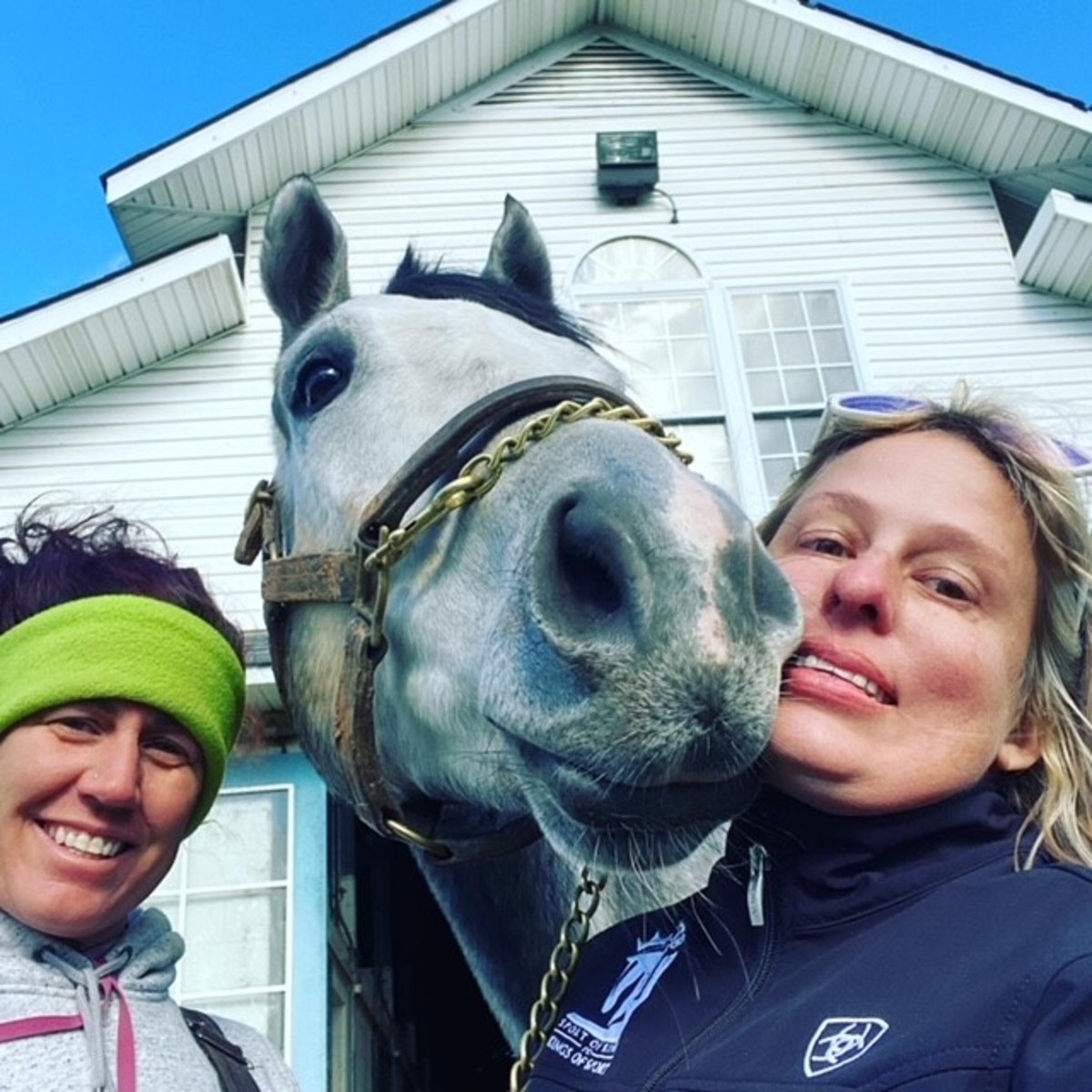
Jessica Hammond with Contented Now, the horse he hopes to bring to the 2023 Retired Racehorse Project Thoroughbred Makeover

Finding a mount might sound like a needle in a haystack, but Hammond thinks she may have found her 2023 equine partner in Contented Now, a 4-year-old gray or roan gelding by Medaglia d'Oro. “I went to one of our partner rehabilitation farms to check on horses and asked about him. Unlike a lot of people, I am not easily swayed by grays, but there was definitely a connection. I also spoke with his trainer who confirmed his good mind,” said Hammond.

Contented Now is still in rehabilitation and Hammond and husband Scott will take him when he is nearing the end of his rehab stint and, from there, go on the road to the Thoroughbred Makeover. 

Hammond's goal is to be accepted to the makeover and successfully finish a class. “If that happens, I'll be on top of the world. Anything above and beyond that would just be a dream,” Hammond said with a refreshing note of girlish enthusiasm. “I also want to have fun with my friends and colleagues and bond with my horse. I think those are both big parts of participating in the Thoroughbred Makeover in any capacity.” 

In addition to competition, dedicated horsemen and women often turn business relationships into lifelong friendships. “I was lucky to gain both a trusted resource and friend in Georganne Hale (vice president of racing development for the Maryland Jockey Club), who is a board member at Beyond the Wire,” she said. “Georganne and I have become good friends and my relationship with her and her opinion on things are important to me.” 

Hale readily acknowledges Hammond's value to the business of aftercare. 

Jessica Hammond hits the road with Maryland Jockey Club executive and Beyond the Wire board member Georganne Hale

“Nobody is as loyal to the horses as Jessica is,” said Hale. “I was ecstatic when I was asked to be on the Beyond the Wire board because I would be working with Jessica directly. What happens to horses after they finish racing is a number one priority for the Maryland Jockey Club and 1/ST Racing. I am fortunate to work for a great company that really cares about horses and aftercare. Through them, I have been able to attend events that focus on aftercare and meet great people like Jessica.”  

Hammond is quick to acknowledge the symbiotic contributions of the Maryland Jockey Club, 1/ST Racing, and Beyond the Wire.  “Everyone is working together,” she said.  “The MJC, 1/ST Racing and Beyond the Wire help in so many ways, including providing veterinarians who assist in addressing welfare concerns.  This team approach has led to more horses retiring sounder sooner and that is obviously one of our primary goals.” 

For Hammond, juggling the day-to-day duties associated with aftercare may be a challenge but it is one that has led to great friendships, grand adventures, and, most importantly, successful placement of many Thoroughbreds following their racing careers in Maryland. 

Aftercare Spotlight: Beyond the Wire

Beyond the Wire is a 501C3, Thoroughbred Aftercare Alliance accredited aftercare program that started as an industry-wide initiative between the Maryland Thoroughbred Horsemen's Association, the Maryland Jockey Club, Northview Stallion Station, 1/ST RACING, the Maryland Horse Breeders Association, and the Maryland jockey colony. It was created to provide a safe transition from racing for all Maryland-based Thoroughbred racehorses. To find out more about Beyond the Wire or to donate to the organization, please visit: https://www.beyondthewire.org/

The post The Horse Comes 1/ST, Presented By 1/ST Racing: Team Approach Drives Beyond The Wire’s Success appeared first on Horse Racing News | Paulick Report.

Source of original post

Indiana Standardbred Euthanized Due To Equine Herpesvirus

A Standardbred in Shelby County, In., was confirmed to have the neurological form of equine herpesvirus (EHV-1) on Dec. 6 by the Indiana State Board of Animal Health. 

The 3.5-year-old filly, who was displaying neurologic deficits, was euthanized. The 39 horses that had been exposed are under quarantine and are being monitored twice daily for temperatures over 101.5 and for other EHV signs. 

A second premise in Madison County, In., has been quarantined and the horses there are being monitored closely. 

Read more at the Equine Disease Communication Center. 

Learn more about EHV here

The post Indiana Standardbred Euthanized Due To Equine Herpesvirus appeared first on Horse Racing News | Paulick Report.

Source of original post

Sol Kumin Pledges $5,000 One-Day Match Donation To TAA Holiday Giving Campaign

As part of the Thoroughbred Aftercare Alliance (TAA)'s month-long Holiday Giving Campaign, Sol Kumin has pledged to match all donations up to $5,000 made to the TAA on Dec. 14, 2022. No stranger to the winner's circle, Kumin's ventures into racehorse ownership have seen the likes of Justify, Authentic, Monomoy Girl, Exaggerator, Whitmore, and Lady Eli, among others. In addition to Kumin's success on the racetrack, the American business leader and philanthropist has been a supporter of the Thoroughbred Aftercare Alliance since 2017.

“I believe as owners we have an obligation to make sure that these horses have a safe place to land when the crowds are gone and their racing days are over,” said Sol Kumin, Madaket Stables. “The TAA works tirelessly to not only ensure that these safe places exist, but that they also get the funding necessary to move on to their second careers.”

“We are so happy to have Sol's support and match for the day,” said TAA Funding and Events Manager, Emily Dresen. “Madaket Stables is a great example of responsible ownership that doesn't end at the track.”

TAA's Holiday Giving Campaign commenced November 29th and is scheduled to conclude New Year's Eve. Those wishing to support the TAA, its 81 accredited organizations, and thousands of retired Thoroughbreds can donate through the TAA's website or text DONATE to 56651. During the Holiday Giving Campaign, TAA is also offering donors the benefit of sending digital holiday cards to colleagues, friends, and loved ones.

Throughout the end of the year, the Thoroughbred Aftercare Alliance will continue to host special one-day only donation matches with some of horse racing's biggest names. For more chances to double your donation, watch the TAA's social media, website, and industry advertisements for the next Holiday Giving match day announcement.

To learn more and donate to the TAA's Holiday Giving campaign, visit: ThoroughbredAftercare.org/HolidayCampaign.

About the Thoroughbred Aftercare Alliance

Based in Lexington, KY, the Thoroughbred Aftercare Alliance is a 501(c)(3) nonprofit that accredits, inspects, and awards grants to approved aftercare organizations to retrain, retire, and rehome Thoroughbreds using industry-wide funding. Along with continued funding from its original partners Breeders' Cup, The Jockey Club, and Keeneland Association, the TAA is supported by owners, trainers, breeders, racetracks, aftercare professionals, and other industry members. Since inception in 2012, the TAA has granted more than $28.1 million to accredited aftercare organizations. Currently 81 aftercare organizations comprised of approximately 180 facilities across North America have been granted accreditation. To learn more about the TAA, visit ThoroughbredAftercare.org.

The post Sol Kumin Pledges $5,000 One-Day Match Donation To TAA Holiday Giving Campaign appeared first on Horse Racing News | Paulick Report.

Source of original post

RTIP: Technology Could Provide Safety Solutions, But More Work Ahead To Figure Out How

Improved safety for racehorses could be just around the corner thanks to new innovations in technology, but regulators are still learning how to harness that tech's power.

That's one takeaway from a panel at the recent 48th Annual Global Symposium on Racing, which was held in Tuscon, Ariz., last week. Panelists provided overviews of several new pieces of equipment that could improve on-track health and safety, including a dynamic face mask that could detect and pinpoint wind problems on-track, a robust heart monitoring and GPS system, and a sensor-based system that can pick up on gait asymmetry.

The piece of technology that generated the most discussion during the panel however was the StrideSafe system. This system has been used in New York racing under the direction of equine medical director Dr. Scott Palmer since summer 2021.

Read more about StrideSafe in our reporting from this year's Welfare and Safety of the Racehorse Summit.

StrideSafe is a three-ounce device that can be mounted to a saddle towel and measures acceleration in three directions, and also measures concussion on front and hind limbs. When placed on a horse over time, it develops a sense of what constitutes “normal” movement for that horse and can issue flags – including yellow “caution” ratings and red “alert” ratings – when it detects significant changes from that individual's version of normal.

“It's not very common for a horse to put his foot in a hole,” said Dr. David Lambert, StrideSafe CEO. “They go on for seconds and seconds [after a stride change] … it's a protracted event when it actually happens.”

The device has been mounted on all starters in New York, generating data from 6,626 starts. Seventy percent of those generated green ratings indicating no problems, 18 percent generated yellow ratings, and 12 percent red. There were 20 fatal breakdowns during the StrideSafe trial period, of which 18 horses had a red rating in their final race, one had a yellow rating and one had a green.

Lambert praised the system for being able to correctly identify issues in 90 percent of fatal injuries from the 20 fatal breakdowns.

In the future, Lambert hopes StrideSafe could make “the catastrophic injury problem go away.”

Support our journalism

If you appreciate our work, you can support us by subscribing to our Patreon stream. Learn more.

There are currently logistical challenges to its use, however. The use of the system in New York was observational and retrospective, meaning horses were not scratched from races based on the results. A red rating also may be (and in several example cases, was) generated within the racing event in which a horse broke down. This meant that on the plus side, it could clearly identify stride differences that a rider may not have been able to feel, but not always far enough in advance to allow for intervention.

A yellow or even red rating may indicate a horse has developed a physical problem, but it may not give the trainer and their veterinarian very specific information about where to look when they contemplate diagnostics. If a trainer receives a yellow rating on a horse who subsequently passes a veterinary exam, are they subject to liability if the horse continues working and suffers an injury later?

Dr. Will Farmer, equine medical director for Churchill Downs Inc., hopes an upcoming study on StrideSafe in Kentucky will help answer some of those questions.

“Studies that have been done in the past was to confirm that the reds were reds, looking back retrospectively and following racehorses,” said Farmer. “Our goal is to try to be proactive. When we get a flag that comes in, we want to be able to communicate that to the trainer to give them an opportunity.”

Farmer also expressed concern that StrideSafe could read “racing-sensitive issues” like a check or bump during a race as a stride departure that could result in a red flag. The planned 2023 study will help further differentiate the technology's feedback. It will also put the device into use during training, with the hope it can provide yellow or red flags before a catastrophic injury occurs under the strain of a race.

During the study period, Farmer said the state veterinarian will not have access to the StrideSafe data and CDI will not be forcing trainers to scratch based on the feedback from the system; at this stage it will instead serve as an informational tool.

“These horses are going through everyday scrutiny,” he said. “In Kentucky they have to have a private veterinary exam before they race, they have to have a regulatory veterinary exam the morning of and then a veterinary exam while they're on the racetrack, so there are multiple modalities they're going through to make sure there are no overt signs of unsoundness.”

Farmer understands that it may be difficult for a trainer to be told that sensors see something they don't. If StrideSafe continues to reliably identify horses with unseen problems, it may serve as a source of more information in the future as regulatory veterinarians conduct pre-race exams or post-claim soundness exams.

“I think there are some things that are beneficial to a trainer, to give some objectivity to some of the decisions that are made,” he said. “We're really excited to see the training aspects of [the device] too.”

Depending on the outcome of Churchill's study, Lambert said cost should not be a major challenge for widespread use of the system going forward – StrideSafe costs $35 per horse start to use, but owner Jim McIngvale's Runhappy Wellness Initiative has told StrideSafe it will subsidize the expense to racetracks in the device's early days.

The post RTIP: Technology Could Provide Safety Solutions, But More Work Ahead To Figure Out How appeared first on Horse Racing News | Paulick Report.

Source of original post

Verified by MonsterInsights