‘We Just Fit Together’: Ontario-Based Wainwright Feels ‘So Safe’ With First Off-Track Thoroughbred

Jillian Wainwright had all but given up on finding a riding horse she could connect with. Then she saw the photo.

For months, she had visited various locales in and around her farm about an hour's drive from Ottawa, Ontario, hopeful, on each occasion, of discovering a horse she could bring home to the 35-acre property and teach to ride.

Each time, Wainwright would head back by herself.

“My previous riding horse – she's now 26 – is a Quarter Horse mare. Nothing really stood out. I had the chance to see some horses in person, but there was really no connection. They were nice horses, but there wasn't really a connection. I had sort of given up, that there was nothing really out there for me.”

A conversation, an exchange nearly three years ago, would change that outlook.

“I have friends, Wayne and Wendy Catherwood, who used to live in Uxbridge [Ontario], and they asked me if I had looked at LongRun. I had no idea, at that point, what it was. They told me to Google it and their website will come up, and there might be some horses that you are interested in. So, I did that, and it was a moment of, 'Wow… look at all these horses.' But I saw that they were racehorses, and I wasn't sure if that would be right for me. I'm used to my little Quarter Horse mare. There is that myth about racehorses, that they are very hyper and hot, that you can't manage them.”

A tree-lined 100-acre home to over 50 retired Thoroughbreds, LongRun, established in 1999, is regarded as one of the most respected horse retirement and adoption organizations, and the first industry-funded adoption program in Canada. The picturesque, pristine property is situated a little less than an hour's drive north of Woodbine Racetrack, in Hillsburgh.

One of its residents was a gelding who was known as Money Talks during his racetrack life.

The dark bay son of champion and multiple stakes winner Mobil raced 49 times over a career that yielded four wins and 18 top-three finishes accompanied by $195,248 (U.S.) in earnings for trainer Bill Tharrenos.

Bred in Ontario by Fred W. Pace, Money Talks was a $23,320 (U.S.) purchase at the 2012 CTHS Canadian-bred Yearling Sale. He debuted on August 11, 2013, at Woodbine, getting up in the final strides to secure a second-place finish in the five-furlong main track race.

Two weeks later, Money Talks broke his maiden courtesy of a 4 ½-length romp at seven panels over the Woodbine main as the 2-5 mutuel choice.

The gelding would contest four stakes races, including the 2014 Prince of Wales Stakes, second jewel in the Canadian Triple Crown, with his best result coming in the Elgin Stakes that same year when he was fourth.

Money Talks' final start came on November 11, 2019, at Woodbine, when he finished ninth in the 1 1/16-mile main track race for the ownership group of Natural Eight Stable, Peter McLaughlin, and Stu and Donna Kreis.

“I was kind of hesitant, but my friends talked me into finding out more about LongRun's horses. They said to get in touch with them and that there was no obligation. If there wasn't a horse for me, that would be okay. I reached out to them and sent an email. I emailed them and they got back, and said they have a few horses that might be a good fit. I filled out the adoption form – which is very detailed – and I sent that in. It wasn't long before I got an email from Lauren [Farm Manager, Millet] at LongRun, saying that they had this horse, Money Talks, who might suit us. They sent some videos and just from seeing that, I thought, 'Woah… this is kind of interesting.' I liked the look of him. We made arrangements to come to the farm to see him. It's a six-hour drive from where our place is. We left really early in the morning.”

The journey seemed much longer for Wainwright.

She thought about a myriad of things throughout the trip, optimistic, but not wholly convinced, the trek back to the farm would be different this time.

When she saw the sign on the pathway leading into LongRun, anticipation and nervousness were running stride-for-stride in her mind.

A few minutes later, Wainwright was led into the barn to meet Money Talks.

“He was in his stall. I walked over and he made eye contact. He looked at me and my heart just soared. And then he put his head out of the stall door, looked me right in the eye, and put his head on my shoulder. Honestly, the feeling was like I was being reunited with an old friend. I thought to myself, 'This is it. I want this horse in my life. Even if I can't ride him, I want this horse.' It was that instant spark and instant connection I had hoped for. I walked him around in the arena, but it was hard to do that because he kept turning and looking at me. Literally, we couldn't take our eyes off each other. I completely fell in love with him the minute that I saw him. There was that instant bond I hadn't felt with any of the other horses I had gone to see.”

But there was still work to be done before the pair could be united.

“The next month or so was very tense. Our barn had to be inspected and we had to get references. I was so worried that we were going to fail. I wanted to have him in life so badly.”

On the morning of June 17, 2020, at Longrun, Money Talks was led into a trailer with the Catherwood's son, Darryl, at the wheel.

Wainwright, who couldn't make the trip, paced around her house for what felt like the entire six hours.

“I was on pins and needles the whole day waiting for that trailer to arrive. And when it did, I don't think I've ever had a bigger smile on my face.”

That look soon changed to one of disbelief when she walked Money Talks into his stall.

Wainwright anticipated her stable of three at the time would give their new roommate an enthusiastic vocal welcome.

It was, in fact, quite the opposite.

“I've had horses for a long time and usually when you bring a new horse in, there is whinnying and squealing, and some level of excitement. The trailer pulled into our yard and there was nothing, it was silent. My horses could see through the barn that there was a trailer there, but there was no sound. We took him off the trailer, and he didn't call to them, and they didn't call to him. We let him run around for 20 minutes and so, and then we took him into the barn. His stall in the end – there are three other horses in the barn – and he had to walk by all of them. They looked up as if to say hello and that they knew him. It was a weird feeling. It was as though they knew who he was and that he was supposed to be there.”

The next step was for Money Talks to get accustomed to his new surroundings, stablemates and life as a riding horse.

Wainwright wasn't going to rush any of it.

“We let him chill out for a while. Obviously, it was much different than what he was used to competing at Woodbine. The flies are pretty bad here in the summer during the day, so he came at peak fly season. I typically turn out my horses at night, and I don't think he had ever experienced that. The first night, I left him out until dusk. He had been out for a couple of hours. The next night, I put him out in the late afternoon and in the night, he was standing under these lights, with a look of, 'Take me in. I don't think I'm supposed to be out here.' It took him a week of transition before he spent a whole night outside. Once he got used to it, he was fine. He was very happy.”

And, in some moments, Money Talks displayed his racehorse roots.

“You would watch him run and he would run in circles in the field. The others would run all over the place and he would run in circles. You could see the racetrack side of him.”

Two months after he first came to Wainwright's farm, Money Talks was tacked up for his first ride.

Wainwright wasn't sure what to expect.

“The same friends who had mentioned LongRun, they came over because they have done a lot of re-training of Thoroughbreds. They helped and it was really great to have that and get to this point. I got up on him, and he was just so quiet. It was incredible. I felt so safe. I was a bit nervous. I was going to get on a racehorse and thought he could just take off and gallop off into the sunset. But he didn't. He was so quiet and so gentle. It was as though he could read my mind. I didn't have to say anything to him. He knew instinctively what he needed to do, and I felt so safe.

“From the minute he looked at me… I feel so good with him. He makes my day every day. We ride, but it's just low-level dressage and flat work. He's a perfect fit for me. We started our dressage training and he accepted everything. You could see he was puzzled at certain points, but he's done well. We did a schooling show last year and he was fifth. I went in with no expectations because it was just for experience. He did great for a first show. He's coming along and I'm just so happy.”

Money Talks also has a new name, two, unofficially.

Both of them, Wainwright offered, quite fitting.

“I call him my “Sunshine Boy,” because he lights up life. He was called “Money,” and he knew that name. He'd pop his head up when you would say that, so I thought that was going to be his name. But he ended up being called “Sunny.”

Apropos, considering the bleak outlook Wainwright once held in her search for the right horse, and to how she views life in the present.

In the end, it was a road worth travelling.

“When I ride him, I think of just how beautiful and powerful he is. It's pure joy to ride him. I'm thinking of nothing else except the two of us riding together. I love being with him. He's an amazing horse. We just fit together perfectly.”
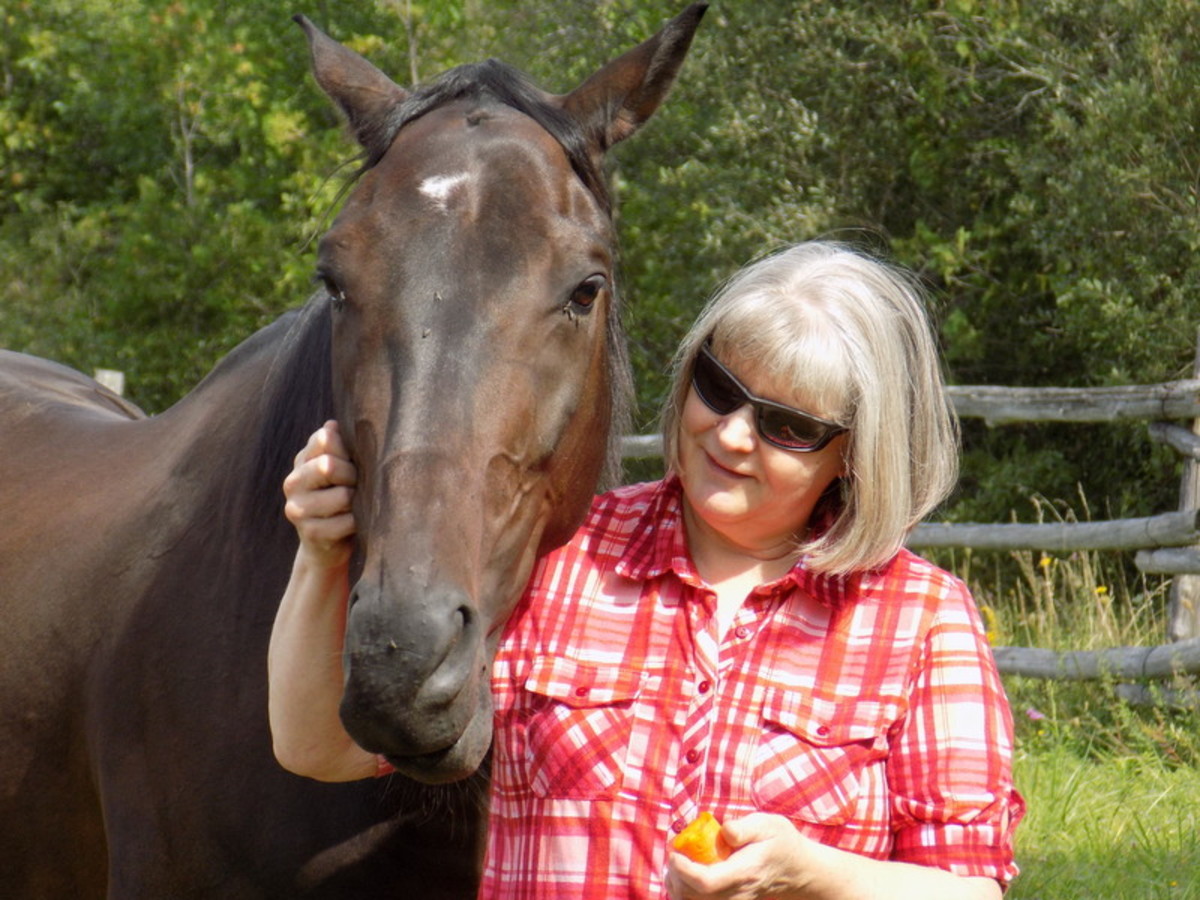
Jillian Wainwright and Sunny (Formerly Money Talks)

The post ‘We Just Fit Together’: Ontario-Based Wainwright Feels ‘So Safe’ With First Off-Track Thoroughbred appeared first on Horse Racing News | Paulick Report.

Source of original post

‘Using Your Core’ Also Helpful For Equine Rehabilitation Patients

Resistance bands, dynamic mobilization, and balance pads may all look like they're not actually “doing” much, but these tools have been shown to improve a horse's postural stability and spinal muscle characteristics. 

Postural stability protects the horse's spinal column, helps to maintain balance, and allows the horse to respond to destabilizing forces and reduces risk of injury. 

Dr. Katherine Ellis and researchers from Colorado State University sought to determine the relationship between muscle strength and postural sway in horses. The scientists focused on the thoracolumbar multifidus muscles, which run next to the vertebra for the length of the spinal column, reports The Horse.

Multiple human studies have shown that damage or disease on the spinal cord has shown reduced multifidus cross-sectional area (CSA). The muscles become painful and then atrophy from lack of use, leading to a chronic cycle of pain and muscle impairment. The humans had reduced postural stability and increased postural sway, especially when combined with prolonged periods of rest. 

Ellis hypothesized that the same would be true for equine patients on stall rest and that targeted exercises should be able to strengthen the muscles and allow horses to return to work while avoiding reinjury. 

The scientists used seven horses enrolled in CSU's rehabilitation program, and had each complete core-strengthening exercises with balance pads, dynamic mobilization, and resistance band systems. The horses were ultrasounded at the beginning and end of the 12-week study. The team specifically measured thoracolumbar multifidus muscle CSA. They also collected postural sway information using force platforms, both with and without proprioceptive balance pads. 

They found a significant increase In CSA between evaluations on both the lame and not-lame sides of the horse. They also found a moderate to strong negative correlation between CSA and postural sway variables, which means that as the multifidus CSA increased, the horse's stance was more stable.

The team concluded that an equine rehabilitation program which includes core strengthening can help improve spinal muscles and postural stability. 

Read more at The Horse.

The post ‘Using Your Core’ Also Helpful For Equine Rehabilitation Patients appeared first on Horse Racing News | Paulick Report.

Source of original post

Thoroughbred Aftercare Alliance’s Holiday Giving Campaign Raises $180,000

The month-long effort to raise funds for the TAA's 81 accredited organizations and thousands off-track Thoroughbreds, the TAA Holiday Giving Campaign, ended on Dec. 31st, resulting in $180,000 raised for accredited aftercare.

“It was encouraging to see such enthusiasm for our holiday fundraiser,” said TAA President, Jeffrey Bloom. “Thank you to every person who donated to the TAA's Holiday Giving Campaign. It takes a great deal of funds to care for our industry's retired athletes, and large influxes of donations such as these are vital to the TAA's ability to support its accredited organizations.”

The campaign featured 14 one-day only match donation days with match amounts ranging from $500 to $10,000. The 2022 match sponsors were as follows: Bob & Jill Baffert, Simon Bray, Donna Brothers, Aidan Butler & Cannonstone, Kurtis Coady & Megan Devine, Jack Damico & East Coast Partners, Denali Stud, Hidden Brook Farm, Sol Kumin, Dr. Pug & Susie Hart, Mike Rogers, Rick Schosberg, Siena Farm, and West Point Thoroughbreds.

Not only was the Holiday Giving Campaign deemed a success in terms of donations, it was an exciting opportunity for the TAA to expand its network of industry supporters. More than 70% of the donations collected during the Holiday Giving Campaign came from first-time donors.

“We are so thrilled with the outcome of the Holiday Giving Campaign,” said TAA Funding and Events Manager, Emily Dresen. “Thank you to the 14 match sponsors, hundreds of donors, and our media partners for making this campaign a success. It's all about the horses and what better time to support our beloved athletes than the season of giving.”

Designed to serve as both the accrediting body for Thoroughbred aftercare facilities and a fundraising and grant allocation body to support these approved facilities, funds raised from the Holiday Giving Campaign will help care for the more than 4,000 retired racehorses currently residing in TAA-accredited organizations across North America. To learn more about the TAA's impact, visit Thoroughbredaftercare.org/taa-impact.

About the Thoroughbred Aftercare Alliance

Based in Lexington, KY, the Thoroughbred Aftercare Alliance is a 501(c)(3) nonprofit that accredits, inspects, and awards grants to approved aftercare organizations to retrain, retire, and rehome Thoroughbreds using industry-wide funding. Along with continued funding from its original partners Breeders' Cup, The Jockey Club, and Keeneland Association, the TAA is supported by owners, trainers, breeders, racetracks, aftercare professionals, and other industry members. Since inception in 2012, the TAA has granted more than $28.1 million to accredited aftercare organizations. Currently 81 aftercare organizations comprised of approximately 180 facilities across North America have been granted accreditation. To learn more about the TAA, visit ThoroughbredAftercare.org.

The post Thoroughbred Aftercare Alliance’s Holiday Giving Campaign Raises $180,000 appeared first on Horse Racing News | Paulick Report.

Source of original post

Watch: Experts Weigh In On OTTBs And their Joint Health Needs After Retirement

The 2022 Retired Racehorse Project's Thoroughbred Makeover wasn't just about competition — there was ample opportunities for education. Throughout the event, Goldophin's Lifetime Care program partnered with The Horse magazine to present multiple seminars devoted to the care of the retired racehorse and current sport horses. One seminar focused on joint issues in off-track Thoroughbreds (OTTBs).

Presenters during the seminar were Drs. Shannon Reed of Texas A&M University Medical Hospital, and Chris Newton of Rood & Riddle Equine Hospital. Both experts answered questions from audience members covering the topic. The discussion was full of information that went back and forth between both presenters, but some of the key takeaways from this talk include:

–Studies show of the Thoroughbreds coming off the track, 31% retired with musculoskeletal issues that the horse could recover from within the first year. All but 2% of those horses saw those issues resolve themselves in the first year.

Most popular areas of pain and inflammation for recently-retired OTTBs:

  • Most veteran OTTBs have common areas of inflammation: front fetlocks and knees
  • Horses training on Polytrack surfaces tend to have soreness in the hind end
  • Sore upper backs and lower necks in 100% of horses coming off the track
    • This leads to the horses overcompensating from that pain and hyper load on specific joints, which leads to inflammation

–[Cortico]steroids is not a dirty word. Many horsefolk have expressed concern about one study that examined cartilage cell cultures and showed evidence that corticosteroids were causing damage to those cells. However, experts point out this was only performed on cultured cells, not actual cells in a horse. Corticosteroids have been used to help deal with clinical symptoms of pain, including inflammation.

–However, you do need to manage risks with benefits. In light of the steroid study, Dr. Reed emphasized that severe inflammation in a join is almost as worse in cartilage than a single dose of steroids used to calm the inflammation. However, “we do know that long-term, repeated exposure of steroids to the joint can damage cartilage,” said Dr. Reed. “Some steroids are worse than others.”

Steroids can cause more issues within the body, including metabolic issues and steroid-induced laminitis if used too much, too fast because it can throw off the body's functions, thus leading to issues in the adrenal glands.

“You have to be judicious with the use of steroids,” said Dr. Newton.

–Joint injections are not maintenance. The popular marketing plot for joint injections is to be used for “maintenance” within joints, however the experts say you must throw the word “maintenance” out the window when it comes to injections.

Why? Because there is no way to reset what is going to happen within the joints and the cartilage — the damage is day to day, and you cannot use injections to “fix” issues.

“There are times where steroids and rest are the most advantageous when dealing with inflammation,” said Dr. Reed. “There are also times that surgery is the most advantageous.”

Support our journalism

If you appreciate our work, you can support us by subscribing to our Patreon stream. Learn more.

“We can treat this and we can take the inflammation away, but if you do that too many times, you surpass the window where surgical repair is going to be advantageous,” said Dr. Newton. “There will be an upset surgeon wanting to know why you injected an OCD six times when it could have been removed after the first issue.”

“If you are an athlete and you're constantly wringing that last little bit of juice out of your efforts, then you're not going to be an athlete for much longer.”

–“OCD” is not a one-size-fits-all malady.  An OCD is a disease syndrome of growing cartilage related to different clinical entities such as epiphysitis, subchondral cysts, and angular carpal deformities. An OCD begins in the development of the fetus and into a young foal. An OCD means different things in different spots in different joints for its own prognosis. During OCD removal surgery, the surgeon will remove the abnormal cartilage flap, then will work to smooth out the edges from where it was removed.

“We're trying to get the cartilage and bone to be a better surface during this surgery,” said Dr. Reed. “We are not restoring it to a normal surface. That is not possible.”

–Wolf's Law: Bone responds to the forces being placed upon it. This means that if there are no forces placed upon the bone of a young Thoroughbred because he is stall bound for the first couple years of life, he will have weak bone. If a Thoroughbred is working and applies asymmetrical forces, the bone will respond to those forces—this is how OCD lesions are forced. Even, symmetrical forces mean the bone will respond to be strong and symmetrical.

–Osselets in horses occurs when the horse's fetlock experiences chronic stress to the point of injury. They are a unique malady for horses who run for a living due to the concussive forces the fetlock takes on while training. When tracks do not have a footing specialist who pays attention to the quality of the footing, the horses that train and race routinely on those tracks tend to have the most issues with osselets because of the stress to their joints.

Treatment for each case of osselets is individualized, said Dr. Reed. Veterinarians will treat osselets according to not just the horse, but the desires of what you want to do with the horse.


The post Watch: Experts Weigh In On OTTBs And their Joint Health Needs After Retirement appeared first on Horse Racing News | Paulick Report.

Source of original post

Verified by MonsterInsights