A new study has shown that therapy horses are more sensitive to touch than riding or show horses.
A horse that is touched repeatedly may become more reactive or less reactive to the stimulation over time. Many factors can affect this, including the horse's demeanor.
Dr. Céline Rochais and a research team from the Department of Animal and Human Ethology within the French National Centre for Scientific Research (CNRS), created a study to determine whether horses used in equine-assisted interventions become more sensitive to touch.
The team used 60 horses for the test: six that participated in equine-assisted therapy only, 14 lesson horses, and 40 horses used in both capacities. Each horse was tested for their touch reactivity with von Frey filaments, nylon threads of variable thicknesses that protrude out of a hard plastic body. This tool is calibrated to apply a specific amount of force, allowing the scientists to obtain standardized measurements.
The researchers found that horses used in equine-assisted therapies were more reactive to touch than other horses. They specifically were more reactive toward the thin filaments.
The team reported that this could be related to how humans interacted with the horses during the equine-assisted therapies; it was noted that participants with disorders had more fragmented actions and brushed the hindquarters more.
The authors concluded that attention should be paid to how horses are brushed and interacted with during equine-assisted interventions and that correct tactile actions should be encouraged.
Interest in novel medication administration methods is on the rise as companion animal owners seek less-painful, longer-acting solutions to medication administration. Horse owners, too, are beginning to look for other ways to medicate their mounts that don't rely on the use of needles.
Equine skin, tendons, and the gastrointestinal tract share many similarities to those of humans, so drugs designed to address issues in humans may often work on horses. However, the relationship isn't always reciprocal: once human dosages are determined, the equine equivalent isn't necessarily considered, but can often be determined, said Dr. Yunmei Song of the Centre for Pharmaceutical Innovation at the University of South Australia.
While human and companion animal medicine have become more focused on ease of administration, Song is hopeful that new drug delivery options are also on the horizon for equine medications. She hopes that these methods will make the medications last longer, easing administration and improving owner compliance – all resulting in improved equine welfare.
Song did caution that the new treatments will most likely cost more than traditional methods of drug delivery.
Horses are not often used in pre-clinical testing of drugs, so there is a lack of data on therapeutic molecules and the treatment of different equine diseases. There is limited understanding of how equine anatomy and physiology may affect therapeutically active molecules.
Though oral drug administration is preferred by many horse owners, there are drugs that are absorbed poorly by horses when delivered orally, but are absorbed well in other species. These include tramadol, acyclovir, and furosemide.
Additionally, how much food is in the horse's stomach can affect how orally-administered medications are absorbed. Because of this, drugs intended to be administered to horses just once a day often will not work well.
Topical medications used in horses may also have efficacy issues as delivery is highly dependent on the individual horse and his environment.
Even with these possible barriers, there is opportunity for new drug delivery systems to be developed that would require minimal dosing and be easy to administer. One to note is needleless injections, which are gaining traction in human medicine, but present challenges in horses because of skin thickness variability.
One new medication delivery method that has worked well is the equine inhaler, which is well tolerated by horses and reduces the severity of equine asthma. The research team expects additional medication delivery technology to be created in the future.
The task force, formed at the urging of then-Gov. Andrew Cuomo, was comprised of attorney Alan Foreman, chairman and CEO of the Thoroughbred Horsemen's Association; retired Hall of Fame jockey Jerry Bailey; Dr. Mary Scollay, then equine medical director of the Kentucky Horse Racing Commission and currently chief of science for the Horseracing Integrity & Welfare Unit; and Dr. Scott Palmer, an equine surgeon and former president of the American Association of Equine Practitioners. Palmer was named chairman of the task force.
The task force's mission was to investigate the cause or causes of death in the 21 fatalities; examine the racing surface at Aqueduct; review policies relating to public disclosures, necropsies, track conditions and pre-race examinations; and examine rules and practices concerning claiming procedures, veterinary procedures, and equine drug use.
One of the key recommendations of the task force was the appointment of an equine medical director for the New York State Gaming Commission, a position that Palmer accepted in January 2014.
Palmer and Foreman were also part of a team that developed the Mid-Atlantic Strategic Plan to Reduce Equine Fatalities, a 2019 paper that developed best practices on a variety of safety-related issues for the Mid-Atlantic region.
So, 10 years after the task force report and three years after the Mid-Atlantic strategic plan, have fatal injuries been reduced at Aqueduct and the other New York Racing Association tracks, Belmont Park and Saratoga?
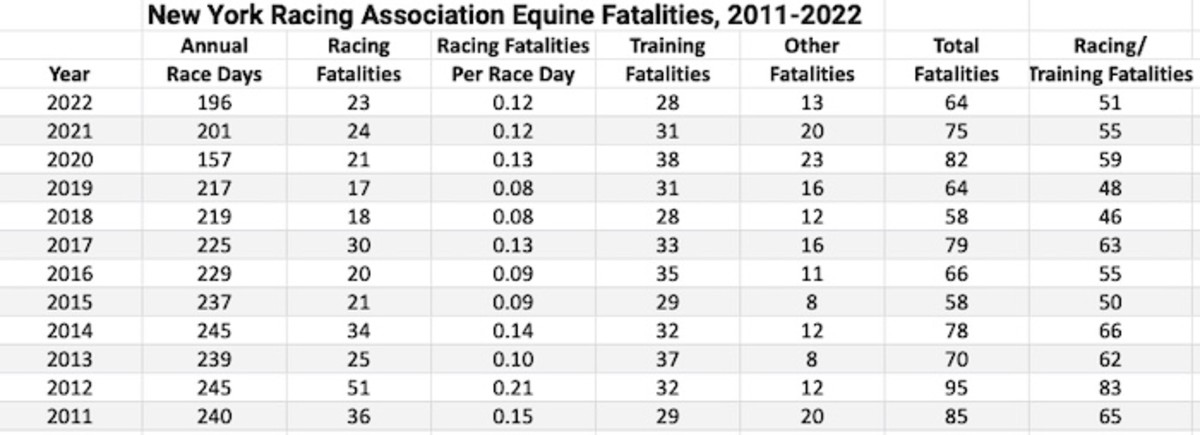
Based on statistics compiled by the Paulick Report from the NYSGC's online database, fatal racing injuries are down significantly from 2012, when 51 horses died. In 2022, 23 horses were listed as having died from racing, either as a result of musculoskeletal injuries or sudden death. That's a decline of 55 percent. Over the same span, the number of racing days has declined by 20 percent. In 2012, there were 0.21 fatalities per race day (roughly one every five days). In 2022, there were 0.12 fatalities per race day (one every eight days).
Training fatalities or “other” deaths (colic and laminitis being the leading causes) have not declined nearly as much as racing fatalities. Training deaths actually increased from 32 to 37 the year after the task force recommendations and there were 28 in 2022, just a 13 percent decline from 2012. Training fatalities saw a 10-year high with 38 deaths in 2020, the year the coronavirus pandemic disrupted racing and training. The number of horses that died from other causes has increased in recent years compared to 2012, also hitting a 10-year high of 23 in 2020.
To review the progress made at New York Racing Association tracks over the last 10 years and the challenges that remain, a number of questions were submitted to Palmer, New York's equine medical director. Following are those questions and answers:
Dr. Scott Palmer (AAEP photo)
Since 2012, when the Task Force was formed to address the spike in fatalities at Aqueduct, racing and training fatalities (not including “other” or “unknown” deaths) at NYRA tracks are down almost 40%. What do you think are the biggest factors that have helped lead to the reduction?
Dr. Scott Palmer: There are many factors that impact equine health and safety. At NYRA tracks, the reduction of equine fatalities can be attributed in part to implementation of a comprehensive risk management program and the recommendations of the New York Task Force on Racehorse Health and Safety. Some specific factors include but are not limited to:
New York's appointment of an Equine Medical Director
Stricter voided claim rules
Claiming purse-to-price restrictions
Prohibition of analgesic medications and joint injections in horses within a timeframe leading up to a race
Strict regulation of thyroid hormone medicine in horses
Enhanced protocols for pre-race inspections of horses
Required continuing education for all trainers and assistant trainers
Real-time race surface monitoring and maintenance procedures
On the other hand, comparing 2022 to 2015 and 2016, the statistics on racing and training fatalities have not improved. When you consider the reduction in the number of racing days the last several years, the numbers look slightly worse. Does this suggest there's no more room for improvement?
Absolutely not. There is ALWAYS room for improvement when it comes to equine health and safety. New York's goal is zero fatalities.
Risk management is an ongoing, iterative process that includes:
Performing a risk assessment to identify risk factors.
Implementing interventions to address those risk factors
Monitoring metrics to determine if interventions are successful
Modifying current interventions or implement new interventions as required to address changes in risk.
With that said, the premise of your question is inaccurate (which is discussed later). Over the past five years, there has been a relative increase in equine training fatalities in contrast to a decrease in equine racing deaths.
One factor is that, by its very nature, training is not regulated in the same manner as racing.
There is a difference in the degree of veterinary scrutiny of horses immediately prior to a race compared with that provided to horses that are training.
For horses that are racing:
On the day of a race, a pre-race inspection is performed in the morning. Based upon the results of this inspection, horses of concern to the regulatory veterinarian are not allowed to race.
All horses are visually inspected by regulatory veterinarians as they enter and walk the paddock, during the post parade, and while warming up before they are loaded into the starting gate.
Similar scrutiny of horses before and during training is undertaken. However, I am encouraged by efforts to further involve attending veterinarians in evaluating horses prior to training. We are considering a requirement that an attending veterinarian attest to the suitability of a horse to train. This cannot, however, just be a paper requirement. To be effective it would require an attending veterinarian to undertake a review.
We are likewise enthused by biometric sensor devices being placed on horses during training as a scalable means to identify Thoroughbred racehorses with subclinical lameness or gait abnormalities. Such lameness is usually impossible to diagnose by veterinary inspection alone. I believe the increased use of this technology can lead to a significant reduction of training fatalities.
In 2019, Santa Anita in California had highly publicized problems with fatal injuries similar to Aqueduct in 2012. Has New York taken anything from the safety protocols they've put in place in California that have successfully reduced the racing and training fatalities?
Yes. California has made a conscientious effort to create a culture of safety at Santa Anita Park. Increased veterinary scrutiny of horses and collaboration between attending and regulatory veterinarians has been critical to their process. Additionally, Santa Anita installed advanced imaging equipment (PET Scan) to help identify horses with pre-existing musculoskeletal lesions that are not evident on routine radiographs. It might be worth examining the interventions implemented due to PET scan availability.
What procedures do you or other regulatory veterinarians undertake when you receive a necropsy report? Does someone meet with the responsible trainer?
Multiple veterinarians review necropsy reports and communicate significant findings with the responsible trainer. The open line of communication between veterinarians and trainers leads to implementation of best practices to protect horses. This process, along with the racing risk management program developed in New York and employed by all Thoroughbred tracks in the Mid-Atlantic region, was incorporated into the HISA safety regulations that are now in place across the U.S.
What types of investigations are done when a horse suffers a sudden death? For example, Herecomesangelina collapsed and died on March 14 and the NYSGC data base note says the investigation is ongoing. What steps are taken during the investigation?
Have you learned anything during those investigations?
Yes. The Commission and/or NYRA searches an applicable trainer's barn to determine if any drugs known to produce cardiac arrhythmia are present. We interview trainers and attending veterinarians regarding medical treatments that may have been administered and consider the clinical history of the horse. Additionally, the necropsy examination for cases of exercise-associated sudden death in racehorses includes a thorough microscopic examination of the heart muscle and conduction pathways in the heart.
The majority of the necropsy examinations of exercise-associated sudden death cases have found no physical abnormalities. However, in some cases we have found evidence of cardiac muscle necrosis, chronic inflammation of the cardiac muscle and one case of congenital abnormality. Similar to findings in human athletes, these horses likely experienced an electrical conduction abnormality in the heart that leaves no trace in the body after death.
Herecomesangelina is one of 10 horses in the barn of Rudy Rodriguez that died in 2021-22, more than any other trainer. What can be done in cases where one trainer has so many horses die?
Based on available information, it's evident that Mr. Rodriguez' stable consists primarily of horses obtained via claiming races. As outlined in the Task Force Report, claiming horses are inherently at increased risk for injury and death.
Our Stewards and I regularly speak directly with trainers – including Mr. Rodriguez – about the increased risk for injury in horses that race in claiming races and encourage them to use increased vigilance when training these horses.
One challenge trainers face is that there is usually no overt clinical sign of lameness in horses that experience exercise-associated musculoskeletal fatalities. This makes it challenging to identify horses at increased risk for injury based upon physical inspection alone.
Use of biometric sensors during training and racing will help to identify horses at risk and prevent musculoskeletal injury, particularly in horses that race in higher risk race categories, such as claiming races.
Do you feel any of the Horseracing Integrity and Safety Authority regulations put into place July 1 have made a difference?
Yes. The HISA whip rule has changed the way that jockeys use the whip during a race. However, with regard to HISA's impact on the number of equine injuries and/or fatalities, it is too soon to tell. Equine fatalities are now so few in number that making an objective comparison of the rate of injuries during a short period of time is challenging.
I am encouraged by HISA's reporting requirement for tracking non-fatal musculoskeletal injuries and look forward to seeing the data, as that will be an important factor in measuring the general soundness of our racing population.
HISA's Anti-Doping and Medication Control regulations have not been approved yet, though you've had time to review them. If the Federal Trade Commission approves regulations similar to those submitted last year, what will be the biggest changes that might reduce the number of fatal injuries or sudden deaths?
As stated previously, there are many factors at play in equine health and safety. New York's present regulations regarding medications are very similar to those in the HISA ADMC regulations. Therefore, I do not anticipate that implementation of the HISA ADMC regulations will have an immediate, dramatic impact on the number of injuries or sudden deaths. However, I do look forward to HISA's required contemporary medication reporting by attending veterinarians, which is part of the existing HISA safety regulations. This required documentation of medication use is likely to help reduce the use of pain control medication in close proximity to the race, in turn reducing the risk for equine musculoskeletal injuries.
Editor's Note: Palmer suggested the data compiled by the Paulick Report would be more accurate had total starts been used rather than race days, then shared the analysis he uses. He also volunteered that fatalities have declined at New York's other Thoroughbred track, Finger Lakes, which is not operated by NYRA.
Palmer: I question the use of “race day” as a metric for the measurement of equine injuries.
The metric used by the Commission's Equine Injury Database of “fatalities per start” is a more accurate measure of risk as it takes into account the variability of the number of starters in each race, which is not considered when using a “race day” metric. The use of starts holds constant the differences that occur because of changes to a racing schedule and is therefore a more consistent year-over-year metric.
Below are the metrics I use to monitor the prevalence of racing, training, and other fatalities:
NYRA Fatality Incidence Rates – 2017-2021
2017
2018
2019
2020
2021
Racing Fatalities
30
19
17
21
24
Number of Starts
16241
14987
14842
11817
14628
Racing Fatalities/1000 Starts
1.85
1.27
1.15
1.78
1.64
Training Fatalities
33
27
32
40
31
Number of OTW
49878
48024
45962
43627
46724
Training Fatalities/1000 OTW
0.66
0.56
0.7
0.92
0.66
Other Fatalities
16
12
17
21
21
Number of Horse-Days
177876
167659
166744
142161
160949
Other Fatalities/1000 Horse Days
0.09
0.07
0.10
0.15
0.13
The Commission classifies fatalities using a different standard than the Equine Injury Database in that the EID classifies only those exercise-related fatalities that occur within 72 hours of the incident, while the Commission classifies fatalities as exercise-related regardless of the time interval after which the death, typically via euthanasia, actually occurs.
Not asked but important to the discussion: Finger Lakes Racetrack has seen a significant reduction in racing fatalities. In 2011, there were 31 racing fatalities (2.9 per 1000 starts) compared to 4 (0.8 per 1000 starts) in the past year. This is relevant because the changes implemented by NYRA after the task force report were also implemented at Finger Lakes. Additionally, the same changes have been implemented at Thoroughbred tracks in the Mid-Atlantic states (14 tracks).
The Thoroughbred Aftercare Alliance closed its second annual Off to the Races online auction Friday, Feb. 3rd and the Lexitonian Stallion Season online auction on Feb. 6. Due to the generosity of their donors, the TAA raised over $56,000 from the 17 offered VIP experience packages and No-Guarantee Season to Lexitonian.
From Jan. 26 to Feb. 3, the public had the opportunity to bid on VIP experience packages on 17 major race days in 2023 and 2024. Each VIP experience package offered a unique itinerary of horse racing-related bucket list activities and tickets to the specified race day(s).
On Feb. 6 from 6pm – 9pm EST, breeders were welcomed to bid on a 2023 No Guarantee season with breed back to Lexitonian donated by trainer Jack Sisterson and his dedicated team at JWS Racing. Bred and campaigned by Calumet Farm, Lexitonian stands at Lane's End for a 2023 fee of $7,500.
“We love this horse, he was impressive as a race horse and he is a physically stunning animal,” said Celia Bennings of Morning Line Equestrian and winner of the 2023 season. “Lexitonian compliments our mare well and we are excited to see that he is a freshman sire by Speightstown. It will be exciting to see what his offspring does on the racetrack.”
In total, 26 sponsors contributed to the 17 VIP experiences packages offered in the TAA Off to the Races auction and Lexitonian Stallion Season auction: 1/ST, America's Best Racing, Anne's Washington Inn, Arkansas Thoroughbred Retirement and Rehabilitation Foundation, Breeders' Cup Ltd., Tom Cannell, Canterbury Park, Christine A. Moore Millinery, Christine Lee's Restaurant, Churchill Downs Inc., David Dunkley Fine Millinery, Del Mar Thoroughbred Club, Fran Taylor and Tom Cheek, Frank & Dino's Restaurant, Hotel at Arundel Preserve, Keeneland Association, LongRun Thoroughbred Retirement Society, Monmouth Park, Mt. Washington Tavern, National Museum of Racing and Hall of Fame, National Thoroughbred Racing Association, New York Racing Association, Old Friends, Jack Sisterson, Second Stride, Tampa Bay Downs, Win Place Home, Woodbine Entertainment.
“Thank you to everyone who participated in our Off to the Races and Lexitonian Stallion Season auctions,” said TAA president Jeffrey Bloom. “We are thrilled with the outcome of these events, and so proud of all the partnerships we have formed along the way with the racetracks, sponsors, and individuals who make all of this possible. We are all here for the horses and so excited by the impact these fundraisers will make on accredited aftercare.”
Businesses or individuals wishing to become involved or sponsor items for TAA auctions and events can contact TAA Funding and Events Manager Emily Dresen at Edresen@thoroughbredaftercare.org.
About the Thoroughbred Aftercare Alliance
Based in Lexington, KY, the Thoroughbred Aftercare Alliance is a 501(c)(3) nonprofit that accredits, inspects, and awards grants to approved aftercare organizations to retrain, retire, and rehome Thoroughbreds using industry-wide funding. Along with continued funding from its original partners Breeders' Cup, The Jockey Club, and Keeneland Association, the TAA is supported by owners, trainers, breeders, racetracks, aftercare professionals, and other industry members. Since inception in 2012, the TAA has granted more than $28.1 million to accredited aftercare organizations. Currently 81 aftercare organizations comprised of approximately 180 facilities across North America have been granted accreditation. To learn more about the TAA, visit ThoroughbredAftercare.org.