Grayson-Jockey Club Research Foundation Approves Funding For 12 New Projects, Nine Continuing Projects In 2023

The board of directors of Grayson-Jockey Club Research Foundation announced Monday that it has authorized expenditure of $1,498,077 to fund 12 new projects and nine continuing projects at 13 universities as well as two career development awards. The 2023 slate of research brings Grayson's totals since 1983 to more than $34.1 million to underwrite 426 projects at 45  universities.

“The Grayson Foundation is dedicated to tackling a variety of equine health challenges, which is clearly reflected in our selected projects for this year,” said Jamie Haydon, president of Grayson. “Our research projects and career development awards wouldn't be possible without the kindness of our donors, and we thank them for their understanding of the significance of equine veterinary research.”

Below is an alphabetical list by school of the new projects:

Transcriptomic Response To Osteoarthritis

Lynn Pezzanite, Colorado State University

This study will highlight the role that cells of the immune system play to contributing to disease progression of osteoarthritis toward the goal of developing treatments for each stage of disease.

 Efficacy of Recombinant Equine Lubricin for Osteoarthritis

Heidi Reesink, Cornell University

This study will assess efficacy of recombinant equine lubricin (rEqLub) in mitigating equine joint disease and identify gene and protein pathways affected by rEqLub in equine joints.

 Treatment Of Meniscal Injury With Mesenchymal Stem Cells

Aimee Colbath, Cornell University

This study will determine whether intra-articular mesenchymal stem cells lead to improved meniscal healing, providing an immediate impact on how veterinarians treat equine meniscal disease.

Stem Cell Neotissue Implants for Equine Tendon Healing

Mandi J. Lopez, Louisiana State University

This study will determine if viable neotissue implants generated from stem cells will augment current therapies to treat debilitating tendon injuries in equine athletes and companions.

Gallium Nitrate to Treat Bacterial Endometritis in Mares

Dale Kelley, Oklahoma State University

This study proposes to develop new, safe, and efficacious antimicrobial strategies to treat antimicrobial resistance.

A VapA mRNA Vaccine for R. equi Pneumonia

Noah Cohen, Texas A&M AgriLife Research

This grant evaluates an mRNA vaccine administered intramuscularly to foals to protect against pneumonia caused by the bacterium Rhodococcus equi, a major cause of disease and death in foals worldwide.

Genomics of Thoroughbred Stallion Subfertility

Terje Raudsepp, Texas A&M University

This project aims to identify candidate genes and regulatory variants underlying impaired acrosome reaction and subfertility in Thoroughbred stallions using multi-platform genomics.

Validation of Biomarkers for Equine Neurodegeneration

Carrie J. Finno, University of California Davis

It is expected that this study will improve the diagnosis of spinal cord disease in horses.

PET MRI Sport Horse Fetlock

Mathieu Spriet, University of California Davis

This study will compare 18F-NaF positron emission tomography (PET) with magnetic resonance imaging (MRI) for assessment of fetlock injuries in sport horses.

Antibiotic Effects On Uterine Microbiome and Resistome

Igor Canisso, University of Illinois

This is a study of uterine microbiome and resistome of mares resistant and susceptible to endometritis treated with post-mating antibiotics.

Nanoparticle Vaccines For Equine Rotavirus B

Feng Li, University of Kentucky

The vaccine candidate developed from this project will help the equine industry to control and prevent equine rotavirus B infection.

An efficacious EPM vaccine is on the way

Sharon Witonsky, Virginia-Maryland CVM

This study plans to identify potential MHC class I CD8 and MHC class II CD4 protective epitopes for an efficacious vaccine against Equine Protozoal Myeloencephalitis due to Sarcocystis neurona.

Career Development Awards

The Storm Cat Career Development Award, inaugurated in 2006, grants $20,000 to an individual considering a career in equine research. This year, Grayson awarded Dr. Shun “Shune” Kimura of University of Georgia. Dr. Kimura's research will investigate how immune and metabolic responses in systemic inflammatory response syndrome (SIRS) impact disease severity, and determine if metformin has beneficial anti-inflammatory and metabolic effects in equine SIRS.

The Elaine and Bertram Klein Career Development Award was first awarded in 2015 and grants $20,000 to a prospective equine researcher. This year's recipient is Dr. Bethanie Cooper of North Carolina State University. Dr. Cooper's research, entitled, “Myristoylated Alanine Rich C-Kinase Substrate (MARCKS) protein as a therapeutic target in equine asthma,” will examine this new protein-based therapy as a potential treatment for horses suffering with equine asthma.

“The track record of Grayson's career development awards in supporting up-and-coming equine researchers is undeniable, and we are thrilled to extend grants to two deserving recipients this year,” said Dr. Johnny Mac Smith, who serves as a consultant for the research advisory committee and is the A. Gary Lavin Chair of the foundation.

Details on the new projects are available at the following link: grayson-jockeyclub.org/default.asp?section=2&area=Research&menu=2.

Grayson-Jockey Club Research Foundation is traditionally the nation's leading source of equine research funding. The projects it supports enhance the health and safety of horses of all breeds. Additional information about the foundation is available at grayson.jockeyclub.org.

The post Grayson-Jockey Club Research Foundation Approves Funding For 12 New Projects, Nine Continuing Projects In 2023 appeared first on Horse Racing News | Paulick Report.

Source of original post

Hilltop Bio Sees Continued Success With Regenaflex-RT And Regenaflex-M

Hilltop Bio is pleased to see continued success throughout 2022 and into 2023 in the equine health market. Hilltop Bio produces the most technologically advanced, convenient, consistent, sterile, and ethically-sourced room-temperature regenerative therapies available today. Its star products include Regenaflex-RT for soft tissue injuries and regional limb perfusions and Regenaflex-M for wounds. Hilltop Bio's products can be purchased by veterinarians with new products for horse owners coming later in 2023.

The regenerative therapy industry has seen rapid changes in the last two decades. Technological and scientific advancements have empowered veterinarians to provide better care for their patients.

“Most veterinarians are familiar with and using stem cell, PRP, IRAP, and ProStride options for soft tissue injuries,” Hilltop Bio CEO, Amanda Drobnis, commented. “What we're seeing in the scientific literature available today is that it's not just the stem cells that fix these injuries; rather, it's the exosomes within those stem cells that have the proteins, growth factors, and cytokines as well as the cell-signaling power already available in the horse's body. At Hilltop Bio, we're focused on being the leader in the most technologically advanced regenerative therapy market.”

“We're harnessing these exosomes and concentrating them into our formulations to work with the body's own cell-signaling power to say 'Houston, we have a problem, send in the immune system's cavalry.' Our products work naturally with the horse's own immune system to up-regulate its healing power and fix itself with minimal scar tissue, reduced inflammation, minimal risk of infection and reduced re-injury rates. We're also offering a more consistent product in terms of proteins and growth factors compared to other modalities available on the market today.”

Top veterinarians like U.S. Show Jumping team vets Dr. Tim Ober and Dr. Heather Sherman of John R. Steele & Associates have been using Hilltop products for a number of years.

“We have been using Regenaflex-RT to treat suspensory ligament and check ligament injuries for the past three years,” said Dr. Ober. “We are seeing consistency in the healing response with good quality repair, and a much more consistent return to performance than with other regenerative approaches we have used.”

Dr. Heather Sherman has also seen positive results using Regenaflex-RT in soft tissue injuries. She recently used Regenaflex-RT on an 18-year-old pony with a left front superficial digital flexor tendon lesion.

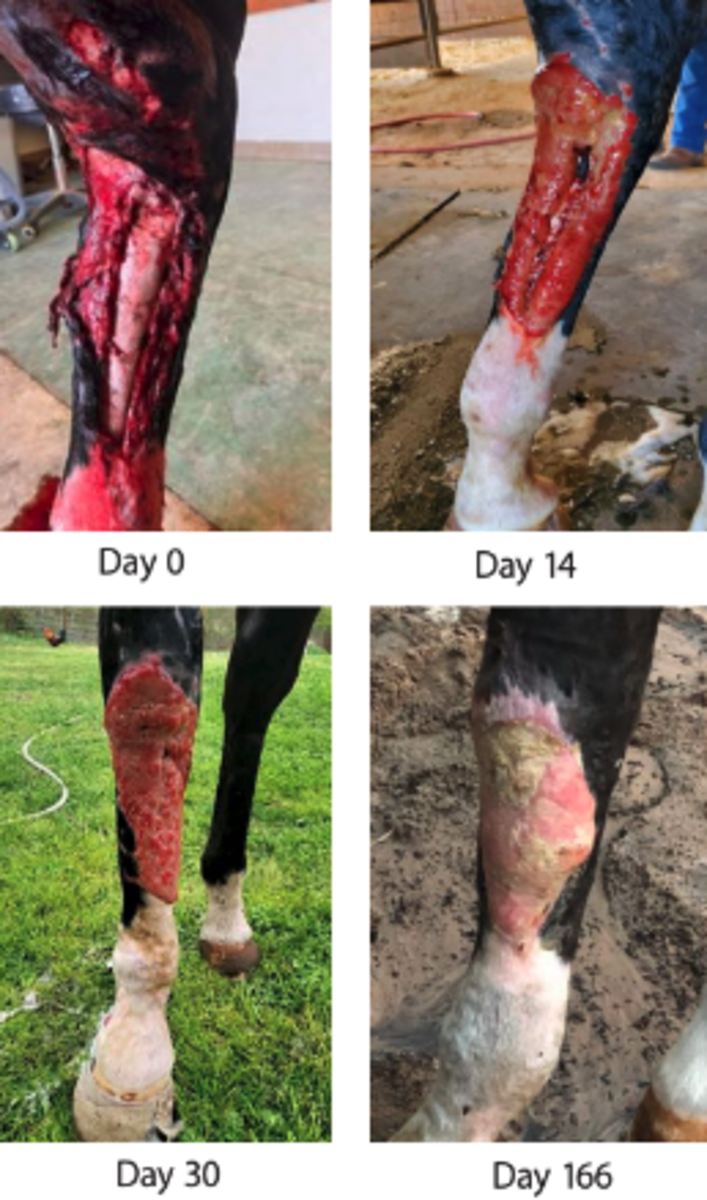
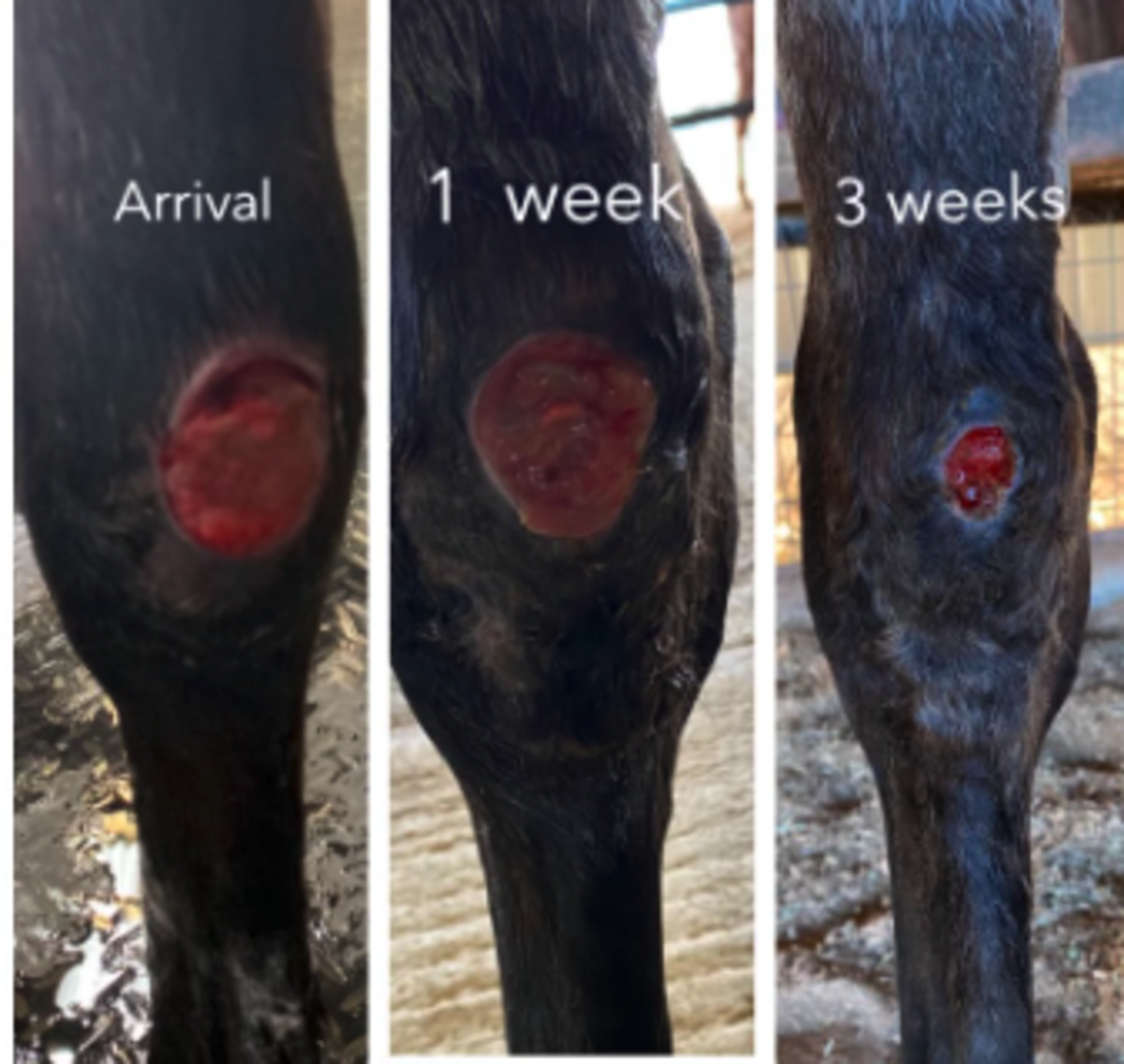
In addition to Regenaflex-RT, Regenaflex-M is Hilltop Bio's membrane product which is suitable for wounds that are difficult to suture or those that have been difficult to heal. Regenaflex-M sterile membranes have been shown to promote faster healing on severe wounds, reduce the development of scar tissue and inflammation, and provide antimicrobial and anti-adhesion properties for use in surgical applications.

Dr. Emily Hood treated a deep hindlimb avulsion with exposed cannon bone with two membranes one time. She has seen consistent healing with no complications on the wound.

Dr. Marty Tanner of Tanner Equine treated a wound that had previously not healed after several weeks of bandage changes and standard-of-care treatment. The wound was later treated with Regenaflex-M membrane and saw results in 3 weeks.

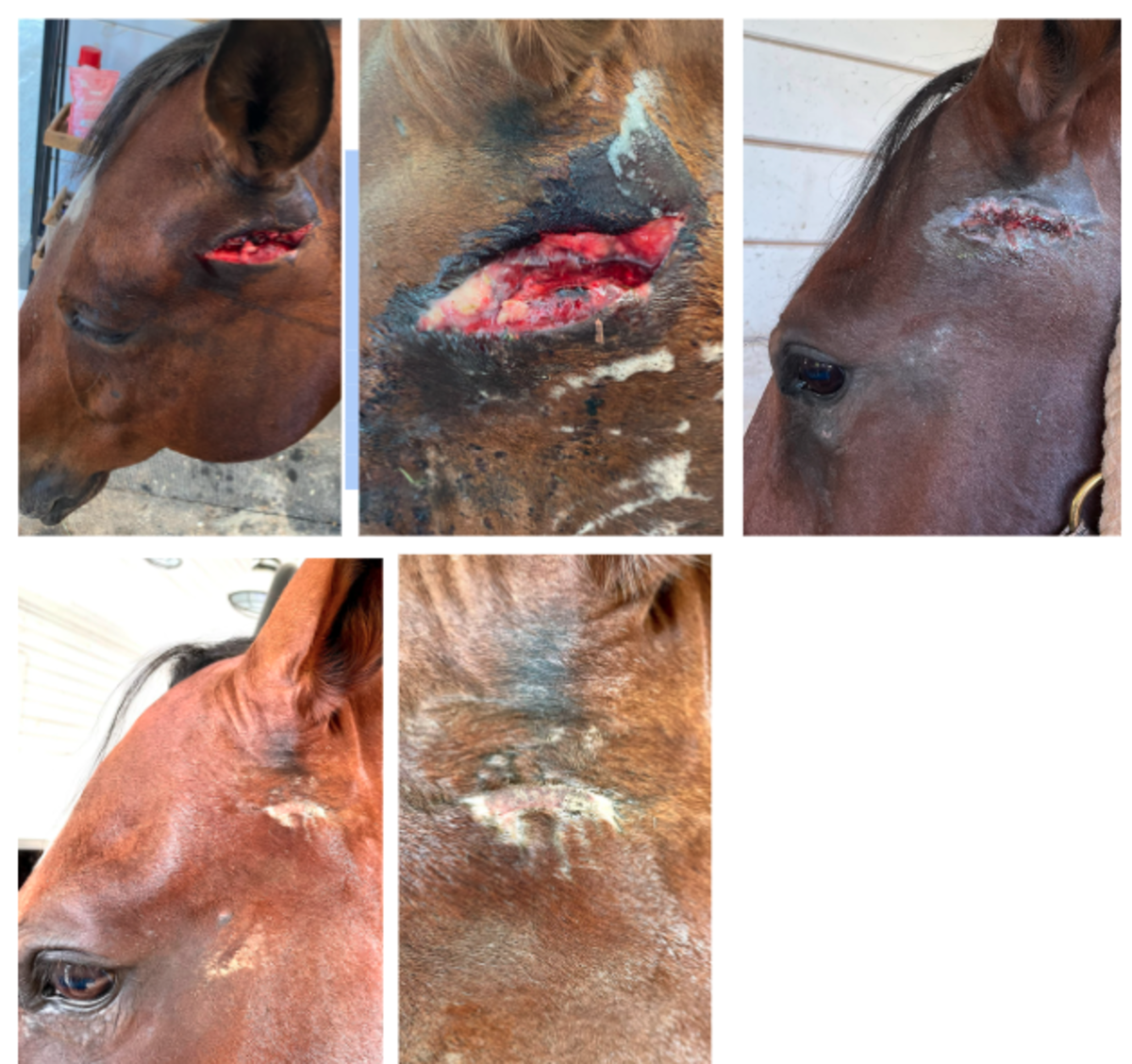
Regenaflex-M can also be used inside wounds that can be sutured closed. The following are a series of photos of a laceration below the ear where Reganaflex-M was tucked into the laceration and sutured over. The horse is healing well after about 6 weeks with hair starting to grow back.

For more case studies and vet testimonials, visit hilltopbio.com/case-studies/

Hilltop Bio is a veterinary biotech company developing innovative regenerative therapies focused on identifying key inflammatory diseases in horses and companion animals and providing targeted regenerative therapies to help reduce inflammation and normalize damaged tissue function. Hilltop Bio has developed a strong pipeline of innovative therapies across many therapeutic classes, alongside cGMP, cGTP manufacturing capabilities and a developing intellectual property portfolio. Hilltop Bio is dedicated to providing targeted therapies that help horses and companion animals regenerate damaged tissues, and that will assist in restoring them to their full athletic potential and long-term health. For more information, visit www.hilltopbio.com

The post Hilltop Bio Sees Continued Success With Regenaflex-RT And Regenaflex-M appeared first on Horse Racing News | Paulick Report.
Source of original post

‘They Spoil Him’: Former Elite Sprinter Caller One Thriving In Retirement At Age 26

Trainer James Chapman's family is perhaps best known for campaigning international Group 1 winner Caller One, a crack sprinter who is now 26 years old and enjoying pampering in retirement.

Following the victory of Drew's Gold in the Jimmy Winkfield on Saturday at Aqueduct, the trainer, who also co-owns the 3-year-old Violence colt, recalled the racing days of Caller One, who captured back-to-back editions of the Dubai Golden Shaeen (G1) in 2001 and 2002 at Nad al Sheba racecourse in Dubai.

The  Phone Trick gelding out of Baltic Sea, by Danzig, also landed the 2000 Lafayette (G3) at Keeneland and the Kentucky Cup Sprint (G2) at Turfway Park. He would finish fourth in that year's Grade 1 Breeders' Cup Sprint [won by Kona Gold], marking the quarter-mile in a blistering :20.82 and the half in 43.56 despite a troubled start.

Caller One also added the Los Angeles Handicap (G3) at Hollywood Park to his ledger in 2001, just two starts before finishing third to the victorious Squirtle Squirt in that year's Breeders' Cup Sprint at Belmont Park.

He completed his career at the age of 10 with a win in the 2007 Rocket Man, a two-furlong sprint in the slop at Calder Race Course. Overall, he retired with a record of 11-5-3 from 29 starts and $3,249,429 in purse earnings.

Chapman said Caller One is enjoying his retirement years in Florida.

“He's at my dad's place in Florida. He's a little long in the tooth, but they spoil him,” Chapman said. “He's lived a good life. He's out in the big field with a couple other horses and doing fine.”

Chapman said he has many fond memories of Caller One, including his tremendous Breeders' Cup efforts.

“In 2001, it was the year Tiznow won the Classic (G1) and the year that [trainer Bobby] Frankel won his first Breeders' Cup with Squirtle Squirt. I remember it like it was yesterday,” Chapman said. “The year before at Churchill, he stumbled leaving the gate and he took off and went :20 and change. He's such a nice horse.”

Chapman's father bought Caller One, who was bred in Kentucky by Orpendale and John R. Gaines Thoroughbreds, for $100,000 at the 1998 Keeneland September yearling sale.

The post ‘They Spoil Him’: Former Elite Sprinter Caller One Thriving In Retirement At Age 26 appeared first on Horse Racing News | Paulick Report.
Source of original post

Hay Now: Horse Owners Often Feed Too Little Concentrated Feeds

Horses that spend part of their day in stalls with hay and concentrated feed at the ready will have little change in their diet between seasons. However, horses that rely on quality pasture for most of their nutrient intake will face some nutritional challenges as they shift to a hay-based diet in winter months, specifically involving ingesting adequate omega-3 fatty acids, protein, and vitamin E. 

Quality pasture is often rich in vitamin E and omega fatty acids; however, once the grass is cut for hay, the omega fatty acids and vitamin E will be lost – neither are heat stable. Horses relying on a hay-based diet will be ingesting far less of these nutrients than they do while grazing lush pastures and additional supplementation is often necessary, reports The Horse

The key to ensuring a horse is receiving an adequate amount of vitamin E and omega 3 fatty acids is to feed him a ration balancer or commercial feed; feeding these at the proper amounts is key. Many horse owners feed far less feed than is recommended for the horse's weight or workload, leading to nutritional deficits. 

Additionally, many feeds use synthetic sources for their vitamin E, which is less bioavailable and therefore unlikely to meet the horse's nutritional needs. Vitamin E utilization varies between horses; the only true way to know if the horse has a vitamin E deficiency is to test his serum vitamin E levels. This will advise a horse owner or caretaker on whether the hay-based diet is adequately providing for his nutrient requirements. 

Horses that are fed hay year-round can be tested at any time, but it's advisable for competition horses to be tested as their show season gears up. A horse lacking in omega 3s may have a dull hair coat or flaky skin. A horse low in vitamin E may have a poor coat as well, but he may also recover from exertion slowly, have sore muscles or lack a topline. Additional omega 3 fatty acids can be offered by feeding ground stabilized flax or an oil like fish or flax oil. 

Read more at The Horse

The post Hay Now: Horse Owners Often Feed Too Little Concentrated Feeds appeared first on Horse Racing News | Paulick Report.
Source of original post

Verified by MonsterInsights
