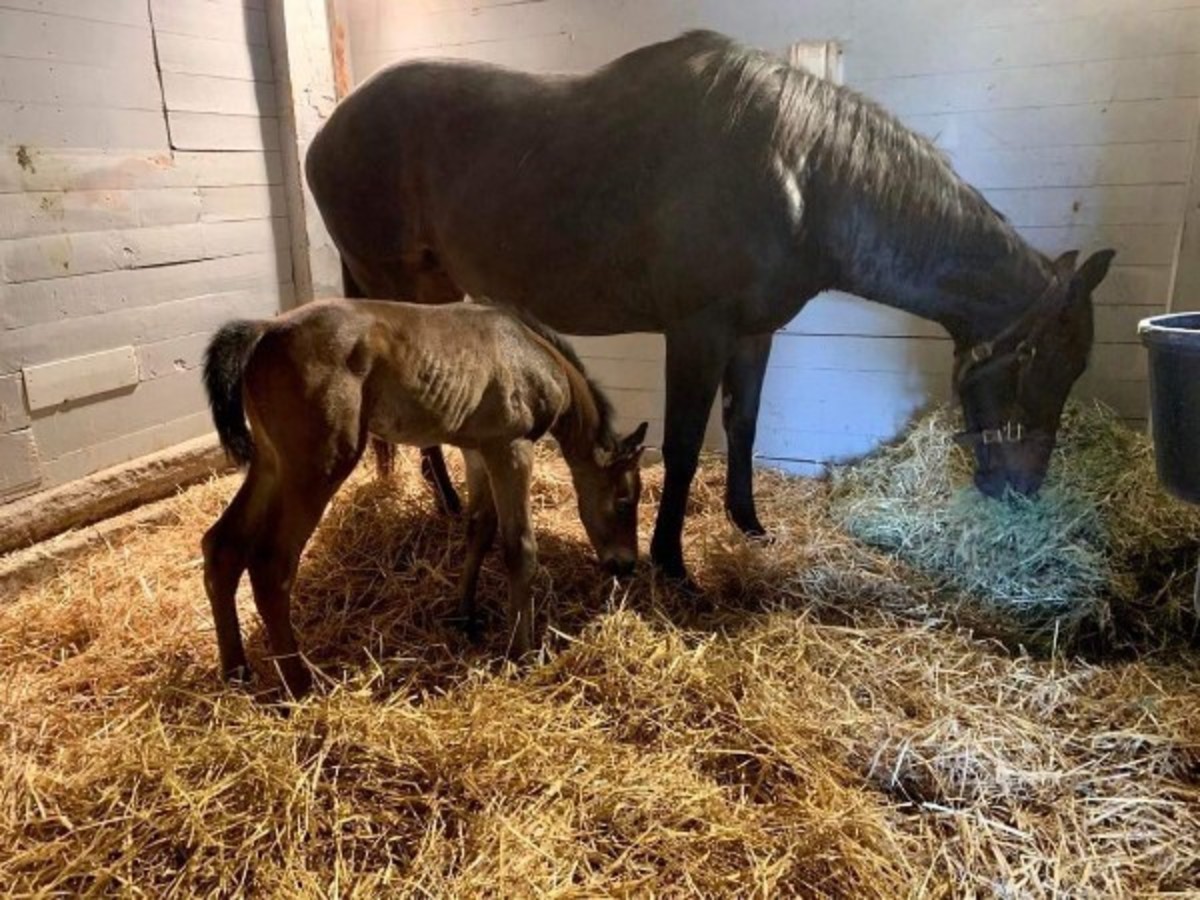
Afternoon Deelites, a six-time graded-stakes winner, was euthanized Feb. 14 at Old Friends, the Kentucky-based Thoroughbred retirement farm, due to complications from colic. He was 31.
Old Friends President and Founder, Michael Blowen, announced his passing. The dark bay stallion, who was the farm's oldest resident and was just two weeks shy of his 32nd birthday, was owned by award-winning composer, Burt Bacharach, who died just six days ago on Feb. 8.
Bred by Blue Seas Music Inc., the son of Private Terms-Intimate Girl, by Medaille d'Or, was foaled in West Virginia on Feb. 28, 1992. For his entire racing career he was owned by Bacharach, trained by Richard Mandella, and ridden by Kent Desormeaux. He ran nine of his 12 races at west coast tracks.
Afternoon Deelites opened his racing career in spectacular fashion, winning his first five races between 1994 and 1995; four of them stakes races.
He broke his maiden as a 2-year old in 1994, winning a maiden special weight race at Santa Anita on Oct. 23. Next time out, he won the Hollywood Prevue Breeders' Cup Stakes (G3) to earn his first graded-stakes win, followed by the Hollywood Futurity (G1) for his first grade 1 victory. In that race, he defeated future Kentucky Derby winner, Thunder Gulch.
In 1995, as a 3-year old, Afternoon Deelites continued his winning streak with victories in the San Vicente Breeders' Cup Stakes (G3), and the San Felipe Stakes (G2). His final win in 1995 was the Malibu Stakes (G1). Also, that year, he was second in the Santa Anita Derby (G1), and eighth in the Kentucky Derby (G1) behind Thunder Gulch.
As a 4-year old in 1996, Afternoon Deelites won one of his four races, the Commonwealth Breeders' Cup Stakes (G2) at Keeneland. In his next race, which would be his final career start, he finished second in the Metropolitan Handicap (G1) at Belmont Park on May 27.
Following that race, Afternoon Deelites was retired with seven wins, three seconds, and $1,061,193 in earnings in 12 career starts. It should be noted that in his career he ran in 11 graded-stakes races and won six.
Afternoon Deelites began his stud career in 1997 at Brereton Jones's Airdrie Stud in Midway, Ky., and stood there through 2003. He then moved to Clear Creek Stud, LLC, in Folsom, La., where he stood the rest of his career.
Afternoon Deelites' top progeny included graded-stakes winners Zappa, Three Hour Nap, and Miss Pickums. He also sired recently deceased Old Friends retiree, Popcorn Deelites, who starred in the 2003 movie, Seabiscuit, which was based on the best-selling book by Laura Hillenbrand.
Afternoon Deelites was pensioned in 2011, and was then sent to Old Friends courtesy of Val Murrell of Clear Creek Stud.
“Afternoon Deelites was a beautiful friend,” said Blowen. “I remember Kent Desormeaux standing in front of his stall a few years ago saying 'Michael, I won the Kentucky Derby on Real Quiet, Fusaichi Pegasus, and Big Brown, and this is the fastest horse I ever rode.' And he was one of the best retirees who ever called Old Friends home.
“Thanks to Burt, his ex-wife, Angie Dickinson, and his widow, Jane, for loving Afternoon Deelites as much as we did.”
The liver is one of a horse's largest organs, weighing approximately one percent of his body weight. It has myriad functions, including the excretion of bile, storage of vitamins and minerals, filtration of toxins, and it plays a key role in fat, protein and carbohydrate metabolism. The liver also contains immune cells, produces proteins for immune functions and prevents gut bacteria from reaching the bloodstream.
Though liver disease in horses is not diagnosed often, this doesn't mean that horses don't suffer from it. The cause of some cases is never known, but liver disease is most-often linked to the ingestion of toxic plants, bacterial infections and fatty liver. Two viruses have also been found to cause the disease.
Liver issues in small animals are much more common. There is often evidence that liver failure compromises the immune system and increases the risk of bacterial infections in organs.
In horses, multiple other conditions can compromise the immune system, including pituitary pars intermedia dysfunction (PPID). Hoof abscesses are particularly common in horses with PPID.
While liver failure might cause hoof abscesses or other infections, it's not likely. More common signs of liver disease are loss of appetite, weight loss, sunburning on white markings, and yellowing of the sclera.
If anything seems amiss, a full veterinary workup is recommended, including bloodwork and endocrine testing.
Sometimes, you find the horse. And sometimes, the horse finds you.
Lili Kobielski and Amanda Halley both know this truism of horse ownership all too well. Halley is reminded of it when she comes to work each day and a dark bay mare nickers at her from her stall at Benchmark Sport Horses in Delaware. Kobielski remembers when she sees a certain blood bay gelding in her field at The New Hill Farm in New York.
Kobielski hadn't exactly been looking for a horse when she was scrolling through her Facebook feed four or five years ago, but when a sale ad for a mare named Blushing Royale popped up, she paused. The daughter of Orientate had a fairly modest resume as a producer but did have a 4-year-old named Mocito Rojo who had just picked up a win in a black-type stakes at Evangeline Downs.
“I thought, why not?” remembered Kobielski. “I called the people who had her. She'd been pasture bred and had been left to foal out on her own. He didn't want to deal with her anymore because he wanted to spend more time coon hunting.”
Blushing Royale wasn't pregnant, so Kobielski shipped her from her point of origin in Arkansas to Kentucky and bred her to Classic Empire, then brought her on home to New York. In the meantime, Mocito Rojo found his stride for trainer Shane Wilson and owner Wayne Davis, racking up wins in the Delta Mile Stakes, Owner Appreciation Cup and scored placings in other black type races in Louisiana and Oklahoma. In spring 2019, Wilson stepped him up and he won the Grade 3 Steve Sexton Mile. As Kobielski was counting down the months to arrival of a Classic Empire baby from his mother, she cheered on Mocito Rojo as he entered the Lukas Classic – then a Grade 3 — and won, defeating Grade 1-placed Quip and Mexican fan favorite Kukulkan.
When it came time for Blushing Royale to foal though, it seemed like the fairy tale was over.
“Unfortunately, when she foaled, the baby was hip locked quite terribly,” recalled Kobielski. “We're lucky to have farmer neighbors. It was literally the farmer neighbors, my dad and my husband (who are not horse people), the night watch, me, my manager's daughter and her boyfriend … I think we had eight people trying to get this baby out. We did. It was traumatic and awful and the baby was born dead.
“My husband decided he was going to will him to live. He sat on him and rubbed him and gave him oxygen and rubbed his ribs. He brought him back to life. The foal sat up and started breathing.”
Although both mother and baby seemed outwardly fine, Kobielski sent them to Rood and Riddle Equine Hospital in nearby Saratoga Springs for monitoring.
“They were great for two days,” she said. “And then the mare dropped dead. She'd hemorrhaged, which was horrible, because we thought we were good. There was nothing they could have done; it happened in like 15 minutes.”
Now, Kobielski was left with a foal and no mare. Luckily, the Rood and Riddle staff were aware of a mare at Hidden Lake Farm who had recently lost her foal. The mare was named Mme Belle Brezing, presumably after a nationally-famous Kentucky madam of the same name. The mare and foal were introduced, and the bond was instant.
Mme Belle Brezing with Treetop. Photo courtesy Lili Kobielski
“She loved the baby,” recalled Kobielski. “We literally did nothing. She ran into the stall like, Oh thank god you found my kid.”
Belle raised the little colt as if he were her own. Kobielski's son named the colt Treetop “so he could be high in the sky close to his mom.” When the time came, Treetop was weaned and Belle went back home. SJB Stables bought Treetop as a yearling for $45,000 out of the 2021 Fasig-Tipton October sale, unaware they'd just purchased the equine Lazarus.
Meanwhile, Kobielski found herself scrolling social media late one night again and came across a photo of another mare. She did a double take. This one was in a bail pen in Texas, and was being advertised as a last-chance sale before her owner claimed she would be shipped to Mexico for slaughter.
As Kobielski looked closer at her identification, she saw a name she recognized.
“It was a daughter of Mme Belle Brezing,” she said. “Of course.”
Lucky Belle on her arrival to Benchmark from a bail pen. Photo courtesy Lili Kobielski
Although she'd never owned Mme Belle Brezing and had no contact with this mare, whose name was Lucky Belle, Kobielski felt compelled to help her. Lucky Belle had left the track after being pulled up and vanned off at Fonner Park in her last start in March 2020, and three months later looked anything but lucky.
“As far as they could tell, she was sound,” said Kobielski. “She had literally lost all of her hair. I don't know if it was a fungus or what, but she was a naked mole rat. She was 300 pounds underweight. It was a train wreck.”
Kobielski paid the fee, had the mare quarantined, and sent her to longtime friend Jessica Redman, who runs Benchmark Sport Horses, a well-known training and sales barn for off-track Thoroughbreds. When Lucky Belle arrived in a van to the operation's Delaware base in July 2020, Benchmark farm manager Amanda Halley took one look in the stall and texted Redman.
“I just about cried,” Halley said. “I remember texting Jessica and saying 'What did you just buy? This is the ugliest horse I've ever seen in this barn.'
“She was just so skinny. Her skin was so dry. Her feet were super, super tiny. She was the grumpiest thing in the stall. I thought, Oh, this poor horse.”
Halley hadn't exactly been looking for a horse, either. After a lifetime doing everything from pole bending to hunters to eventing to jumpers, Halley was feeling burned out on the horse show world – and maybe on horses in general. The job with Redman had been a way for her to remain in a barn while deciding whether she had lost her passion for horses. When Lucky Belle showed up, Halley had just lost her own horse a few weeks earlier and while she'd had a few favorites among the sale horse roster, she didn't consider herself “in the market” for another.
Support our journalism
If you appreciate our work, you can support us by subscribing to our Patreon stream. Learn more.
Halley and Redman made a plan on how they would rehabilitate the angry, thin mare. She'd require additional feed and skin treatments. And then, a few days after her arrival, Redman texted Halley a picture of a swelling she discovered inside the mare's front legs. The swelling, which was accompanied by a fever, abscessed and ruptured, leaving a six-to-eight-inch wound under her chest. They could only guess she'd been injured at some point in the difficult-to-see area, possibly in the bail pen, and it had gotten infected. Now, she'd need numerous injectable medications and routine cleaning and flushing of her wounds.
“I ended up spending a lot of time with her,” said Halley. “I won't ever forget, Jessica had to do her medications on a weekend and said 'It took three of us, and we can't get this horse medicated.' I said I'd be out in about an hour, and I walked into her stall and gave it to her.
“I think she knew I was trying to help her, and she just wasn't going to trust anybody else.”
Under their management, Lucky Belle began to thrive. Halley started with ground work as they waited for the mare to add weight and heal. Two months into her time at Benchmark, Halley swung aboard for her first ride.
“I realized this horse was super athletic,” she said. “She wasn't fit, but she was really trying.
Lucky Belle on one of her first rides in Aug. 2020 (top) and in February 2022 (bottom). Photos courtesy Amanda Halley
“She made my heart smile. It made me cry, because I brought this horse along. I made this connection with her.”
As planned, Lucky Belle went up for sale through Benchmark once she was healthy and fit.
“We had several people come to look at her,” remembered Halley. “They wanted mares, they wanted fancy, they wanted this. Then they would see her and say, 'Oh she's not that fancy. We don't like her.' I kind of took offense to it, even though the first rule of horse sales is you can't take anything personally. So I did what Jessica calls 'spite-buying.' I walked in the barn one day and said, “Here's half of her price. I'll have the rest in a couple of months.'”
Halley continued Lucky Belle's training, adding fitness and experience. They have no ambitions to enter the show world, but Halley said the brave mare has given her the confidence she'd been lacking over bigger fences.
Lucky Belle after her new lease on life
“She can go from jumping three-six fences to giving my 3-year-old son a ride around the yard,” said Halley. “This horse has so much heart. I watched her race videos and you could see there was passion in what she wanted to do. She tried her heart out for somebody. I thought, that's what I want. Even if you're not the fanciest, not the most talented, I want you to try for me. I want a horse that's going to give everything they have. When I rode her [the first time], with everything she'd gone through … she still trusted me to get on her and do everything I asked her to do.”
Halley said the mare is still a one-person horse. She's no longer as defensive with new people, and now reserves pinned ears and grumpy faces for everyone but Halley – except now it's all bark and no bite. The one exception is Halley's son, who can summon her with a whistle and rely on her to stand like a statue as he sorts out her halter and lead rope.
“I say all the time, she lets me ride her, but that is his horse,” Halley said.
Kobielski was thrilled to hear that Lucky Belle had found her person without even having to leave Benchmark. Halley is thrilled, in hindsight, that none of the buyers who came to see her saw what Halley saw in the mare.
“She went from this skinny, what I thought would be a hard-keeper Thoroughbred to going on alfalfa and a balancer and she looks like a Warmblood,” said Halley. “In looking at her now, she was in the condition she was in because people were not feeding her. People were writing her off because of how she looked, but she didn't ask to be in the condition she was in.”
Before long, Redman and Halley will assist in finding a new home for another foal loved by Mme Belle Brezing. After entering training and missing some time due to tendon strains, Kobielski was pleased to hear from Treetop's connections that they were ready to retire him. He never made it to the track, but after his most recent setback, his owners didn't want to push him. She brought him back to his home in New York, where he is recuperating before he goes to Benchmark in search of his next chapter.
Treetop, all grown up. Photo courtesy of Lili Kobielski
It's almost certain Treetop will meet Lucky Belle whenever he heads to Delaware. Now, when people come horse shopping at Benchmark, they ask about Lucky Belle and Halley is proud to tell them she's not for sale.
“When I see her head over the door, she nickers, she looks happy to see me,” Halley said. “She just makes my heart smile, and that's all I need. I say all the time that even if something happened and I couldn't ride her anymore, she'd never go anywhere. She'll be with me forever.”
Belle Gambe, a 2-year-old half-sister to Breeders' Cup champion Uni, has been released after being stuck in a United States Department of Agriculture quarantine stall for nearly a month due to what owner Peter Brant calls a “faulty” test, reports the Thoroughbred Daily News.
The daughter of Dubawi was tested before leaving Ireland for the U.S. on Jan. 13, returning a negative result. Upon her arrival at the Kentucky Import Center, however, Belle Gambe tested positive for the venereal disease Dourine, so the USDA placed the filly in quarantine at Churchill Downs.
The Center for Food Security and Public Health describes Dourine as “a serious, often chronic, venereal disease of horses and other equids. This protozoal infection can result in neurological signs and emaciation, and the case fatality rate is high.” The disease is communicated almost exclusively during breeding; Brant believes the test result to be a false positive, since Belle Gambe is a 2-year-old who has never been used for breeding.
A second test was performed on Belle Gambe 14 days later; she tested positive again, though at a smaller concentration. The filly tested negative on Feb. 13. If she had remained positive, Brant would either have had to return her to Ireland or elect for euthanasia.
Now released from quarantine, Belle Game will be allowed to join trainer Chad Brown's string at Payson Park in Florida.
“I am very excited that she has been released and that she is on her way to Florida now and is getting ready to start her career, which I hope is successful,” Brant told TDN on Monday. “You can't cry over spilled milk. I just think this is an example of how there are problems with these false positives and the horses shouldn't have to suffer as a result of a lack of science.”