Osteoarthritis (OA) can cause chronic pain in horses, but it can be difficult for equine owners and managers to recognize and manage. Though it's often stereotyped as an older-horse disease, OA can affect younger horses, as well. OA often limits the athletic pursuits in which horses can engage.
Dr. Diane Howard, of the University of Edinburgh, has interviewed a plethora of horse owners whose horses experience chronic OA pain and developed a 15-question survey that she hopes will help horse owners identify and monitor OA pain in their horses.
Additional participants are needed to determine whether the questionnaire is helpful. Preliminary results are promising: responders can complete the survey in less than five minutes, and have found the questions to be straightforward and helpful.
The researchers hope that early OA detection, ongoing monitoring, and informed decision making will significantly impact animal welfare. The research is funded by Morris Animal Foundation.
Want to take part in the study or have additional questions? Email Diane Howard at dianehoward@gmail.com
There are many ways to present horse racing during a broadcast of the Sport of Kings. There's the sport, the gambling, the stories about the people involved, the history, and more.
When I appeared on the international broadcast of last Saturday's Obaiya Arabian Classic at the Saudi Cup that was carried by Fox Sports in the United States, I was prepared to talk about all of these things. However, Nick Luck and Michelle Yu, two of my favorite and most well-versed racing broadcasters, asked me something that isn't often discussed on horse racing television but should be: about the breed itself.
Admittedly, the fact that there was an Arabian race broadcast on sports television networks throughout the world was a special occasion, but the same conversation could be had about the Thoroughbred or Quarter Horse breeds. That could lead to more of an understanding about horses in general that could help with racing's messaging about how the sport plays a positive role in the lives of horses, both on and off the track.
Here's how the conversation went, and if you are inclined to watch the whole clip in the tweet embedded here, I hope you'll appreciate how seamless the conversation went from racing as a sport to horses as the special animals that make racing one of the most intriguing sports in the world.
I enjoyed this moment on the broadcast of @thesaudicup where @TheMichelleYu, @nickluck, and I not only talked about what a great race the Obaiya was about to be but also about what makes the Arabian breed and what makes racehorses special. I'm writing about it for @paulickreport. pic.twitter.com/nj30YXLzUF
“You know all about the Thoroughbreds, but you've got a real passion for the Purebred Arabians. Just tell me why,” Nick said.
I proceeded to answer about the long careers of these horses, how they race all over the world, and the rivalries that they develop. Then, I decided to go slightly off track, which was probably slightly off script.
“Recently, I started riding myself, and I have an Arabian that I event on,” I said. “So, you put it in front of an Arabian—we just mentioned about distances and surfaces, but any type of sport as well—and the Arabian, with the mind that they have, will likely excel at it.”
That could have, maybe even should have, been the end of the conversation. After all, the horses were walking behind our set in the parade ring.
However, Michelle asked a follow-up question, “What additional passion did you find for the Arabian once you started to ride an Arabian?”
“Just how keen they were,” I responded, and I proceeded to talk about our family's Arabian, AA Two Face, that we evented and raced simultaneously last year.
It was a brief cool moment to share about the versatility of racehorses without it seeming forced.
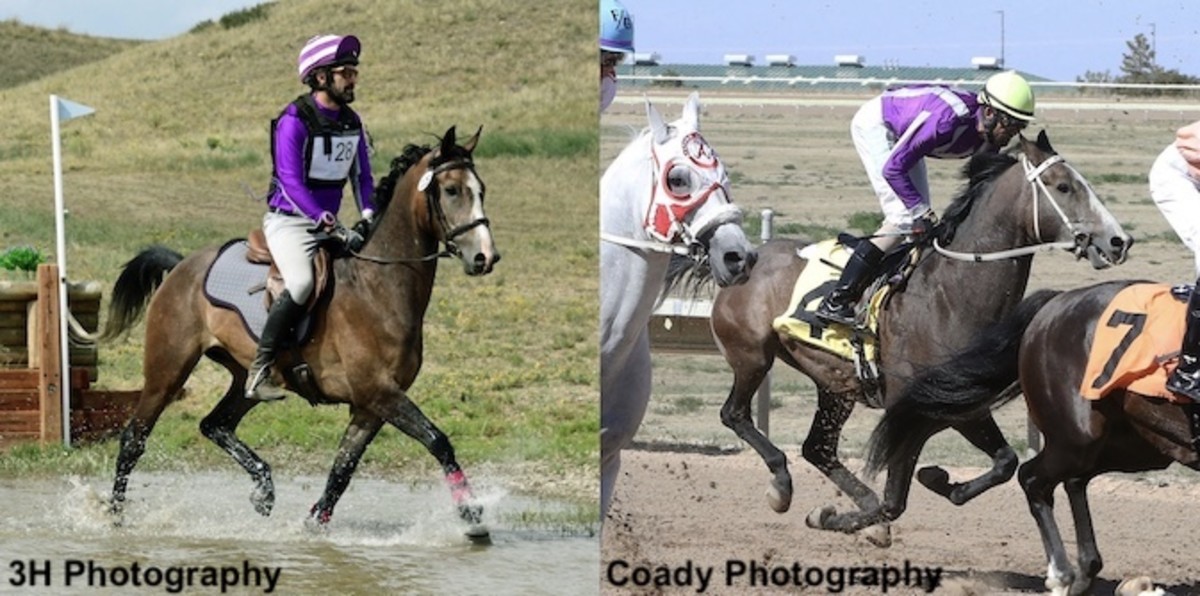
AA Two Face competes in the USEA's Area IX Eventing Championships (left) one month before racing in the Emirates Breeders VIP Stakes at Bally's Arapahoe Park. And, yes, the author is wearing the horse's racing silks for eventing.
Then, it was time to get back to the horses in the race, with my segue being, “But he was nowhere near racing the caliber of these horses.”
Nick, being the professional he is, chimed in, “So the truth of it is, they can do anything, but today, Jonathan, we've got to find the one that can do anything the fastest.”
We switched to talking about the race, and racing would be the focus for the remainder of the broadcast, as it should be.
That racing broadcasts are willing to take a moment to celebrate racehorses as athletes beyond just racing can play a role in assisting with racing's image and social license to operate.
NBC Sports did something similar with Whitmore during its coverage of the 2022 Breeders' Cup Sprint, a race Whitmore had won two years earlier. They showed footage of the celebrity chestnut gelding winning at Keeneland and then competing down the road in Lexington at the Kentucky Horse Park in Competitive Trail at the Retired Racehorse Project Thoroughbred Makeover. Donna Brothers rode Whitmore for her coverage of the Sprint.
“He's really become a little bit of a mascot for the Thoroughbred racehorses that have moved into other sort of disciplines,” Brothers said in an exchange with NBC Sports' Ahmed Fareed. “I don't know what you think, Ahmed, but he's doing great out here.”
It turns out Donna, while aboard Whitmore, interviewed Irad Ortiz Jr., who rode Elite Power to victory in the Breeders' Cup Sprint two years after riding Whitmore to win the same race at the same track. Elite Power would then go on to win the Riyadh Dirt Sprint in his next race at the Saudi Cup, where retired racehorses also got their moment in the spotlight thanks to the approach Nick and Michelle took to their race coverage. I hope that continues during coverage of this year's Triple Crown races and more because it's a positive narrative for horse racing.
Announcing horse races inspired Jonathan Horowitz to become an advocate for off-track Thoroughbreds, as well as to learn to event on OTTBs and to expand his announcing of and writing about equine sports to horse shows around the United States. He also works for the United States Eventing Association and runs the Super G Sporthorses eventing barn with his wife, Ashley. He can be reached on Facebook and Twitter at @jjhorowitz.
The Arizona Department of Gaming confirmed last week that pre-race veterinary inspections are still not taking place consistently at Turf Paradise in Phoenix as the state remains unable to hire adequate staff.
On Jan. 28, the 5-year-old gelding Class Proof struggled in the fifth race at Turf Paradise, a $4,500 claiming contest. According to the chart, Class Proof, trained by Jorge Rosales for Remmah Racing, dueled early for the lead against Flyinunderthegraydar and traveled three wide before he “went wrong” nearing the half-mile pole and was pulled up by rider Israel Hernandez. In the process of pulling up, Class Proof's heels were clipped by rival Riviera Champ, who unseated his rider, Rigo Sarmiento and later walked off.
Class Proof was vanned off. He was determined to have suffered a catastrophic injury and was euthanized. According to the race's chart, Class Proof was claimed out of that race by Juan Pablo Silva for Tijuana Racing Stables. The chart does not indicate the claim was voided.
Although the Horseracing Integrity and Safety Authority dictates a claim may be voided on a horse who is found to be lame following a race, Arizona rules dictate that if the horse leaves the gate it is considered a starter and there is no option to void the claim on a horse who is considered a starter.
According to the state, pre-race veterinary exams did not take place on horses running on Jan. 28 or on Jan. 26 due to “emergency staffing issues,” meaning that Class Proof went to the post on Jan. 28 without a regulatory veterinarian attesting to his soundness on the morning of the race.
In the initial days after Class Proof's breakdown, sources voiced confusion to this publication about the horse's regulatory status. In his prior start at Golden Gate Fields on Nov. 19 when trained by Jack Steiner, Class Proof was running for a $5,000 tag and was claimed but had the claim voided by the state veterinarian due to unsoundness and was placed on the California Horse Racing Board's vet list. Sharp observers of Turf Paradise racing pointed out that at the time of his death in January, Class Proof still appeared on an online page showing the California vet list, which should have prevented his entry at Turf Paradise.
In fact, California officials say, Class Proof did indeed fulfill the requirements to be removed from the California list prior to running in Arizona. In December, Class Proof was in Arizona with Rosales and was examined by veterinarians there on Dec. 15, when he performed an official workout under observation. Officials in Arizona pulled a blood sample from the horse after the workout, which came back clear on Dec. 27. California Horse Racing Board equine medical director Dr. Jeff Blea said the horse was set to automatically be removed from the list on Jan. 3 since Arizona officials had fulfilled California's vet list removal requirements.
“There was a clerical error,” said CHRB spokesman Mike Marten. “The horse was removed from the vet's list on January 3 but somehow, inaccurately was placed back onto the list. We are working on improving the process.”
Arizona has struggled in recent seasons with getting enough personnel on its pre-race inspections team. While the state has sometimes been able to contract an additional veterinarian to help out, the entirety of pre-race inspections at Turf Paradise often fall to Dr. Sue Gale, chief veterinarian for the Arizona Department of Gaming. Last season, Gale told commissioners she had a system for identifying horses at elevated risk of injury but the process of combing through each race card to flag at-risk horses takes about four hours and she usually couldn't complete it. In December, Rudy Casillas, executive director of the Arizona commission, reported that although the state had been advertising an open position for an additional veterinarian for some time, it had no applicants.
Also in January, sources told the Paulick Report that Arizona officials had found illegal electrical devices (commonly called buzzers, batteries, or machines) at the racetrack. A spokesman for the state confirmed the discovery of two buzzers in the Turf Paradise paddock and said the matter remains under investigation by Gaming Department staff.
A horse that is actively colicking can be distressing to see.
It's imperative that veterinarians, horse owners, and other management personnel be prepared to make decisions quickly if a horse is colicking – with the understanding that the plan may change and what risks come along with those decisions. Dr. David Freeman, Appleton Chair of Equine Surgery at the University of Florida's College of Veterinary Medicine, discussed a paper he co-authored on the subject at the 2022 American Association of Equine Practitioners convention.
According to The Horse, Freeman found that operating on horses before sections of their intestine become so damaged as to require removal is key to the possibility of a positive outcome. Taking the “wait and see” approach – and hoping that the colic resolves with medication before exploring surgical options – makes a successful surgery even less likely.
Horses that undergo surgery eight to ten hours after the colic begins often have more complex surgeries that cost more and have a higher risk of complications. Additionally, equine survival rates are reduced, both over the short and long term.
Freeman noted that quickly addressing strangulating lesions, where a section of intestine loses blood supply, is imperative to their resolution: these types of colic will never resolve with on-farm, medical treatment only. These colic cases represent at least 60 percent of colic in horses over 20 years old. There are additional types of lesions that worsen with time, even if on-farm medical care gives the impression that the horse is improving.
Freeman also said that if a field vet suspects a strangulating intestinal obstruction, he or she needs to refer the horse to a surgical facility rather than waste time with diagnostic procedures and time-consuming treatments like running fluids. Many of the tests that are run at the farm are repeated when the horse is referred to the hospital, adding to the expense.
Freeman concluded by noting that horses that are colicking – especially older horses that may have strangulating lipomas – should be referred to a surgical clinic early on in the colic episode. Doing so is likely to increase survival rates with fewer complications and therefore less cost when compared to a delayed presentation at a clinic.
Freeman said that there are three reasons why owners may refuse surgery:
The horse will not be the same after surgery
Old horses don't do well with anesthesia and colic surgery
Lack of owner funds
He noted that the first two reasons have proven to be myths. The last reason is a valid one, but if the owners change their mind hours after the colic begins, the outcome can still be dire as surgical treatment was delayed.
Communication between owners and veterinarians can prevent delays in colic care and minimize cost if the horse is referred to a surgical facility before complications arise. Early referral is also closely associated with positive surgical outcomes.