The Pandemic And Horses In Need – What Are The Facts?

You may have seen the comments on Facebook: “Shelters are full from pandemic adoptions being returned now that everyone's gone back to work!”

Or maybe you saw someone who needed help but were told not to call their local shelter because “they're all full.”

So what's the truth?

Well … it's complicated.

But—and you may be surprised to hear this–it's mostly good news. At least for equid sector of shelter operations.

Let's start with the pandemic fact: During the pandemic the demand for horses (and other animals) skyrocketed. While prices in the private sector shot up, and supply shrank as equids of all types were purchased. Adoptions at animals shelters also went through the roof. In fact, many cleared their paddocks…at least temporarily.

The Equine Welfare Data Collective (EWDC) Fourth Report, which details intakes and outcomes among welfare organizations across the country, tracked changes in intakes and adoptions from January 2018-December 2020.

Shelter intakes and overall surrenders of equines went down sharply from January 2019 to June 2020. Like way down. Good, right? Well, this is where things get complicated and why we may feel like surrenders are now increasing drastically, as well.

Because in all honesty, they are.

But that's not necessarily a bad thing.

During the pandemic many shelters had to close their doors to owners seeking help. Local ordinances forced shelters to limit operations to strictly animal care. In areas without restrictions, shelters needed to protect their staff and limit contact with the general public. That meant shelters were not able to coordinate nearly as many intakes of equines in need.

So what happened to all of those equines and owners that needed help during the pandemic? They had to wait. Now shelters have opened their doors again and those owners are reaching out for help in what looks like a crisis level surge. While this new surge of desperate owners might seem like it can overwhelm the welfare community, in reality it hasn't yet met pre-pandemic levels.

Are you following along?

Overall intakes and adoptions both dropped, though adoptions far outpaced intakes, resulting in what felt like a mad rush to bring home a new horse. This was both good and bad. Intakes and outcomes have not yet rebounded back to pre-pandemic levels, as of the most recent data from 2021. The EWDC Fifth Report that details information for all of 2021 continues to demonstrate that welfare organizations are working hard to accommodate owners in need. The data from 2022 is currently being analyzed as you read this and will be published at the end of the year. However, it is likely to continue to tell the same story.

Let's look at some numbers, thanks to data collected by the EWDC and the United Horse Coalition (UHC):

  • There are over 900 equine welfare organizations operating in the United States.
  • Those 900 equine welfare organizations have a daily capacity of about 47,000 equines.
  • These have historically operated on any given day at about 85% capacity.
  • Which means there is room for roughly 10,000 equines in need.

When the pandemic first began there was fear within the equine industry and welfare community of a repeat of 2008.

What happened then?

There were anecdotes of horses starving in paddocks, being set free on the side of the road and owners in financial crisis. All of these were calling on overflowing rescues for help, only to be turned away. The conversations surrounding the pandemic were focused on avoiding a repeat. I think the industry as a whole managed to do it. And that should be celebrated.

The financial crisis of 2008 inspired the growth of assistance services within the equine industry and welfare community. These services include hay banks, husbandry support, veterinary support, euthanasia and disposal support, mini grant programs and more. All of this with the goal to help owners in need keep their horse when appropriate.

Flash-forward to 2020, and COVID support was found everywhere, including the horse industry. The UHC's own COVID-19 support page saw over 15,000 hits in nine months. Owners across the country felt the need to be proactive and planned for the worst, while hoping for the best.

We can't yet anticipate the future, and things like rising hay costs, diesel prices, and continuing inflation have the industry once more on alert. Rising intakes may not mean there are more horses in need. Instead, it may be that we're getting better at intervention before things get bleak. We can identify and network with horses and owners in need and offer a hand before it becomes a critical neglect case or worse.

There will always be horse owners in need and the equine welfare community is doing an extraordinary job to support them. It's important to continue to discuss equine welfare with facts and not rely on anecdotes. While anecdotes may be true, heard in isolation they propagate a half-formed narrative. They're not the whole story. We can't effectively develop programming with anecdotal evidence. It's important to zoom out and view things on a bigger — more national — level.

Furthermore, having the capacity to help means nothing if we're not willing to network and support each other.

So, how can we all improve horse welfare?

We, as an industry, need to increase owner support. If you're a business or industry association, this could be done directly through funding assistance programs, or indirectly via educating customers and association members on where they can find help. We also need to do better with elevating our fellow equine welfare communities at the national level. Owners can't reach out for help if they don't know where to ask, and welfare organizations can't supply help if they aren't able to access owners.

Supporting good welfare means meeting horses in need at the source – their owners in need.

If you know an owner in need, please direct them to the UHC Equine Resource Database. This is a free to use, searchable directory of all the known equine welfare and assistance programs available in the United States. The database can be found at www.unitedcoalition.org The UHC is always happy to partner in education and outreach initiatives to help owners understand options if they ever find themselves in need.

Lastly, this article was only made possible by the data supplied by the Equine Welfare Data Collective. The EWDC is a first-of-its-kind comprehensive industry driven data collection, analysis and reporting initiative. Formed in 2018, the EWDC collects, analyzes, and reports data on equines in need, organizations supporting them, and owners seeking help. The EWDC is a grant-funded program that relies on industry support to operate. To learn how you can support the EWDC, reach out to the United Horse Coalition at UHC@horsecouncil.org You can view all of the EWDC reports for free at www.unitedhorsecoalition.org/ewdc-reports

Emily Stearns is the Health, Welfare, and Regulatory Affairs Liaison for the American Horse Council.

The post The Pandemic And Horses In Need – What Are The Facts? appeared first on Horse Racing News | Paulick Report.
Source of original post

Australia: Group 1 Winner The Quarterback Finds Forever Home With Former Jockey Matthew ‘Max’ Allen

In 2016, The Quarterback made dreams come true for connections when he won the Lexus Newmarket Handicap at Melbourne's Flemington Racecourse, especially his trainer Robbie Griffiths, for whom it provided his first Group 1 win. These days the champion is enjoying retirement in the care of his ex-jockey, Matthew 'Max' Allen.

The 2016 Newmarket feels like yesterday for Robbie Griffiths.

“To win any Group 1 was remarkable, but to win your first Group 1 at Flemington in the best sprint race in Australia, the Newmarket Handicap, that's just a dream,” Griffiths said.

A horse with a great affiliation with the Flemington straight, having had three wins there already including the Listed Kensington Stakes, connections were confident in The Quarterback's ability. Vital to the result was input from part owner and Griffiths' close friend, the late Deane Lester. Lester's pre-race analysis and speed map helped form a plan for The Quarterback to follow Chautauqua, a known backmarker.

“It was a pretty brave plan to try and come off the back of a champion, but that was our strategy, and with the light weight we thought we would stalk him, and it all came to fruition,” said Griffiths.

Piloting the horse to victory that day was Craig Newitt, his third Newmarket win after victories on Miss Andretti and Shamexpress. The Quarterback's more regular rider at the time, Max Allen, couldn't ride at the 52kg allocated to the horse but was “there in spirit,” according to Griffiths.

“Max was a big part of his story. He rode him in a lot of his wins, from his maiden victory right through a lot of his victories throughout his career.”

Allen has become an even more integral part of The Quarterback's life, and took him into his care once the horse retired. Happily living at Allen's home, The Quarterback is “spoilt rotten” by Allen, his partner Rachel ,and son Max Jr., with visits to the beach and freedom to run around the paddock in the company of his paddock mate.

“I don't think people outside of racing understand the bond that everyone has with racehorses in general, because we all started ungodly hours of the morning and you don't do it for the money, you do it for the passion, and it's the passion and the love you have with the horses that you work with,” Griffiths said.

Horses that retire from racing but go on to have successful careers in other areas is always thrilling for Griffiths, his team and the owners.

“We have a lot of our horses that compete well in Garryowens and Barastoc newcomers and show jumping and so on, or are just happy in retirement like The Quarterback.”

While the Newmarket brings back special memories each year for Griffiths and connections, it will be especially emotional in 2023 as the first one without Deane Lester, who was such an essential part of The Quarterback's success.

The post Australia: Group 1 Winner The Quarterback Finds Forever Home With Former Jockey Matthew ‘Max’ Allen appeared first on Horse Racing News | Paulick Report.

Source of original post

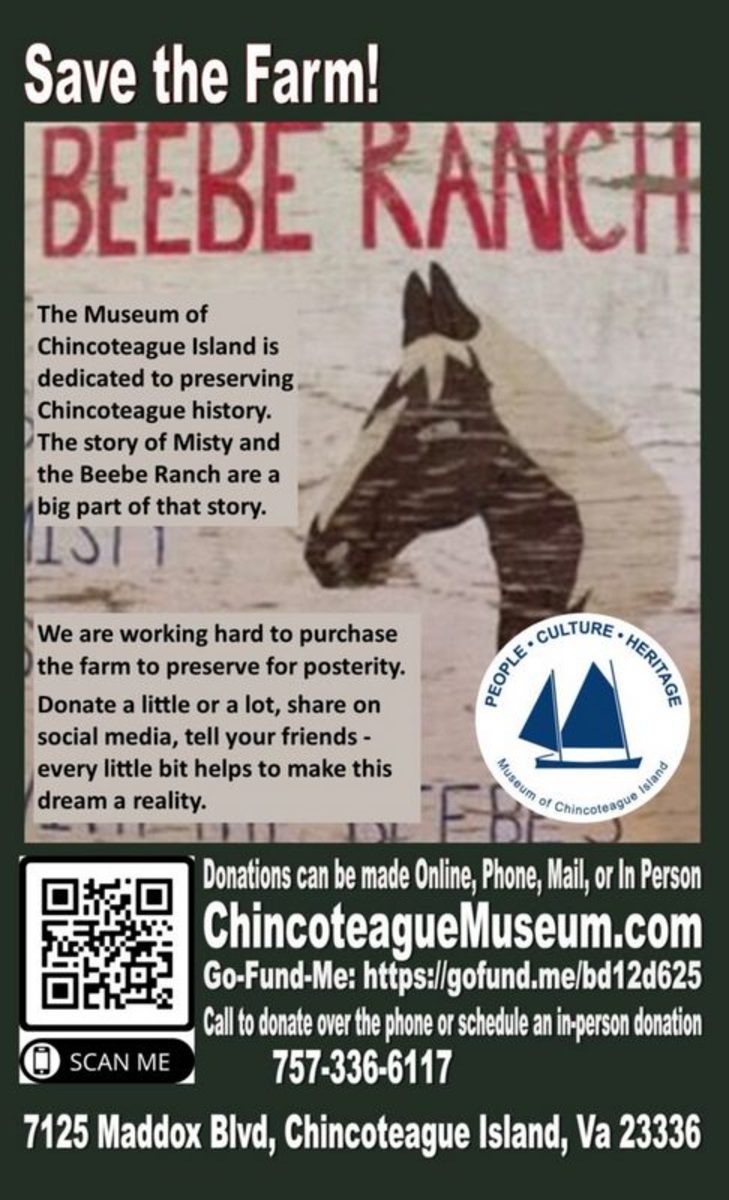
Museum Of Chincoteague Island Calls For Donations To Save Historic Beebe Ranch

Virginia's Chincoteague Island is fortunate to have visitors come from around the world to enjoy the untampered seashore, amazing wildlife, and the quaint historical downtown. Many of those visitors also come because of Misty of Chincoteague, a book published in 1947 by Marguerite Henry that inspired millions.

Misty of Chincoteague tells the against-the-odds story of two siblings Paul and Maureen Beebe. These two children lived on the ranch with their grandparents, Clarence and Ida Beebe (affectionately called Grandma and Grandpa Beebe in the story). The charming story centers on the children's desire to buy the wild pony of their dreams and the challenges they faced to make that dream a reality. It is a heartwarming tale that made the Beebe family, Misty, and the Beebe Ranch a beloved part of the literary world.

Now, after 100 years, the Beebe family need to sell the ranch. The demands of maintaining the ranch plus the desire to use the funds to help their aging family is certainly a good enough reason to sell. The Museum of Chincoteague Island appreciates all they have done to preserve the remaining 10.3 acres of the ranch. This property is where Misty spent most of her life, and the original home still stands. The Beebe family has reached out to the Museum in the hopes that the museum could acquire the property and maintain it as the ranch. Allowing it to be incorporated into the museum would help protect it for many years to come. Because of the circumstances, the museum has been given one month to see if they can generate the funds to purchase the property.

The mission of the Museum of Chincoteague Island is to preserve, collect, and protect the history of Chincoteague and Assateague Island. It is with this mission in mind that we would like to ask the public to join us to save the Beebe Ranch. If we can raise the funds in what can only be called a colossal, grassroots effort, we can preserve the ranch for future generations, keep a treasured part of Chincoteague intact, and support the mission of the museum to protect our history, making the Beebe Ranch an officially an extension of the museum. Since we have been given one month to generate the funds, please understand that this can not be done without you!

We are asking you to consider making a tax-deductible donation to the Museum of Chincoteague Island. Our goal is $625,000. The family has already been given an offer by a developer for that amount. If we are not successful in raising our goal, the donor will be able to decide if they would like their donation returned.

Whether you are able to donate a little or a larger sum, share on social media, or tell a friend, every action can help make this dream a reality. Donations can be made through the Museum of Chincoteague Island website, GoFundMe, or by mailing a check to PO Box 352 Chincoteague Island, VA, 23336.

For further information, please feel free to call the museum directly at 757-336-6117.

About Museum of Chincoteague Island

The mission of the Museum of Chincoteague is to collect and preserve the material culture that reflects the historical progression of the life on Chincoteague and Assateague Islands. We display and interpret those objects to enhance the understanding of various experiences and events from the Town's past by preserving objects of significance, along with proper documenting of their history and acquisition, for the use of future generations in understanding the history of Chincoteague and Assateague Islands.

The post Museum Of Chincoteague Island Calls For Donations To Save Historic Beebe Ranch appeared first on Horse Racing News | Paulick Report.

Source of original post

‘The Best Equine Athlete Out There’: Former Racehorses Soaring To New Heights

It was only fitting that on this day Jim Phillips was spending his morning marveling at the exploits of a former racehorse excelling in a much different arena.

On a hot, partly cloudy morning in Ocala, Florida, the man who has had a longstanding association with Thoroughbreds watched intently as Wabbit, known as Molinaro Kissing during his racing days, was taking part in an equestrian event.

“They really are incredible athletes,” praised Phillips, a retired animal health business executive and equestrian, who is still highly involved in the latter as an owner. “They do well in the equestrian disciplines. They have good minds and learn quickly. They are, in my mind, the best equine athlete out there.”

Phillips would certainly know.

Thoroughbreds have been a part of his life for decades, including the times he worked at one of the sport's most iconic operations.

“As a teenager, I worked at Windfields Farm, so I've been very familiar with Thoroughbreds. For the most part, we've had horses forever. Ninety percent of them have been Thoroughbreds. They are great athletes, have a lot of heart and in my opinion are undervalued in the equestrian world. They used to be the staple and when warmbloods came into popularity, their presence in the Jumping and Eventing world diminished. They're sound, they're athletic and they also have a better self-preservation mechanism, in my opinion, so they generally land on their feet.”

His bond with horses – Phillips has also dabbled in Thoroughbred and Standardbred ownership – has continued to grow over time.

Through his friendship with Dr. Mike Colterjohn, one that began during their collegiate days, Phillips became familiar with LongRun Thoroughbred Retirement Society, not only with their dedication to find suitable adopters for the ex-racehorses, but also with the back stories of the horses.

The more he learned, the more Phillips felt compelled to become involved with the organization that was established in 1999, the first industry-funded adoption program in Canada, and one of the most respected horse retirement and adoption organizations in the world.

Six years ago, he found an ideal way to achieve that intention. ​ ​

A $325,000 sales-topping full brother to multiple stakes winner and champion Pender Harbour, Mike, a son of Philanthropist, won his first time out, but eventually his true calling came in three-day eventing.

Mike was named after Dr. Mike Colterjohn, one of his breeders (Dr. Moira Gunn, Marv Chantler and Hugh Sutherland were the others) and a Canadian Horse Racing Hall of Fame inductee. Dr. Colterjohn, who delivered Gardiner Farms with its only Sovereign Award for Outstanding Breeder, passed away on March 28, 2012, exactly one year after Mike was born at Paradox Farm, in Caledon East, ON.

In the latter stages of 2017, Mike, who contested the 157th running of the Queen's Plate (it switches back to the King's Plate this year), was retired and given the chance to try his hooves in the eventing world under the watchful eye of Phillips, his new owner.

It was around that time when Phillips contacted LongRun with an offer.

“The owners of Mike gave him to me, so I wanted to give something back. I spoke with Vicki [Pappas] at LongRun and told her about an idea I had for a fundraiser, where I would match the donations up to $15,000. So, it was promoted through her network, hoping to raise funds and awareness for off-track Thoroughbreds. That's how it all started. She was very enthusiastic and quite helpful at getting the message out. It went very well, and I think everyone was happy with how it all went.”

The campaign, known as “I Like Mike,” was a meaningful endeavor for Phillips, who made the pledge to match all donations up to $15,000.

In all, $60,000 was raised for LongRun.

“We are blessed and grateful to have been introduced to Jim, who not only generously hosted our most successful fundraiser ever but, along with his wife Colleen, continues to support us and takes every opportunity to tout the superiority of the Thoroughbred,” said Pappas, a founding member and Chair with LongRun.

“In my opinion, LongRun has all the components you need to help the ex-racehorses,” added Phillips. “They have the facility, the core capabilities of knowing what works and what doesn't, and how to find the right homes for these horses. They have the expertise and infrastructure to get them to the right places. They have a funding base that is sustainable and affiliations with the right organizations to help these horses. They tick all the boxes. That's what drew me to them.”

Mike, who posted one win and two thirds from eight career starts, was a fast learner in Eventing and prompted Phillips to enter the gelding into the 2018 Thoroughbred Makeover Competition, for retired Thoroughbreds in training for less than 10 months, held at Kentucky Horse Park.

Throughout the summer of 2018, Mike and Phillips took part in shows in Ontario, finishing 18th of 100 entrants in Eventing and sixth as top amateur.

Last year, Mike won an Open Intermediate Event in Ocala and competed successfully at the Three-Star level with two-time Olympian and Canadian Team eventer Jessica Phoenix, who nominated him for this year's Pan American Games.

Molinaro Kissing, a son of Line of Departure, has also fared well in equestrian.

Winless in five starts – his top finish was a fifth – the Ontario-bred has formed a formidable duo with Phoenix.

After top-10 finishes in Four-star competitions in 2022, the pair tackled the Five-Star course at the Maryland Five-Star at Fairhill in October where they had a double-clear cross-country and finished 19th.

“He's been nominated to the National Three-Day Eventing squad,” noted Phillips. “He's the only Five-Star horse, the highest in Eventing, that's nominated for Canada at this time. He's been a great ex-racehorse for sure. He has everything you need to be a top-level event horse. It's very rewarding in so many ways. We've been to a lot of places with both him and Mike.”

Phillips, who along with his wife Dr. Colleen Mitchell, resides on a farm in Mono, Ontario, is hopeful there are still more adventures to come.

“I've always been a big fan of Thoroughbreds and had good luck with them. It always puts a smile on your face when you see them thriving after their racing career. Whenever I see Mike or Wabbit out there, it makes me proud. It also reminds me of how amazing they are as athletes. There is something special about that breed.”

Wabbit competing on Cross Country at the 2022 Maryland Five-Star Event

The post ‘The Best Equine Athlete Out There’: Former Racehorses Soaring To New Heights appeared first on Horse Racing News | Paulick Report.

Source of original post

Verified by MonsterInsights