Background Check: Acorn

In this continuing series, we examine the past winners of significant filly/mare races by the lasting influence they've had on the breed. Up today is Belmont Park's GI Acorn S., the first leg in New York's prestigious summer trio of Grade I events for 3-year-old fillies.

Long a coveted prize, the Acorn has been designated a Grade I from the very beginning when the grading system became official in 1973. A disproportionate amount of its winners are in the Hall of Fame, ranging from Top Flight to Twilight Tear to Cicada to Ruffian, and so many more. The quality of the Acorn winners set the tone for their broodmare careers as well. Not surprisingly, the Acorn boasts a ridiculous number of high-class future broodmares among its winners, including a glorious five-year streak in the 1950s that saw five consecutive winners eventually cultivate champions among their descendants.

Following are highlights of some of the most important Acorn winners by what impact they've had on the sport through their sons and daughters.

Finder's Fee (1997, Storm Cat–Fantastic Find, by Mr. Prospector), bred by Phipps Stable: Granddam of 2022 Horse of the Year and current first-season sire Flightline (Tapit), whose fee of $200,000 at Lane's End is one of the highest introductory fees in history.

Prospectors Delite (1989, Mr. Prospector–Up the Flagpole, by Hoist the Flag), bred by W. S. Farish: The 2003 Broodmare of the Year produced Horse of the Year Mineshaft (A.P. Indy), MGISW Tomisue's Delight (A.P. Indy), and three other graded performers. She is also the granddam of GISW Mr. Sidney (Storm Cat).

Meadow Star (1988, Meadowlake–Inreality Star, by In Reality), bred by Jaime S. Carrion: This memorable ginger was granddam to the dams of champion and gone-too-soon sire Arrogate (Unbridled's Song) and MGISW Belle Gallantey (After Market).

Stella Madrid (1987, Alydar–My Juliet, by Gallant Romeo), bred by Calumet Farm: Japanese champions Lucky Lilac (Jpn) (Orfevre {Jpn}), Mikki Isle (Jpn) (Deep Impact {Jpn}), and Diamond Biko (Jpn) (Sunday Silence), as well as additional Japanese G1SW Aerolithe (Jpn) (Kurofune) and U.S. GISW Lilacs and Lace (Flower Alley) all trace to this classy bay.

Chris Evert (1971, by Swoon's Son–Miss Carmie, by T. V. Lark), bred by Echo Valley Horse Farm: From five daughters, U.S. champion Chief's Crown (Danzig); French champion Special Duty (GB) (Hennessy); GISWs Classic Crown (Mr. Prospector), Sightseek (Distant View), Tates Creek (Rahy), Etoile Montante (Miswaki), Obligatory (Curlin), and Dominican (El Corredor); and many more very useful graded winners hail from this lovely chestnut.

Marking Time (1963, To Market–Allemande, by Counterpoint), bred by Ogden Phipps and Wheatley Stable: Her champion daughter Relaxing (Buckpasser) turned into a Broodmare of the Year responsible for champion Easy Goer (Alydar), as well as additional GISWs Easy Now (Danzig) and Cadillacing (Alydar). Others tracing to her include GISW Strolling Along (Danzig) and several other high-class winners.

Gun Runner is one of several top horses descending from 1945 Acorn winner Gallorette | Sarah Andrew

Quill (1956, Princequillo {GB}–Quick Touch, by Count Fleet), bred by R. N. Webster: Champions Run the Gantlet (Tom Rolfe) and Awesome Feather (Awesome of Course), Japanese champion Maruzensky (Jpn) (Nijinsky II), and GISWs Dance of Life (Nijinsky II), Sumptious (Summing), Caucasus (Nijinsky II), and Vettori (Ire) (Machiavellian) are among those who trace to this grand gal.

Bayou (1954, Hill Prince–Bourtai, by Stimulus), bred by Claiborne Farm: A number of high-class horses descend from this mare, including champions Slew o' Gold (Seattle Slew) and War Pass (Cherokee Run); GI Belmont S. winner Coastal (Majestic Prince); and GISWs Aptitude (A.P. Indy), Sleep Easy (Seattle Slew), Oath (Known Fact), Slew's Exceller (Exceller), River Flyer (Riverman), and Victory Ride (Seeking the Gold).

Princess Turia (1953, Heliopolis {GB}–Blue Delight, by Blue Larkspur), bred by Calumet Farm: Her son Forward Pass (On-and-On) was just 1 1/4 lengths shy of winning the Triple Crown, but took the 1968 sophomore colt championship.

High Voltage (1952, Ambiorix {Fr}–Bynamo, by Menow), bred by Wheatley Stable: This elegant gray's sons and grandsons included U.S. champion Impressive (Court Martial {GB}), MGISW Majestic Light (Majestic Prince), and SW Bold Commander (Bold Ruler), the last two both sires of note.

Happy Mood (1951, Mahmoud {Fr}–La Reigh, by Count Gallahad), bred by Mrs. John D. Hertz: Canadian Horses of the Year With Approval (Caro {Ire}) and Izvestia (Icecapade), Canadian champion Serenading (A.P. Indy), GI Belmont S. winner Touch Gold (Deputy Minister), GI Kentucky Oaks winner Buryyourbelief (Believe It), and other GISWs Haynesfield (Speightstown), Healthy Addiction (Boston Harbor), and Pretty Discreet (Private Account) all descend from this splendid chestnut.

Secret Meeting (1950, Alibhai {GB}–Burgoo Maid, by Burgoo King), bred by James C. Brady: Broodmare of the Year Anne Campbell (Never Bend); champions Sensational (Hoist the Flag) and Rushing Fall (More Than Ready); Epsom Oaks winner Long Look (Ribot {GB}); and GISWs Trumpet's Blare (Vice Regent), Dancealot (Round Table), Albert the Great (Go for Gin), Desert Wine (Damascus), and Menifee (Harlan) all trace to her.

Nothirdchance (1948, Blue Swords–Galla Colors, by Sir Galahad III {Fr}), bred by Bieber-Jacobs Stables: Dam of champion Hail to Reason (Turn-to {Ire}), who later turned leading sire, and ancestress of GISW and sire Meadowlake (Hold Your Peace).

Gallorette (1942, Challenger II {GB}–Gallette, by Sir Gallahad III {Fr}), bred by Preston M. Burch: Not only does stellar young sire and 2017 Horse of the Year Gun Runner (Candy Ride {Arg}) trace to her, but so do 2005 Horse of the Year Saint Liam (Saint Ballado), Irish champion Minstrella (The Minstrel), Canadian champion Charlie Barley (Affirmed), and GISWs Success Express (Hold Your Peace), Greenwood Lake (Meadowlake), Air Express (Ire) (Salse), Buster's Ready (More Than Ready), Rolling Fog (Posse), Whitmore's Conn (Kris S.), and Funtastic (More Than Ready).

Nellie L. (1940, Blenheim II {GB}–Nellie Flag, by American Flag), bred by Calumet Farm: Granddam of champion and Kentucky Derby/Belmont S. winner Bold Forbes (Irish Castle), this captivating bay has a number of other classy descendants, including GISWs Life At the Top (Seattle Slew), Lakeway (Seattle Slew), Saratoga Six (Alydar), and Jilbab (A.P. Indy), as well as English G1 winner Dunbeath (Grey Dawn II {Fr}).

Proud One (1938, Blenheim II {GB}–Some Pomp, by Pompey), unknown breeder: Her descendants have included 1965 Kentucky Derby winner Lucky Debonair (Vertex), as well as GISWs Lady Love (Dr. Fager) and Tantalizing (Tom Rolfe).

Baba Kenny (1928, Black Servant–Betty Beall, by North Star III {GB}), bred by Idle Hour Stock Farm: This very first winner of the Acorn set the tone with her descendants including daughter Bee Mac (War Admiral), who beat the boys in the Hopeful S.; 1988 Horse of the Year and nine-time GISW Alysheba (Alydar), the second of four consecutive GI Breeders' Cup Classic winners to bring a GI Kentucky Derby win to the year-end championship race; G1SW and good sire Lear Fan (Roberto); multiple back-type winner and good sire Better Self (Bimelech); and another Acorn winner in Riverina (Princequillo {GB}).

The post Background Check: Acorn appeared first on TDN | Thoroughbred Daily News | Horse Racing News, Results and Video | Thoroughbred Breeding and Auctions.

Source of original post

This Side Up: Plus Ca Change….

At a time when so many people seem to be allowing a duty of vigilance to crumble into morbid defeatism, it seems a little unfair that our sport should be going through such a hard time even as we approach the 50th anniversary of the most luminous tour de force in the story of the modern breed.

Of course, as some powerful evocations of the time have lately reminded us, Secretariat arrived as a sunbeam into a wider world darkened by Vietnam and civic unrest. And nor should we deceive ourselves that even our own, notoriously insular community was back then immune to some of the things that vex us in 2023.

For instance, without reprising what have doubtless become tiresomely familiar objections to tinkering with the Classic schedule, let's not forget that Secretariat faced down a Triple Crown drought stretching to Citation in 1948. Obviously a still longer wait followed Seattle Slew and Affirmed, but we've found two horses equal to the task in the last eight years. Even so, the trainers are somehow trying to bully us into reconciling the paradox that they want more time between the races and therefore (assuming this indeed renders those races more competitive) to extend the intervals between precisely those Triple Crown winners that supposedly represent our best route to wider engagement.

Well, the world moves on. And it's not as though the Thoroughbred has ever permitted hard and fast rules anyway.

On the one hand, it's pretty unarguable that the old school, by exposing their horses more, helped the public to develop a rooting interest. If Flightline (Tapit) was perhaps as talented as we've seen since Secretariat, in making just six starts he barely scratched the surfaced of national attention.
And I do like to think there were other, incidental gains in the aggressive campaigning of horses, whether in terms of educating the animal or showcasing the type of genes that breeders should wish to replicate. But if Mage (Good Magic) is only the latest proof that modern trainers can prepare a raw horse even for a challenge as notoriously exacting as the Kentucky Derby, then let's roll back to that summer of '73.

Okay, so Secretariat himself had made nine juvenile starts from July 4. But if you would presume experience to be an asset at Churchill on the first Saturday in May, then how much more crucial should it be for the template itself, the most venerable race of all: the Derby at Epsom, that crazy rollercoaster with its twisting hill? Yet half a century ago, in a field of 25, the race was won on only his second career start by Morston (GB).

He was bred for Classic stamina, at any rate: by St Leger winner Ragusa (Ire) out of an Oaks runner-up (herself by a St Leger runner-up) who had already produced the 1969 Derby winner Blakeney (GB). Ragusa, incidentally, was out of a mare imported from a very old American family that had earlier produced Hard Tack, the sire of Seabiscuit. The St Leger, remember, is run over 14 furlongs. As the Japanese have reminded us, the lifeblood of the Thoroughbred is not brute speed but class: the ability not just to go fast, but to keep going fast.

That is certainly the hallmark of Galileo (Ire), whose legacy saturates the 244th running of the Derby on Saturday. With 93 juveniles and just a dozen yearlings still to come, he is represented by a single son, Artistic Star (Ire), unbeaten for one of the outstanding trainers in Europe yet available at tempting odds. Of the remaining 13 starters, eight are by sons of Galileo (including two by principal heir Frankel {GB}); two are out of his daughters; and one is out of a mare by another of his sons. That leaves just two runners to have bobbed to the surface of a European bloodstock industry that squanders mares, by the thousand, on stallions that cannot remotely satisfy the definition of class given above.

But, yes, the world moves on. Sometimes it just moves on in the wrong direction. It's a pretty dismal reflection on where our sport stands today that its greatest race has been shoehorned into the middle of lunch to avoid the F.A. Cup Final. Because what American readers may not realize is that this particular soccer match, in its heyday, also once brought England to a standstill—but has in recent years, even as the game has boomed, also lost much of its popular traction. With many managers resting star players for this tournament, you might even say that the F.A. Cup has shared the same decline in popular culture as the Derby (for which Parliament itself used to take the day off).

Fixed television schedules are also a thing of the past, with the young especially expecting to do most of their viewing “on demand.” That puts live events at a premium. In Britain, however, broadcasting rights for the most prestigious sporting events—including both the F.A. Cup Final and the Derby—are ringfenced for free channels. (Which obviously invites the paradox that the most coveted events, with no competition from channels with subscription revenue, are least likely to achieve their true market value.) Unusually, the F.A. Cup Final is broadcast simultaneously by both the BBC and ITV. And since the latter also has the rights to the Derby, racing has been unceremoniously shown its place.

By an unmissable irony, the match that has elbowed the Derby aside is being contested by Manchester City and Manchester United. As such, it is what the soccer world knows as a “derby” match between local rivals. The origin of this usage is tenuous, but some have ascribed it to the Epsom race. Horseracing, after all, long precedes football (in all its variations) in popular culture.
Yet now we find the Jockey Club taking out injunctions in anticipation of animal rights protests, even for a race in such innocuous contrast to, for instance, the Grand National. And that is without the current traumas of Churchill Downs having remotely penetrated wider consciousness on that side of the pond.

But let's resist adding another “basso profundo” to the prevailing chorus of miserabilism. Let's hope for another infectiously exciting chapter in the Epsom epic: maybe a final Derby for Dettori, who has already won two of three British Classics on his farewell tour; or perhaps one more for another old master, Sir Michael Stoute.

His runner hadn't even seen a racetrack before Apr. 20. Put that in your pipe and smoke it, Mage! Passenger (Ulysses {Ire}) is actually out of a War Front mare. Fifty years on from Morston, then, perhaps Passenger would be an apt reminder that the more the world changes, the more it stays the same.

The post This Side Up: Plus Ca Change…. appeared first on TDN | Thoroughbred Daily News | Horse Racing News, Results and Video | Thoroughbred Breeding and Auctions.

Source of original post

Dreaming Of Julia Takes Home Broodmare Of The Year Honors

The Kentucky Thoroughbred Association (KTA) and the Kentucky Thoroughbred Owners and Breeders (KTOB) awards dinner Apr. 5 in Lexington named Dreaming of Julia (A.P. Indy), dam of Grade I winner Malathaat (Curlin) and Grade II winner Julia Shining (Curlin), the 2022 Broodmare of the Year.

Summer Wind Equine was awarded a bronze mare and foal as the breeder of Flightline (Tapit), who was crowned Champion Kentucky-Bred Horse of the Year and Champion Kentucky-Bred Older Dirt Male.

Godolphin received multiple bronzes as the recipient of the P.A.B. Widener Trophy, best known as the KTOB Breeder of the Year, as well as KTDF Owner & Breeder of the Year.

2022 KTOB Broodmare of the Year and her owner and 2022 Champion Kentucky-Breds and their breeders:
Broodmare of the Year: Dreaming of Julia (Owner: Stonestreet Thoroughbred Holdings LLC)
Horse of the Year, Older Dirt Male: Flightline (Summer Wind Equine)
Two-Year-Old Male: Forte (South Gate Farm)
Two-Year-Old Filly: Wonder Wheel (Three Chimneys Farm, LLC & Clearsky Farms)
Three-Year-Old Male: Epicenter (Westwind Farms)
Three-Year-Old Filly: Nest (Ashview Farm & Colts Neck Stables)
Older Dirt Female: Malathaat (Stonestreet Thoroughbred Holdings LLC)
Male Turf Horse: Casa Creed (Silver Springs Stud, LLC)
Female Turf Horse: War like Goddess (Calumet Farm)
Male Sprinter: Jackie's Warrior (J & J Stables)
Female Sprinter: Goodnight Olive (Stonestreet Thoroughbred Holdings LLC)
Racing Abroad: Country Grammer (Scott Pierce & Debbie Pierce)
Steeplechase Horse: Snap Decision (Phipps Stable)

Four merit awards will be presented to individuals for their contributions to the Kentucky Thoroughbred Industry.

2022 Merit awards will be presented at the KTOB Awards Dinner Presented by Anthem:
P.A.B. Widener Trophy for KTOB Breeder of the Year: Godolphin
Hardboot Breeders' Award pays tribute to distinctive but unsung breeders that help make up the backbone of our industry: John Williams
Charles W. Engelhard Award acknowledges a member of the media for outstanding coverage of the Thoroughbred Industry: Steve Byk
William T. Young Humanitarian Award distinguishes a person or organization in the thoroughbred industry “who recognizes and promotes the human endeavor: H. Greg Goodman

Also to receive awards are the top Kentucky Thoroughbred Development Fund (KTDF) money earners in 2022 in five separate categories.

2022 Kentucky Thoroughbred Development Fund (KTDF) Leaders:
KTDF Sire of the Year: into Mischief (Spendthrift Farm)
KTDF Earner of the Year: Kitodan (Foster Family Racing, Douglas E. Miller & William J. Wargel)
KTDF Owner of the Year: Godolphin
KTDF Trainer of the Year: Brad Cox
KTDF Breeder of the Year: Godolphin

Recipients of the 2022 KTOB Kentucky-Bred Champion awards were voted on by the full membership of KTA/KTOB while the KTDF category leaders were tabulated using purse money won at Kentucky racetracks in 2022. KTOB merit award recipients were voted on by the KTA/KTOB Board of Directors.

The post Dreaming Of Julia Takes Home Broodmare Of The Year Honors appeared first on TDN | Thoroughbred Daily News | Horse Racing News, Results and Video | Thoroughbred Breeding and Auctions.

Source of original post

Sadler Staying On Flight Path

As noted by colleague Bill Finley earlier in the week, we've just passed the 50th anniversary of Secretariat's sophomore debut. Yet even two years ago hardly anyone had heard of an unraced son of Tapit, meanwhile acclaimed by many as the best American Thoroughbred since.

Okay, so he had been a seven-figure yearling; and everyone who had participated in his education knew that he was something special. In fact, John Sadler was so aware of the impending responsibility that he was saying nothing. For one thing, if people had any inkling of the talent he was about to detonate, the races wouldn't have filled. But also because this, like all secrets, was a burden as well as a privilege.

Looking back, Sadler accepts that doing justice to Flightline felt like so intense a duty that it could not come without some personal cost.

“I kind of devoted my time to him to a point where I probably shut some people out,” he admits. “The odd dinner at night, that kind of thing. I really drilled down, I said to myself, 'I'm going to walk this walk with this horse.' I wanted to be right alongside him, every step, because I knew it was going to be so special. So here I am today, light mood, happy as heck, because I always said my time to celebrate would be when it was over. Very early on, I said to myself: 'I'd like to pitch a perfect game.' That's a career goal. And we did.”

But so much of life is about the pursuit, rather than the actual moment of fulfilment. Sadler, tall and bronzed, looks in great shape at 66. But now that he has consummated a generational dream, can he still maintain the same motivation?

“We've been pondering that a lot,” he acknowledges. “But like B. Wayne Hughes of Spendthrift Farm used to say, 'My health insurance is that group of yearlings over there.'”

So, while he knows that he can hardly expect another Flightline, Sadler also feels that the true horseman's appetite, happily enough, can never be finally sated.

“I'm pretty confident I'll have a lot of good horses come my way, because I still want to do it,” he says. “If there's a time to not do it, I'll know when that is. Somebody said I'd retire right after Flightline. But rushing into a decision like that, with horses, is always rash. Time will see where we're at. I've got some really good young people in my operation. They've invigorated me the last several years and really make me excited about the future. My assistant Juan Leyva is just going to be a phenom, and I've a couple of other guys like that. So I'm really not feeling a lot of pressure.”

And, actually, that's just why it's appropriate to catch up with Sadler now, when the dust has settled and Flightline is embarking on a new career at Lane's End. Because the horse himself was such a meteor, burning with almost agonizing brightness as it became clear how fleeting his passage was likely to be, that he almost became a communal possession. As such, we rather lost sight of his more intimate context: of the decades of groundwork that prepared Sadler for the task that would define his career.

That long accretion of experience didn't just make him eligible, but also duly appreciative. Yes, he could feel vindicated–not least after the notorious torments he endured, for much of his career, at the Breeders' Cup–but the true gratification was personal, not public. Because for the great horsemen, it's about the process, the daily and seasonal cycles of engagement. If that ultimately produces a champion, then it all makes sense. And, that being so, then of course you continue with the immersion.

“Totally, a lifestyle,” he replies, when asked how he views his vocation now. “It's the journey that I've always loved: horses coming in, and seeing where they go. You don't want to be like a claiming trainer, slashing around here and there, but to develop horses. I think that's where my strong suit is. And for this to hit at this time, in the latter part of my career, is so special. When I started out, I wanted to be known as a good professional. I know I achieved that. But then to get these great horses is gravy on my career.”

Because don't forget that Sadler started out right at the other end of the scale. With no background in the game, he learned under tough, old-school horsemen, and laid the foundations of his own career with tough, fast Cal-breds.

“I've had to battle stereotypes my whole career,” he muses. “When you're a young trainer, you get locally-bred horses and those happen to be sprinters. And we did well with them. So, as I started getting better horses over the years, and won important races over a distance of ground, that's fun. But every year they'd write how Sadler can't win at the Breeders' Cup. And you'd be beaten a head. Or find yourself running against Miesque. I think I did that three years, and I ran against Goldikova a couple of times, too. And when you do that, it doesn't matter if you have the best turf horse in California.”

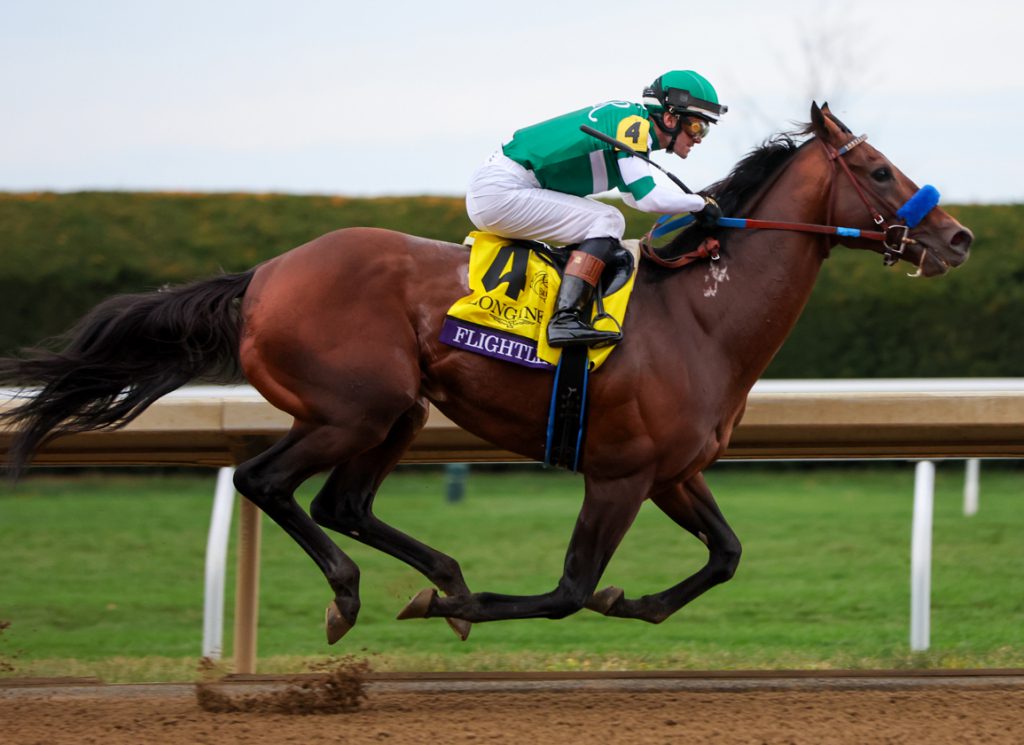
Flightline | Breeders' Cup Eclipse Sportswire

But if Sadler had a long wait for the best materials, in one respect he could not have been more blessed.

“Oh, absolutely!” he exclaims. “I came under a brilliant class of horsemen. They may not have all been perfect human beings. In that era, they might have smoked or drank too much. But they were self-made guys and really knew what they were doing.”

He absorbed priceless insights assisting racetrack vet Dr. Jack Robbins, observing the day-to-day methods of clients like Ron McAnally and Gary Jones.

“It was great practice,” he says. “I loved that we were going in all these different barns: you could take something from every one of them and then build your own program. And Dr. Robbins himself was so smart. A tremendous veterinarian, obviously, but also a successful horse owner, one of the charter members of the Oak Tree Racing Association. Tough guy, opinionated guy, smoker, drinker, but just a great man.”

Robbins could see that his protégé was unusually attentive. Sadler might say, “Oh, Doctor, I went over to such-and-such a barn and suggested a vitamin shot for that horse.” And Robbins would reply, “Oh John, no, that was a terrible idea!” And then he'd wink.

Sadler also learned a great deal as assistant to Dave Hofmans, though his big break came in 1979 when Eddie Gregson had taken on a big client and was looking for someone, he could trust to take four or five to Golden Gate Fields. There were things going on–a pari-mutuel strike, people shipping out–and Sadler quickly learned not to turn down horses. By the end of spring, he was up to 30 or 40.

Gregson's heartbreaking end, by his own hand, still grieves all who knew him. “He was really a bright guy, very sensitive, he knew food and wine and was very cultured,” Sadler recalls. “It caught everybody off guard, nobody saw that coming. But you never know what goes on with people. A great guy and a great trainer also.”

Besides these mentors, Sadler cherishes no less affection for the horses who also assisted his education. He'll never forget the $100,000 match, at Santa Anita in 1991, where his Cal-bred speedball Valiant Pete (The Irish Lord) beat Quarter Horse champion Griswold in a world record dash. And then there was the $50,000 claim Olympic Prospect (Northern Jove).

“He didn't run very well the day we claimed him,” Sadler recalls. “But he became really an important horse for me, early on. You couldn't train him very hard, but he ended up winning every sprint stake in the state. One day Patrick Valenzuela got on him, I can't remember what happened to the usual jock, in a race called the Potrero Grande [now the GIII Kona Gold S.]. He just let him roll, and they went that first half-mile in 42-and-change. And won! I mean, he was tiring at the end. But I've never seen that, before or since.”

With that kind of background, it meant a great deal to Sadler gradually to disclose a mastery with two-turn horses. Whatever pinnacle it might also represent in the story of the breed, let's not forget that Flightline last summer–by a bewildering 19¼ lengths–was his barn's fourth different GI Pacific Classic winner in five years, all owned (part-owned, in this case) by Sadler's cherished patrons at Hronis Racing.

That streak was started by the slow-burning Accelerate (Lookin At Lucky), whose campaign at five would have made him a lock for Horse of the Year but for landing in the same ballot as an unbeaten Triple Crown winner. He remains Sadler's richest runner at $6.7 million. “I just love him to death,” Sadler says. “His foals are going to be like him, they'll be later types, but I've two or three [of his first crop] that I really like and I'm expecting a lot of them to come forward as the year goes on.”

But Flightline was a freak from the outset. “He never hid his talent,” Sadler says. “April Mayberry called me from the farm and said, 'John, this horse gives me goosebumps.' She's been doing it a long time, and the only other to give her that feeling had been Zenyatta. So, we were expecting a lot when he came in. And even after the first, short piece of work, we were all just going, 'Wow.'
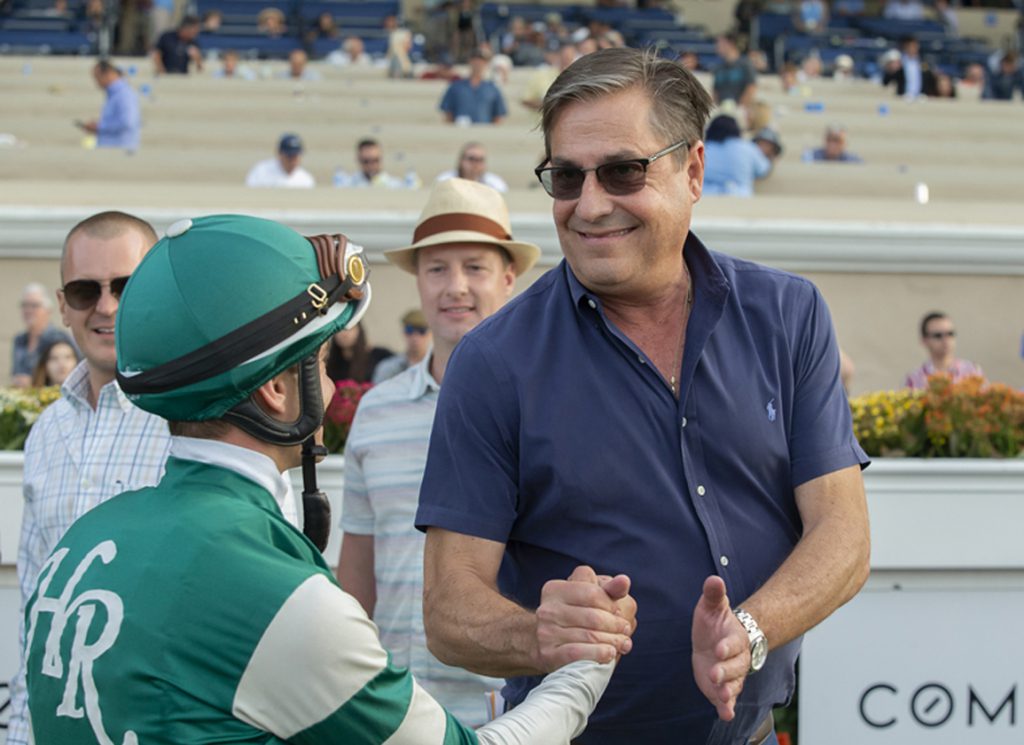
John Sadler with Flavien Prat | Benoit

“I mean, usually, I have to train them up. This horse, it was just a straight line. He's already there. He was so willing, from day one he just wanted to do it. Most of the early training was about getting him to relax and carry his speed. Even when he broke a little slow, he was very keen to charge out there between horses and push them aside. So, it was just about calming him down a little.”

While it was bittersweet only to race Flightline six times, Sadler absolutely understood his retirement. It would have been virtually impossible to find domestic opposition, unless or until a sophomore champion proved willing to take him on, while the insurance of fresh challenges overseas would have been eye-watering.

Whatever life after Flightline may comprise, it's been an incredible odyssey for the stockbroker's son who gazed across a paddock fence one summer vacation and fell in love with the horses grazing there. It should plainly end in the Hall of Fame, for which Sadler has a belated nomination this year. In some ways, perhaps he doesn't stand out from the production line of his profession merely in terms of his craggy six feet and four inches. And he does admit that there have been times when he has sensed a little resistance, notably in East Coast perceptions.

“You get that a little bit,” Sadler concedes with a shrug. “But you know what, when you've been training a long time, I don't really let those things bother me. I love training a stable of horses. I like where I train. I'm very comfortable doing what I'm doing. And, when you've been doing it a long time, you tend to end up with clients that are people you really like. So, I feel I'm in a good place. Like I said, I've hit most of the marks I want to. You can't worry about that kind of stuff. I mean, anything can happen with horses–and that's what's fun.”

That willingness to fight your corner, feisty and independent, was something he always loved about the California circuit.

“I was always trying to model after the guys that might not have had the best horses, but were always very hard to beat,” he remembers. “Even back then, they went out and won everywhere. I loved Tommy Doyle going over to win the Belmont [in 1975, with Avatar]. When California ships out, the results have always been amazing–and continue to be, to this day.

“We don't have gaming or casinos but we have the most beautiful tracks in the world and we always hold our own. Yes, when there's 15 protestors, versus 40,000 on opening day, and I'm signing autographs with Flavien Prat for an hour and a half, it's the 15 protestors that get all the noise. But California's led the way in all sorts of reforms. It's an adjustment, but you either embrace it or get stuck in the past.”

Sure enough, California has now given us one of the all-time greats soon after producing the only Triple Crown winners of modern times; not to mention a mare that arguably reached a wider public than any of them. Zenyatta's trainer, incidentally, is also deservedly nominated for the Hall of Fame–and would certainly join Sadler in stressing their shared debt to David Ingordo, now purchaser of three GI Breeders' Cup Classic winners.

“I was a friend of David's father so I've known him since he was in short pants,” Sadler says with a chuckle. “Actually, I do have a picture of him in short pants! He calls me Uncle John sometimes. So, it's been fun for me, and a source of great pride, to see how his business has developed. He's a tremendous, tireless worker, and obviously brilliant at it.”

Whether on behalf of his closest circle, then, or the entire Turf community, Sadler says he's profoundly grateful for the benediction he shared over the past couple of years.

“Many of the horses Flightline beat were really never the same afterwards,” he remarks. “He was a very dominant colt. At the Breeders' Cup one morning, Juan was coming off the track just as Epicenter was going up and Juan said he could feel Flightline rise up under him, literally making himself bigger like a rooster, as that horse came by.”

And something else happened that week. One morning Sadler's phone rang and there was Ron McAnally, 90 years old and still rooting for that lofty young man who used to follow Dr. Robbins round the barn.

“John,” McAnally said. “Don't let those photographers bother Flightline. I had that once with a horse, they were pestering him every five minutes, and he didn't run any good.”   Sadler hardly needed telling, but was still blown away. “Okay, Ronnie, I really appreciate that.”
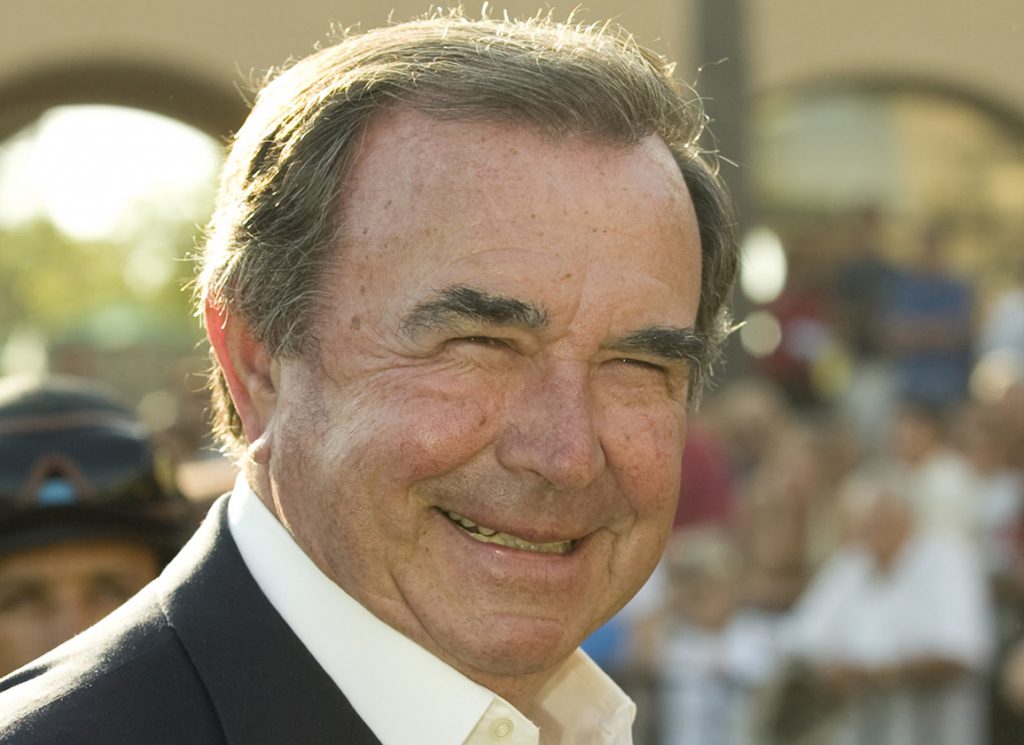
Ron McAnally | Benoit

McAnally, of course, had bred Rock Your World (Candy Ride {Arg}), who won the GI Santa Anita Derby for Sadler a couple of years ago. That connection had given him an extra buzz, and now it was adding something memorable to the Flightline adventure, too.

“That was a special call for me,” Sadler says. “He's one of the good guys and it was great that he wanted to pass that on to me, that he was still thinking of me. Like I said, as a young trainer I relied on the older guys a lot. I had great mentors. You'd sit around in the cafeteria, and these guys were so colorful, some of them in that era were doubtless politically incorrect–but they knew their stuff.”

By the same token, nothing pleases Sadler more today than when a young trainer seeks his counsel. Evidently that doesn't happen as often as a generation ago.

“That's a shame because horsemen are really very generous with their knowledge,” Sadler says. “I think to be a good horseman is intuition based on experience. And I do have the background: I walked hots, I groomed, I came up from the bottom of the stable. I didn't come in at the management level. So, I put in the years. And it's been a great journey. None of this happened overnight. It's like the guy that did 50 movies before he won the Academy Award. It's a lifetime of work.”

The post Sadler Staying On Flight Path appeared first on TDN | Thoroughbred Daily News | Horse Racing News, Results and Video | Thoroughbred Breeding and Auctions.

Source of original post

Verified by MonsterInsights