Full disclosure, for anyone who knows me or has spotted my videos (Farrier Tales), I am not a 'plater,' but I am guessing that would be a foregone conclusion given the rotund nature of the horses featured. In fairness to them, they do go fast, but tend to have a few obstacles in the way.
As one might expect, there is a significant amount of client crossover with the racing and show worlds; I've spent a fair amount of time at the farms, handling broodmares, wrestling babies and shoeing my fair share of newly 'broke' young horses getting their first set of training plates.
It goes without saying, I tip my hat to all of the track shoers of the world. I have wheeled my toolbox into stalls, with my stall jack, dropping nails, wondering how in the heck do these guys do this? As Seamus Brady (legendary U.S. Equestrian Team Farrier), my mentor, would often cry out when I was under a horse for a while, “You need to come up for air.” Of course, this is a reference to the bent-over position platers endlessly hold as they pull, trim, shape and nail on shoes, seemingly in one motion. Fortunately, shoeing show horses has me coming 'up for air' more frequently.
While the disciplines are different, including shoe types and styles, the science of shoeing and its practice are universally the same. When we say, 'beauty is in the eye of the beholder,' we should also consider (relative to horseshoeing), 'balance is in the eye of the beholder,' since not all farriers see the foot the same way. Every farrier brings varying levels of skill, education and experience which affects their ability or inability to read, trim and balance a foot. Of course, the horse's overall behavior, including its patience and cooperativeness for shoeing, should never be overlooked.

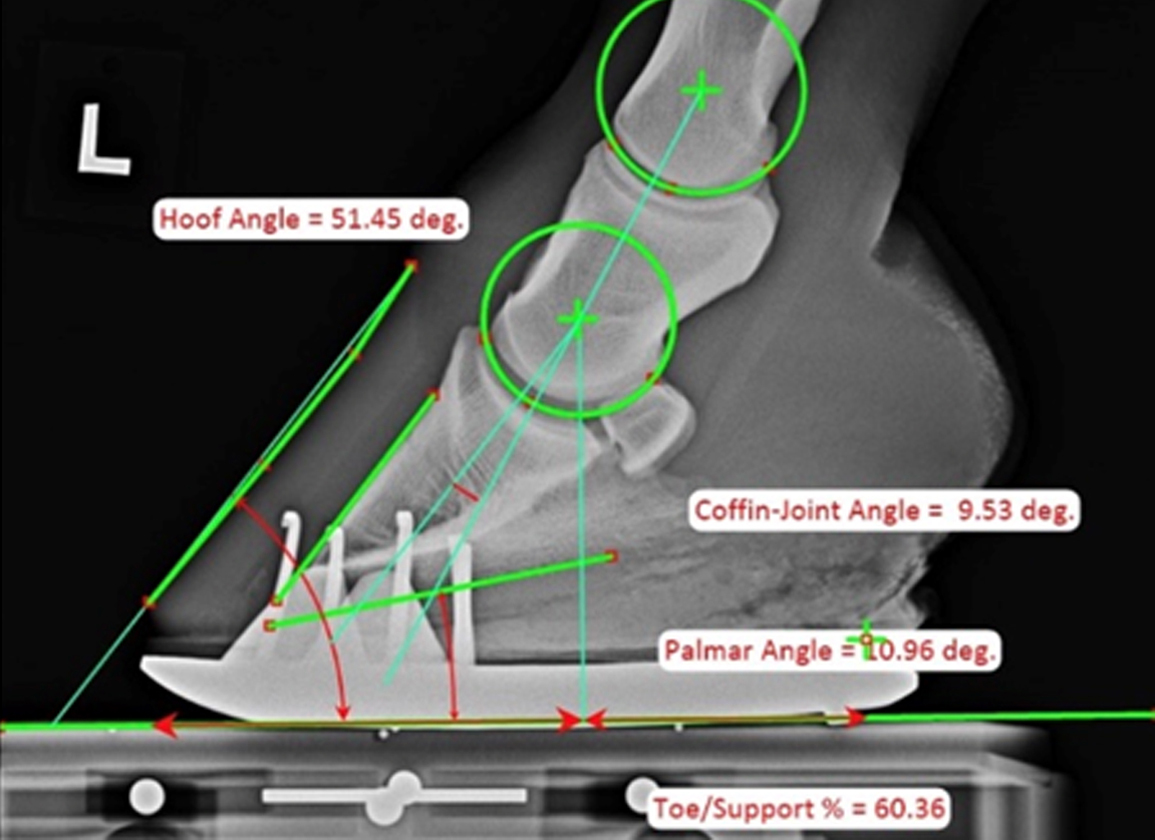
Lateral radiographs of the same hoof which highlight pre- and post- shoeing with interventions and observable/measurable changes. Top image demonstrates subluxation of the bony column (bending line), as well as improvement in the shoe's caudal placement, enhanced breakover, increased palmar angle and corresponding hoof angle. | Courtesy of Dr. Isaiah Robinson, DVM, Miller & Associates
Defining Balance and Alignment
'Balance' exists when phalangeal or bony column alignment is achieved. Bony column alignment refers to the relationship of coffin/pedal (P3), short (P2) and long (P3) pastern bones. This relationship, while attempting to achieve equilibrium, should be the most important consideration for farriers. Failure to address these issues will undoubtedly affect many other mechanisms and
.
may likely lead to soreness, lameness and, of even greater significance, lead to a career-ending injury.
Failure to address the hoof's 'forward' migration 'off the horse's leg,' increases stress and strain on the soft tissue aspects of the leg and may negatively affect the duration of unrollment (breakover), which science believes can be directly influenced by farrier interventions. Unrollment referring to the hoof's rotation, loading and unloading with breakover being the final moment when the toe leaves the ground.
Incorporating Radiography for Shoeing
Pre- and post-shoeing balance radiographs have become fairly commonplace in the pleasure/show world. Perhaps one can cynically argue, it is another 'billable opportunity' for veterinarians and, in some instances, I might agree. However, there have been many occasions where balance radiography has been a great tool to have when trying to read what Seamus often referred to as 'comical' or unusual feet.
The harsh reality is there are only two ways to find something out as it relates to a horse's foot: going too far (which is always discouraged) or taking a picture and seeing where things stand. (Of course, this excludes doing the same thing [wrong] repeatedly, which I am told is the definition of insanity.) Radiographs will likely highlight what is needed to effect reasonable changes, attempting to modify breakover and improve alignment and ultimately performance.
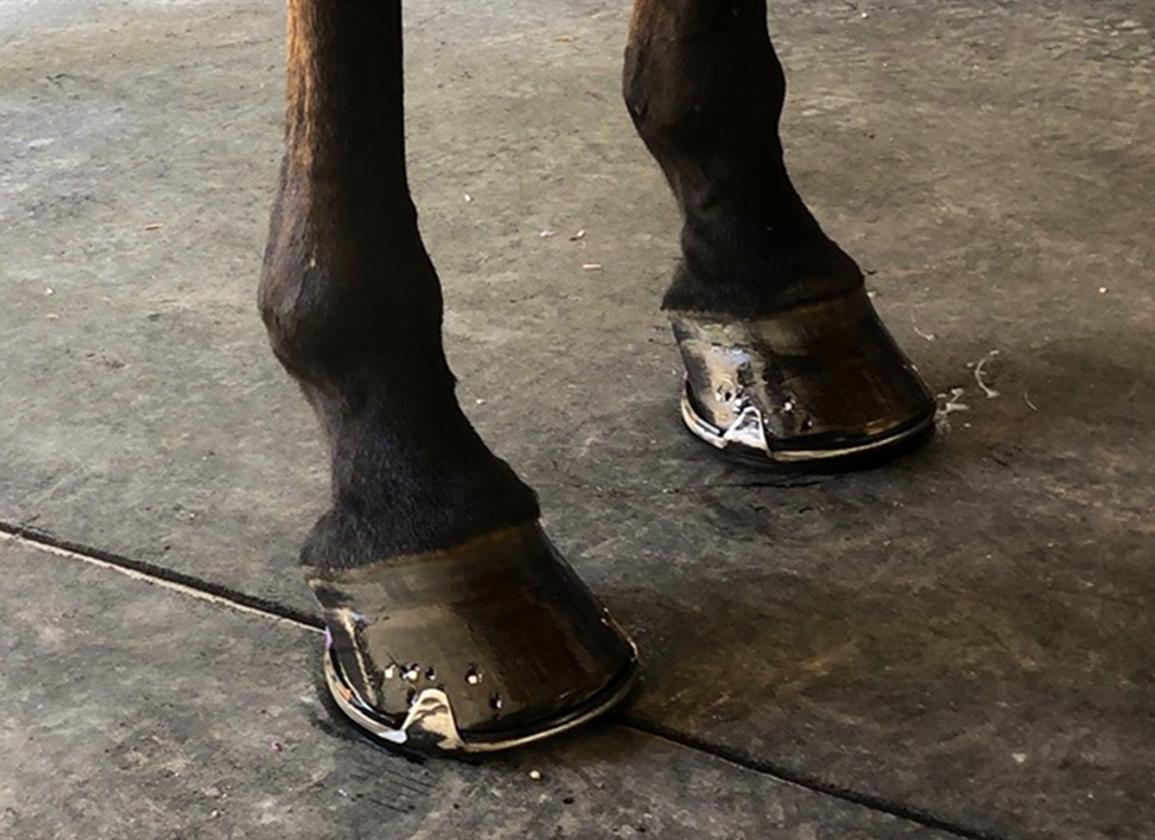
An image of a 'high/low' hoof presentation post shoeing; the 'high hoof:' left front (on right) and 'low hoof:' right front (on left). With radiography, a veterinarian/farrier can determine their ability to make possible changes to correctly address this hoof presentation. | Courtesy of Jude Florio
Furthermore, radiography may reveal 'false' soles, the misleading appearance that a farrier is looking at the 'bottom' (sole) of the foot. Some horses can naturally build up sole, a protective property of the hoof, which makes reading a foot difficult without going too far. More importantly, radiographs can provide a visual aid to identify the coffin bone's vertical depth (distance from bottom of bone to sole/ground surface) on the low heel/long toe hoof presentations which can aid a farrier's decision to take a foot 'down' (trimming from the bottom) or take a foot 'back' (pulling a foot forward and rasping the outer wall back) (See Figure 2).
I certainly recognize the Thoroughbred hoof is not easy. Frankly, for someone who drives nails as high as I tend to, which is a non-issue but necessary with heavy jumping warmbloods, a Thoroughbred foot is a landmine, thin walled and sensitive. A bit of sage advice that I once received and often repeat: 'I get paid for what I leave on and not for what I take off,' as it relates to trimming and shoeing. That statement is most appropriate when considering the task at hand for the racing Thoroughbred shoer, however, we should always be open to seeking out new techniques, increasing our knowledge which we can only hope improves our skill.
When considering this topic, I reached out to a well-respected veterinarian whose practice covers a variety of performance horses, including those which frequent the track and show ring. He said he deals with foot-related issues often and encourages farriers to 'back toes' with the goal of improving alignment. I asked him, “Do you shoot any balance rads for shoeing?” His answer, “Jude, it's just not done [in racing].” Adding, on the rare occasion that foot radiographs are taken, “Most of the time the farrier doesn't even look at them.” Perhaps they should.
The post Shoeing: A ‘Balancing Act’ appeared first on TDN | Thoroughbred Daily News | Horse Racing News, Results and Video | Thoroughbred Breeding and Auctions.
