One of the most respected racing and bloodstock journalists in Britain and Ireland for over 20 years, Ryan McElligott bid adieu to the press room at the Goffs November Breeding Stock Sale as he embarked on his new role as Chief Executive of the Irish Racehorse Trainers Association.
Admitting there was some emotion surrounding the move, McElligott looks back on over 20 years reporting on the sport he loves and looks ahead to the challenges he faces in his new position as the IRTA chief.
The 41-year-old wears many hats. As well as being a talented journalist, he knows the programme book better than most, a skill that David Wachman and more recently Gordon Elliott have utilised by securing his services in that department.
McElligott has also been a jockey's agent for his close friend and multiple Group 1 and Classic-winning rider Wayne Lordan for the majority of his career and has enjoyed notable success in the pinhooking department with another good friend in Luke Barry of Manister House Stud.
All that and more, including his thoughts on the National Hunt and Flat market, are discussed below in this week's Starfield Stud-sponsored Conversations Q&A.
Brian Sheerin: The Goffs November Breeding Stock Sale marked the end of your journalism career as you move on to pastures new. Did you feel any emotion in closing that chapter?
Ryan McElligott: There would have been. Sales have been an integral part of my life for well over 20 years so there was an eerie feeling at Goffs in knowing that it was going to be the last sale I was going to write about.
BS: How did you get into racing journalism?
RM: I was very interested in racing from an early stage and, in my heart of hearts, knew that I wanted to do something in the sport. When I was in Transition Year in secondary school, I did three weeks work experience with The Irish Field back when it was based in D'Olier Street in Dublin, and I enjoyed that. I actually shared an office with Mark Costello [current deputy editor of the paper] during that time. The following summer, I did more work experience with The Irish Field and at that stage I had my heart set on doing racing journalism. I wasn't really thinking of doing journalism in any other sphere other than racing. Just as I began my journalism degree, I got some freelance work for The Irish Field and did my first ever sales report for the EBN-the Derby Sale at Tattersalls in 2000. When it came to graduation time, The Irish Field's chief racing reporter Cliff Noone retired so it was all a question of good timing and I ended up getting a lot of work very early on in my career. I was unbelievably fortunate that a lot of things happened to fall into place for me.
BS: Any particular highlights?
RM: As I look back on it now, it was a great time to be covering racing because you had so many powerful yards from Ireland competing on the big stage. On the Flat, you had Aidan O'Brien, Dermot Weld, Jim Bolger, Kevin Prendergast and John Oxx. They were all operating at the peak of their powers at that time. It was remarkable when you think back about it now.
BS: Journalism can be a thankless job at times and invariably you might end up writing something that somebody doesn't agree with but you got through your career without any major bust-ups. How so?
RM: I don't know. There was one thing that I really didn't enjoy writing about and that was the sale period of autumn 2008 through to 2010. It was bad. It wasn't good for anybody. It wasn't good for the sales companies, breeders, pinhookers, nobody. You can't get away from the fact that the figures have gone through the floor but all you can do is try to handle it in a humane manner. I was at one sale in 2009, now it would have been a low-key sale, but after three hours one of the senior guys went into the office to check what the figures were and they were zero. The figures were zero after three hours. I was covering that sale for the Racing Post at the time and I can remember ringing the Bloodstock Editor at the time to tell them that there was nothing happening there. We decided to give it just 150 words. At that stage, an acceptance had formed that the world was in freefall and a bad thoroughbred sale in Ireland was just symptomatic of what was going on.
“That was pretty sobering stuff but, bit by bit, we managed to get ourselves back in the game.”
BS: Were you pinhooking at that time?
RM: We would have been and 2008 would have been pretty grim. By my recollection, we had a Hawk Wing filly who I think cost seven grand as a foal and we sold her for 30 grand as a yearling. Lolly For Dolly (Ire) (Oratorio {Ire}) was the other one to get sold. The rest of them, we either gave them away or put them into training. It wasn't good. As the market is contracting before your very eyes, even the slightest mistake is going to be punished severely. I'll never forget, the night before the Orby, the Minister for Finance Brian Lenihen addressed the nation to basically tell us that we were F****d. That was pretty sobering stuff but, bit by bit, we managed to get ourselves back in the game. We bought very little in 2009 but we gave small money for a Diamond Green (Fr) colt at Goffs who ended up making 60-odd grand at Book 2. We're talking small sums, relatively speaking, but that provided the little bounce that we needed to get back on our feet. Luke [Barry] and I will always recall selling that horse. We knew he was nice. It happens when you have a good one because you're standing there and, all of a sudden, the sales ring fills up around you and you know something is going to happen. Dwayne Woods outbid Sir Mark Prescott for the horse.
BS: How did you get into pinhooking?
RM: Luke was a year ahead of me in primary and secondary school so we were always very friendly. He spent some time in America and when he came home was trying to get the whole pinhooking thing going. I was working at the time but had zero responsibilities and no family so had some cash to put in and that's how it started. The first horse we bought was a Danetime (Ire) foal who ended up being called Danish Express (Ire). He won a Bath maiden for a man called Peter Winkworth and was a grand little horse. We actually lost money on that horse. He cost €28,000 as a foal in 2003 and was sold for 22,000gns as a yearling. That was the first year of it. I think we'd two the following year and then two becomes three and then three becomes five and so on. I'm involved more on the National Hunt side of things now. That's just the way it has evolved.
BS: That was a conscious decision of yours, to concentrate more on the National Hunt stock.
RM: The National Hunt horses come here to me for a couple of years and I like having them around the place. You could have questioned what way the market was going to go on the Flat and, as it happened, it way outperformed what I thought it would this year. Circumstances changed as well. I have other concerns now that I wouldn't have had when I was younger in terms of the fact I have a young family and I suppose, with work, I got a bit disconnected with the whole pinhooking thing. For example, going to a sale in Newmarket just didn't suit me. It's a lot easier to keep a handle on the National Hunt sales as it's all happening on your doorstep but the Flat is vast. The pinhooking is very much Luke's thing.
BS: I know you say it's more Luke's thing than yours but it's something that has gone well for almost two decades now so what has been the approach.
RM: Well, you need to try and buy something that is going to be acceptable to the market. That's the first thing. Okay, proven sires are going to cost a premium but it's always good to have a sibling running for you the next year and a lot of great touches have come from that. It's great when horses we've pinhooked go on to success. We pinhooked Lolly For Dolly. Fozzy Stack bought her off us as a yearling and she won the Windsor Forest S. at Royal Ascot. We went back some years later and bought her Sir Percy (GB) half-sister for 27,000gns as a foal before selling her for €210,000 as a yearling so the family was good to us. In terms of Luke, his family had Starfish (Ire) (Galileo {Ire}) who bred La Collina (Ire) (Strategic Prince {GB}), Astadash (Ire) (Zoffany {Ire}) and many more black-type horses. That was their family. Starfish was really good to them and they bought her as an unraced filly out of Stack's. At that time, Luke and I would have had many conversations about Starfish because Decado (Ire) was in the pedigree. He won a Tetrarch S. and was placed in an Irish Guineas for Kevin Prendergast. Luke's Dad Frank was very close with Kevin so there would have been an affinity with the family given Kevin had Decado. Starfish ended up being an incredible success story for them. That's something that stands out. I like seeing Luke do well.

Lolly For Dolly winning at Royal Ascot under Wayne Lordan | Racingfotos.com
BS: Have you tried to buy many siblings to some of the younger horses who might be showing up well at home at Gordon Elliott's given you have an insight to the yard?
RM: You try and work every angle you can but it's very rare that it happens. If you know there's a good one, chances are that 10 more people know it as well. I remember a few years ago we tried to buy a half-brother to what Gordon thought was a smart horse in Pencilfulloflead (Ire) (Shantou). Half the sales complex knew about it as well, though. Kevin Ross bought the horse for €36,000. He was by Califet (Fr) and we thought we'd be very clever buying a half-brother to the then unraced Pencilfulloflead but we didn't get him. You would have had a chance of doing something like that 20 years ago but not any more.
BS: Are there any stallions you've done particularly well with?
RM: Beat Hollow (GB) was very good to us. Choisir (Aus) and Danetime (Ire) on the Flat as well.
BS: You were a Blue Bresil fan before it was cool to be one.
RM: We had that Blue Bresil (Fr) horse who ended up making £340,000 after winning his point-to-point, Willmount (GB). He was out in a field with The Four Sixes (Ire) (Westerner {Ire}), who we put into training with Gordon before selling privately to the McNeill family after he placed in a Leopardstown bumper. We sold Willmount at the Land Rover Sale to Rob James for €46,000 and he won his point for Colin Bowe.
BS: And is there anything coming through on the Flat that you like?
RM: I am a big Cotai Glory (GB) fan. I think he's a really nice sire. If you bought a mare it would be a fair start if you sent her to Cotai Glory. I think he's a good idea. He got the Group 1 winner, The Platinum Queen, in his second crop. I only realised the other day that The Platinum Queen (Ire) was the first two-year-old to win the Abbaye in 40-odd years. That's a fair feat. I've never owned a Cotai Glory but he's a stallion I like.
BS: Tell me a bit about your new role as chief executive of the Irish Racehorse Trainers Association.
RM: I had been writing for over 20 years and just began to look at other avenues. This position came up and a number of aspects of the role interested me. You are representing a significant body in Irish racing. You are representing a body where some of its members are global names. It's a body with the capacity to drive change and positive change at that. I thought it was a role with potential.
BS: It's a role that comes with its challenges.
RM: Absolutely. It's an organisation that has gone through a difficult period. It has endured some very challenging times but a representative body for one of the most significant cohorts of people in Irish racing, that's got to have potential.
BS: Have you had a chance to pick up the phone to many people who have maybe lost faith in the organisation down through the years or is that something that will happen a bit further down the line?
RM: That's going to be an ongoing thing. I started on Dec. 1 and am trying to feel my way around at the moment but the hope would be to, over the course of time, instill a newfound confidence in the organisation.
BS: And you continue to do the race planning for Gordon Elliott who you work well with.
RM: He's very easy to work for. There's never been a cross word between us. He's a singular talent. Gordon actually rode a few point-to-pointers for my Dad back in the days when he was riding. I remember doing a pre-Cheltenham feature with him in 2007 when he had Silver Birch (Ire) (Clearly Bust {GB}) running in the cross-country. That was the year Silver Birch won the Grand National. We kept in contact after doing that feature and I would have recommended the odd horse to him here and there. We just became firm friends over the course of time. It was in 2015 that he asked me to do some race planning for him. Before that, I had been doing that role for David Wachman. David actually announced his retirement that season and, as it happened, Gordon had approached me about the role the week before.
BS: In many ways, Willie Mullins and Gordon Elliott have brought National Hunt racing to a new level. Could you give us an insight into how Gordon operates and how your relationship with him works?
RM: Gordon is always concentrating on getting the next winner or the next good horse. It's never a case of basking in the afterglow for a considerable period of time after any big win. He was at Cheltenham the other day and I think he bought seven horses. He's got serious drive. In terms of race planning, when a meeting is closing, I'd give him a ring and propose a list of entries. He's the one who is looking at the horses every day so he says yes or no. The list is refined and there are plans for different horses at every level. It's fairly collaborative.
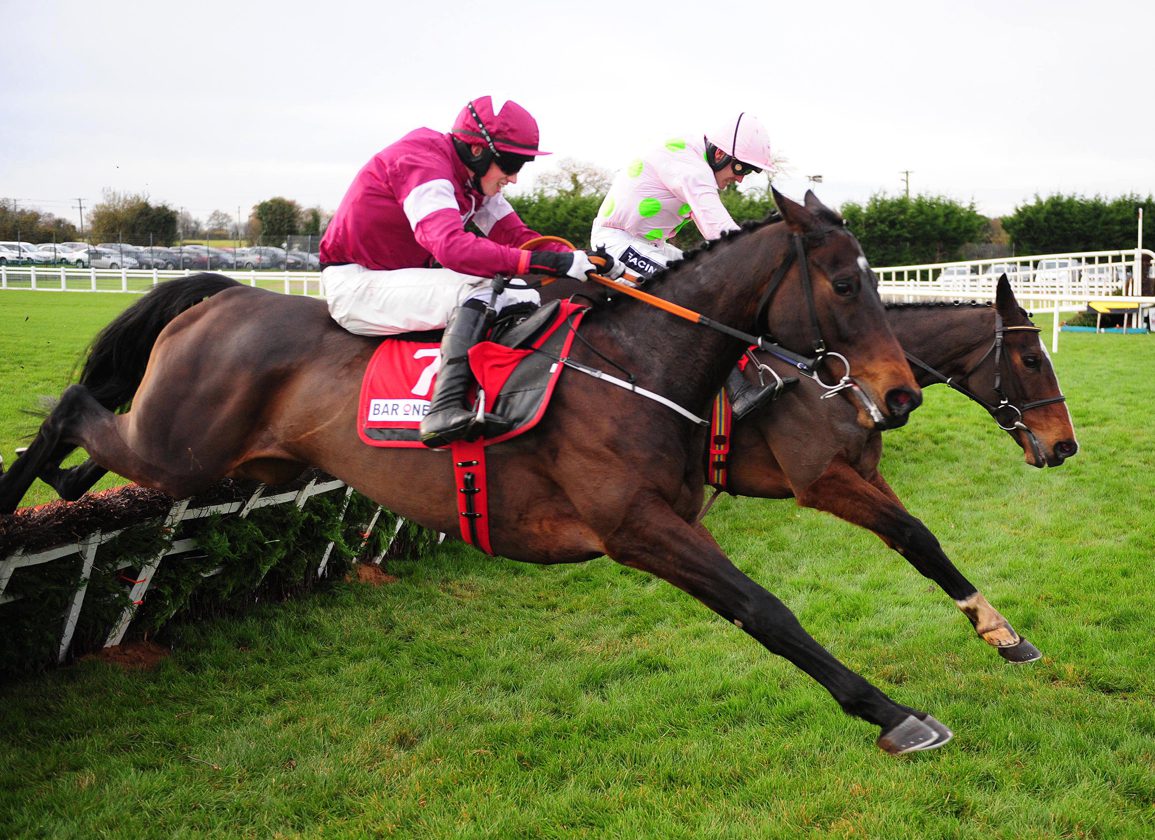
Apple's Jade fights off Vroum Vroum Mag to win the Hatton's Grace Hurdle | Racingfotos,com
BS: Is there any victory that you can look back on and say, 'that really cemented our relationship,' or is it something that has grown organically?
RM: It has grown organically and it's a great help that the yard is just a conveyor belt of winners. I remember we had a lot of discussions about Apple's Jade (Fr) (Saddler Maker {Ire}). Gordon obviously got her off Willie and she had been a brilliant juvenile hurdler the season before. She got beaten by Rashaan (Ire) (Manduro {Ger}) in the WKD Hurdle at Down Royal on debut for Gordon before running in the Fighting Fifth at Newcastle where she was beaten by Irving (GB) (Singspiel {Ire}). So that still wasn't great but it was a step in the right direction at least. The Hatton's Grace Hurdle was just a week after the Fighting Fifth and I can remember we'd a lot of back and forth as to whether she should go to Fairyhouse or not. She was taking on Vroum Vroum Mag (Fr) (Voix Du Nord {Fr}) and, eventually, we came to the conclusion that it was a good idea. It worked out and she won the first of many Grade 1s for Gordon. That was a good day.
BS: It's fair to say you've been in Gordon's corner for the good days and the bad. You spent a lot of time at Cullentra just before he was suspended in 2021.
RM: I did spend an awful lot of time there. For him, it was obviously a very challenging week, extremely so. I think the phrase he uses at times to describe the whole thing is 'a moment of madness,' and yes it was, but he just found himself at the centre of a storm that I don't think anyone could have foreseen.
BS: And it was a big season for your jockey Wayne Lordan, who scooped the prize for ride of the year at the HRI Awards last week for his heroics aboard Waterville (Ire) (Camelot {GB}) in the Irish Cesarewitch.
RM: Wayne has been there towards the head of the jockeys' standings for quite some time. He's a very modest and self-effacing character and is quite happy to just go out there and do his thing and let the horses do the talking for him. I was thrilled for him last week because that was a great ride.
BS: Was there ever a temptation to take on more riders or was it always the intention to have just one top-tier jockey like Wayne on the books?
RM: I never really set out to be a jockey's agent. It was actually David Wachman and Fozzy Stack who were keen for me to take over Wayne back in the day because they felt it would be handier to pick up the phone to me. I ended up doing Wayne by default in a way. I wasn't the one who came up with the idea. That was in 2008 or 2009. I've been doing it since. A long time.
BS: Sole Power was the first big one.
RM: He was the first Group 1 winner. He won the Nunthorpe at 100-1 and was the longest-priced Group 1 winner in Britain for 30-something years at the time. If you look back, the Nunthorpe took place on the same day of a really low-ley Killarney meeting, so there wasn't anything going on in Ireland that day. Sole Power (GB) (Kyllachy {GB}) was trained by Eddie Lynam, who was a big supporter of Wayne down through the years, and it's actually funny because Wayne was meant to go to York to ride another one of Eddie's, Notalossonya (Ire) (Cadeaux Genereaux {GB}), that day. Notalossonya had won the good 3-year-old handicap at Galway that season and was very much the one that Wayne was going over to ride. Anyway, Notalossonya got balloted so Wayne ended up going to York for this one ride, a 100-1 shot in a Group 1, and it happened. I don't think Wayne won another race on Sole Power after that but he got on Slade Power (Ire) for Eddie as well. Slade Power was a hell of a horse-winner of the Diamond Jubilee S. and the July Cup.
BS: And how did the move to Ballydoyle come about in 2017?
RM: Again, that was all around the same time when David Wachman announced his retirement. Wayne ended up in Ballydoyle and it has worked out well for him. He rode Winter (Ire) (Galileo {Ire}) to win the 1000 Guineas at Newmarket in his first year at Ballydoyle. Winter had won her two-year-old maiden at Dundalk under Wayne when she was based with David. She transferred over to Ballydoyle and Wayne kept the ride for the Guineas. He actually won the Guineas on Winter and then beat her in the Matron S. later that season on Hydrangea (Ire) (Galileo {Ire}).
BS: Iridessa was another important filly for Wayne.
RM: To win a Breeders' Cup race was big. Iridessa (Ire) (Ruler Of The World) {Ire}) was a great filly for Wayne. He won four Group 1 races on her. She was an unbelievable filly and, when you think about it, Joseph O'Brien did an unbelievable job with her to bring her all the way from winning a median auction maiden at Killarney to landing a Breeders' Cup Filly and Mare Turf. Luckily, Wayne happened to be on her for many of those good days and they built up quite the relationship. I was out for dinner the night she won the Breeders' Cup. I've only watched that race about a thousand times since! But there's Wayne's record, he's won Classics, Breeders' Cup races, big winners in Australia–he's a top jockey.
BS: Getting back to the market, how do you see the next 12 months playing out? A lot of people have been driving on regardless at the sales but perhaps concentrating more on the high-end bracket. What way have you played it?
RM: You are looking at what is going on around the world and obviously we have this tech thing going on. Maybe that isn't too dissimilar to the horse business. Obviously you have the war in Ukraine and its many destabilising effects. The cost of living crisis has been the main news story in Ireland over the past number of months. People's gas and electricity bills have gone through the roof. We haven't seen that bite in the thoroughbred industry, which is obviously good, but there has to be a point where it manifests itself in some shape or form. I am wondering did we see a little bit of it creep into the National Hunt foal market towards the end of the year. Clearance rates were running at around 60% so you were dealing with sales where a third of the horses were not selling. That market is of course predominantly Irish with a bit of English thrown in there so I am just wondering did we see a little bit of tightening there. Obviously the Flat is much better insulated because it's an international market. Even the most low-key of Flat sales had an international element to it. Take the Open Yearling Sale at Goffs, there was a major international element to that with the Eastern Europeans and so on.
BS: I know you are only two weeks in your new role but what sort of calls have you fielded from trainers? There must be serious concerns out there.
RM: I have had a number of calls outlining how tough it is for trainers to make ends meet at the moment. Insurance premiums are a major concern as they have gone up again. Unfortunately, a lot of trainers are finding it very tough but you can't wave a magic wand and make it better. I hope over the course of time that the organisation can make a difference. Maybe we could look at staging races for trainers who do not have more than 40 horses in training or something similar. Would that be a better way to do it rather than races for trainers who have had 10 or less winners the previous season? Maybe races confined to a certain echelon could work well. It's something that could be refined over a period of time but that's certainly something we could look at. It was put to me years ago that we should have a premium 45-65 at something like a Galway festival and make it worth €22,000. I thought it was a great idea. You'd have a hell of a handicap in that you'd have 16 or 18 horses who've either won or come second on their previous start as that's what you'd need to do in order to guarantee a run with the balloting system. It would be a real thing to aim towards Galway with those hoses. It could just work and it would create a tremendous betting race.
BS: I'd love to see more claimers in the programme.
RM: I don't think that would be a bad thing. There seems to be a good turnover of horses in claimers and the culture to these races has definitely changed. They are reasonably regular on the Flat but they remain somewhat infrequent over jumps. I'm not sure if claimers need to be worth more money but there could be more of them. The system as it is is functioning and growing.

The post ‘Trainers Are Finding It Tough But You Can’t Wave a Magic Wand’ appeared first on TDN | Thoroughbred Daily News | Horse Racing News, Results and Video | Thoroughbred Breeding and Auctions.
Source of original post
