‘I’ve Never Given Myself a Chance to Fail’: Luke Morris on High Days and Hard Work

There can have been no finer example of reward for effort than the Prix de l'Arc de Triomphe victory of Alpinista (GB) (Frankel {GB}). Not only for the mare herself, slogging through the Longchamp mud with five Group 1 wins already to her name, but for her trainer Sir Mark Prescott and owner-breeder Kirsten Rausing, who have collectively a century of experience in this great sport between them. Then there was her jockey, Luke Morris. Not the most fashionable member of the British weighing-room, but certainly the most worthy, for barely a day goes by that he is not grafting away and, since 2011, not a season has passed without Morris riding at least 100 winners. 

Ironically, 2022 was by one measure his least successful season for the last 12 years, as his final tally was 'only' 103 winners. But it was of course his most significantly prestigious year, with his gallant grey partner providing him with three Group 1 victories, in France and Britain, to add to the trio of German Group 1 titles collected the previous year, culminating in one of the most emotional Arc victories in living memory. 

“Going to Longchamp on that day, I'm realistic enough, I know I'm not really going to ride a favourite or a second favourite probably in the Arc again in my career,” he reflects. “So I was very relaxed about it and I just wanted to enjoy the day, enjoy the moment. And I'd gone through everything with a fine-tooth comb, and I just wanted to leave no stone unturned. Because you only get one shot at these sort of things. So it was so nice when everything worked out exactly how we hoped and how we planned, really.”

Alpinista is not, of course, the only good horse with whom Morris has been associated in a riding career which is heading towards the 20-year mark. Gilt Edge Girl (GB) (Monsieur Bond {Ire}) was his first Group 1 winner, at the same track, for Clive Cox in the Prix de l'Abbaye back in 2010. Six years later he was back at 'lucky Longchamp' to claim the same race aboard the Prescott-trained Marsha (Ire) (Acclamation {GB}). That lightning-fast filly would go on to win another two group races the following year, including the G1 Nunthorpe S., but even her achievements must pale slightly when set against the record of Alpinista, on whose dam Alwilda (GB) (Hernando {Fr}) Morris won three races, and whose grand-dam Albanova (GB) (Alzao) was another to heap Group 1 successes on Prescott's Heath House Stables.

Morris says, “I've ridden lots of the dams of the fillies we get from Lanwades and Miss Rausing. And, for me, it was hugely rewarding to be able to almost repay the faith that Sir Mark and Miss Rausing had put into me by giving me the job with Sir Mark at a very young age. I think it was only my second year out of my claim and I had ridden a Group 1 winner but I hadn't had many opportunities in big races. Sir Mark gave me opportunities for big owner-breeders at a young stage of my career. And to be able to repay him and Miss Rausing was something special to me.”

An Arc victory would be a highlight on any jockey's CV, but one senses that Morris takes pride in every winner. Last week he reached another important milestone in his career when riding his 2,000th winner in Britain, a feat which has only been achieved by five other jockeys currently riding in the country: Frankie Dettori, Joe Fanning, Paul Hanagan, Ryan Moore and Jamie Spencer.

“Last year was a year I'll never forget,” he says. “And to ride 2,000 winners has been on my radar for probably a couple of years now. There are five or six other jockeys who are still riding who have done it and I think just about every one of them has been a champion jockey. So it's something I'm immensely proud of, and it just spurs me on to keep working harder to ride more winners, and to try and ride good winners as well.”

It is hard to imagine how Morris would find the time to work harder than he does already. While many of his contemporaries in the weighing-room are enjoying less taxing winter-riding gigs in warmer climes, he is driving through the freezing fog currently engulfing Britain to take full books of rides on the all-weather tracks. As we speak, he is about to head to Southwell's evening meeting to ride six horses for six different trainers. It is the kind of punishing schedule a jockey on the way up must adhere to if the rides are available, but the tall, lean Morris, now 34, has long since proved his worth. His right foot does not look like it will be easing off the accelerator any time soon, however. 

“Weight-wise, I'm quite lucky in that I naturally sit around 8st 4, so generally I don't have to sweat or lose too much weight, but being busy all the time just means I never really get the chance to put any weight on, so that suits me well,” he says. “And since I first started out, from my first, probably even before my first ride, I always had a fear of failure. So I've never given myself a chance to fail, really.

“I remember the days when I was 12 or 13, I used to ride out every day before school for Michael Bell, and even when we had the six-week summer holidays, I told my parents I wouldn't be allowed a day off. Because it was more important that I was in there riding out every day, rather than going on a family holiday.”

Plenty of parents would be delighted to see a similar work ethic in their teenage children, and Morris's dedicated approach is clearly one which sits well with his long-term employer, who expects loyalty from those connected to his stable, but gives the same in return.

“Sir Mark has had three jockeys in 53 years of training,” notes Morris, who followed George Duffield and Seb Sanders in the role. “He expects you to be extremely professional, to work hard, and he's the same. So, like I say, I can't thank Sir Mark enough for what he's done for my career, and I'd like to think riding for him, since I joined him, I've stepped up my game, because his traits have rubbed off on me. We've got some really nice yearlings this year from good owner-breeders again, so you just hope that there's going to be another good one along soon.”

In the meantime, Morris is using what little spare time he has to nurture his own breeding ambitions. He spent the December Mares' Sale pounding the yards at Tattersalls in search of a mare with the help of Joseph Burke.

“After Alpinista won the Arc, I said I'd treat myself to a relatively nice broodmare,” he explains. “We saw some [at Tattersalls], and we underbid a few but didn't have much luck. So Joe went off to Arqana and we got a mare called Clara Luna.”

Clara Luna (Ire), a daughter of Muhtathir (GB) and half-sister to the G2 Prix Muguet winner Don Bosco (Fr) (Barathea {Ire}), has already produced the GIII Pin Oak Valley View S. winner Colonia (Fr) (Champs Elysees {GB}). The name of another Arc winner, Enable (GB), appears under her third dam, Fleet Girl (Ire), who was an early acquisition for Prince Khalid Abdullah when he bought Ferrans Stud in 1982. And a touch of loyalty to Lanwades is exhibited by the fact that Clara Luna was bought in foal to Sea The Moon (Ger).

“I've been interested in bloodstock and racing since I was six years old and I've been wanting to get a mare, but when the time was right. So she stays at home for most of the year and then will go off to foal. It's hugely exciting on a different spectrum, really,” says Morris.

“I hadn't met Joe before, but he'd come highly recommended and I spent a week walking around the mares with him before I went racing every day. I couldn't believe how much I learnt in a week walking around with him, because I might know a bit about form, but looking at mares I was a little bit lost and Joe taught me plenty in that week. I don't really have many hobbies outside racing, so it's my hobby, not that it's really outside of racing, but it feels that way.”

He adds, “Once she foals to Sea The Moon, she'll return to Study Of Man, who is obviously a son of Deep Impact, and from what Saxon Warrior has done, we very much hope that he'll follow that path. I studied the Return of Mares, and Miss Rausing's sent some good mares to him, so hopefully he can reward her and reward everyone that supports him.”

Morris may yet have the pleasure of riding the offspring of Study Of Man and Alpinista, with Rausing having stated that the mare would visit the young stallion during her second season after a potential first mating with Dubawi (Ire).
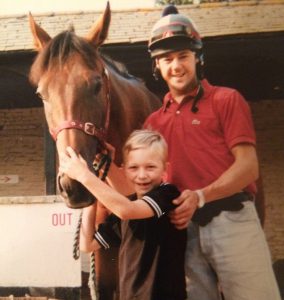
 

Luke Morris, age seven, with Flemensfirth

Along with a fledgling equine breeding project, Morris has his own young family to keep him busy, and his 13-month-old son Henry has already taken to the saddle in the hunting field over Christmas. The jockey's own passion for horses was sparked when he moved to Newmarket at the age of six and walked to school alongside the town's horse walks as members of the racing community went about their daily work. Before long, he was one of them.

“My stepdad worked for John Gosden and he used to look after Flemensfirth and ride him every day. So every day of the school holidays, I used to go and watch Flemensfirth swim, and give him a pat, and it almost felt like I was part of the team then. So that was probably where I really got hooked,” he recalls.

“I've always had a passion for horse racing. If wasn't a jockey, I'd be a massive horse racing fan because I love horses, and I just feel lucky that I've found something to do as a career that is very much like a hobby to me.”

That old saying may go, 'do something that you love and you'll never work a day in your life,' but don't be fooled. It is hard work that got Luke Morris to where he is today, and hard work will doubtless keep him at the top of his profession for years to come. That he derives so much pleasure from that position is a much-deserved benefit. 

The post ‘I’ve Never Given Myself a Chance to Fail’: Luke Morris on High Days and Hard Work appeared first on TDN | Thoroughbred Daily News | Horse Racing News, Results and Video | Thoroughbred Breeding and Auctions.
Source of original post

Value Sires Part III: Farhh and Away

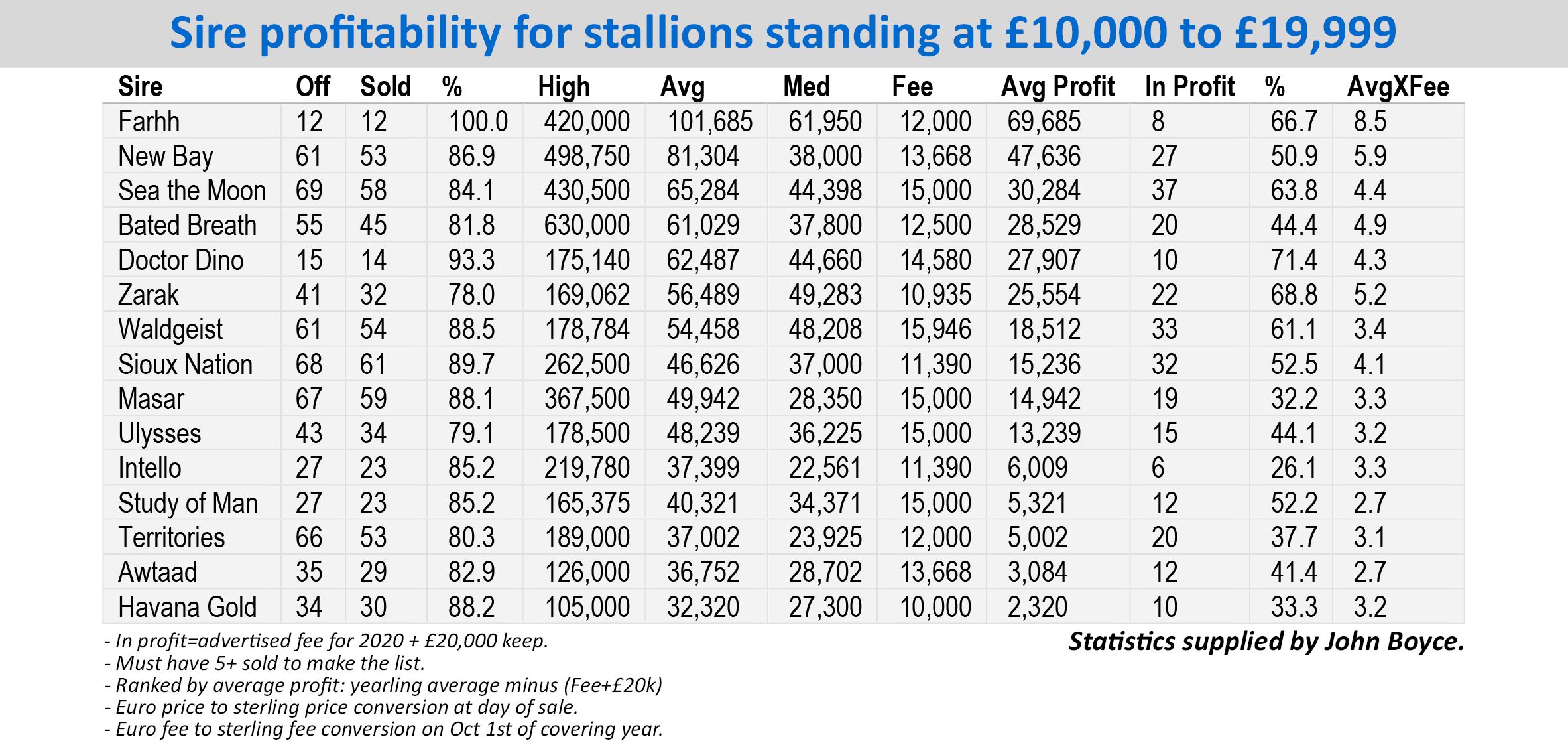
As we move into the third tier of our examination of stallions by yearling profitability, the name at the top of the list for those standing between the equivalent of £10,000 and £19,999 perhaps provides an example of how rarity drives demand.

On paper, the Dalham Hall Stud-based Farhh (GB) has an awful lot going for him. A son of Pivotal (GB) out of a dual Group 1 winner over a mile and a half, he was lightly raced, with just one winning appearance in each of his two- and three-year-old seasons. Then at four, when things fell into place for him, he had Nathaniel (Ire) then Frankel (GB) holding him off the top spot in three consecutive Group 1 races. In total, Farhh ran second in four Group 1s that season, in the Eclipse, Sussex, International and Prix du Moulin, being beaten just a head in the latter by Moonlight Cloud (GB). The infrequency of his appearances resumed in his five-year-old season but boy was he worth waiting for, as he won the Lockinge and the Champion S. to round off his career in style.

Unfortunately things haven't gone swimmingly for the handsome Farhh at stud, as his career has been dogged by poor fertility. It has also been liberally sprinkled with excellence. 

From eight crops of foals to date, the largest number recorded in one year was 39 in 2019. The previous year only 18 Farhh foals were born, and there were 14 in 2022. From a total of 189 foals eligible to have raced so far he has had 149 runners and 89 winners, including 17 stakes winners. His seven group winners give a snapshot of the diversity one can expect when it comes to distance, which is perhaps no surprise given the speed and stamina influences in his own pedigree. His Group 1 winners King Of Change (GB) and Fonteyn (GB) are both essentially milers; the Group 3 winners Wells Farhh Go (GB) and Dee Ex Bee (GB) were both talented stayers, while another, Far Above (GB), was an extremely fast winner of the G3 Palace House S. at Newmarket. Far Above and King Of Change are both now at stud, and it will be interesting to see how much of a boost they can give to the Pivotal male line to enhance the good work being done primarily in France by Siyouni (Fr).

For the benefit of this exercise, as previously stated in Part I and Part II, the stallions are examined in four key price brackets according to their yearling sales returns of 2022 set against their fees at the time of covering. The average profit has been determined by the stallion's fee plus a figure of £20,000 for keep costs. The profitable stallions featured must have had at least five yearlings sold in 2022 to make the list and prices have been converted to sterling from Euros according to the conversion rate on the day of the sale.

With an average yearling price which was 8.5 times his 2020 fee of £12,000, Farhh was the clear leader in this field. Twelve of the 22 member of his 2021 crop were offered for sale, with the ten sold returning an average profit of £69,685. The only reason I have not given Farhh the gold medal which his results certainly deserve is that his poor fertility does present something of a risk, but that is for each breeder to weigh up for themselves as he is quite clearly a very good stallion.

Click Table To Enlarge. 

While the scarcity of Farhh's offspring could well have been a driver in his sales returns, the same cannot be said for New Bay (GB), who had 53 of his 61 yearlings offered sold for an average which was almost six times his 2020 fee. That figure of €15,000 was the lowest he stood for, and well done to those breeders who caught him at that fee in 2019 and 2020. Subsequently he has shot up to €37,000 in 2022, and that was then doubled to his current high of €75,000. One of his three Group 1 winners to date, Bayside Boy (Ire), has just joined New Bay on the roster at Ballylinch Stud, while the other two, Saffron Beach (Ire) and Bay Bridge (GB) remain in training with further lofty targets in their sights. 

In fee, New Bay has moved up two tiers on these stallion tables in just two years. His average profit on the yearlings sold last year was £47,636, and with a likely upturn in the quality of mares covered in line with his fee, it is fair to expect for his yearling average to continue to climb as long as those results on the track keep coming.

Sea The Moon (Ger) bucked a certain number of trends merely by being recruited to stand at Lanwades Stud in the first place. Not many winners of the German Derby make it to studs outside Germany, and not many sons of Sea The Stars (Ire) are afforded places at Flat studs, a situation that is as ridiculous as it is regrettable. 

Early on in his stud career, Sea The Moon caught the imagination of Australian buyers who switched their attention to buying foals and yearlings as the prices for horses in training climbed, and he has a decent strike-rate with his offspring to have ended up down under. They include the G1 Caulfield Cup winner Durston (GB), G3 N E Marion Cup winner Favorite Moon (Ger), and the Group 3-placed Pondus (GB). 

As he embarks on his ninth covering season, Sea The Moon's popularity remains strong. His yearlings of 2022, conceived the last year he stood for £15,000, returned  average profit of £30,284 from 58 sold. Though his fee has since risen to £25,000, he remains that rare middle-distance horse to be holding his own in the centre ground of the stallion market.

With such illustrious stud-mates as Frankel and Kingman (GB), Bated Breath (GB) can be in danger of being under-appreciated but he should not be, for he is a mid-range stallion who offers great value in a commercial marketplace. A Group 1 winner in Europe would be a boost to his profile–presently his sole top-level winner, Viadera (GB), posted her best performance in America–but he has had plenty knocking on the door, including the Group 2 winners Worth Waiting (GB), Daahyeh (GB), and Space Traveller (GB). The last named, twice a Grade I runner-up in the States, has recently joined the roster at Ballyhane Stud.

Bated Breath's fee has increased to £15,000 from the £12,500 paid for the nomination fee when these yearlings were conceived, but that keeps him within this bracket, and when considering a yearling average of £61,029 and average profit of £28,529 from the 45 sold through the ring last year, he remains an enticing prospect for breeders.

Doctor Dino (Fr) is primarily considered a National Hunt stallion, with the likes of Sceau Royal (Fr), La Bague Au Roi (Fr) and Sharjah (Fr) to his credit, but he should be regarded as a dual-purpose option, for he is also the sire of G1 Prix de Diane runner-up Physiocrate (Fr) and Group 3 winners Golden Legend (Fr) and Villa Rosa (Fr). Admittedly those three Flat horses named were all bred by Henri and Antonia Devin at Haras du Mesnil, where Doctor Dino stands, but if we are to learn, then it should be from the best, and the Couturié/Devin family has proved for many years to be extremely capable of producing top-class Flat runners. 

Like his sire Muthathir (GB) before him, Doctor Dino can cut it under both codes, and he has gradually worked his way up from an opening fee of €3,000 to his current high of €20,000. He stood at €16,000 when these yearlings were conceived, and showed a decent average profit of £27,907 for the 14 sold in 2022. There aren't many male-line descendants of Sharpen Up left at stud in Europe (Jack Hobbs is another, but he too is marketed primarily as a jumps sire), so it would be pleasing to see Doctor Dino have broader appeal to Flat breeders.

The more obvious French stallion high in this list, from a Flat perspective at least, is Zarak (Fr). Considering that his pedigree stretches back ten generations and 100 years to Mumtaz Mahal (GB) and the foundation of the Aga Khan Studs, he really would be a fitting stallion to make it to the top, especially as a son of the celebrated Zarkava (Fr). He is making all the right noises, with nine stakes winners from his first two crops as well as two Classic place-getters in La Parisienne (Fr) and Times Square (Fr), and there is a general clamour for his young stock. His opening fee of €12,000 held solid though his first four seasons until rising to €25,000 last year and €60,000 this year. This is the territory in which stallions start to get found out, but with the might of the Aga Khan broodmare band behind him, along with support from plenty of outside breeders, Zarak has a decent chance of taking another big step forward. Last year his yearlings sold for five times his 2020 fee and showed average profit of £25,554.

The G1 Keeneland Phoenix S. winner Sioux Nation made an extremely promising start to his stud career with his first runners in 2022. His tally of winners was such that in any normal year he would have been champion first-season sire, but he came up against another prolific youngster in Havana Grey (GB), who had the edge when it came to the number of stakes winners. Sioux Nation, one of the last of Scat Daddy's sons to retire to Coolmore, was not lacking in this regard himself, and Lakota Sioux (Ire) and Sydneyarmschelsea (Ire) both won Group 3 races, while Matilda Picotte (Ire) landed the Listed Bosra Sham S. and was third in the G2 Lowther S.

His second-crop yearlings were conceived off his opening fee of €12,500. This dipped to €10,000 for two years before bouncing up to €17,500 for the coming season on the back of that promising start. Even at this new fee, Sioux Nation still looks a profitable option if he can build on his debut season with runners, for his 61 yearlings sold last year fetched an average price of £46,626 (four times his fee) and average profit of £15,236.

The 2020 covering season saw three very smart recruits to the stallion ranks in Britain and Ireland. Derby winner Masar (Ire) joined the Darley team in Newmarket, the town which has also become home to the Niarchos family's Prix du Jockey Club winner Study Of Man (Ire), who is at Lanwades Stud, while the Arc winner Waldgeist (GB), who was only narrowly denied the previous year's Jockey Club when beaten a short-head by Brametot (Ire), retired to Ballylinch Stud. All three have top-drawer pedigrees to match their racing records and, while their first two-year-olds will be unleashed this season, it is fair to expect all of them to be better represented once that crop turns three. 

That said, two things should be kept in mind when considering Masar. His sire New Approach (Ire), a fellow Derby winner, had been champion two-year-old and with his first crop he pulled off the extremely rare feat of being represented by three juvenile stakes winners at Royal Ascot. Masar was no slouch at two himself, beating the smart sprinter Invincible Army (Ire) over six furlongs on debut in May before winning the G3 Solario S. and finishing third in the G1 Prix Jean-Luc Lagardere. He could well be in the mix in the first-season sires' table this year.

Masar's first yearlings sold for an average which was 3.3 times his opening fee of £15,000. He has dropped only fractionally to £14,000 but it may well be a good time to use him. His average profit on 59 yearlings sold was £14,942.

Waldgeist outstripped that from an opening fee of €17,500, with 54 sold for an average 3.4 times that mark and average profit of £18,512. He was of course a Group 1 winner at two, and his stock looked pretty tidy, as he is himself, and may well not take too long to come to hand. With a drop in fee to €12,500 for 2023, again this could well be a good time to strike for this well-bred son of Galileo (Ire).

Just as Waldgeist will have been lent support by the powerful Ballylinch partners, including his co-breeder Gestut Ammerland, as well as Newsells Park Stud, so will Study Of Man been supported by the Niarchos family and Kirsten Rausing at Lanwades. The latter was responsible for 25 of Study Of Man's first crop of foals, including ten from her 'AL' family and a filly out of Group 1 winner Madame Chiang (GB) (Archipenko), while other notable first-crop members include a half-brother to Derby winner Desert Crown (GB) (Nathaniel {Ire}) who was retained by breeder Gary Robinson of Strawberry Fields Stud. Juddmonte Farms, Gestut Fahrhof, Blue Diamond Stud, and Hascombe & Valiant Stud were among the other major operations to back the son of Deep Impact (Jpn) and grandson of Miesque (Nureyev).

With some notable owner-breeders involved it wasn't a surprise that not many of Study Of Man's yearlings came onto the market, but of the 27 that did, 23 were sold for an average of £40,321 at an average profit of £5,321. His stud fee was adjusted from an opening £15,000 to £12,500 for his next two seasons, and that is where it remains for 2023, which seems an extremely fair price for a horse with a pedigree of hugely international significance.

The Niarchos family's Flaxman Stables Ireland was also responsible for breeding Ulysses (Ire), the son of a Derby winner and Oaks winner in Galileo and Light Shift (Kingmambo). He does need to have a big year this year, but there have been glimmers of potential from Ulysses's first two crops to date, with Piz Badile (Ire) winning the G3 Ballysax S. and finishing second in the Irish Derby, while Holloway Boy (GB) announced his talent in no uncertain terms when winning the Listed Chesham S. on his audacious debut at Royal Ascot. 

At Cheveley Park Stud, his fee has dropped from an opening £30,000 to £10,000 but there were still plenty of Ulysses supporters at the yearling sales, where 34 of his yearlings sold for an average of £48,239, representing average profit of £13,239 from his 2020 fee of £15,000. There will be plenty of people happy to see Ulysses have a noteworthy season in 2023.

Value Podium:

Gold: Bated Breath

Silver: Sea The Moon

Bronze: Waldgeist 

The post Value Sires Part III: Farhh and Away appeared first on TDN | Thoroughbred Daily News | Horse Racing News, Results and Video | Thoroughbred Breeding and Auctions.

Source of original post

“Everyone Is Welcome,” – Opportunity Knocks On La Route Des Etalons

Is it just me or should France be known as the bloodstock land of opportunity? This is the country that saw Wootton Bassett (GB) and Walk In The Park (Ire) pull themselves up by the bootstraps after entering the stud book at relatively modest sums. There are few serious racing nations that provide as much of a chance for a stallion to flourish than France does.
Take Kauto Star (Fr), the greatest staying chaser of the modern era, as an example. He hailed from the largely unheralded Village Star (Fr) but the cream was still provided with the right chance to rise to the top here.

A similar story was shared on one of the final stops of this year's Route des Etalons at Haras de Montaigu as the stud's Mathieu Leffray, along with his brother and father, sourced a mare by the name of Idaho Falls (Fr) for the miserly sum of €500 from the French equivalent of Done Deal.


What has that got to do with anything, you might ask? Because it was Idaho Falls who went on to produce multiple Grade 1-winning chaser Allaho (Fr), the highest-rated son of Haras de Montaigu's No Risk At All (Fr), who played a starring role on the Route des Etalons.

No Risk At All has proven his versatility as a jumps sire given he is also responsible for Champion Hurdle-winning mare Epatante (Fr) and, as he stood proud in the French sunshine, another high-class prospect, Allegorie De Vassy (Fr), hardened her reputation for Cheltenham Festival honours when winning by a street at Thurles.

Opportunity does not just knock for the National Hunt breeder alone at Haras de Montaigu, either, with G1 Prix Morny and G1 Prix Jean-Luc Lagardere winner Dabirsim (Fr) new to the roster, as Emma Berry highlighted in her preview of La Route.

Along with the opportunities available to Flat an National Hunt breeders in France, another thing that quickly became apparent whilst touring through Normandie was how interconnected the breeding sector is, with every stud playing host to a foreign-registered vehicle and many of the same faces who toured the Irish Stallion Trail a week previously spotted in attendance.

One man in particular who reported an increased level of international traffic, largely down to young sires Persian King and Hello Youmzain, was Nicolas de Chambure of Haras d'Etreham. A strapping son of Kingman (GB), the French 2,000 Guineas winner Persian King is quite the contrast to the dual Group 1-winning sprinter Hello Youmzain (Fr), but both stallions, whose foals sold well in 2022, compliment each other at stud.

“We have great expectations for them,” de Chambure said. “We put in plenty of work in getting Persian King and Hello Youmzain purchased and then by putting the syndicate together to support them.

“When the foals arrived, it was the first step towards seeing a little bit more of them, and obviously the breeders had high expectations and they've met those expectations so we are very happy.
“Persian King and Hello Youmzain are very different horses. That is also why we took the risk to retire two horses in the same year because they have very different profiles and are from different sire lines.

“The foals also looked different and were what you'd expect from their stallions. We will keep a good eye on them throughout the spring and right up to the yearling sales. That's going to be very important for them and then hopefully they will be spread out among good trainers around Europe. We will be supporting them as well.”

De Chambure added, “The fact that British and Irish breeders can see that these good French sires have appeal to the main pinhookers and trainers in the industry, I think that will give them the confidence to increase their trust in these French stallions on the whole. It has been very positive.”

Etreham also has the first 2-year-olds by City Light (Fr), a smart miler by Siyouni (Fr), to look forward to in 2023 while, interestingly, de Chambure revealed that breeders are now adopting a different approach to the mares they are sending to Almanzor (Fr).

He explained, “City Light has over 90 2-year-olds to run this season and, being a son of Siyouni, there is a bit of a buzz about him. The first reports are positive. His 2-year-olds are quite racey and, by the end of the year, we can expect them to be showing what they can do because they should be 2-year-olds.

“Almanzor has four or five exciting horses who have just turned three. He has an important year ahead of him but I think he has the numbers coming and breeders have adapted in the mares that they have been sending him. We are going to continue to see him improve and his next big horse is just around the corner, I am sure of that.”

That horse could well be the Aga Khan's Rajapour (Ire), unbeaten in three starts at two and, crucially, hailing from the smart Rock Of Gibraltar (Ire) mare Raydara (Ire), who is exactly the type de Chambure will be encouraging breeders to send Almonzor going forward.

“We were all a bit surprised that Almanzor had been throwing some size and, from his first crop, we got a few who were a bit big and backward. We all realised that and, even though they were like that, he showed that he can sire a really good horse. They can quicken and they have a turn of foot. Most of the breeders, the mares they have sent him now have a bit more speed and are more short-coupled, and we have seen the difference in the progeny.”

a half an hour down the road from Etreham, some of the finest National Hunt sires standing in France were on show Haras de la Hetraie , including Gold Cup-producing Kapgarde (Fr), whose Fakir D'Oudaires (Fr) took the feature G2 Kinloch Brae Chase at Thurles on Sunday.

The sire of last year's Gold Cup hero A Plus Tard (Fr) was joined in parade by fellow accomplished National Hunt stallion Great Pretender (Ire), best known for being the sire of Benie Des Dieux (Fr) and Greaneteen (Fr).

But it wasn't all about the stallions at Haras de la Hetraie, as not only did the stud offer top-notch entertainment when For Fun (Fr) lived up to his name by trying his hardest to break away from his handler, but the spread on offer was not bettered on the trip.

If it's French onion soup made by the boss himself, Pascal Noue, a fine selection of cured meats and enough oysters to feed a small village, Haras de la Hetraie was worth the trip even for those who hadn't got a mare in tow.

However, the majority of the people who made the trip to Sumbe were there in a professional capacity, according to Mathieu Le Forestier, nominations and racing manager at the stud, who reported that a lot of business had been done across the two days.

Easy to see why. Horses like Mishriff (Ire) don't retire to stud very often and, despite the fact that his debut season will be interrupted due to a slight setback, Le Forestier explained how interest in the stallion has not dwindled in the slightest because of it.

He said, “We envisage him covering 140 mares this year, which is a good number. The Prince [Faisal] will send him 35 to 40 mares of his own, which leaves about 100 nominations in Mishriff. “There have been virtually no cancellations from breeders after we announced his setback and the interest in him did not wane. We expect that he will resume covering on Mar. 15 and we don't see it being a big issue, except maybe for in the case of maiden mares.


“There aren't many alternatives to a horse of the quality Mishriff has in France and we have waited a long time to have a freshman with credentials as good as he has in the stud book here. Selling him is not the hardest job in my life.

“The good thing about Mishriff and Golden Horde (Ire) here at Sumbe is that they do the talking. We have done a lot of business over the past two days. There have not been many passers by and most of the people that have come here have been serious breeders.”

On the 2020 G1 Commonwealth Cup winner Golden Horde, who stands for €8,000, he added, “Golden Horde has been popular. He'll have good numbers but, most importantly, the right blend of people who breed to race and those who breed to sell have used him. We have 15 yearlings by him that we plan to race and they will be divided up between Andre Fabre, Jean-Claude Rouget, Roger Varian and Clive Cox.”

The sentiments shared by Le Forestier about Mishriff were be echoed by Mathieu Alex at Haras de Beaumont about G1 Qipco Champion S. winner Sealiway, set to stand for €12,000 this season, and very much the pride and joy of Pauline Cheboub's operation.

Asked if there had been much international interest at Haras de Beaumont on Saturday and Sunday, Alex said, “Yes, German, Irish, English, Swedish, Danish, American–we have had plenty of interest. This is business but also, and this is very important, the Route des Etalons gives us a chance to open our doors to the public and the industry needs that. Tourists, neighbors, it doesn't matter, everyone is welcome and we have to open the doors and explain our game. We have to show them that we love our horses. We have a mission.”

He added, “Sealiway was a champion two-year-old, which is extremely important nowadays. He won a Group 1 in England, the Champion S., where he beat three Classic winners, so he is a serious horse for France. That type of horse usually retires somewhere else. This place is for him. If it wasn't for him, none of this would be here. He's an extremely important horse and stallions like him are extremely important for this country. You've seen it with Le Havre (Ire), Siyouni (Fr), Wootton Bassett (GB), the whole country is propped up by them because they attract breeders from abroad. Also, they prop up the sales. So we need stallions like that.

“There has been a short-supply of top-class stallions in France and then we had three or four good ones at the same time. I don't know why that is. Siyouni is getting old, Le Havre is dead and now Wootton Bassett is gone. There is an opening and we need new good ones coming through. French people know that and, without mares, it doesn't matter how good Sealiway is, we need the mares. We are in the process of sorting out the mares for him this year and the important thing is numbers.”

If La Hetraie boasted the best food of the tour, well then the biggest crowd was recorded at Haras de Bonneval, where over 100 people turned out to see Siyouni and co strut their stuff during one of the afternoon sessions on Saturday.

Siyouni may have been the star attraction but Zarak (Fr), one of the hottest properties the country has to offer and set to stand for €60,000 this term, sent tongues wagging. Even Alain De Royer-Dupre turned out to say a few words about his Group 1-winning son of Dubawi (Ire) who has quickly made his mark at stud.


One of the more famous studs in France, Haras de Bouquetot, were provided with an opportunity to showcase some of its newbies, with Galileo Gold (GB) having made the move from Tally-Ho to stand alongside fellow newcomer Thunder Moon (Ire). Armor (GB) should make plenty of appeal to breeders, being a speedy son of No Nay Never, but there was no doubting the star attraction, as Wooded (Ire) wowed everyone in attendance and makes plenty of sense at €12,000.

Whether you are a high-end breeder on the Flat, want to produce the next big jumping star or are in search of a bit of value over both codes, the 2023 Route des Etalons confirms that there is something for everyone in France.

Three takeaways from the Route des Etalons
After a helter-skelter two days touring some of the best studs in France, here are some takeaways from a memorable trip.

Important Newbies
Mathieu Alex obviously has a vested interest in seeing Sealiway succeed but he spoke frankly and honestly about the need for another superstar stallion in France.

Siyouni is obviously operating at his pomp and, if Zarak continues on the trajectory that he is on, he could well take over the mantle but the importance of horses like Sealiway and Mishriff entering the stud book in France cannot be understated. Let's hope they are a success as there is clearly an opening there.

Exciting Times For Haras d'Etreham
Haras de Etreham managed Wootton Bassett from a €6,000 freshman to becoming a €40,000 stallion after just seven seasons before Coolmore swooped in and secured a deal for him to stand in Ireland in 2021 where he stands to this day for a cool €150,000.

Have Etreham uncovered the next Wootton Bassett in either Persian King or Hello Youmzain? That is obviously an exceptionally high bar to aim for but the early signs are promising.

In Persian King, Etreham can offer breeders a quality son of Kingman who has plenty of size while Hello Youmzain is exactly what you'd expect one of the fastest sons of Kodiac to look like.
The first foals by both stallions went down well in 2022, with some notable names signing for the progeny of the two, and it appears as though the future is bright for everyone at the famous French stud.

Dominance Of The Jumps
The dominance of the French-breds over jumps in Britain and Ireland is nothing new and a major highlight of the trip was getting the chance to see Kapgarde and No Risk At All in the flesh.
On Saturday, the Willie Mullins-trained It's For Me (Fr) (Jeu St Eloi {Fr}) shot to the head of the Champion Bumper betting when bolting up in a Navan bumper for Simon Munir and Isaac Souede.

Jeu St Eloi is more or less an unknown as a stallion in Britain and Ireland, which goes back to the point made about France's ability as a nation to churn out top-class horses time and time again from relatively obscure origins.


Beaumec De Houelle (Fr) could be the next sleeper of a stallion for National Hunt breeders to take note of. One of the only sons of Martaline (GB) to stand in France, he won five of his six starts, including the G1 three-year-old hurdle at Auteuil in 2018.

Of course, jumps horses retiring to stud is nothing new in France, with Balko being another example, whereas it is quite rare in Ireland. Apart from Nickname, few entires have competed at the highest level, although who's to say what heights Sir Eric would have reached had he not suffered a fatal injury.

The French do things differently, that's for sure, and they are all the better for it. The proof, as they say, is in the eating, and there was a lot to digest on this trip.

The post “Everyone Is Welcome,” – Opportunity Knocks On La Route Des Etalons appeared first on TDN | Thoroughbred Daily News | Horse Racing News, Results and Video | Thoroughbred Breeding and Auctions.

Source of original post

Winter Oaks Goes To Lope De Vega’s Al Agaila

6th-Lingfield, £100,000, Hcp, 1-21, 4yo/up, f/m, 10f (AWT), 2:05.12, st.
AL AGAILA (IRE) (f, 4, Lope De Vega {Ire}–L'Amour de Ma Vie {GSW-UAE, SW-Fr, GSP-Eng, $322,632}, by Dansili {GB}), sent off the 10-11 favourite for this Winter Oaks having won the course-and-distance Winter Oaks Trial with ease last month, tracked the leading trio throughout the early stages. Earning the advantage approaching the furlong pole, the bay held on to score by a head from Morgan Fairy (Ire) (Lope De Vega {Ire}). Simon Crisford said, “It was a tactical race and she would have benefitted from a stronger pace, as I think a real strong gallop will see her to better effect. Throughout the summer, she started growing and we had to give her some time, but she is doing very well now. We will speak to her owner Sheikh Khalid [bin Hamad Al Khalifa] and see if he is interested in coming back here for the [Feb. 25 G3] Winter Derby. We will be running against Pyledriver (GB) (Harbour Watch {Ire}) and Lord North (Ire) (Dubawi {Ire}), so it will be like the [G1 King George all over again! Entries for Dubai World Cup Night close on Monday and she will certainly get an entry for the [G1] Dubai Turf.” The winner is the sole runner from two foals of racing age so far out of the dam, who captured the G2 Balanchine and was runner-up in the G2 Duke of Cambridge S. and G2 Cape Verdi. A half to the GII Marathon S., GIII Greenwood Cup and GIII Hawthorne Gold Cup winner Scuba (Tapit), her 2-year-old full-brother to the winner was a €75,000 purchase by Barry Lynch at the Goffs Orby. Sales history: €240,000 Ylg '20 ARDEAY. Lifetime Record: 6-3-1-2, $101,809.
O-KHK Racing; B-Ballylinch Stud (IRE); T-Simon & Ed Crisford.


The post Winter Oaks Goes To Lope De Vega’s Al Agaila appeared first on TDN | Thoroughbred Daily News | Horse Racing News, Results and Video | Thoroughbred Breeding and Auctions.

Source of original post

Verified by MonsterInsights
