When Do CAWs Help And Hurt California Racing?

Last month, a lengthy Financial Times feature detailed the growing share of overall handle generated through Computer Assisted Wagering (CAW)–both in California and nationwide.

CAW players are a small group of high-volume and largely anonymous gamblers with an outsized impact on the betting markets due in no small part to the sophisticated wagering tools at their disposal. Because of their high stakes play, they're offered inducements in the form of rebates and reduced takeout rates largely not available to the average punter.

CAW proponents argue that these deep-pocketed players provide much needed financial ballast to an industry in flux. Critics say the industry has bent over backwards to accommodate their trade, to the point where their influence on betting pools is akin to a run-away train. It's not an easily told story–attention needs to be paid to the numbers behind the numbers.

Using California Horse Racing Board (CHRB) data, the story illustrated the way total California handle has shrunk appreciably between 2007 and 2021, but the share of that handle from CAWs has increased hand over fist during the same window.

When it comes to by far the most influential of these computer syndicates, the Elite Turf Club–a Curacao-based company owned in part by The Stronach Group and NYRA Bets LLC–their share of overall wagering has increased from about 3% to roughly 30% between 2007 and 2021, according to the FT's analysis of CHRB data.

Just two Elite Turf Club accounts account for the majority of all “Elite Turf Club” wagers bet, the FT calculated. Though here it should also be noted that other important betting entities facilitate CAW play, including some key ADW platforms.

Bill Nader, president and CEO of the Thoroughbred Owners of California (TOC), told the TDN that the Elite Turf Club's percentage share of the overall handle during Santa Anita's recently completed “Classic Meet”–which ran Dec. 26 last year through April 9–was 22.89%.

This number is important for one crucial reason: There is a tipping-point when the percentage share from CAW players on overall handle becomes so large that their participation at these levels becomes unsustainable–that it begins, essentially, to cannibalize the market.

“I think everyone would pretty much agree that around 25% is the cap and anything above that might be taking it too far,” said Nader, who presides over the organization given final say over any betting-related contracts inked in the state.

“Even the CAW player would agree that in striking the right balance through their lens–to avoid the CAW player competing against the CAW player which is not what their model wants–they need liquidity in the pools for distribution of investment,” said Nader.

Scott Daruty, president of Elite Turf Club, agrees there's a balance to strike–but he takes a more circumspect route as to what the tipping point is, highlighting different variables factoring into the equation, like the size and location of a racetrack.

“There are very different answers. I can only speak to the tracks that we operate,” said Daruty, pointing to the 1/ST Racing facilities.

“I would think if CAW is 15% of the pool, you're fine. I think if it's 30% or more of the pool, I personally would start to get worried about that,” Daruty said. “Other tracks who have different circumstances may answer that question differently.”

Does the 22.89% CAW play on total handle from the recent Santa Anita Classic Meet strike the right balance?

“I am not overly troubled at 22% if in fact that is the [right] number,” said Daruty, adding how, at the time of the interview, he was not able to verify the figure.

Earlier this week, the Daily Racing Form reported that Santa Anita will cut purse levels for the upcoming Spring meet. This cut was anticipated months in advance, said Nader, but has been influenced by issues like a slate of lost racing days through inclement weather this winter in Southern California.

Not inconsequentially, the purse account is in an operating deficit–a number currently sitting at $554,417 in the red, but expected to shrink to $430,789 through June 18, said Nader. How much of the state's purse account deficit can be attributed to the impacts from CAW play?

“They're volume players and they make a significant contribution,” Nader responded. “That's where I come back to the need to strike the right balance.”
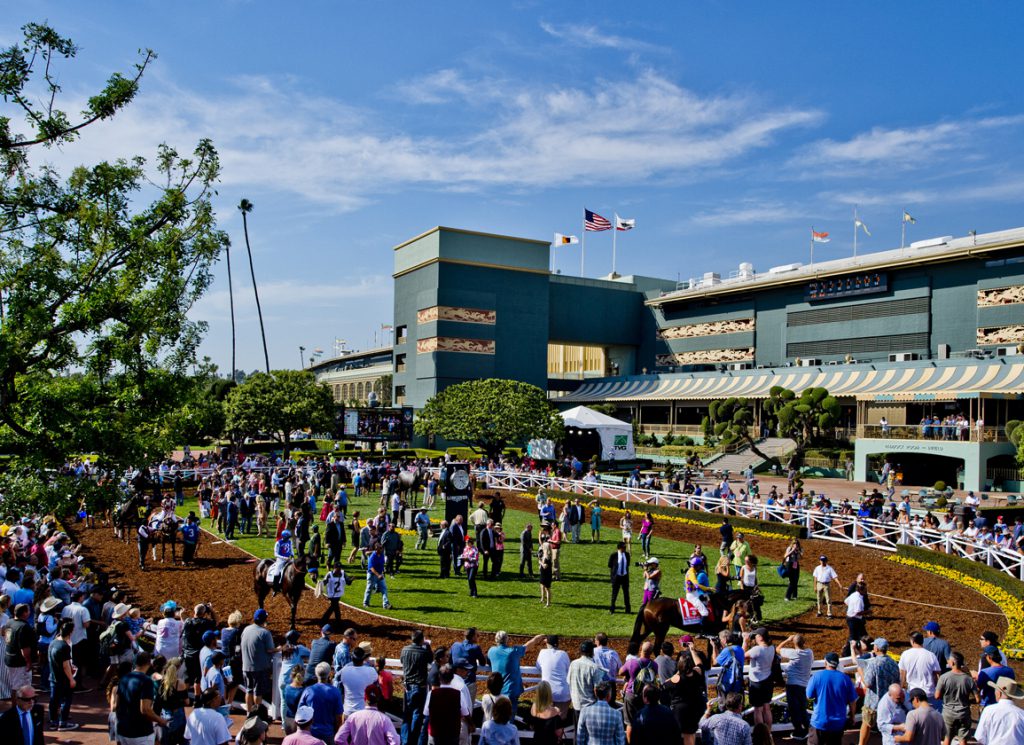
Santa Anita | Benoit

Modifications Already Instituted in California

That said, efforts have already been made at Santa Anita and Golden Gate Fields to control CAW growth in California—the first concerning the Rainbow Pick 6.

Since Santa Anita's fall meet last year, CAW players have been prohibited from taking out the Rainbow Pick 6 jackpot on a non-mandatory payout day.

“CAW players must bet in a 40-cent unit which means they can't take out the jackpot,” Nader said. By rule, the only way the jackpot would be paid is to a single 20-cent unit.

The second concerns a bête noir of CAWs among ordinary gamblers–swinging last-minute odds changes. In response, CAW players must pay a surcharge of around 3.5% on top of their normal rate if they want to bet to the close of the win-pool, said Nader.

These modifications, said Daruty, were made at least partly in response to player feedback.

“There were complaints about late-odds shifts and a lot of focus on CAW players as the cause of that, and we wanted to take steps to try to alleviate the problem if not wholly at least partially,” Daruty said.

Have these modifications rectified the problem of late-odds changes? “We've monitored it carefully and we believe it has had a materially beneficial impact on that issue,” Daruty replied, leaving the door ajar for further possible pricing changes in CAW play.

“I don't know there is ever a perfect answer or a final answer,” Daruty said, adding that anything more specific on possible pricing tweaks would be a hypothetical. “It's an issue we will continue to monitor and if necessary make adjustments.”

Nader took a similar stance to Daruty, saying that the CAW surcharge is so prohibitive, “it effectively prices them out of participating in the win pool.”

But these modifications haven't fully addressed the issue of striking the right balance between CAW and non-CAW play, Nader added, once again saying “it's all about how we control access to the pools and how we price it to ensure fairness.”

As to what additional controls on the betting pools could and should be instituted, Nader also largely steered away from specifics, explaining that contract negotiations are ongoing between the tracks and the TOC with the Del Mar summer meet on the horizon.

Del Mar offers an intriguing case study as to the growing impact from CAWs in California.

According to publicly available CHRB data, the total amount Elite Turf Club wagers at Del Mar annually has increased nearly 56% comparing 2018 data–the year prior to the Santa Anita welfare crisis and a global pandemic–and 2022 numbers.

On a handle-per-race basis, the increase is even more stark. Comparing 2018 numbers to 2022, the Elite Turf Club's per-race handle increased 73.1% at Del Mar.

“I'm not trying to avoid the question, but we still need to have the conversations with the track partners,” Nader said, when asked about specifics concerning these ongoing negotiations. “We have the rights to approve, but I need to respect the position of the tracks. We need to come together.”

Nader pointed, however, towards the higher takeout wagers–like the Pick 4, 5 or 6 bets–as an area for possible pricing modifications.

“The CAW players have gravitated towards the multi-leg wagers which are higher takeout wagers. In many cases, higher takeout wagers can lead to higher rebates. There's where I think there's room for discussion,” said Nader.

For win, place and show or Exacta wagers, the takeout is extracted one time for each race. In the multi-leg wagers, however, the takeout is extracted only one time for a sequence of races.

“So, in terms of payments to tracks through commissions and to owners through purses, those dollars are not working nearly as hard as they would be in the single race pools,” said Nader.
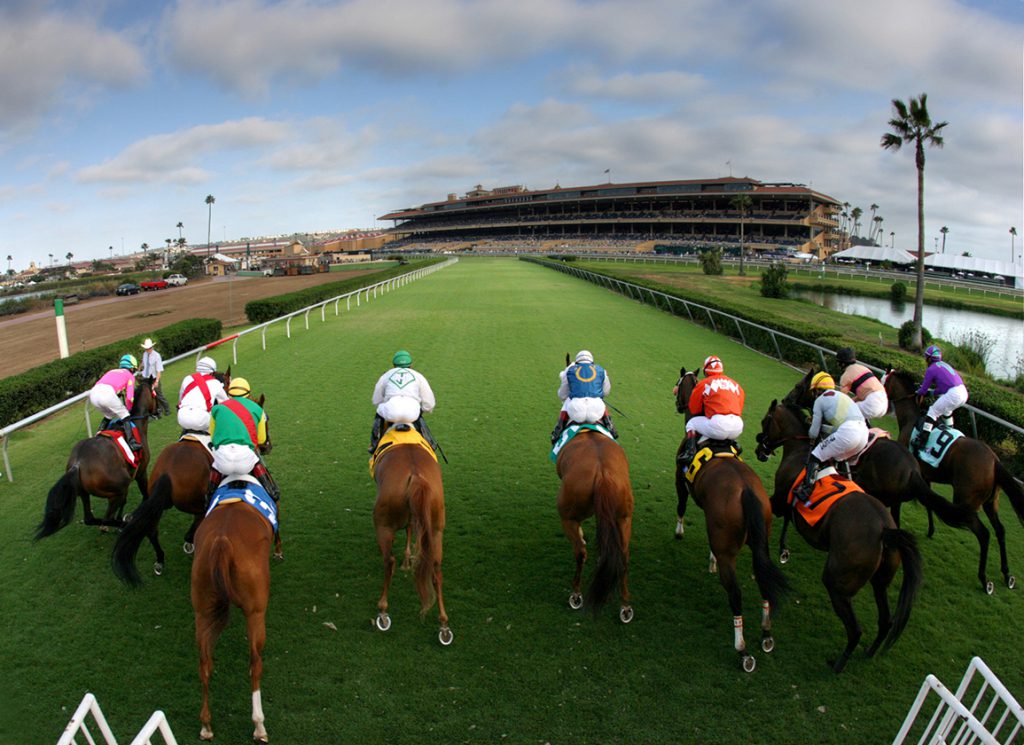
Del Mar | Horsephotos

Concern Over Core Customers

The Thoroughbred Idea Foundation (TIF), an industry think-tank, has been banging the drum about the rise of CAWs, and the implications for the industry, for several years.

Just this March, TIF co-founder Craig Bernick warned that the current trajectory of CAW play risks substantial losses to both mainstream betting customers and to racehorse ownership.

In the same vein, Pat Cummings, TIF executive director and a former executive with the Hong Kong Jockey Club, stressed how vigilant California horsemen should be to the impacts from CAW to the long-term sustainability of the state's racing industry.

“No group should be pushing more for reform in this space–and to date, that has not really happened,” Cummings said, pointing to how California's purses are built solely upon handle, unlike other states which bolster their purse revenues through other sources. “Wagering is the lifeblood of the sport, but in America, nowhere more so than California.”

As such, pricing is key. “The growth of CAW play is proof that the cost we charge bettors via takeout matters,” Cummings said.     “If takeout was higher for CAWs, they wouldn't wager or churn as much as they do,” Cummings added. “And while we don't have access to the deals cut to incentivize them, their overall growth is the sign that improving their experience through better pricing has worked.”

Indeed, the lack of public transparency by the industry at large about the impact from CAWs is glaring. Take the CHRB, one of the more transparent commissions when it comes to CAW data.

Until 2021, the CHRB issued detailed annual betting data on individual Elite Turf Club accounts. Last year, the CHRB lumped all Elite Turf Club accounts into one block.

More specifically, the incentives offered these players is another major bugbear of CAWs. According to the FT, the rebates that CAW players receive can be around 10% of whatever they bet.

When asked if these details should be made public, Nader said that any effort at pricing transparency should ideally be done uniformly across the nation. “But I'm not sure there's a willingness to do that,” said Nader, who added that legal obstacles could similarly hinder such endeavors.

When asked the same question, Daruty said that “we believe very strongly that the personal wagering habits of our customers and their personal situations is something that should remain private, so we're not prepared to discuss specific rebates of specific players–that would not be appropriate.”

Individual rebates, Daruty explained, are dependent upon a wide variety of factors.

“Thus far we haven't found a one-size fits all model that we think makes sense for our racetracks, the horsemen who run there, as well as our customers. Until we can come up with such a model, we're going to continue to have a wide variety of rebates available to a wide variety of customers,” Daruty added.

Which leads to a fear among track operators that weakened CAW incentives could drive these price-sensitive players from the game. At the same time, without controls on CAW access to the betting pools, CAW is only going to further sour the average gambler to the game, Nader admitted.

“For the casual bettor, I'm not so sure,” Nader said. “It's the core customers, they're the ones I'm concerned about. I'm talking about the ones at a level just below the CAWs–they're the ones contributing on a day-to-day basis or participating at a higher rate. We want to make sure we're looking after their interests.”

What should that look like? Nader skirted specifics, calling it “a question for the industry at large to look at.” That said, “the key is introducing new people to the sport. Maybe we haven't done a good job at that for the last 10 to 20 years.”

The post When Do CAWs Help And Hurt California Racing? appeared first on TDN | Thoroughbred Daily News | Horse Racing News, Results and Video | Thoroughbred Breeding and Auctions.

Source of original post

Johannes Providing a String of Firsts for McCloskeys

After watching the races just across the street from their home in Del Mar, Joe and Debby McCloskey decided to take the plunge into racehorse ownership with the purchase of a filly by Congrats at the 2014 Keeneland September sale. Now, nearly a decade later, Johannes (Nyquist)–the first foal out of that first filly–has become the couple's first stakes winner and the 3-year-old gave promise of more firsts to come in the near-future with an authoritative second stakes victory in the Pasadena S. at Santa Anita last Sunday.

Johannes began his racing career on the main track, but immediately found success on the turf where he broke his maiden by nine lengths at Santa Anita Dec. 31. He overcame a world of trouble to win the Mar. 5 Baffle S. before making his two-turn debut in the Pasadena.

“It was our very first stakes win,” Joe McCloskey, a retired businessman, said of the Baffle. “Obviously, it was fantastic and to be able to back it up with another stakes win, you talk about firsts. Cuyathy was our first horse, and this is her first foal, and now two stakes races back-to-back. There are a lot of firsts with that horse.”

Recalling his first foray into racing, McCloskey said, “We have a condo that is right across the street from Del Mar, so it was convenient to go over and watch the horses. Eventually we got hooked up with a couple of trainers and said, 'Let's give it a shot.'”

The California couple headed to Kentucky with a plan–sort of– and a dream.

“We were pretty naive back then,” McCloskey said with a chuckle. “We put a budget together of $100,000, with $50,000 for a horse. And we thought we would get one out at Keeneland and start there. We thought that was going to be plenty of money.

“So we went out to Keeneland and my wife Debby and I were wondering how we would know if it was the right horse, when will we know? So Debby put it out there and dreamt about and said, 'I know if there is a heart on the horse somehow, a heart comes into my mind, that will be our horse.' We get to our book–when you can get a horse for $50,000–and the first one comes up and the hair on the cowlick kind of looked like a heart, maybe this is it? So we bid on it, but we got outbid. Maybe there needs to be a better heart? Surprisingly when Cuyathy came by, our trainer said what do you think? And lo and behold, we look down at the chestnut and it was in the shape of the heart. And the hammer dropped at exactly $50,000. Our trainer thinks we are nuts at this point, but anyway that's how we got Cuyathy.”

The McCloskeys ended up taking another filly home from Keeneland that year, going to $8,000 to acquire a daughter of Curlin they named Reiki Baby.

Cuyathy went on to win three times in 20 starts, including a third-place effort in the 2018 Kalookan Queen S., and earn $107,923. Reiki Baby, who didn't make it to the races until she was four, was a first-out winner at Santa Anita in 2017 and twice second before being retired after four starts. Both mares, now 10, ultimately became the McCloskeys' broodmare band.

“People told us, if you think racing is tough, breeding is even worse, it's tougher,” McCloskey said. “So we looked at each other and said, 'Let's give it a shot.' We are a micro-breeders, those are the only two mares that we have. But they were our first two horses. Literally, Cuyathy was the first horse we bought and Reiki Baby was the second one.”

The breeding operation got off to a slow start when Reiki Baby's first foal, Lightheart (Blame) failed to make it to the races. But it has picked up steam thanks to Johannes, whose dam was producing her first foal by Nyquist at about the same time Reiki Baby was producing another colt by the GI Kentucky Derby winner.

“We bred both Reiki Baby and Cayathy to Nyquist,” McCloskey said. “People said we were nuts. I said, this whole game is nuts, let's just go all in, let's breed both to Nyquist and maybe one will catch.”

Johannes, along with Reiki Baby's second foal Reiquist, began his racing career back east with trainer Bill Morey, but both suffered some bad luck.

“Billy had both our horses at Churchill and in one day, I get a phone call he goes, 'Joe, Reiquist has a fracture, we have to ship him back to Rood and Riddle in Lexington. And Johannes has some chips. I said, 'You've got to be kidding–this is one phone call and my first two horses. Long story short, we brought Johannes over to Rood and Riddle, took out a few small chips and Dr. Bramlage saw a little issue on the other leg, so they took it out and we gave him time off to come back. And then Rood and Riddle repaired Reiquist's fracture and he's at Santa Anita. He just breezed three furlongs twice already and he's looking really good.”

Both horses are now in the Southern California barn of trainer Tim Yakteen, who McCloskey credits with a slow and steady approach to the races.

“Tim Yakteen is probably one of the best, most conservative trainers there are when it comes to getting your horse back in good shape,” McCloskey said. “People say you have to have patience in this business. In this business with Tim, you have to have glacial  patience. But he knows his business.”

In his first start for Yakteen, Johannes was a solid third behind Fort Warren (Curlin), subsequently third in the GII San Vicente S., and Spun Intended (Hard Spun).

“He was just coming back off a layoff and he came in third, but he really challenged Fort Warren,” McCloskey said of that effort last October. “I was sitting in a box next to Bob Baffert and Bob came down and said you've got a nice horse there. So the dirt looked really good then.”

Johannes took a step back next time out, however, finishing a well-beaten fifth at Del Mar in November.

“We brought him over to Del Mar, but we shipped him in the day before the race and he got very nervous and he was washed out and he didn't perform well there,” McCloskey said. “At that point, we decided to see what would happen if we put him on the turf because his mother had success sprinting over both Tapeta and turf.”

Of that first try on the lawn that resulted in an emphatic maiden score, McCloskey said, “Boom. We put him on the turf and it was like, I guess he likes the turf. He won by nine lengths and he wasn't even asked.”

Making his next start in the 6 1/2-furlong Baffle S., Johannes was mired in traffic down the hill and had nowhere to go turning for home, where things only got worse for the dark bay colt as he was jostled about before ultimately slicing between foes and bounding away once in the clear in the final strides (video).

“I've never seen a horse get into that much traffic, have to steady that much, and then he sliced and diced picking his path,” McCloskey recalled. “I tell you, I would have taken all my money off the table halfway through the race. I thought there was no way this horse could do anything, but he popped out and still won by 1 1/2 lengths. I went up to Umberto [Rispoli] after the race and his head was still shaking. I said, 'You got in a little trouble?' and he said, 'This horse is a freak to be able to come through there.'”

After the drama of the Baffle, Johannes's win when stretched to one mile in the Pasadena S. was somewhat ho-hum. Settled at the back of the pack, the heavy favorite powered to the lead at midstretch and sauntered clear to an easy 3 1/2-length victory (video).

The pair of stakes victories have likely earned Johannes a spot in graded-stakes company, but connections are still weighing their options.

“Right now, we are pointed towards the [GII] American S. [at Churchill Downs] on Derby Day,” McCloskey said. “We know we want to keep him with 3-year-olds at this point. So that's the race that is on screen. But because it's Derby day and because of the way he got a little nervous just shipping in to Del Mar, we might look for some other options, so maybe instead of 75,000 people, we have 10,000. We will get a couple 3-year-old races in him and from there, if he continues to do what we think he can do, we will look at the 3-and-up races. Then, in the best of all worlds, of course, you look at the Breeders' Cup in November. Do we even have a shot at that? We hope so. It's one step at a time in this business for sure.”

The McCloskeys also have plenty to look forward to from their two-horse broodmare band. Reiki Baby has a 2-year-old colt by Mendelssohn and a yearling filly by Practical Joke. Cayathy has a 2-year-old filly named Sea Dancer (Mastery) who is in training with Morey at Keeneland, as well as a yearling filly by Gun Runner. She produced a filly by Knicks Go this year and will be bred back to Mandaloun.

“We are smart enough to know that you can't make a lot of money in this business unless you are super lucky,” McCloskey said. “But with that Gun Runner filly out of Cuyathy, it's giving us cause for pause to think maybe we sell that filly–because you can't keep them all–or do you maybe say, if Reiki Baby isn't doing what we want, do we keep that filly and still have two [broodmares]. But it's not like we are going to have five or six more. We are happy with two, we get to see them, and maybe we would have one more.”

McCloskey said he and his wife have no specific goals for their racing and breeding operation, but are content to enjoy the ride.

“I've seen a lot of smart people lose a lot of money in this business,” he said. “So we will just try to keep it balanced, to have fun and, as long as we are having fun and the horses are helping pay for some of the bills, we are happy. This is a crazy business. It's just a matter of making sure that you're enjoying it every day. And we are right now.”

While they are enjoying the business, they are also very focused on paying it forward.

“We balance everything we do back on the other side,” McCloskey stressed. “We are big supporters of a place here in California called Laughing Pony Rescue, which is in Rancho Santa Fe, and we save a lot of horses there. We donate to CARMA and New Vocations, some of those people have taken our horses. We think it's important that anybody who is in this business balances it out by helping the other side of the equation, the ones that are retired.”

The post Johannes Providing a String of Firsts for McCloskeys appeared first on TDN | Thoroughbred Daily News | Horse Racing News, Results and Video | Thoroughbred Breeding and Auctions.

Source of original post

Sunland Park Hosts Fundraiser for Injured Riders

Sunland Park Racetrack & Casino is playing host to a fundraiser for recently injured riders 19-year-old Bryce Bourdieu and 21-year-old Joree Scriver. The pair will be presented checks by SPRC Simulcast Coordinator and Chaplaincy representative Rayeanne Holland Saturday, Apr. 1, the racetrack's final Saturday of the season.

Raffle prizes included VIP packages at Sunland Park, a Professional Bull Riding event, the Ruidoso Jockey Club and Del Mar Racetrack, as well as a $2,000 saddle, a $1,000 pallet of horse feed and $3,500 custom boots by Mario Garcia.

Raffle tickets are available at the Sunland Park Turf Club, with the drawing scheduled for Apr. 1.

Bryce Bourdieu was injured last August in Texas, where he worked as an exercise rider and assistant starter. The son of popular Sunland Park Racetrack Handicapper Julie Renee Farr and jockey Martin Bourdieu, Bryce is recovering from extensive injuries, two back surgeries and a lower leg amputation. His medical bills are in the hundreds of thousands of dollars.

Joree Scriver was seriously injured during a New Year's Day race when the horse she was riding suddenly fell. She had emergency back surgery to repair several fractured vertebrae and continues to suffer from the surgery, broken ribs a collapsed lung, facial lacerations and a severely bruised spinal cord. She has been receiving rehabilitation care in Colorado.

The post Sunland Park Hosts Fundraiser for Injured Riders appeared first on TDN | Thoroughbred Daily News | Horse Racing News, Results and Video | Thoroughbred Breeding and Auctions.

Source of original post

Del Mar Boosts Maiden Allowance Purses

Del Mar will once again offer a bonus package for maidens competing at the highest levels on dirt throughout its upcoming 84th summer season, the track said in a release on Wednesday.

The move adds 25% in purse earnings to runners who fit the simple specifications of the program, is available to all dirt competitors in maiden allowance races, all California-bred maiden allowance races or any maiden-claiming race at the $62,500 level or above. The maiden must come from the barn of a trainer who has no more than 60 horses stabled in Southern California.

“It is simply a monetary incentive for owners and trainers to run in essential races that help solidify our racing cards throughout the meet,” said Tom Robbins, Del Mar's executive vice president for racing.

The track has also raised its maiden allowance purses for '23 to a California record $82,000. Its 25% maiden bonus elevates that purse to $102,500. The other races that qualify for the maiden bonus program are maiden-claiming $150,000 ($57,000 purse, that rises to $71,250 with the bonus), maiden-claiming $80,000 ($50,000 purse, that climbs to $62,500) and maiden-claiming $62,500 ($46,000 purse, that goes up to $57,500). The bonuses apply to horses that earn purse money for finishes from first through fifth.


The post Del Mar Boosts Maiden Allowance Purses appeared first on TDN | Thoroughbred Daily News | Horse Racing News, Results and Video | Thoroughbred Breeding and Auctions.

Source of original post

Verified by MonsterInsights