The “Quick Fix” of Synthetics is Not the Answer
Horse racing has been down the path of synthetics before at Santa Anita, Del Mar, Keeneland, etc. Much time was lost, approximately a decade ago, with a focus on changing surfaces as a panacea for horse racing breakdowns. We now know there are other causes for horse breakdowns that are more prevailing. The greatest single cause of racing deaths has to do with pre-existing conditions of the horse, and only in particular instances is the surface itself the primary reason for horses breaking down while racing. Synthetics have found a role to play in the Industry but racing on synthetics exclusively means to change the sport itself in a fundamental way: from breeding, to handicapping, to the aesthetic beauty of competition–the reasons we are all fans of horse racing. And, changing to synthetics will not appease the critics if that is the motivation to do so.
But statistics show that horse racing deaths are less on synthetics than either dirt or turf. Surely safety must be the main focus with racing today. Yes, safety must be a central focus but there has to be some perspective. Horses also die in nature. The thoroughbred industry cannot be expected to prevent ALL deaths of horses and a comparison must be made as to how often and how horses die in nature to reach a fair, concise view of horse racing. Such a comparison, of course, is extremely conjectural. There are no thoroughbreds in nature and not many other horse breeds in nature today at all. Experts from many areas would have to weigh in on such a comparison.
In other words, the approach to the issue of horse racing deaths in general, that is, how the question is posed, is false. So too is the case for synthetics falsely stated. Are we to believe that horses somehow have more trouble competing on dirt and turf than fabricated material? Biology and evolution would initially say otherwise. Similarly, are we to suppose that the breeding of thoroughbred horses is inherently producing unsound animals? Again, general evolutionary changes of such a magnitude would take time. To make such an argument, geneticists would have to be consulted to ascertain that thoroughbred breeding practices are actually producing inherently unsound horses. But first things first. Looking mainly into the track surface and or scrutinizing breeding operations are not the places to begin when investigating horse racing breakdowns.
Back to the statistics. Statistics don't lie. More horses break down on dirt or turf than synthetics per Jockey Club figures. But statistics don't always give answers either. Indeed, the overall sample size in the Jockey Club figures in the aggregate is large but the fact that the number of dirt races were about 7 times more than synthetic races is a cause for pause in a comparison. Sample sizes are usually uniform in the scientific method. And when looking at individual tracks per year, the sample size is quite small when considering dirt races only. A track can thus vary markedly from year to year in horse fatalities as the Jockey Club statistics indicate.
And the sample has to be RANDOM. Horses that are selected to compete on synthetics are not randomly chosen. That is, the two populations: horses that run on dirt and horses that run on synthetic are not uniform. So the synthetic numbers for horse fatalities that are generally lower than for dirt fatalities may or may not be because of the surface. The fact that both are samples of thoroughbreds is not rigorous enough to make a valid comparison. The sample population has to be random. A random sample also compensates for genetic variation in a species. The best argument for synthetics in terms of the data comes from Gulfstream Park in 2022. At Gulfstream, there were about 7000 starts on synthetic with one fatality whereas there were about 6000 starts with 8 fatalities on dirt. At least the number of starts were comparable at the same track for each surface but again, horses were selected by trainers for various reasons to race on synthetic rather than dirt. Better comparison of the two surfaces–but still not a random sample of the horse population at Gulfstream and one year is not nearly enough to draw any serious conclusions.
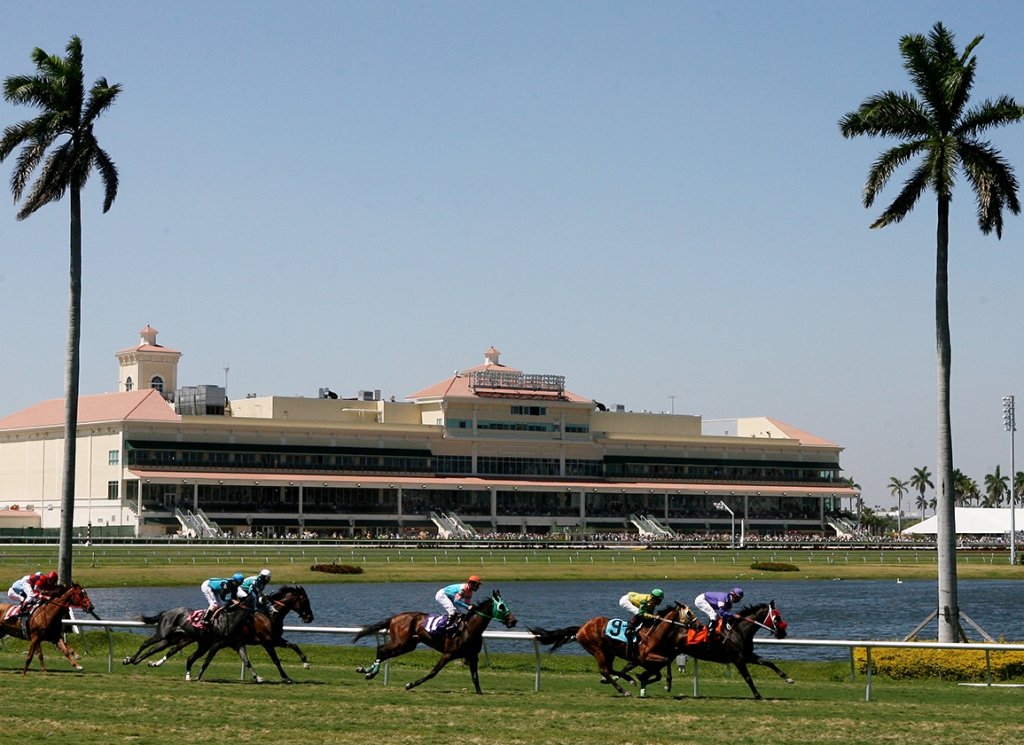
Action at Gulfstream Park in Hallandale Beach, Florida | Bill Denver/EQUI-PHOTO
Any glance at aggregate statistics for analysis would have to consider figures after 2019 after the implementation of new safety protocol stemming from the racing deaths at Santa Anita that year. But even here, with a seemingly logical approach to the data on racing breakdowns, a comparison is problematic. There are inexplicably low dirt rates of fatalities (say below 1 per 1000) before 2019 with dirt racing at various tracks that, in other years, had higher rates of about 2 per 1000. Such variability calls into question any definitive conclusion about track by track breakdowns relating to surface only.
What we do know is that Del Mar, Santa Anita and Keeneland have had remarkably low rates of fatality on dirt the last 2-3 years. For example, Keeneland had 3 deaths from 2020 to 2022 in almost 5000 starts or about 0.6 per 1000. Del Mar had none from 2021 to 2022 with almost 4000 starts. Such figures compare favorably with the lowest synthetic figures. Given these Keeneland and Del Mar figures it is a stretch to say that dirt racing is inherently or significantly more dangerous than synthetic racing. The question does remain: are these rates extendable over time? If the safety reforms in horse racing continue and are enhanced, the chances are they can be.
What we can say with some assurance is that all horse racing death rates are going down from year to year. The average rate of horse death for 2022, in an industry where safety reforms have not been sufficiently generalized, was 1.25 deaths per thousand. Still, it is too early to draw conclusions about horse racing deaths (especially in the wake of the recent spate of breakdowns at Churchill) until the new protocol is agreed to and generalized throughout the industry and a number of years with such protocol in place has passed. The hard work of putting in the safety measures is just beginning.
Horses run slower on synthetics than dirt. Is running fast then a problem? There are many misconceptions here. The issue is not speed but how often a horse is asked to race at high speed. Here the veterinarians can chime in to assist trainers with their training and racing schedules. A dialogue should ensue on best practices. A horse can race more often if it is running easily. A horse in a grade I race cannot race as often as winning at that level usually requires maximum effort. So comparisons by racing fans of one horse's schedule to another are not valid. Each horse is different both in terms of circumstance and genetic variation and trainers must be more in tune with their vets moving forward not just on a horse's ailments and therapeutic medication but on their racing schedule itself.
–Armen Antonian Ph.D

The post Letter to the Editor: Armen Antonian appeared first on TDN | Thoroughbred Daily News | Horse Racing News, Results and Video | Thoroughbred Breeding and Auctions.
Source of original post
