Revised CHRB Whip Penalties On Target For BC, Largely With Guild’s Blessing

In an attempt to get a revised whip violations penalty scheme on the books before Del Mar hosts the Nov. 5-6 Breeders' Cup, the California Horse Racing Board (CHRB) Wednesday advanced a rule amendment that mostly has the blessing of The Jockeys' Guild because it strips out a previously controversial proposal that would have docked jockeys 50% of purse earnings if they over-whipped while finishing first, second or third in graded stakes.

That purse penalization had been proposed by the CHRB in March in an attempt to disincentivize riders from disregarding the number of times and manner in which a Thoroughbred can be struck with the whip, particularly if the jockey believed the reward of winning a multi-million-dollar stakes far outweighed the cost of incurring a comparatively smaller fine or suspension.

When the Guild and other stakeholders argued last month that going after purse money was too harsh, the CHRB voted 4-3 to table the measure and revise it. The new version that the board voted 6-0 on Apr. 21 essentially is the same proposal, except with the purse penalization removed from the new language of Rule 1688.

Left intact from last month's version was an amendment to change the maximum fine of $1,000 and a minimum suspension of three days to a minimum fine of $500, or, if determined by the stewards to be an egregious or intentional violation, a larger fine, a minimum suspension of three days, or both. That is the meat of the measure that now advances to California's mandatory 45-day public comment period before it will come back to the CHRB for a final vote.

Based on testimony delivered Wednesday by Shane Gusman, an attorney representing the Jockeys' Guild, the riders aren't likely to challenge the proposal before its expected adoption.

Gusman thanked the CHRB for addressing concerns that he aired on behalf of the Guild back in March. “We certainly appreciate the clear linking of the most egregious conduct with the significant, or higher, penalties, and the elimination of the 50% purse forfeiture provision,” he said. “Those were pretty large concerns of the folks in the Guild in California.”

Gusman did say that parts of the penalty scheme do “remain concerning,” including there now being no cap on the maximum fine. He said that creates a concern that “someone could get a fine that's out of whack” in relation to the infraction, and he asked the board to monitor the wide discretion that stewards will be given once the new version of the rule gets officially enacted.

Gregory Ferraro, DVM, the CHRB's chair, reminded Gusman that jockeys always have the avenue of appealing stewards' fines to the full board if they believe they're not fair, adding that, “I think your worries there are probably not significant.”

At the March meeting, CHRB Vice Chair Oscar Gonzales had said that “this rule is [about] making sure that the upcoming Breeders' Cup goes off [more] smoothly than anything else.” He articulated a concern that the combination of two days of Grade I stakes and too weak a penalty scheme would create “a wild west type of a situation” in which jockeys openly flouted the six-strike, underhand-only, no-more-than-two-hits-in succession rule in order to cash in on a lucrative and prestigious payday.

Scott Chaney, the CHRB's executive director, noted that it is standard for the stewards to hold daily briefings with visiting riders from other parts of the country and from overseas during the Breeders' Cup week, and that this year the stewards will be tasked with making sure no rider can say he or she wasn't aware of the whipping protocols and the penalties for violation.

“I think this protects the domestic rider,” Ferraro said with respect to the Breeders' Cup. “Our concern had been that riders, particularly from foreign countries, could violate the rule, and a $500 fine and three-day suspension would be meaningless to them. This allows for considerably more punishment for egregious violations and it's increasingly fair to our domestic rider colony.”

But the Breeders' Cup is only two days a year every several years in California. Chaney, a former steward, explained how the new proposed rule will also affect everyday riding.

“The idea is that it standardizes penalties throughout the state,” Chaney said. “Based on existing language, it appears that we have sort of a disparate application among boards of stewards. And so to be more fair to jockeys, particularly in Northern California, it would create a minimum fine. It also delineates the cases in which stewards would deviate from that fine” for any outlandish abuse of the whip.

CHRB commissioner Alex Solis, a retired Hall of Fame jockey who had spoken out against the version of the rule that was floated last month, was absent from Wednesday's meeting and thus did not cast a vote.

The post Revised CHRB Whip Penalties On Target For BC, Largely With Guild’s Blessing appeared first on TDN | Thoroughbred Daily News | Horse Racing News, Results and Video | Thoroughbred Breeding and Auctions.

Source of original post

Wagering Insecurity: When Doping And Gambling Are Intertwined

This is Part 2 of the Thoroughbred Idea Foundation's (TIF) series “Wagering Insecurity.” 

Faced with remarkable competitive pressure from the rise of legal sports betting, horse racing is at a crossroads. 

Confidence amongst horseplayers and horse owners is essential to the future sustainability of the sport. Efforts to improve the greater North American Thoroughbred industry will fall flat if its stakeholders fail to secure a foundation of integrity, along with increased transparency of the wagering business and its participants over time. Achieving this is growing increasingly difficult after the sport has neglected its core base – horseplayers – for decades.

“Wagering Insecurity” details some of that neglect, and the need to embrace serious reform. Fortunately, there are examples across the racing world to follow.

PART 2 – INTERTWINED

Corruption resides at the intersection of significant financial gain and loose regulation. Purses boosted by subsidies from slots and other non-racing wagering present a robust opportunity for illicit activity but the sport's regulatory structure has not kept pace, either with other racing jurisdictions around the world or modern sports.

Jack Anderson, a leading global expert on sports integrity, was the keynote speaker at the University of Arizona's Global Symposium on Racing in 2018, presenting “Integrity in the World of Commercial Sport.”

Director of Sports Law at the University of Melbourne, he advises the Asian Racing Federation's Council on Anti-Illegal Betting and Related Financial Crime (ARFCAIB), whose work will also be referenced later in this series, and is a current member of both the World Athletics Disciplinary Tribunal and the International Tennis Federation's Ethics Commission, among other roles.

He spoke with TIF about the relationship between doping and other illegal activity to affect the outcomes of sporting events.

Effective doping control is of course a vital element of the integrity objectives of a sport such as racing but it should not be the sole integrity concern and should not be seen in isolation.

“Doping in a sport such as racing is often intertwined with gambling interests, which in turn may be symptomatic of wider illicit or even criminal involvement in the sport. 

“Studies commissioned by racing regulators in Great Britain and Australia noted an immediate concern with levels of criminality in the sport, attracted to the money and image laundering opportunities presented by the sport's long association with gambling.” 

Anderson told TIF that doping and gambling often go together, and the presence of doping in a racing culture can be symptomatic of other issues.

“The prevalence of doping in a racing jurisdiction may also be reflective of weaknesses in that racing organization's race day operations such as:

stewarding and standards of veterinarian oversight, 

lack of capacity in intelligence gathering on and knowledge of industry participants

vulnerabilities in the licensing and registration of industry participants, and 

the ability of the racing organization or jurisdiction to punish misconduct by industry participants.” 

There should be little need to explain the perception of doping in North America's racing culture. While the sport is regulated, public confidence in the ability of regulators and their laboratories to catch cheaters is low.

Have any doubt?

How long did Jorge Navarro and Jason Servis win at unusually high rates never to be discovered by North American racing's laboratory and regulatory structure but instead to be uncovered by a federal investigation?

EXAMPLES OF RACE FIXING, ETC.

Relatively few organized conspiracies have been uncovered in American racing over the past 20 years.

Those that have been uncovered were mostly, though not entirely, the product of state or federal law enforcement work, spurred into probing racing from other investigations rather than industry initiatives. Whether it is trainers and veterinarians illegally doping or jockeys manipulating races, TIF found only occasional instances of individuals identified and punished for attempting to profit via legal wagering channels over this period.

In January 2005, 17 individuals including trainer Gregory Martin were indicted on a host of counts including illegal gambling, conspiracy and money laundering. The plot involved the “milkshaking” of at least one horse at Aqueduct in an attempt to fix the race's outcome.

In October 2005, jockey Roberto Perez was suspended for seven years after placing superfecta bets on a race he rode and where his mount finished out of the first four placings.

Jockey Ricardo Valdes was one of seven jockeys barred by Tampa Bay Downs in December 2006, and was later indicted by the federal government in May 2009. He pleaded guilty to one count of attempt and conspiracy to commit mail fraud, with 18 other counts dropped, and was sentenced to just more than one year in prison, with three years of supervised release, in April 2015. Two co-conspirators served longer jail terms as their criminal activities moved beyond horse racing and into influencing collegiate sport events.

In July 2015, three jockeys were arrested at Evangeline Downs in Louisiana after being accused of manipulating a race at the track a month earlier, and being caught with illegal electrical devices known as “buzzers.”

Texas stewards, and local courts, caught up with jockey Roman Chapa for a well-documented incident at Sam Houston Race Park a few months earlier regarding buzzer use in January 2015, handing the journeyman a five-year suspension and $100,000 fine. He has since returned to riding.

Stewards at Canterbury Park in Minnesota suspended jockey Denny Velazquez for one year after finding a buzzer in his possession in July 2020.

Gulfstream Park has dealt with a few incidents that raised eyebrows, drew bettor complaints, and did yield some suspensions. Ray Paulick outlined those in a January 2020 article which included a series of incidents, strange superfecta payouts and more.

Florida racing is highly de-regulated, with individual tracks often controlling nearly all measures of oversight.

Paulick wrote:

“The track is under no obligation to notify the wagering public who is banned or suspended, for what reason, for how long, or whether or not a suspension (made public or not) has been reduced in time…

“It is not the most transparent way of doing business and does not instill a great deal of confidence in the wagering public.”

The indictments that scooped Jorge Navarro and Jason Servis, among others, were made public thanks to the eventual involvement of the U.S. criminal justice system. Notably, private investigations sponsored by The Jockey Club, among other groups, were seemingly crucial to yielding these indictments, though the majority of the cases have yet to be tried as of April 2021.

Federal involvement also led to the conviction of veterinarian and trainer Alfredo Lichoa when he was sentenced in February 2021 to three months in prison for his role in a money laundering scam that involved a Florida-based horse owner and dirty money from Brazilian politics.

As the site of these more recent incidents, it is notable that Florida no longer has a racing commission. The sport is regulated by an amalgamation of house (racetrack operator) rules and some state oversight on testing and licensing.

The indictments from these cases revealed no details regarding wagering on the horses or races involved. If racetracks or other groups have investigated suspicious wagering, the public is unaware of any outcomes. The lack of transparency, of any public discourse on these matters, is itself disconcerting. An opaque integrity infrastructure is like having no integrity infrastructure.

MASOCHISTIC

Jack Anderson's remarks connecting doping, wagering and other concerns are worthy of reiteration:

“Doping in a sport such as racing is often intertwined with gambling interests, which in turn may be symptomatic of wider illicit or even criminal involvement in the sport…

“The prevalence of doping in a racing jurisdiction may also be reflective of weaknesses in that racing organization's race day operations.”

The 2014 case of Masochistic case offers insight to how doping and wagering can be intertwined.

Masochistic debuted at Santa Anita on March 15, 2014, in a maiden race restricted to California-bred horses and the stewards' minutes, published by the California Horse Racing Board, explain the rest.

“Jockey OMAR BERRIO…was in the office to review the ninth race from yesterday's card. At issue was his lack of effort on his mount, MASOCHISTIC, trained by A. C. AVILA. There was no discussion of the pertinent facts as a formal hearing will be set in the near future. The Board of Stewards was concerned that Mr. Berrio prevented his horse from giving his best race. The horse was examined and tested post-race, and the CHRB investigators were directed to look into the matter.”

Video of the race is damning for Berrio. Masochistic was under a stranglehold the entire race, and Berrio never once asks the horse for an effort, cruising under the line in fifth as the 8-1 fourth betting choice.

On April 26, 2014, stewards held a hearing and reported that Masochistic tested positive for the sedative acepromazine and disqualified the horse from his fifth-place effort.

Seven days later, on May 3, Masochistic appeared in an open maiden race at Churchill Downs. The race was not just a class hike from state-bred maidens to open maidens, but was the third race on the biggest day of the year – Kentucky Derby day.

It was fairly unusual for a horse trained by Avila to race in Kentucky.

In the 10 years prior to this race, Avila trainees made nearly 1,400 starts and only six of those came in Kentucky, all in graded stakes races. Two of the six starts came on Kentucky Derby Day in 2005, when Oceanus finished ninth in the Grade 2 Churchill Downs Handicap at 60-1 and Santa Candida was eighth at 24-1 in the Grade 1 Humana Distaff Handicap.

Omar Berrio rode both.

Masochistic's maiden race was the only horse Avila was saddling at Churchill on May 3rd and he legged-up that day's eventual Derby winning jockey, Victor Espinoza.

The race jumped at 11:33 A.M. Eastern time, with total intra and inter-race wagering pools of more than $3.7 million. Masochistic went straight to the lead and never looked back, winning by 14 lengths. Despite the shift from state-bred maidens to open maidens, Masochistic was dispatched a solid 2-1 favorite.

Some 10 days later, the late Ned Bonnie, then a Kentucky Horse Racing Commission member, thought a betting coup was perpetrated on Derby Day.

Frank Angst from the Bloodhorse details the rest:

“Bonnie, who consistently reminds other commissioners that the betting windows can provide a bigger prize than a purse for nefarious horsemen, said the state needs to bring in outside help to investigate events surrounding the maiden win of Masochistic… 

“While that race may have been run squarely, Bonnie believes the betting public was duped by a program line that didn't provide the whole story with its “fifth by 4 1/4 lengths” in Masochistic's March 15 debut at Santa Anita Park.

“Importantly, the comment line noted a disqualification but there was no room for the reason for the DQ—a failed drug test. It did not note a follow-up investigation of Masochistic's rider that day, Omar Berrio, who is being investigated by the California Horse Racing Board for lack of effort in the March 15 race…

“Despite the disqualification and the rider investigation in California, Masochistic was allowed to be entered at Churchill in the May 3 maiden race. Horse racing is regulated from state to state.

“Bonnie believes the May 3 race won by Masochistic should be investigated closely, particularly wagering associated with the race, because Churchill may have been used to carry out a betting coup. The thinking is that with larger than usual purses on Derby day, large wagers would not catch as much attention and the larger pools would help ensure higher odds.

“Kentucky Horse Racing Commissioner Dr. J. David Richardson said because the horse ran legitimately in Kentucky and any concerns about his effort occurred in California, it was up to the CHRB to conduct the investigation.

“We're not in California, and we're not in Kansas,' Richardson said to Bonnie…

“Kentucky Horse Racing Commission supervisor of pari-mutuel wagering Greg Lamb said Kentucky has previously worked with other regulators and has provided wagering information as needed. After the meeting, Lamb provided a spreadsheet that showed $3,741,395.97 was wagered on the May 3 race at Churchill.

“The most money wagered on the third race May 3 at Churchill was the $545,292.50 sent in on-track. The other four outlets with more than $100,000 wagered were advance-deposit wagering outlets TwinSpires.com, TVG.com, XpressBet.com, and Churchill Downs-owned Isle of Man-based rebate shop Velocity Wagering.”

Nearly a year after Masochistic's sedated debut, the California Horse Racing Board suspended Avila for 60 days and fined him $10,000, the maximum allowed under the rules of the state.  Berrio's ride in the race is never referenced again in any other CHRB report, and in March 2021, a CHRB spokesperson confirmed to TIF that no complaint was ever filed against him for the ride.

Masochistic went on to become a Grade 1 winner for a different trainer and was the center of controversy after the 2016 Breeders' Cup Sprint, a race where he finished a close second, but tested positive for a banned steroid and was disqualified.

As the back-and-forth at the Kentucky Horse Racing Commission exhibited, state-by-state finger-pointing is of no benefit for the bettors, who surely took the brunt of the incident on both days. While horsemen have recourse as purses are re-distributed following positive tests, bettors have none.

In this case there was active, visible oversight. There were meaningful investigations. But due to a variety of factors, those measures failed. Instead, it showed the inherent impracticality of relying on state regulation of what has become a national business.

Overall, the greater industry has generally fought-off for decades meaningful attempts to improve integrity, specifically in regards to wagering. In our next installment, “Wagering Insecurity” details how nearly 20 years ago, and with key entities in the sport aware of exact vulnerabilities in wagering systems, a $3 million fraud was perpetrated on the sport's biggest day.

Coming Tuesday, April 20  Part 3 – Volponi

Miss a previous installment? Click on the links to read more.

Part 1 – Expectations

The post Wagering Insecurity: When Doping And Gambling Are Intertwined appeared first on Horse Racing News | Paulick Report.

Source of original post
Miller Fined $500 for Class 4 Positive

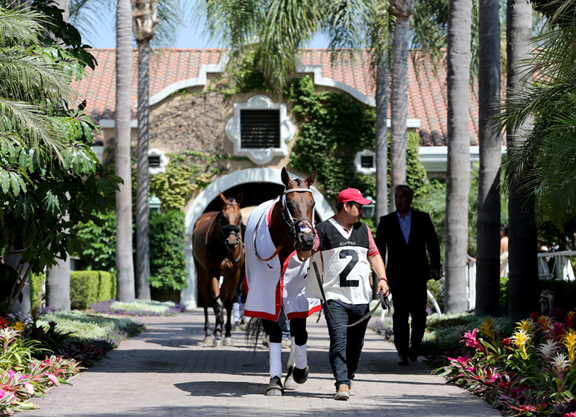
Trainer Peter Miller, currently third in wins and fourth in earnings at Santa Anita Park, has been fined $500 for a Class 4 finding of isoflupredone that was confirmed via split-sample testing when his trainee, Hembree (Proud Citizen), won the GII Joe Hernandez S. at 5-1 odds Jan. 1.

Isoflupredone is an injectable steroid primarily administered for anti-inflammatory effects. The drug's 4C categorization is on the less-severe side of the scale of the Uniform Classification Guidelines for Foreign Substances list published by the Association of Racing Commissioners International.

According to the California Horse Racing Board rule book, a trainer's first violation within a 365-day period for a Category C drug violation can result in a minimum fine of $500 to a maximum fine of $1,000 (absent mitigating circumstances).

In April 2017, Miller was previously fined $1,000 by the CHRB for an isoflupredone overage.

No disqualification or purse redistribution was listed within the ruling text on the CHRB website.

Hembree, owned by Tom Kagele, subsequently raced Feb. 6 when fifth in the GIII Thunder Road S. at Santa Anita.

It was not immediately clear at deadline for this story if Miller was appealing the fine. The stewards' ruling was dated Apr. 10.

The post Miller Fined $500 for Class 4 Positive appeared first on TDN | Thoroughbred Daily News | Horse Racing News, Results and Video | Thoroughbred Breeding and Auctions.

Source of original post

Political Climate in California

At the start of last month, a small cadre of animal rights protestors snuck onto the Golden Gate Fields racetrack, lay down with arms interlocked in pipes, and halted live racing–as well as a vaccination drive on facility grounds–until police intervention saw their removal.

While the incident had a flash-in-the-pan quality, it had the corollary effect of reminding those within the sport here in the Golden State of the somewhat precarious position in which it still finds itself–an important part of the economic puzzle, employing tens of thousands, but one that doesn't always fit squarely with the state's broader progressive bona fides on animal welfare.

And so, placed in the context of the last two years, during which time the sport has been buffeted by sweeping reforms and hitherto unbeknownst scrutiny, it begs the question: Where does the state's industry now find itself in terms of political favor and cultural currency?

The answer appears both promising and cautionary, with the California state senate's vote against the reappointment of Wendy Mitchell to the California Horse Racing Board (CHRB) Monday providing yet another indicator of a delicate balancing act.

“Two years ago, at this date, we were sitting at meetings with The Stronach Group [TSG], reviewing various plans whether to close Santa Anita for the rest of the meet,” said Greg Avioli, president and CEO of the Thoroughbred Owners of California (TOC), pointing to the welfare crisis that had engulfed Santa Anita.

Since then, the sports political roller coaster has been helter-skelter, taking in a joint hearing in Sacramento, a letter of condemnation from senator Dianne Feinstein, major pieces of legislation, a regulatory board dramatically reshaped by Governor Gavin Newsom–who told The New York Times in 2019, “I'll tell you, talk about a sport whose time is up unless they reform. That's horse racing”–as well as a proposed ballot initiative to end racing in the state (one that was ultimately extinguished before voters had a chance to weigh in).

Two years later, sweeping equine welfare and safety reforms have proven markedly effective. “We've come a long way,” Avioli said.

Del Mar | Horsephotos

As to the temperature in Sacramento toward horse racing, “We have conversations with legislators and representatives weekly. In this last week, the conversations have focused on the recent safety results, particularly at Del Mar,” Avioli added, referring to recent news out of the Southern California track that it is among the safest in the nation for the third year straight year.

As a result, “I do not expect that you're going to see additional bills on the same subject,” said Avioli about prospective legislation in Sacramento. “The core issues of horse safety and welfare right now seem to be adequately addressed by the legislature.”

That sentiment appears mirrored by Senator Bill Dodd, whose legislative fingerprint can be seen on a number of horse racing-related bills over the past two years.

A spokesperson for the state senator, who represents the northern San Francisco Bay Area and Delta region, wrote in an email: “As chairman of the committee overseeing horse racing, Sen. Dodd follows developments in the sport closely and continues to monitor his previous measures to improve rider and equine safety. He has not introduced any new legislation in this area so far this year.”

Josh Rubinstein, Del Mar Thoroughbred Club president, strikes a similar tone to Avioli.

Industry progress made at the local, state and national level–including recent passage of the Horseracing Integrity and Safety Act (HISA)–means there is now a “different tone in our conversations with governmental leadership” compared to two years ago, Rubinstein wrote, in an emailed response to questions.

“We have real tangible progress we can point to, which makes a difference,” he added.


Protesters on the track at Golden Gate | Direct Action Everywhere

“I think there's some positives in all of this”

And so, what to make of events up at Golden Gate, by an organization called Direct Action Everywhere, which purportedly seeks to shut the facility down?

Anti-racing protests in California aren't new or novel–picketers have routinely descended upon both Del Mar and Santa Anita in recent years, often prompting workers at both facilities to stage counter-protests.

Indeed, Scott Chaney, CHRB executive director, downplays the significance of what occurred last month.

“I don't think a few protestors at Golden Gate are representative of the larger population in California,” Chaney said, highlighting both overarching public sentiment toward the sport, and the fractured nature of animal welfare organizations in the state with disparate sets of goals and agendas. “I think lumping animal rights activists in one group is unfair.”

At the same time, Chaney acknowledged the long thread of political activism woven throughout the history of the City of Berkeley–whose district Golden Gate Fields partially overlaps–as something the industry needs to be cognizant of.

Political pressure was brought to bear on the CHRB last October, when Berkeley City officials wrote the board requesting an investigation into equine fatalities at Golden Gate.

(The track routinely boasts a better equine fatality rate than the national average, which was 1.53 per 1,000 starts in 2019, according to The Jockey Club. In 2020, it was 1.23, 0.64 in 2019, and 1.12 in 2018.)

The CHRB responded with a letter explaining these rates, while listing a series of increased medication and safety measures the board had recently undertaken statewide and intended modifications for the future, including those specifically geared toward Golden Gate.

How was the letter received? “I'm not certain,” said Chaney.

“But to be fair, this is all against the backdrop of a global pandemic,” he added, saying that the track had built a good rapport with the City's Public Health Division as a result of a large facility outbreak last year, illustrated by the vaccination drive conducted on Golden Gate property. “I think there's some positives in all of this.”

In a written response to questions, Craig Fravel, CEO of 1/ST RACING, wrote, “At 1/ST, we believe in the right to free speech and peaceful protest, but the types of actions exhibited by the activists that disrupted live racing at Golden Gate Fields last month run directly counter to a safe and healthy environment and endangered the lives of thousands of people as well as the horses they were claiming to protect.

“Animal rights and extreme activists are very different,” Fravel added. “Those in our industry who stand for ethical horse racing believe in the protection of these beautiful creatures and are working together to ensure that racehorses are cared for before, during and after their racing careers.”


A surface safety evaluation at Santa Anita | Horsephotos

“It's a very substantial undertaking”

Which brings us to the path forward, and political land mines still to be negotiated. Come the next election cycle, could racing face another potential challenge at the state ballot?

“You always have to be cognizant in California–just look at Governor Newsom and the recall effort–of the ballot initiative as a challenge for horse racing,” Avioli said.

However, “You generally need upwards of $100 million to support a ballot initiative successfully. It's a very substantial undertaking,” he said, adding, “There is no indication of serious talk of a ballot initiative right now to address horse racing.”

One important distinction, said Avioli, is that a history of state initiatives related to animal welfare show support “to some level” by the Humane Society.

“We have good relations with them,” he said, of the global non-profit. “It all goes back to the fact that we did two years of the most aggressive reforms that have ever been done in this country in horse racing and it appears to be working.”

But that brings us to perhaps the biggest sticking point moving forward, one that highlights the various levers and conflicts tugging at the sport both within and without: the issue of continuing reform.

Horsephotos

According to Avioli, after two years of snowballing regulatory change, the industry is at a point of consolidation, allowing the dust to first settle on a radically altered landscape before further modification.

“The CHRB seems right now to be not in an activist role,” he said. “They understand the massive amount of new regulations that have been put in place over the last 24 months, and they do not expect it to continue at the same rate.

“Now's the time to focus more on implementing those–see the results of the new rules–before we go on and add additional ones,” Avioli said.

Yet, Kathy Guillermo, vice president of People for the Ethical Treatment of Animals (PETA)–an organization, alongside the Humane Society, afforded key industry input–is critical of the rate of change since the CHRB has undergone its recent personnel reshuffle.

“For all the criticisms of the previous board, at the end, we were working very closely with them to try to make those changes,” Guillermo said, pointing to efforts that included tightened rules pertaining to multiple violators, as well as the implementation of central pharmacies on racetrack grounds, mirroring jurisdictions like Hong Kong.

And while the reforms instituted have seen the industry turn a corner, “a lot more still needs to be done,” Guillermo said.

“There has always been a division in racing about what needs to be done to correct the public perception. I see about half the people really get it,” Guillermo added. “And I see other entrenched parts of racing that still refuse to believe that they're going to have to be accountable to anybody but themselves. And they need to get on the same page.”

Here, it should be noted that the new board has been split on a number of controversial topics in recent months, including the issue of whether to grant Los Alamitos–the latest California facility under scrutiny for its welfare record–a truncated six-month license. After an extended period, the board granted the facility its typical 12-month license.

More recently, the panel was divided over the issue of whether to implement even tighter whip reforms than currently exist, with the board eventually voting 4-3 to table the motion for the time being.

Guillermo released the following statement regarding commissioner Mitchell's failed re-election to the CHRB:

“I've never had a conversation with Wendy Mitchell, nor has PETA ever contacted her directly, but it has become clear to us in the last several months that the California Horse Racing Board has failed to bring about the promised changes to protect horses.”

Guillermo added: “The board and, apparently, the California legislature remain beholden to the old guard in racing that considers abuse and death to be normal business practices, rather than listening to the public that has demanded change. PETA won't sit by quietly while the body count mounts. Legislators can expect to hear from our 700,000 supporters in the state.”

Del Mar | Horsephotos

It's unsurprising, then, many are circumspect about this ongoing balancing act.

“While we may not always agree, as stakeholders we share a collective vision to ensure a healthy and sustainable future for horse racing in North America,” wrote Fravel.

“There is a vast ecosystem that makes up the Thoroughbred racing industry and in order to move forward, the entire industry needs to continue to prioritize equine health and safety and to demonstrate that priority at every turn,” he added.

“It's complicated,” admitted Rubinstein, distinguishing between inclinations from the fringe elements of the animal rights movement and the more orthodox viewpoints of the mainstream.

“So, our messaging is aimed at the more reasonable people who want to see the sport continue and thrive, who appreciate that it is an economic engine for so many people, that it protects family farms and working open space.”

The majority of people support horse racing, he added. “As an industry, we have to take the initiative in Washington and at a state level to affirm recent progress and our overall commitment to safety and welfare.”

The post Political Climate in California appeared first on TDN | Thoroughbred Daily News | Horse Racing News, Results and Video | Thoroughbred Breeding and Auctions.

Source of original post

Verified by MonsterInsights