Breeders’ Cup Presents Connections: Scaling The Mountain Isn’t For ‘The Faint Of Heart’

The standings at any given track are certainly not the end-all, be-all when it comes to measuring a trainer's performance with racehorses. That said, the current standings at West Virginia's Mountaineer Park present a compelling picture of an up-and-coming young trainer who has finally earned a chance to show what he can do.

Ben Delong has saddled 14 winners from 46 starters at Mountaineer this year, placing him second in the standings behind Jay Bernardini, who has 15 wins from 133 starts. The 34-year-old Delong is in the middle of a career year, despite the pandemic, posting his highest-ever earnings and poised to eclipse his highest number of winners.

“I'm on a hot streak right now, but I'll be honest with you, I'm just feeding faster horses,” Delong said, laughing. “I had some new owners who did well at the end of last year, and they started sending me new horses. I used to have 15 to 20 horses, and now I have 45 to 50. It's just having the quality of horses and going where I think they're going to be live.”

Delong isn't stabled at Mountaineer in New Cumberland, W.Va., but instead bases his operation at the Ashwood Training Center in Lexington, Ky. Being at Ashwood allows Delong to be hands-on with the horses from the first time they wear a saddle all the way to the winner's circle, and everything in between. He even drives the trailer hauling the horses to the races, more often than not.

“I'm just not suited for a nine-to-five (kind of job),” he said. “I guess I'm on the five-to-nine schedule instead.”

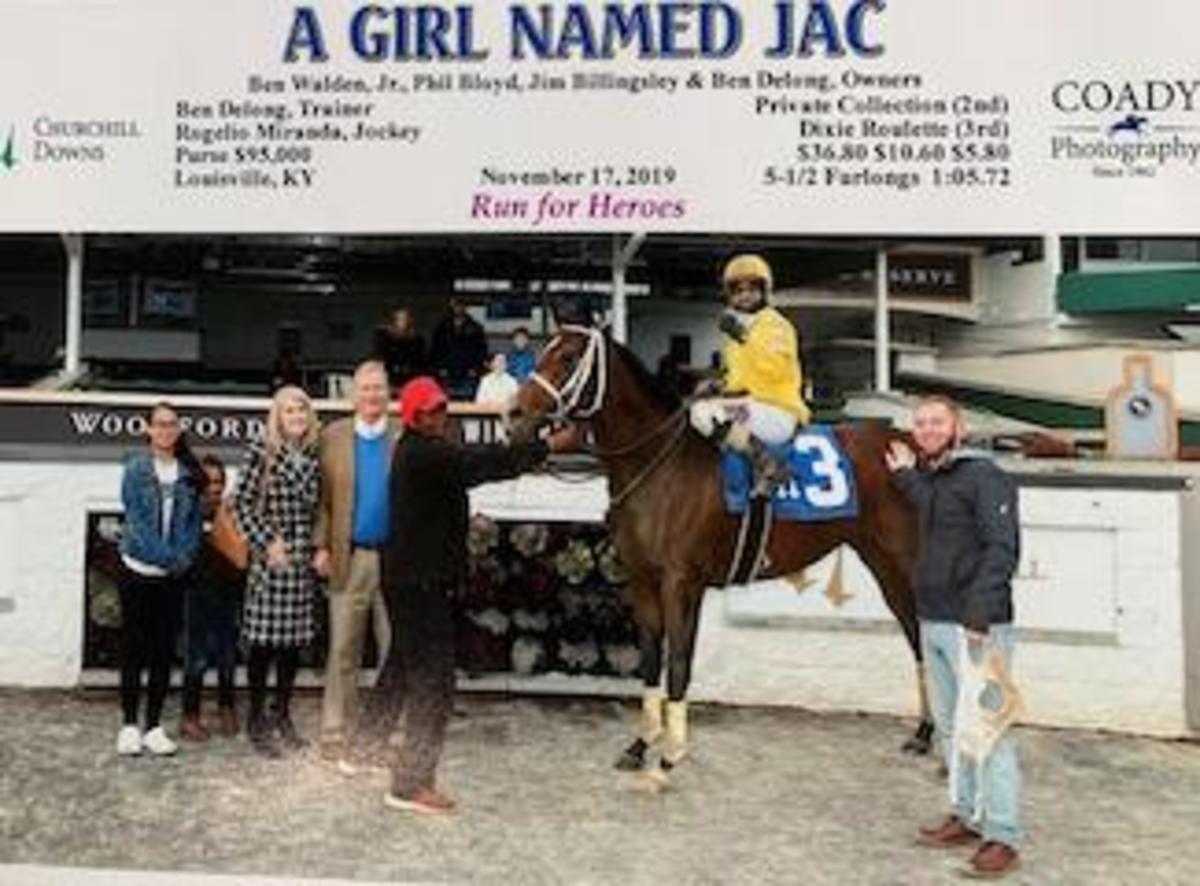
Perhaps the biggest win of his career came last fall at Churchill Downs, when Delong saddled A Girl Named Jac to win a maiden special weight event at odds of 17-1. The filly was his first winner beneath the Twin Spires.

A $5,500 yearling purchase at the Keeneland September sale in 2018, the Ontario-bred daughter of Point of Entry was sent to Delong to be started under saddle. He liked the filly from the start, so when the owners approached him in 2019 about training her in exchange for an ownership stake, Delong agreed.

“I took her on a deal because I liked the horse, and because I only had about eight horses at the time, so I was more than willing to jump on it,” he explained. “She turned out to be a pretty decent little horse.”

A Girl Named Jac finished third in her debut at Indiana Grand on Nov. 1, then returned to win the Churchill race in mid-November. In February, Delong and the other partners sold her at OBS for $75,000.

It was a big deal for the long-time gallop hand to prove he could both see and develop a horse's potential, not only to the outside world, but to himself as well. Delong never got the opportunity to be an assistant under a big-name trainer, or to learn the art of training through any of the more traditional methods.
Instead, he was raised around the backside of Fairmount Park in Illinois by his father, a former jockey. Delong wanted to travel as soon as he was able, so he left his home track at 17 to work the circuit between Prairie Meadows in Iowa, Remington Park in Oklahoma, and Oaklawn Park in Arkansas. Delong galloped for different trainers, freelancing early on, and eventually picked up a salary job for Wayne Catalano.

Things changed when he and his fiancée, Cassie Corvin, had a daughter in 2009. Delong knew he needed to stabilize his lifestyle, and in 2011 he made the move to Lexington and got a job galloping for Kellyn Gorder. He kept freelancing on the side as well, and it was one of those freelance mounts, a horse named Compromisin I'mnot, that drew Delong into the training business.

The owner was looking to move the mare and wound up giving her to Delong. He took out his trainer's license, and Compromisin I'mnot gave him his first winner in 2013 at the now-defunct Beulah Park. In all, the mare ran in-the-money 12 out of 14 starts, and Delong knew he wanted to keep training.

Without an assistant position on the horizon, however, Delong started out training a few cheap horses of his own while galloping full-time. He would run them wherever he thought they could do well, often shipping out of town to do so.

“It's easier to ship and know you're going to get a check,” Delong said. “I'll never turn my back on the little small tracks. I'm obviously from one, I never look down on them.”

It took until 2018 for Delong to eclipse $100,000 in earnings; he won 20 races that year.

“I definitely had to learn by trial and error,” said Delong. “I was a very stubborn individual as I got into it, but as I got older, I realized asking for help is not a bad thing. Though, if it wasn't for being so stubborn, I probably would have chosen a different path!

“I guess you could say I worked under dad, because he taught me all I know about horses. He's pretty sharp with horses, since he trained and was a jockey, and he galloped for a lot of years for a lot of people. When I've got a question I don't know the answer to, he's my go-to guy.”

Though his father is now semi-retired at age 65, he still lives at Ashwood and helps out when he can. Delong racing remains a family operation, through-and-through; Delong's fiancée works Saturdays and Sundays at a hospital in Elizabethtown as a radiology technician, and she gets up early Monday mornings to help exercise horses at Ashwood.

“I couldn't do it without her,” Delong said. “We had plans to get married before COVID hit, but we put them on the back burner. We're gonna make a date soon enough, but we both have plans for the future and neither one of us is going anywhere; that piece of paper isn't going to change our life or our commitment.”

Delong also has a trusted assistant, Sherman Mitchell, whose 23-year-old son, Austin “Worm” Mitchell, is learning to be a groom and helps haul horses to the races when Delong has other commitments. (Worm earned his nickname because as a young boy he loved fishing so much that he used to carry worms around in his pockets.)

“He wanted to move forward and do like I did, working side by side with his dad,” Delong said of the younger Mitchell, now his barn foreman. “I can really rely on him. He goes above and beyond anything I could ask him to do, and he definitely wants to make sure the horses are where they need to be.”

Despite the pandemic and its effect on racing this year, things are looking up for Delong in 2020. He remains committed to the game because he loves the horses, but he admits there were times it wasn't easy to keep making his way to the track every morning.

“The racetrack is a very hard game,” Delong said. “It's not for the faint of heart, and you have to be willing to do a lot of going without to get where you want to be. Everybody wants to be able to move to the top of the game, but I'm a day-by-day kind of guy. Obviously I've got to deal with what I've got in front of me, and when I've got that kind of horse to go to that level, I'll be ready for it.”

At the end of the day, he just wants to provide a better life for his daughter, who hopes to be a marine biologist.

“Hopefully I can give her more than I had,” Delong said.

The post Breeders’ Cup Presents Connections: Scaling The Mountain Isn’t For ‘The Faint Of Heart’ appeared first on Horse Racing News | Paulick Report.


Source of original post

Breeders’ Cup Presents Connections: ‘I Still Can’t Find The Words’

Tommy Drury is used to standing on the sidelines, watching horses he had a hand in go on to major success on the racetrack. He doesn't mind; the unique niche he's carved out in the Kentucky Thoroughbred industry allows him to stay home with his son and daughter year-round, and to work hand-in-hand with some of the sport's top horsemen.

Last Saturday all of that changed when Art Collector earned the trainer his first graded stakes win in the G2 Toyota Blue Grass at Keeneland. Still, Drury found himself pulling back to watch the post-race celebrations from the rail.

“When the horse came back, they started sponging him off and everybody high-fived and all that,” Drury remembered. “The horse was circling, and I was just lost, I was kinda standing there, off to the side.

“I was just watching, literally I was just taking it in. I was so happy for my assistant Jose Garcia, for (long-time friend and groom) Jerry Dixon; I mean this is the same crew that you're gonna see in the last race at Turfway Park and here we are in the Blue Grass. I just wanted to watch it for a minute. As they started circling the horse, finally (jockey) Brian (Hernandez) kind of hit me in the back and said, 'Hey, you just won the Blue Grass,' and it just hit me, like, 'Yeah, yeah we sure did.'”

With Art Collector established as one of the top three contenders for the Sept. 5 Kentucky Derby, Drury can't help but be awestruck at the sudden shift in his career.

“The way we got the horse, the way everything's fallen into place, how do you describe it?” said Drury, who followed his father into racing and has saddled 471 winners since 1991. “It's just, it's unbelievable.”

Neither Drury nor the 3-year-old son of Bernardini would be in this position had the coronavirus pandemic not caused the postponement of this year's Run for the Roses.

Art Collector made his first five starts for trainer Joe Sharp and began his career on the turf, winning a 6 ½-furlong maiden special weight sprint at Kentucky Downs in his second out. The colt made his first attempt at two turns in the G3 Bourbon over 1 1/16 miles on the Keeneland turf, but he leveled off late to finish seventh.

Switched over to the dirt, Art Collector found his stride in his fifth start when he won a six-furlong allowance at Churchill by 7 ½ lengths. Unfortunately, a post-race test found elevated levels of levamisole in Art Collector's system, and the colt was disqualified.

Owner and breeder Bruce Lunsford gave Art Collector a brief break at Kesmarc, then sent him to Drury's barn in January to prepare for a return to the track. He and Drury have a long-standing business relationship, and Lunsford's horses often use Drury's facility as a waystation between races.

“The only thing Bruce said was, 'This is a really, really nice horse,'” said Drury. “The only reason I knew who he was was Brian had sent me a text and asked me if I had Art Collector… At that point I thought, if Brian's trying to figure out where this horse is at, he must be alright.”

Art Collector was intended to move on to the care of trainer Rusty Arnold when he was ready to resume racing, but the virus put everything on hold.

Keeneland canceled its April meet, and Churchill kept delaying the start of the Spring meet, awaiting permission from the Kentucky governor to resume live racing. Meanwhile, Art Collector kept quietly accumulating solid workouts over the Pro-Ride synthetic surface at Skylight.

Hernandez, who is Drury's long-time friend and has been the trainer's go-to rider since his bug-boy days, shipped back to Louisville from his winter home in New Orleans early this year to be nearby after his wife gave birth. The jockey began coming out to Skylight nearly every week to breeze Art Collector, and his reports back to both Drury and Lunsford were extremely optimistic; everyone was just waiting for the chance to get him going.

Finally, Churchill announced that racing would resume in mid-May and released its first condition book.

There was an allowance race that would be perfect for Art Collector on May 17, but Churchill was only allowing trainers to ship in to the backstretch in stages based on where they had spent the winter; Arnold's string from Florida wouldn't be allowed on the track until after the first weekend of racing.

Rather than wait and miss the race, Lunsford allowed Drury to saddle Art Collector for his first start of 2020. The colt won the seven-furlong contest by 2 ¾ lengths, and Lunsford decided Drury had done such a good job that he ought to keep training him.

Arnold also called Drury after that first win, congratulating him.

“It was one of the classiest things anybody's ever done,” Drury said. “Rusty said, 'Tommy, that horse ran fantastic. There's absolutely no reason to change anything, that horse needs to stay exactly where he's at.'”

Lunsford was ready to try Art Collector around two turns again, but Drury wasn't convinced he wanted to go that far. The colt isn't particularly large, Drury explained, and his one previous race around two turns hadn't gone well.

Art Collector is bred for the distance, though. His dam is a two-turn stakes-winning daughter of Distorted Humor named Distorted Legacy, whose half-brother Vision and Verse earned over a million dollars on the track, running second in both the G1 Belmont Stakes and the G1 Travers.

With the colt training exceptionally well, Drury entered him in another allowance race at Churchill, this time over 1 1/16 miles on June 13. Art Collector responded with a dominant 6 ½-length victory, earning a 100 Beyer.

“I was a little nervous before that second race,” Drury admitted. “I was really happy to see him get around the second turn that day, that was pretty exciting.”

The decision was made to enter Art Collector in the Blue Grass. On Wednesday before the race, Shared Sense, whom Art Collector had beaten in the June 13 allowance, came back to win the G3 Indiana Derby.

On the same day, trainer Ken McPeek decided to enter the points-leader for the Kentucky Oaks, Swiss Skydiver, in the Blue Grass. Suddenly, Drury started to wonder if he'd picked the wrong Derby prep to point for.

Lunsford is a staunch supporter of Kentucky racing, though, and Drury knew that if he wanted to even think about the Derby with Art Collector, the colt would have to be tested.

That doesn't mean the trainer wasn't nervous.

“It's funny, I can run a $5,000 claimer at Belterra and get nervous, so that part doesn't change,” Drury said. “The toughest part for me is after you throw the jockey up and you're just waiting. That post parade was the longest six minutes of my life. Actually, Tammy Fox (trainer Dale Romans' partner) yelled at me over the fence, 'You look like you're washing out, are you okay?'”

Standing at the sixteenth pole, Drury watched with his heart in his throat as Mike Smith sat chilly on Swiss Skydiver at the top of the stretch. Art Collector was coming on strong, but from his vantage point it was hard to tell whether the colt would get to the wire in time.

When the pair blew past him, Drury could see Art Collector passing the filly, and the images around him started to blur.

“You know, my program really hasn't been geared toward getting this kind of horse,” Drury explained. “I'm the behind-the-scenes guy. If a guy needs a 2-year-old legged up, he calls me. If a guy runs out of stalls at Churchill and he has three horses coming, he calls me. I'm happy to do it, and I've made a good living doing it, but because I do it, you don't even think about stuff like this.

“You kind of feel like it's never going to happen, you almost know its never going to happen. And now, all of a sudden this thing… I don't know how to describe it. I still can't find the words. People keep asking me what I think and how I'm feeling, and I just don't know.”

Drury sent excited texts to his son and his daughter after the race, but otherwise settled in for a quiet evening at home with a pizza and a cold beer. By the next morning, he had over 312 text messages on his phone, and voice mails from other trainers and friends from all over the country.

“I laughed and told Bill Mott, 'I always wondered what it was like for you guys after you win a big race!'” Drury joked. “I called Rusty and I told him, 'Thank you so much for what you did, because this thing has changed my life.' You know Rusty, he just said, 'Tommy, that was the best thing for that horse.'”

Whether Art Collector makes another start before the Derby has not yet been decided, with Drury deferring the decision but suggesting the Ellis Park Derby on Aug. 9 as the most likely option.

Looking forward to the first Saturday in September, one day before his 49th birthday, Drury has a hard time imagining what it might look like with the virus protocols Churchill will employ. He hopes to be able to bring his children with him on the walkover, but no matter what happens he's grateful to be along for the ride with his horse of a lifetime.

“You know, the best part of all this is that I'm sharing it with my crew and my friends,” Drury said. “It means so much to be here with Jose, and Jerry, and Brian, and with Bruce as well.”

“The most special thing about it is to be on this trail with Tommy,” Hernandez echoed, speaking to the Ellis Park press office. “I've ridden at every little racetrack in the country, I think, for Tommy. Indiana, River Downs, Beulah, Ellis and now to win the Blue Grass for him is a special moment. Being friends like we are, it's more special to have this good of a horse. We've always talked about 'Man, if we could ever get a really good one like this, the trip it would put us on.' It's meant a lot.”


The post Breeders’ Cup Presents Connections: ‘I Still Can’t Find The Words’ appeared first on Horse Racing News | Paulick Report.

Source of original post

Breeders’ Cup Presents Connections: ‘I’ve Always Thought He Was A Star’

Trainer George Weaver has long believed that Vekoma is capable of big things on the racetrack. The 4-year-old son of Candy Ride has delivered on that faith in a major way this season, earning back-to-back Grade 1 victories in the seven-furlong Carter Handicap and last Saturday's Runhappy Metropolitan Mile Handicap.

Vekoma defeated Network Effect and Code of Honor by 1 ¼ lengths in the Met Mile, leading throughout the one-mile contest.

“I actually did think he could be on the lead,” Weaver said after the race. “I thought we had the most natural speed of the horses in the race. I knew the outside horses liked to show speed, but at the end of the day I thought if we broke well, they might just be caught chasing. When I talked to Javier in the paddock, he was non-committal, and I said the whole time that I know Javier understands this horse and feels what he can and can't do, and I left it in his hands.

“At the quarter pole, it seemed like all comers were coming and I thought 'Man, does he have anything left in the tank or not?' When they got to the eighth pole and I saw him rebreak and keep going, I got excited. It was fun.”

The big wins have increased Vekoma's career earnings to $1,245,525, making him Weaver's highest earner since the trainer took out his license in 2002.

“I was so proud of him,” said Weaver. “Physically he's matured and filled out, and I really couldn't be any happier with him.”

The Met Mile was Weaver's fourth top-level win as a trainer, following Saratoga County's win in the Group 1 Dubai Golden Shaheen in 2005 and Lighthouse Bay's win in the Grade 1 Prioress in 2013.

Still, the Louisville native grew up with dreams of the Kentucky Derby. He made his inaugural Run for the Roses in 2015 with Tencendur, but that horse faded to finish 17th.

Early last year, Weaver had gotten excited that Vekoma might give him a stronger chance in a second trip to the Derby. The colt won the G2 Nashua as a juvenile, and made his 3-year-old debut a third-place finish in the G2 Fountain of Youth Stakes. In April, Vekoma dominated the G2 Blue Grass Stakes by 3 ½ lengths, securing his spot in the starting gate for the Kentucky Derby.

Unfortunately, Vekoma disappointed on the day, up close early and fading to finish 12th, and the colt was sent to the farm for a break that lasted the remainder of 2019.

“He did not perform well on Derby day, and I don't know if it was the (sloppy) track or if it just wasn't his day,” Weaver said. “He's a terrifically talented racehorse, and I've always thought he was a star. Obviously, we were hoping to do better in the Derby, but history shows that a lot of really nice horses don't run well on the first Saturday in May.”

Bringing the colt back to the races involved a lot of dedication from both Weaver and his wife and business partner, Cindy Hutter. The couple first met in 1991 when they were employed by D. Wayne Lukas, but didn't date until they both made the move to trainer Todd Pletcher's team.

Pletcher, also employed by Lukas early in his career, left the Hall of Famer to go out on his own in 1996, and Hutter went along as his assistant. Weaver made the move to Pletcher's barn in 1997, but as assistant trainers, he and Hutter had to work at separate locations for much of the year.

In 2002, the couple made the decision to stick together and work for themselves.

“We decided to make a go of it and do everything all at once,” Weaver explained. “We went into business for ourselves, we bought a house, had a kid; we didn't hold back and did it all at once.”

Today, 18 years later, Hutter is very hands-on with the horses while Weaver is able to handle many of the business aspects like communicating with owners and planning races.

When it came time to bring Vekoma back to the races early in 2020, Hutter was on the talented colt's back nearly every morning.

“She's gotten on him most of his career,” Weaver said. “I have confidence when she tells me they're doing well. She's a great horseperson and knows our horses very well.”

In late March, Vekoma made his first start off a nine-month layoff a winning one in Gulfstream's listed Sir Shackleton Stakes, dominating the seven furlong-contest by 3 ¾ lengths. Though his next start was delayed a bit by the coronavirus pandemic, Vekoma didn't miss a beat and celebrated his first Grade 1 win with an impressive romp in the Carter Handicap, a Win and You're In Challenge Series race for the Breeders' Cup.

With a 7 ¼-length win and a final time of 1:21.02 for seven furlongs, Vekoma earned an automatic entry into the Breeders' Cup Sprint. The Met Mile win earned the colt a slot in the Dirt Mile, so there are plenty of options leading up to this year's World Championships.

“Nothing's written in stone, but we'll probably focus on a mile or under going forward,” Weaver said. “We're going to nominate to the Whitney for sure, but he's run two huge races back-to-back. The most likely scenario, to me, is that he would come back in a race like the Forego. We want to plot a campaign to get us to the Breeders' Cup, so we'll take a look at the calendar and go from there.”

“I think he's the best older horse in the country,” co-owner Randy Hill told NYRA publicity. “The horse will tell us. He's such a warrior.”

The post Breeders’ Cup Presents Connections: ‘I’ve Always Thought He Was A Star’ appeared first on Horse Racing News | Paulick Report.

Source of original post

Breeders’ Cup Presents Connections: ‘100 Percent Country Boy’ Savors Graded Win At Belmont

Last Saturday, June 27, trainer Todd Beattie sent out his first graded stakes winner since 2014 when Victim of Love upset the Grade 3 Vagrancy at odds of 27-1. While her victory may have been a surprise to the bettors, Beattie has long believed that the 4-year-old daughter of Speightstown had the talent to play on the big stage.

“She's really just a hard-trying filly, that's the biggest thing you can take your hat off to her,” Beattie said. “She's a late foal (May 27), so she's been playing catch up a little bit, but her age isn't making such a difference right now. She's been steadily getting a little better, and I can see things where her maturity is really helping her.”

Usually, Beattie prefers to start his own runners as 2-year-olds, doing the groundwork himself and giving his wife, Amanda, a leg up for the babies' first rides. One of his most famous runners was Taris, whom he saddled for a nine-length triumph in the 2014 G2 Raven Run at Keeneland before selling her privately to Coolmore. The mare would later win the Grade 1 Distaff at Churchill Downs in 2016.

Conversely, Victim of Love is a homebred for Tom Stull's Tommy Town Thoroughbreds. The filly began her career in New Mexico, breaking broke her maiden in her third start by 11 3/4 lengths when conditioned by Henry Dominguez. She won the listed Island Fashion Stakes in her next start, in February of 2019, but after finishing off the board in her next two outings, Stull decided to make a change.

“I do a lot of work with Tommy Town, I'm kind of their outlet out here on the East Coast,” explained Beattie. “They wanted to send her here because there would be some more opportunities, and the competition wouldn't be quite as tough as in their California base.

Victim of Love after her Vagrancy win

“We've been figuring her out and what distance suits her. Her very best might be that middle distance, 6 1/2 to seven furlongs, and obviously the wet track didn't hurt her, but she can run on a dry track too.”

From his private barn at Penn National, Beattie slowly began teaching Victim of Love to get into her races a little earlier. She won an allowance race at Laurel in October, and two starts later captured the listed What A Summer Stakes at the Maryland oval.

In the Vagrancy coming off a three-month break due to the coronavirus pandemic, Victim of Love broke a bit slowly. She was sent up into the race, then took over at the head of the lane and pulled away to win by 1 3/4 lengths under jockey Jose Lezcano.

“The trainer [Todd Beattie] told me to break and try to keep her busy,” Lezcano said. “She broke a little bit behind, but with a tap on the shoulder, she jumped right there on the bridle. When I asked her, she really took off. My filly kept going the whole way around and never stopped. She gave me everything she had.”

The filly's success suggests she appreciates the quiet, laid-back atmosphere of Beattie's private barn at Penn National.

“I'm 100 percent country boy,” Beattie said. “I've never lived in the city, but I always felt blessed because I get to see it in my rearview mirror when I'm leaving. I live on a mountain and I have a small farm, about 15 minutes away from the racetrack, so I can train on the track and come and go as I please. A guy that really likes the countryside appreciates that kind of lifestyle.”

Born and raised in Antigo, Wisc., the same hometown as Hall of Famer D. Wayne Lukas, Beattie learned to appreciate Quarter Horses as well. He doesn't train them to race, however. Instead, he and his wife enjoy competing in cutting horse shows, and they use the Quarter Horses as ponies at the track to keep them fit during the week.

“The nice part about training horses at the track is that I always ride a pony and watch the horses train,” Beattie explained. “It works out good that I don't have to go work my cutting horses when it's real hot in the afternoons!”

The entire Beattie family is involved in the horse industry, as well. Of six children, five are full-time with horses, and the sixth enjoys riding cutting horses after her day job. Beattie's sister, Holley, is married to 2-year-old trainer Bryan Rice, and the couple founded Woodside Ranch in Florida. They've developed racehorses like millionaires Hollywood Wildcat and War Chant, and more recently Breeders' Cup Champion Storm the Court, among many others.

After living in Wisconsin during the winters for his entire childhood, Beattie was quick to follow his brothers and sisters to Pennsylvania for year-round racing. Like his family, he particularly enjoys the early stages of training, from the first ride through the first race on the track.

The trainer has saddled over 1,700 winners, but Victim of Love was just Beattie's eighth graded stakes victory. His best horse was millionaire and Grade 1 winner Fabulous Strike.

“I really like to watch the young horses progress, and we start right from scratch,” Beattie explained. “We'll have unbroke horses and I like to develop them and see them get to the next stage. In the past I've had 60-80 horses, and I ended up being a business manager rather than a horse trainer. I prefer to do the training myself, so I try to keep my numbers down within reason, so that way I can have a little bit of a life.”

Of course, coronavirus has made that life look quite a bit different over the past several months. Pennsylvania was one of the last states to get horse events started again, and Beattie is grateful to be able to resume more normal operations. He and his wife have been to three cutting horse shows in the past month, and they've started shipping horses around to run once again.

“Who would have imagined this would have happened in our lifetime?” Beattie said of the pandemic. “It's been really tough trying to hold on, and you're trying to manage your horses. Yeah, you're training them, but you don't have a target you're aiming for, so you try to maintain a little conditioning, but you don't want to tighten them down. Now we feel a little better about getting our horses ready.”

The post Breeders’ Cup Presents Connections: ‘100 Percent Country Boy’ Savors Graded Win At Belmont appeared first on Horse Racing News | Paulick Report.

Source of original post

Verified by MonsterInsights