Hearing Officer Affirms Medina Spirit Derby DQ And Baffert Penalties

The hearing officer assigned to oversee trainer Bob Baffert and owner Zedan Racing Stables' appeal of penalties related to the drug disqualification of 2021 GI Kentucky Derby winner Medina Spirit (Protonico) has issued a recommended order to the Kentucky Horse Racing Commission (KHRC) that the underlying stewards' rulings be affirmed in their entirety.

The 47-page report was made public via press release by the Kentucky Public Protection Cabinet early on the Friday evening of the long Memorial Day holiday weekend. Its issuance comes 765 days after Medina Spirit crossed the finish wire first in the 147th Derby but subsequently tested positive for betamethasone in a KHRC post-race drug screening.

The recommendation, which must be considered and voted upon by the full KHRC board at a later date, upholds Medina Spirit's DQ, a 90-day suspension that Baffert has already served but wanted expunged from his record, and a $7,500 fine imposed upon the Hall-of-Fame trainer. Acceptance of the report's findings by the KHRC would affirm Mandaloun (Into Mischief) as the official winner of the 2021 Derby.

“The Hearing Officer finds and concludes that the KHRC has shown that the stewards' decision was made on reliable, substantive evidence that the horse, Medina Spirit, was administered and carried the prohibited substance, betamethasone,” hearing officer Eden Stephens wrote.

“The plain language of the KHRC's betamethasone regulations is clear: betamethasone is prohibited in a post-race sample,” Stephens wrote.

The debate over whether or not Medina Spirit's betamethasone finding was the result of an injection or the application of an ointment to treat a skin condition had been a focal point of testimony during six days of appeal hearings in August 2022.

“Parties agree the KHRC has the burden of proof but differ framing the question of what needs to be proven,” Stephens wrote. “KHRC argues it must establish a prima facie case that Medina Spirit [tested positive for a prohibited drug]. Appellants believe this case is solely premised on whether the use of a topical ointment, Otomax, for a clinically diagnosed skin infection on a racehorse, constitutes a violation of any clearly expressed and unambiguous rule…” Stephens wrote.

“At the running of the 147th Kentucky Derby on May 1, 2021, no KHRC regulation set forth an 'established concentration level' under which betamethasone is allowed in a post-race sample. Therefore, a laboratory finding of betamethasone in a post-race sample establishes a prima facie case that a trainer violated the KHRC's medication regulations,” Stephens wrote.

“Appellants contend that 810 KAR 8:010 Section 4 permits the administration of betamethasone ointment; therefore, a betamethasone positive arising due to an ointment administration is not a violation. This interpretation improperly conflates the KHRC's regulations governing medication administration with the regulations governing medication levels in post-race samples,” Stephens wrote.

“The KHRC's regulations do not state that any route of administration excuses a post-race betamethasone positive,” Stephens wrote.

“Additionally, the KHRC has a longstanding, uninterrupted history of treating all medications without thresholds as limit-of-detection medications and of finding that the administration route leading to a medication positive is irrelevant,” Stephens wrote.

“Betamethasone is a Class C drug. Its presence in a horse's post-race sample is prohibited by the KHRC, regardless of method of administration. Betamethasone has the potential to influence performance, as well as health and safety, in equine athletes,” Stephens wrote.

“Finally, the Stewards' Rulings in this case were restrained and reasonable. The stewards could have imposed a five-year suspension and $50,000 fine. Instead, they suspended Mr. Baffert for 90 days and fined him $7,500,” Stephens wrote.

The press release outlined the next steps in the process.

“Both parties can file exceptions to the recommended order should either party believe the hearing officer made an incorrect finding of fact or conclusion of law. The matter will then be referred to the KHRC to issue a Final Order,” the release stated.

“A Final Order may be appealed to Circuit Court within 30 days of issuance of the Final Order.  If no appeal is filed within 30 days, the case will end,” the release stated.

A Saturday morning voicemail message seeking comment from Baffert's attorney, Clark Brewster, did not yield a reply prior to deadline for this story.

The post Hearing Officer Affirms Medina Spirit Derby DQ And Baffert Penalties appeared first on TDN | Thoroughbred Daily News | Horse Racing News, Results and Video | Thoroughbred Breeding and Auctions.
Source of original post

This Side Up: Why The Long Face?

As and when he finally quits riding the kids to sleep, at least John Velazquez doesn't have to worry about a next career. Because what he did in Baltimore last week showed him to have everything it takes to lead a cortege. Not just the restrained tempo, but also the way he reliably maintained all dignity and decorum while Irad Ortiz Jr. came lurching out of the procession in his usual unruly fashion.

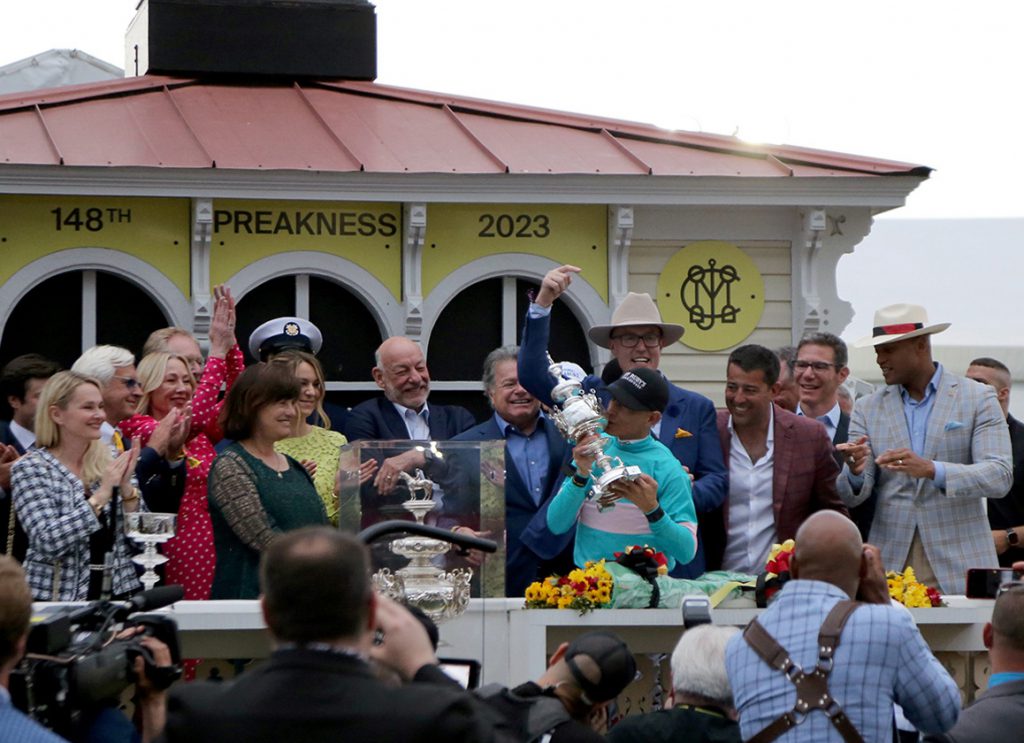
True, Velazquez wouldn't last the first week if he were to lead a funeral at the same kind of lick as he did the GI Kentucky Derby field on Reincarnate (Good Magic), quite a contrast to the way he has previously hypnotized his pursuers in that race. But Johnny V. amply redressed that aberration with a masterly ride in the GI Preakness S. to confirm himself, for our community, as apt a companion as might be found for a horse bearing a name like National Treasure (Quality Road).

But we won't dwell on the cortege analogy, which will be far too morbid for some tastes in the prevailing atmosphere. This I must admit to viewing with some ambivalence. Because however troubled our relationship with Main Street, unrelieved “sackcloth and ashes” may yet cause us additionally to fail in the more straightforward priority of retaining our existing audience.

(Click the arrow below to hear this column as a podcast.)


Alongside a wholesome determination to keep improving, I do feel that we should stand up for the many glories of our sport with rather more pride than we seem able to find in our hearts just now. (It's like the old joke. Horse walks into a bar. Barman says, “Why the long face?”) We have so much to celebrate, so many stories to discourage mainstream complicity in the kind of extremist agenda that will tolerate zero risk; that would candidly prefer no horses at all, rather than expose them even to the most conscionable and scrupulously-managed risk. That position is invulnerable to the reminder that Thoroughbreds don't make terribly good house pets, so really, we need to concentrate on the far larger numbers who might share the aspiration of giving these noble creatures not just life but the best life possible.

John Velazquez wins the GI Preakness S. | Horsephotos

As Californian horsemen, veterinarians and administrators will confirm, that can raise the bar to challenging levels. But their collective efforts have produced such spectacular dividends, turning round an existential crisis virtually overnight, that I feel that the wider community has been inadequately grateful. Major investors in the industry have abandoned the Californian circuit to a pretty vicious circle: small fields, which diminish handle, which restricts purses, which reduces fields. Yet still it keeps coming up with champions, developed by some of the most accomplished horsemen of our time-regardless of where you happen to stand on the one who has just consolidated an incredible resumé with yet another Preakness.

Views of Bob Baffert, in fact, are a good example of all this wringing of hands. It sometimes feels as though you're only allowed to say one of two things: either he exemplifies everything that's wrong, or he's a maligned genius. And whichever camp you find yourself in, get ready for the invective.

All genius is flawed, because all genius is human. We certainly saw a human being last Saturday, but only in circumstances that maintained the bitter polemics. So much of our discourse, above all regarding HISA, is infected with venom; much of it is conveyed, at calamitous expense, by lawyers. But who wants to be invited to a civil war, instead of a garden party?

I do understand that parts of our community will only stir from their complacency if adequately alarmed by the costs of inaction. And yes, too much naïve enthusiasm might blind us to real dangers. It's even arguable that the way the geographical heart of the industry is thriving, in Kentucky, may insulate too much opinion against societal fissures that feel a world away.

Certainly, professional horsemen have their share of culpability in the loss of public traction. As I suggested last week, we're either breeding horses that aren't up to the task; or hiring trainers who won't properly explore the genetic attributes we may wish to replicate. In either scenario, a solution is absolutely within our hands.

But one other thing also needs to be understood by horsemen. You can't have it both ways: you can't refuse synthetic tracks, which are demonstrably safer, and also refuse more exacting regulation. If you won't accept the kind of strictures that redeemed dirt racing in California, then you'll just have to make do with synthetics.

And actually, that whole area is yet another that only tends to disclose division and misunderstanding. One of the main reasons for the perceived failure of the initial synthetics experiment was a prescriptive view of bloodlines, as adapted only to one type of surface. So, whatever our grievances with Churchill Downs, especially regarding Arlington, I'm glad to see them putting their shoulder to the Turfway wheel. Having loaded Turfway with starting points, they were rewarded with a trial winner who ran a brilliant second in the Derby. In the process, remember, Two Phil's precisely emulated his sire Hard Spun. Are we any more likely to take heed, this time round?

National Treasure at Pimlico | Jim McCue

While we're on the subject, I'm intrigued that the sire of the Preakness winner has lately surfaced among those extraneous speed influences sampled by Coolmore for their plethora of staying mares by Galileo (Ire). Quality Road's own track career was all about carrying speed on dirt. But his dam was by Strawberry Road (Aus), out of a half-sister to the dam of Bahri (Riverman); and of course, his sire Elusive Quality adapted very well to the European theater. Quality Road has had a couple of Royal Ascot winners, while his daughter Bleecker Street last year emerged as one of the elite grass talents in America. So, it's unsurprising that he should be looking like a promising experiment for Coolmore, not least through his son Cairo (Ire) who runs in a Classic at the Curragh on Saturday.

Actually, National Treasure himself has plenty of chlorophyll in his maternal family, while his first two dams are respectively by sons of El Prado (Ire) and Blushing Groom (Fr). But he's presumably never going to risk grass, when he's not getting anything like enough respect as it is.

The world outside is understandably aghast at our horrible run of breakdowns. But even those turning their gaze inwards just want to tell us what a terrible Preakness it was, and how we're clinging to the wreckage of an antediluvian Triple Crown. It evidently wasn't a “terrible” enough race for the Derby winner to swat aside horses that finished third and fourth in the crop championship at the Breeders' Cup. Sure, that was largely the work of Johnny V.–and emphatically nothing to do with a two-week turnaround-but if these races are so soft, please feel free to go and win one.

So, let's offer due congratulations to this very game animal; to the people who bred and raised him; and to those who found him, and have now brought out his potential. It was a difficult day, for sure, but life is full of ups and downs and horseracing is no different. In fact, that's exactly why its stories are so compelling; and why we must share not just our grief and guilt, but also our joy and pride.

The post This Side Up: Why The Long Face? appeared first on TDN | Thoroughbred Daily News | Horse Racing News, Results and Video | Thoroughbred Breeding and Auctions.

Source of original post

CDI Releases Statement Regarding Baffert Lawsuit

Following a summary judgment issued by a federal judge Wednesday that dismissed Hall of Fame trainer Bob Baffert's lone remaining claim in his lawsuit against Churchill Downs, Inc. (CDI), Churchill Downs issued a statement on Thursday. The statement appears in its entirety below.

“Churchill Downs is pleased that the Court granted our Motion for Summary Judgement in the Civil Action brought against our company, CEO and Board Chairman by Bob Baffert, resolving in our favor the last remaining claim, just as the Court had ruled in our favor on all of his previous claims. While he may choose to file baseless appeals, this completes the seemingly endless, arduous and unnecessary litigation proceedings instigated by Mr. Baffert.

“Our actions to suspend Mr. Baffert following Medina's Spirit [Protonico]'s confirmed positive for a prohibited race-day substance, coupled with his extensive history of drug violations, was done in the best interest of protecting the integrity of horseracing. Now more than ever, participants and operators in this industry must individually and collectively assume responsibility to take every reasonable measure to protect our equine and human athletes and reject any practice that jeopardizes that mission.

“We are encouraged that the Horseracing Integrity and Safety Authority (HISA) Anti-Doping and Medication Control (ADMC) Program has gone into effect this month which will allow uniform rules to govern the industry and expedite both the testing and adjudication process which has historically created confounding delays and threatened the confidence and trust of our fans.

“As we stated when we suspended Mr. Baffert in June 2021, we reserve the right to extend his suspension and will communicate our decision at the conclusion of the initial two-year suspension period. This U.S. District Court ruling in our favor is a victory in our ongoing actions and steadfast commitment to protecting the safety of our equine and human athletes.”

The post CDI Releases Statement Regarding Baffert Lawsuit appeared first on TDN | Thoroughbred Daily News | Horse Racing News, Results and Video | Thoroughbred Breeding and Auctions.

Source of original post

Judge Dismisses Baffert’s Lone Remaining Claim Against CDI

A federal judge on Wednesday issued a summary judgment that dismissed trainer Bob Baffert's lone remaining claim in his 15-month-old lawsuit against Churchill Downs, Inc. (CDI). The order was handed down three months after the same judge tossed out five other counts in the case that alleged civil rights violations related to the gaming corporation's two-year banishment of the Hall-of-Fame trainer.

“The Court denied Plaintiffs motion for a preliminary injunction and dismissed Plaintiffs' claims for unlawful exclusion, unlawful conspiracy in restraint of trade, unlawful use of monopoly power, tortious interference with contractual relations, and tortious interference with prospective business relations,” wrote Judge Rebecca Jennings of United States District Court (Western District of Kentucky) in her May 24 order. “Defendants now move for summary judgment on Plaintiffs' only remaining claim–breach of due process.”

Back on Mar. 14, CDI had argued that, “Because Baffert's due process claim fails as a matter of law…the Court should grant Defendants summary judgment and dismiss Baffert's complaint in its entirety.”

Jennings wrote May 24 that CDI's suspension of Baffert from CDI-owned tracks and the 2022 and 2023 GI Kentucky Derbies did not “devalue” his training license in a manner that amounted to “an indirect deprivation of a property interest.”

“[Baffert's] license was not suspended or revoked by the issuing entity, meaning he must demonstrate an indirect loss in the value of his Kentucky trainer's license. For Plaintiffs to demonstrate that this indirect injury amounted to a violation of due process, they must prove that Baffert's license was rendered valueless…

“Here, the undisputed evidence demonstrates that Baffert's license is not valueless,” Jennings wrote. “While suspended from racing at CDI racetracks, Baffert conceded that he has 'raced horses all around the world with enormous success.'

“The Court cannot find that Baffert's Kentucky trainer's license was rendered valueless when he used it to win over $1 million racing horses in the Commonwealth [at Keeneland]….Therefore, Plaintiffs cannot demonstrate that they were deprived of a property interest–a necessary element of their due process claim,” Jennings wrote.

“Plaintiffs have failed to produce specific evidence creating a genuine issue of material fact that would allow a reasonable jury to find in their favor at trial,” Jennings wrote.

“Because Plaintiffs cannot prevail on the first element of their due process claim, the Court will not continue to examine additional arguments,” Jennings wrote.

CDI first imposed its ruling-off of Baffert in June 2021 because of a string of drug positives in horses Baffert trained, including two in CDI's most prominent races, the 2020 GI Kentucky Oaks and the 2021 Derby.

“Judgment is entered in favor of Defendants with respect to the claims brought in this matter,” Jennings wrote.

“This is a FINAL and APPEALABLE Judgment,” Jennings wrote. “The Clerk of Court is directed to strike this matter from the Court's active docket.”

Note: This is an updated version of a previously published story that contained an error describing the ruling. TDN regrets the mistake.

The post Judge Dismisses Baffert’s Lone Remaining Claim Against CDI appeared first on TDN | Thoroughbred Daily News | Horse Racing News, Results and Video | Thoroughbred Breeding and Auctions.

Source of original post

Verified by MonsterInsights