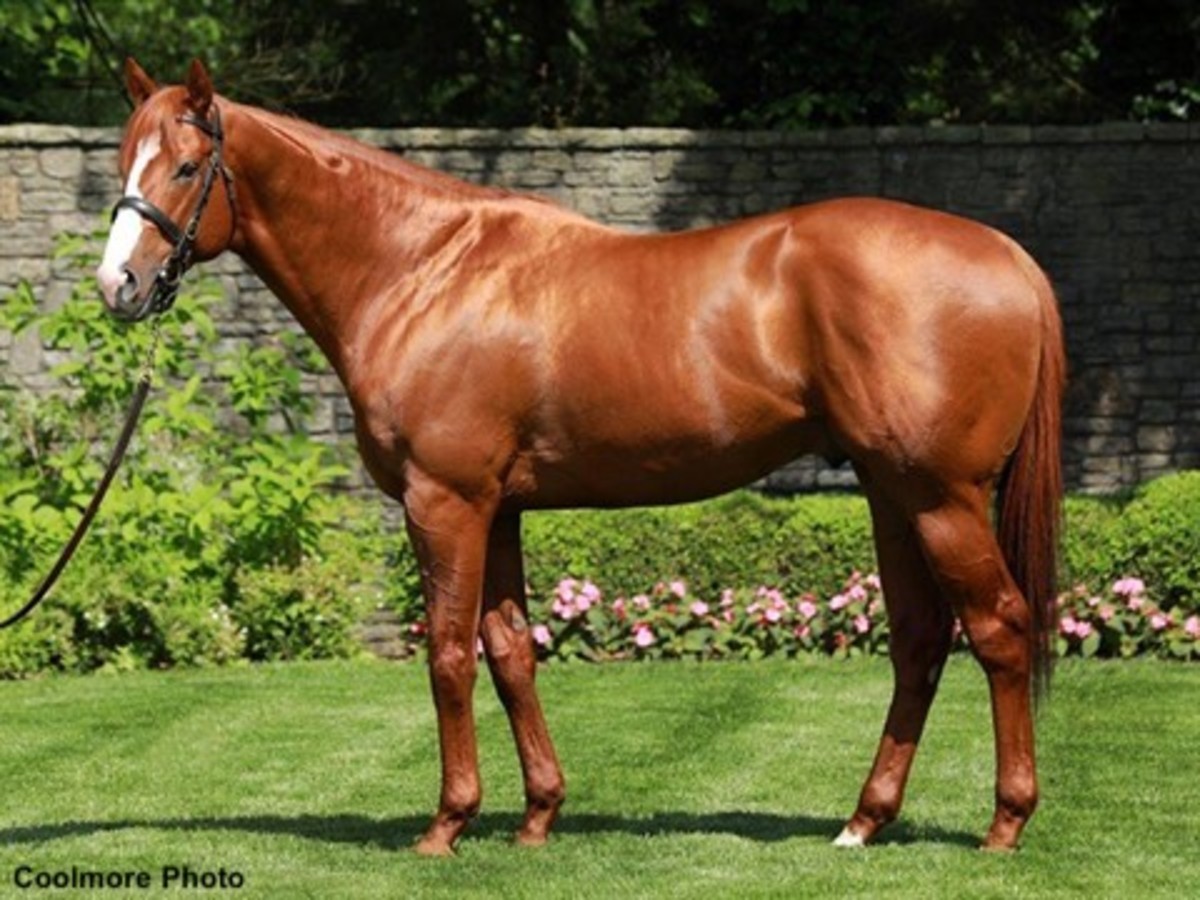
Graded stakes winner Killybegs Captain was represented by his first foal when the winning Cryptoclearance mare Clearly Perfect delivered a colt Jan. 31 at Anne Morgan's and Tim Little's Mill Creek Farm in Stillwater, N.Y.
Killybegs Captain, an 8-year-old son of Mizzen Mast out of the Holy Bull mare Al Maha, stands for $2,500 LFSN at Mill Creek Farm.
Bred by Morgan, the newborn colt is the third foal out of Clearly Perfect. The mare's first foal, the Giant Surprise gelding Clear Surprise, sold for $14,000 2014 Fasig-Tipton Saratoga fall mixed sale and won four of 18 starts and $48,651. Clearly Perfect is also the dam of the newly turned 2-year-old Frank Conversation filly Franca who sold for $10,000 at last year's Fasig-Tipton Midlantic Eastern fall yearling sale.
Campaigned by Curragh Racing and trained by John Terranova, Killybegs Captain won seven of 27 starts with five seconds and three thirds for $572,453 in earnings. A $75,000 purchase at the 2016 OBS April 2-year-olds in training sale, Killybegs Captain was a winner at 3, 4, 5 and 6 and rose from the allowance ranks to become a stakes winner in his last two seasons.
Killybegs Captain scored his biggest victory in the Grade 3 Frank J. De Francis Memorial Dash at Laurel Park in 2019, defeating a field that included He Hate Me and New York Central in 1:08.10 for 6 furlongs.
Third in the G2 John A. Nerud Stakes at Belmont Park and G1 Forego Stakes at Saratoga Race Course in 2019, Killybegs Captain also won back-to-back editions of the Pelican Stakes at Tampa Bay Downs in 2019 and 2020. He defeated multiple Grade 1 winner Imperial Hint in the 2019 edition of the Pelican, winning the six-furlong stakes in 1:09.66.
The latest issue of the Back Ring is now online, ahead of the Fasig-Tipton Kentucky Winter Mixed Sale.
The Back Ring is the Paulick Report's bloodstock newsletter, released ahead of, and during, every major North American Thoroughbred auction. Seeking to expand beyond the usual pdf presentation, the Back Ring offers a dynamic experience for bloodstock content, heavy on visual elements and statistics to appeal to readers on all platforms, especially mobile devices.
Lead Feature, Presented By Gainesway: Myra Lewyn dives into the history of the picturesque Xalapa Farm near Paris, Ky., that was used as a shooting location for “Seabiscuit,” and was recently acquired by Hill 'n' Dale Farms.
Stallion Spotlight, Presented By New York Thoroughbred Breeders, Inc.: A discussion on the veteran New York sire Bustin Stones, who was deemed “the most underrated stallion in the country” by Richard Migliore.
Ask Your Veterinarian, Presented By Kentucky Performance Products: Dr. Peter Sheerin of Rood and Riddle Equine Hospital explains the difference between putting broodmares under overhead lights or a mask light, and how the light process effects a mare's cycle.
Pennsylvania Leaderboard, Presented By Pennsylvania Horse Breeders Association: For a third straight year, Blackstone Farm was Pennsylvania's leader by state breeder awards. Stakes winner Dance Code was one of the many on-track successes that got them there.
Indiana Yearling Spotlight, Presented By Indiana Thoroughbred Alliance: An analysis of Hip 400, an Indiana-bred yearling by Spendthrift Farm's Goldencents, who will be offered at this year's Fasig-Tipton Kentucky Winter Mixed Sale.
Best Of The Breeders, Presented By Muirfield Insurance: Thanks to a pair of top-level victories by the hot 3-year-old Newgrange, the partnership of Jack Mandato and Black Rock Stable ended January with a razor-thin lead among breeders of graded stakes winners.
First-Crop Sire Watch: Stallions whose first crops of yearlings are represented in the Fasig-Tipton Kentucky Winter Mixed Sale, including the number of horses cataloged and the farm where the stallion is currently advertised.
In “Making Claims,” Paulick Report bloodstock editor Joe Nevills shares his opinions on the Thoroughbred industry from the breeding and sales arenas to the racing world and beyond.
The bloodstock market of 2021 seemed as though it would be easier to forecast compared with the unprecedented turbulence of the prior year, but no one could have foreseen the level of gusto with which certain sections of the market would bounce back.
A starving buying bench took auction returns to record highs last year, while Gun Runner's freshman class of runners put their sire in the history books. Pleasant surprises can be hard to come by in the Thoroughbred business, and last year was full of them.
After a year that went better than expected for many, will that momentum keep up the pace, or will it stall? Which stallions will see their stocks rise and fall in the coming year? I try to answer those questions with five predictions for how the year will play out in the bloodstock market.
1. Into Mischief Will Repeat As Leading General Sire…Again
Into Mischief will stand the 2022 breeding season at Spendthrift Farm for $250,000 live foal stands and nurses
You can't hit the Pick 5 without getting the first leg, so we'll start off with a safe one.
For a second consecutive year, the Spendthrift Farm resident set North America's single-season record for progeny earnings. The $24.4 million his runners earned in 2021 was more than $8.1 million higher than next-closest Ghostzapper at $16.2 million. If that $8.1-million difference were an actual stallion, it would have finished in the top 20 on the general list. That's quite the chasm for any horse to overcome.
In 2020, Into Mischief reached the top of the heap on the strength of Horse of the Year Authentic's Kentucky Derby and Breeders' Cup Classic triumphs, and the success of champion sprinter Gamine. Last year, Gamine was back to add a pair of Grade 1 wins and $851,900 to the pot, joined by a pair of electric 3-year-olds in Grade 1 Haskell Stakes winner and Kentucky Derby runner-up (at the time of publishing) Mandaloun and Breeders' Cup Dirt Mile winner Life Is Good. G1 Carter Handicap winner Mischevious Alex completed Into Mischief's quartet of Grade 1 winners in 2021 and highlighted his 13 graded or group stakes winners on the year.
The reason why Into Mischief is my pick to repeat again as leading general sire is the same one I had last year, and the same one I'll use every year for the foreseeable future: he's got the pipeline set for life.
The commercial market is firmly in Into Mischief's corner, putting him on the conveyor belt of success that includes sending him big-time mares, which produce expensive sale horses that have proven to become serious runners, and the cycle begins again. Once that conveyor belt gets going, it tends to only pick up momentum, as it has here. When one set of elite horses leaves the racetrack, another generation quickly takes its place, and perhaps goes even farther.
Into Mischief is perennially one of North America's most active stallions by mares bred, meaning he'll have a unique foundation of blue-collar earners to support the flashy graded stakes horses, the likes of which few of his rivals can muster. Looking to the future, Into Mischief has 195 newly-turned 2-year-olds of 2022; once again from the strongest book of mares he'd seen to date. They'll be given every shot to take home lucrative maiden special weight purses at the country's biggest meets, then become the next class of major stakes winners to keep their sire at the top of the list for years to come.
Get comfortable. The top of the list doesn't look to be changing anytime soon.
2. The North American Foal Crop Will Rise In 2023
This might seem out of place on a list of predictions for 2022, but stay with me, here.
Many pearls have been clutched over North America's shrinking foal crop, and it's certainly harrowing to see that number get slashed by more than half from 44,000 in 1990 to a projected 18,700 in 2022. Assuming The Jockey Club's projections for 2021 and 2022 hold true, the foal crop will have posted a decline in seven consecutive seasons, and the last time it grew by more than one percent was 2005.
However, this is a business that loves to chase a trend, and after an auction season that saw incredible depth and record-setting returns, it's not hard to imagine present and potential breeders eyeing that landscape and seeking out their own piece of it. The November breeding stock sales were strong to the last day, suggesting there is a commercial craving for broodmares that might not yet be quenched by the sale ring. If there is demand, the supply will catch up, whether that means bringing mares back into production that might have gotten time off or retiring fillies from the racetrack to enter the breeding shed. This is not a business of people who happily accept not getting what they want.
Assuming that demand is met with enough horseflesh, one would assume more mares would be bred than in previous years, with the hope that the market will remain just as electric when the ensuing foals enter the commercial space a few years down the road. Since the foals would be conceived in 2022 and born in 2023, this is a long-term prediction that hinges on the short-term.
With all of that being said, I don't expect the 2022 Report of Mares Bred to be bursting at the seams like it's the 1980s again, or even the post-recession upturn of the mid-2010s. Even if breeders are as enthusiastic as they've been in years, there are only so many mares out there to be bred. Save for a mass exodus of broodmares from other countries, any rise in the foal crop is going to have to be a gradual crawl by design. A percentage point or two of growth, though, would be a giant morale boost for an industry that desperately needs horses to fill starting gates around the country.
3. Justify Will Be The Leading Freshman Sire By Earnings
Justify
The 2018 Triple Crown winner tied with fellow Ashford Stud Mendelssohn as North America's most active stallion of the 2019 breeding season with 252 mares bred, and he attracted an absolute murderer's row of mares to fill his first book. There is little excuse for anyone but Justify to finish at the top of the freshman sire list.
If he is successful in that assignment, Justify will take a familiar path to the top employed by Ashford Stud to get the likes of Uncle Mo and American Pharoah to the head of the freshman list: Get as many foals on the ground and into the starting gates as possible, and use the deep class from that first book of mares to propel the foals into the biggest races. It's the plan that every stallion manager draws up for their rookies, but only a chosen few are able to execute it to perfection.
The commercial market seems willing to go on this ride with Justify. He finished fourth among North American-based sires by average yearling sale price ($357,387) and second by yearling gross ($26,804,000). We'll learn more about whether those looks and pages can run when we get into this year's juvenile sale season, but that kind of early endorsement is critical for a stallion with expectations as big as Justify's.
If Justify is somehow unable to get the job done, the logical next guess would be Lane's End resident City of Light. The stallion himself is a specimen, and his yearlings were received astoundingly well during last year's sales. I get the impression the City of Lights (Cities of Light?) are going to do their best work around two turns, which might preclude them from the early prizes on the juvenile stakes calendar, but I thought the same of Gun Runner, and we all saw how that turned out.
4. Arrogate Rebounds From His Rough Freshman Season
One of the biggest surprises of last year's sire races was the highly-touted champion Arrogate finishing out of the top 10 by earnings among freshman sires. After his brilliant racing career, strong debut book of mares, and fevered support at auction – hastened by his untimely demise – the dominoes appeared to be set for him to contend for the top spot, but his first crop left more questions than answers.
The late resident of Juddmonte Farms finished the year in 12th on the freshman earnings list, and without a North American stakes winner. His first winner didn't come until September at the tail end of the Saratoga meet, and his only stakes-placed runner on the year ran second in a restricted stakes at Delaware Park. Arrogate's freshman season might not have been a worst-case scenario when put up against his lofty expectations, but it certainly teetered on the edge of it.
A year earlier, we were saying a lot of the same things about Runhappy, a much-hyped stallion who limped to a 15th-place finish on the freshman sire chart in 2020 without a stakes winner to his name. A year changed a lot for Runhappy, who leapt to fourth among second-crop sires by earnings in 2021, powered by Grade 2 winners Following Sea and Smile Happy.
Runhappy rewarded patience during his own on-track career, not truly hitting his stride until the summer of his 3-year-old campaign. Arrogate had a similar trajectory, vaulting himself into graded stakes competition during the Saratoga meet of his 3-year-old season, and winning the world's most expensive races later that year and into age four. He didn't even make his first start until April of his sophomore year, so we still don't have an apples-to-apples comparison of what the Arrogates should be doing at this stage based on their sire's own racing career.
The Arrogate foals always had the two-turn look to them as young horses, suggesting they might relish the opportunities to go longer that will be afforded to them as they get older. Any runners that make noise on the Triple Crown trail would be late to the party, but the longer races later in the spring and beyond should play to their advantage if they have the talent to match their pedigrees. One or two of those could change the entire trajectory of a stud career cut short.
The tide has already started to turn for Arrogate, who picked up his first stakes winner on Jan. 1 when Alittleloveandluck took the Ginger Brew Stakes on the turf at Gulfstream Park. Arrogate left himself a lot of ground to make up on the leaders in his class, but he fits the profile of a stallion that's got it in him to pull it off.
5. The Auction Market Cools Off A Bit
I never felt like I got an acceptable answer for the question I kept asking throughout a cracking 2021 auction season: “Why is the market THIS good?”
Were people with gobs of money excited to spend it and blow off some COVID-related steam? I'm sure they were. Are purses up at some of the sport's biggest meets, making it more appealing to race horses? Definitely. Were there some other forces in play? Probably. Even so, it's hard to fathom how even a combination of these factors led major buyers to stick around until Books 5 and 6 of the Keeneland September sale when they'd have normally been home for days.
Personally, I think a lot of key players held on to their money and horses during the 2020 auction season, and once it was clear there was going to be a Thoroughbred industry to come back to in 2021, they had more capital than they normally would. With more money in reserve, that pushed everyone down a book or two in order to buy horses in their price range.
If I'm right about that, it means the end users out there might have spent a big chunk of their surplus in 2021, and they might enter this year's auctions with budgets closer to a typical year.
When a good thing appears suddenly, it can vanish just as quickly. However, the Thoroughbred industry is not known for suddenness, barring some kind of global-scale economic event. I don't expect the market to grow from the fever-dream season it saw in 2021, but I don't expect it to plummet, either.
Record paces are hard to keep up, but a slight downturn can still result in an all-time renewal of a particular sale. That's where I see us headed in 2022, probably for reasons as scattered as the ones that got us here in the first place.
This piece originally appeared in The Back Ring, the Paulick Report's bloodstock newsletter. To learn more about the Back Ring, click here.
In “Value Bloodline Showcase,” we'll look at stallions that offer value in regional marketplaces, with interviews from the operations that stand them.
In this edition, Tony Wolfe DVM of Wolfe Equine Services, discusses Charming Kitten, a graded stakes-winning son of Kitten's Joy who stands at Breakway Farm in Dillsboro, Ind. Charming Kitten's first foals are yearlings of 2022.
Charming Kitten
Dk. b. or br. h., 2010, Kitten's Joy x Iteration, by Wild Again Race Record: 33-8-8-3; $1,018,701 Advertised Fee: $2,500
Question: Charming Kitten was Indiana's most active stallion by mares bred in 2021. To what do you attribute that popularity?
Tony Wolfe, Breakway Farm: I think the simplest reason is that he's the total package. He's a gorgeous horse – correct conformation, built right, and very easy on the eyes. When you look at him, you don't even have to know what you're looking at, you just know you're looking at a true athlete.
He has the pedigree to back it up: A direct son of Kitten's Joy – if you don't know about Kitten's Joy, then COVID has had you isolated for too long. On top of the pedigree, he has a proven record. He earned over $1 million. He won the Grade 3 W.L. McKnight Handicap, and combined won or placed in 15 stakes races. He raced against tough fields and proved his worth.
He also crosses well with most pedigrees, so it opens him up to being versatile for breeders and trainers when looking where to go with their mares. For what he brings to the table, you'd be hard pressed to find a better value for your money.
If I've got a mare that could use help from a stallion physically, what can Charming Kitten best contribute to the equation?
Wolfe: The feedback we have received from the breeders of his first crop (now yearlings), is that he improved every mare – no joke. Large, correct foals with great minds. Strong foals with great bone from the start. And, to be fair, these are reports from owners that bred one or two mares to him – not just a single owner. He has 15 or so yearlings from just as many owners.
What would a breeder looking to harness the Kitten's Joy sire line find familiar in Charming Kitten?
Wolfe: After seeing this first crop hit the ground, and mature into yearlings, all I can say is that a breeder will realize quite quickly that Charming Kitten will continue the legacy of producing winners. I have full confidence in that. His prowess and demeanor are immediately evident, but the real kicker is that he's passing that on as a sire. He is most definitely producing athletes.
What makes Charming Kitten a good fit for the Indiana program?
Wolfe: He's a great fit for the Indiana program because he's a unique pedigree with a lot of class. Indiana is growing. Better class horses are coming to the state, as it should be, and he's a perfect example of that. He brings athleticism that will be successful at long and short distance. He's improving mares, and he's going to produce horses that can win in conditioned or opened races. Why not have an Indiana-sired condition advantage on top of a horse that can win an open race?
Why should a breeder outside of Indiana consider Charming Kitten?
Wolfe: Similar concept to the last question. The horses produced by Charming Kitten will be versatile. Kitten's Joy has shown us without a doubt the success that this pedigree brings to the table. Do you want to pay $50,000 for Kitten's Joy in 2022, or do you want to produce a similar athlete for $2,500 by breeding to Charming Kitten? Charming Kitten is worth way more, but we want people to feel safe and good about breeding to him – so, let's do it.
Charming Kitten did his best work going over especially long routes of ground. How do you think that should inform the types of mares that breeders should send to him to best fit Indiana's stakes program, where turf races top out at 1 1/16 miles?
Wolfe: We're seeing a lot of “speedballs” in Indiana. Break fast, quick start, and then die out. We're breeding too much speed and no endurance. These mare owners need to look at outcrosses that make sense to improve a mare's produce record. Charming is versatile, and his pedigree is as well. It's not restricted to just long routes, but he certainly can help improve that for mare's when it comes to their offspring and it should be considered.
What are some of the common traits that you've seen among Charming Kitten's first foals?
Wolfe: The breeders have all said the same thing: The foals are large, strong, great bone and correct conformation. Excellent demeanor and easy to work with. We didn't get a single criticism from any breeders this year; just that they absolutely loved their foals (now yearlings).
Charming Kitten was Grade 1-placed over synthetic and ran respectably over dirt in the 2013 Kentucky Derby. Do you see reasons for optimism that he might be able to sire successful runners on surfaces beyond turf?
Wolfe: Most definitely. His record shows his prowess over dirt and synthetic. He finished third in the Grade 1 Blue Grass Stakes over the synthetic at Keeeneland. He finished ninth in the Kentucky Derby on the dirt (outracing Palace Malice and Goldencents). He's a versatile horse and we're going to see that in his offspring.
What's something about Charming Kitten that you think goes overlooked?
Wolfe: His demeanor. It may not be the “top of the list” for breeders, but it should be. This horse is nothing but class. You can handle him with ease, he's respectful, listens, and knows his job. His foals have shown the same demeanor, so we have very trainable, correct athletes. Total package.
What else should breeders know about Charming Kitten before picking up the phone?
Wolfe: We're here to ensure success. We're a part of the team, and we're all friends. When you breed to Charming Kitten, we'll be here for you through it all.