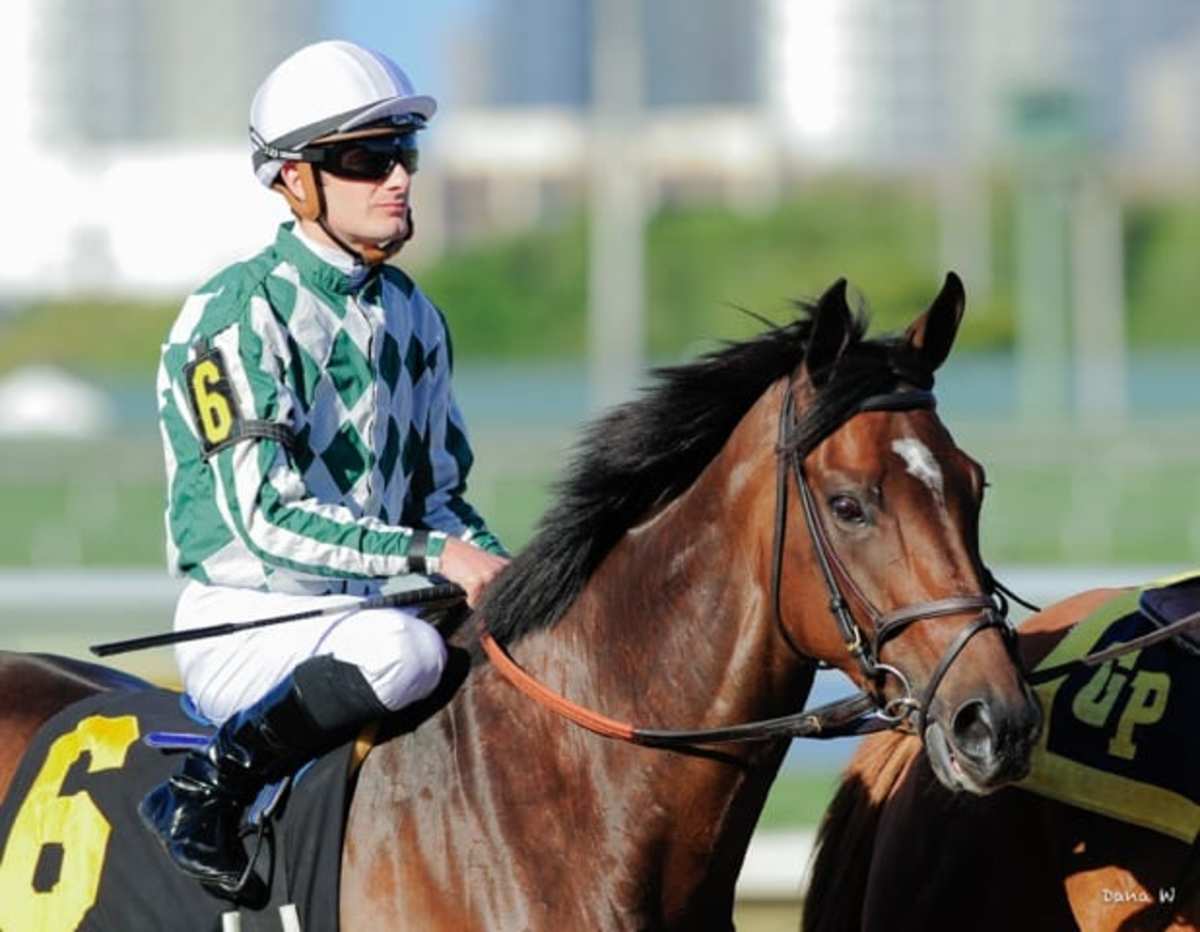
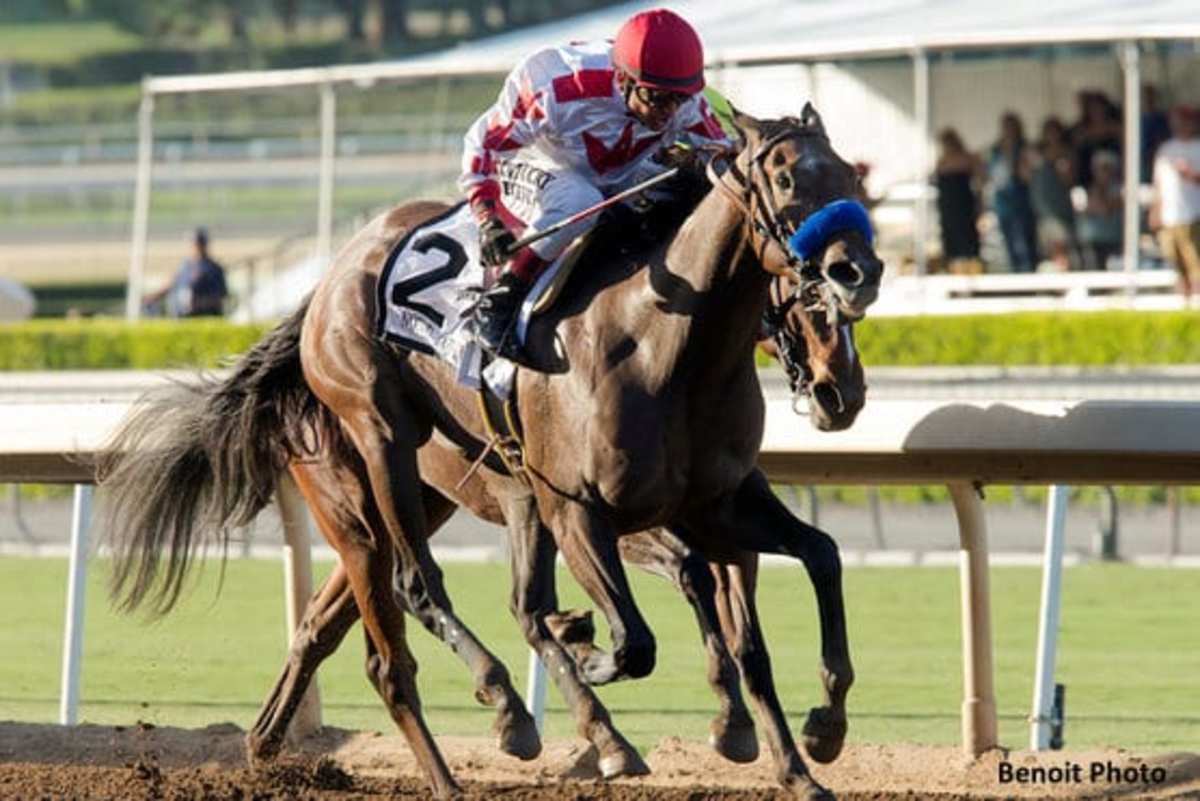
Dr. Schivel, a Grade 1 winner at two and three, will retire to Taylor Made Stallions after the $2-million Breeders' Cup Sprint, the farm announced today.
The millionaire son of Violence—first or second in nine of 14 lifetime starts—ranks among the top sprinters in the country and is a leading contender for the Breeders' Cup Sprint. A stud fee will be announced following the Breeders' Cup.
“We are very excited for the opportunity to stand Dr. Schivel in partnership with Tim Cohen, Dean Reeves, and Bill Branch,” said Taylor Made's Travis White. “It's very special to have a horse that was talented and precocious enough to win a Grade 1 at two and then come back to win another Grade 1 as a 3-year-old beating older horses. Dr. Schivel, who has defeated 13 Grade 1 winners in his career, has been a sound, extremely consistent horse and his Breeders' Cup Sprint as a 3-year-old was a remarkable performance. He has remained in Grade 1 form throughout his racing career, and Mark Glatt said Dr. Schivel has been all class from day one. He is a big, good-looking son of Violence and breeders will really like what they see.”
Campaigned by Red Baron's Barn, Rancho Temescal, Reeves Thoroughbred Racing, and William A. Branch, and trained by Mark Glatt, Dr. Schivel is a two-time Grade 1 stakes winner and earner of $1,327,100. Dr. Schivel burst onto the scene as a 2-year-old. After a romping 5 ¾-length victory in a maiden special weight at Del Mar, Dr. Schivel captured the $250,000 Grade 1 Del Mar Futurity in effortless fashion a month later.
At three in 2021, Dr. Schivel stamped himself as a leading sprinter with a tenacious victory against older horses in the G1 Bing Crosby Stakes at Del Mar, defeating Grade 1 winner Eight Rings, as well as multiple graded stakes winners C Z Rocket, Law Abidin Citizen, and Brickyard Ride.
In a sensational effort in that year's $2-million Breeders' Cup Sprint at Del Mar as a 3-year-old, Dr. Schivel finished second in a photo finish after contesting a hot pace in the early going, taking over in the stretch, just getting nailed right on the wire. He lost in the closest of photo finishes in a final time of 1:08.49, finishing ahead of 2021 champion male sprinter and multiple Grade 1 winner Jackie's Warrior.
In addition to his Grade 1 successes, Dr. Schivel is a two-time winner of the G2 Santa Anita Sprint Championship Stakes. He landed the 2021 edition by a clear 3 ¼ lengths. In this year's renewal on Sept. 30, Dr. Schivel defeated graded stakes winner Speed Boat Beach and Grade 1 winner Arabian Lion in another strong effort, blitzing six furlongs in 1:08.49. Dr. Schivel kicked off this year's campaign with a wire-to-wire allowance score at six furlongs at Santa Anita where he earned a 105 Beyer—one of four 100-plus Beyers in his career—in winning in hand by 4 ¼ lengths.
Dr. Schivel is the second-highest earner for his sire Violence, a top 10 general sire in 2023. In addition to Dr. Schivel, Violence is also represented by the reigning champion 2-year-old male Forte, a four-time Grade 1 winner. Violence is also the sire of Grade 1 winner Volatile. The latter's yearlings are proving to be a commercial success in the auction ring this year, with yearlings selling for up to $1.15 million and $700,000 at the Keeneland September Sale. With a current yearling average of $134,973, Volatile has the third-highest yearling of all first-crop sires.
Bred in Kentucky by William A. Branch and Arnold R. Hill and produced from Lil Nugget—a half-sister to multiple Grade 1 winner and millionaire Ultra Blend—Dr. Schivel's first two dams are both Grade 1 producers.
It was no secret that Flightline's inaugural book at stud was going to be one of the most exclusive clubs to join during the 2023 breeding season.
After retiring undefeated following a resounding triumph in last year's Grade 1 Breeders' Cup Classic, the son of top commercial sire Tapit, out of the Grade 3-winning Indian Charlie mare Feathered, stood for a debut fee of $200,000 at Lane's End in Versailles, Ky.
While an advertised fee is not a guarantee of the price that is actually paid for a breeding, pairing it with his racing and pedigree credentials created the kind of exclusivity that ensured that Flightline would see only the cream of the crop among the broodmare population.
Flightline ultimately covered a reported 152 mares; a group that included Eclipse Award winners and Eclipse producers, Breeders' Cup winners, a Broodmare of the Year, a Canadian Horse of the Year, and a number of seven-figure mares purchased at auction.
Among the mares in Flightline's inaugural book, eight will be on offer at this year's Fasig-Tipton November Sale, and 11 have been cataloged for the Keeneland November Breeding Stock Sale.
Following is a list of the mares reported by The Jockey Club as bred to champion Flightline during the 2023 breeding season, along with notes on their racetrack performance and notable foals or family members.
Absinthe Minded (Quiet American): Grade 1-placed stakes winner, dam of Kentucky Oaks winner Secret Oath
Gloryzapper (Ghostzapper): G3 winner, sold for $1.5 million
Go Google Yourself (Into Mischief): G3 winner
Grace Adler (Curlin): G1 winner, sold for $700,000
Grand Sofia (Giant's Causeway): Dam of G1-placed stakes winner Chop Chop
Harmonize (Scat Daddy): G1 winner, dam of G3 winner Integration
Harmonize (Scat Daddy) wins the Jessamine Stakes at Keeneland
Harvest Moon (Uncle Mo): G2 winner
Hennesey Smash (Roll Hennessy Roll): Stakes winner, dam of G2 winner Slammed, stakes winner Roll on Diabolical, G2-placed Smash Ticket
High Opinion (Lemon Drop Kid): G2-placed
Hollywood Girl (Giant's Causeway): Daughter of G1 winner Hollywood Story, half to G1 winner Honor A. P., G2-placed Hollywood Star, stakes winner Miss Hollywood
Hot Cash (Ghostzapper): G3-placed, sold for $575,000
Hot Dixie Chick (Dixie Union): G1 winner, dam of G1 winner Pauline's Pearl, G3-placed stakes winner Union Jackson
Immediate Impact (Into Mischief): Half-sister to champion Arrogate
Imprecation (First Defence): Dam of G2 winner Anothertwistafate, G2-placed Ajourneytofreedom
Mo Money Mo Honey, a multiple allowance winner who went unbeaten in three starts, has been sold to enter stud at Haras Don Juca in Uruguay, the South American publication Turf Diario reports.
The 4-year-old son of Uncle Mo raced exclusively in Maryland last year for owners Robin Doser and Metropolitan Thoroughbreds, winning on debut at Laurel Park by six lengths. He then took a six-furlong allowance race at the same track by seven lengths, and he finally won an allowance optional claiming race at Pimlico Race Course by a front-running 4 1/4 lengths.
After that race, owner Mike Repole purchased a majority share in Mo Money Mo Honey and transferred him from trainer Benjamin Feliciano Jr. to Todd Pletcher. The colt was brought back from a long layoff in May to log workouts in Saratoga, and he turned in regular breezes through the middle of July.
Among the parties that helped broker the stud deal was Mid-Atlantic-based jockey and Argentina native Horacio Karamanos, who rode Mo Money Mo Honey in all three of his career starts.
Bred in Kentucky by Jeff Prunzik, Mo Money Mo Honey is out of the stakes-winning Curlin mare Stopshoppingdebbie, whose runners also include the Street Sense colt Generous Tipper, who finished third in this year's Grade 1 Breeders' Futurity.
There's always another auction down for the road, but while many of the buyers and sellers at this week's Fasig-Tipton Kentucky October Yearling Sale will be returning to Lexington, Ky., in the weeks to come for the fall mixed sales, the staff of Preferred Equine will be heading in another direction.
The operation of David Reid has about 140 horses to sell in Pennsylvania at the Standardbred Horse Sales Co. Harrisburg Yearling and Mixed Sales, taking place Nov. 6-10.
It's a return to normal business for the Briarcliff Manor, N.Y.-based consignment, which will put over 400 Standardbreds through the sales ring in 2023, compared to about 20 Thoroughbreds. Of that smaller group, 11 were offered at this week's Fasig-Tipton October Sale.
On the surface, the differences between Thoroughbred and Standardbred auctions might appear negligible. The horses are shown to potential buyers at the barns in the days leading up to the sale, they go through the ring until a hammer falls, and the horse hopefully gets a new owner. With the same auctioneers often holding the gavel for auctions of both breeds, they even tend to sound the same.
It's a similar destination, but the roads to get there can be quite different.
That starts with when and why the horses are being sold. Where the Thoroughbred realm has several outlets for buyers to purchase horses ahead of their racing careers, Standardbreds offer only a yearling market at public auction for young prospects, followed by racing-age and breeding stock markets for older horses.
“Most of your Standardbreds, a high majority of them are being purchased by end-users and racing them, where here (at Thoroughbred sales), you have a weanling-to-yearling pinhook market, 2-year-old in training pinhooks,” Reid said. “Just by the nature of the breed, we're not able to do that. [Standardbreds] can't go race speed in March (of their 2-year-old season). It's a gradual progression, starting in November and they expect to race in June, where the Thoroughbreds can go race speed earlier for a short period of time.
“When we're at a Standardbred sale, there are no agents, per se, so it's much more hands-on,” he continued. “There's a high percentage of the horses that are being sold that the trainer has laid eyes on, that'll be training that horse for the next few years.”
The inspection process at a Standardbred sale arguably requires more self-reliance from its buyers, but that can remove a lot of the friction between buyers and sellers seen in the Thoroughbred realm.
There is no repository of radiographs and scopes at the Standardbred sales, and there are no books with veterinarian reports on each horse for buyers to reference. Instead, interested parties are encouraged to have horses radiographed by their own vet in the evenings of show days, as opposed to interrupting potential inspections during the day to grab an x-ray.
Reid said he's seen an uptick in horses being vetted at the Standardbred sales over the past decade.
This does not mean, however, that Standardbred consignors are selling horses without any disclosures. Preferred Equine's Austin Luttrell said certain procedures are much more forwardly presented than their Thoroughbred counterparts.
“OCD (Osteochondritis dissecans) surgeries are mentioned at the sale and put on the stall,” he said. “If something did have OCDs in the stifles, we put when the surgery happened, and it's announced publicly in the sale.
“I think that the potential perspective buyers taking care of the vet work themselves, instead of relying on a vet book that's provided by the consignor would help the Thoroughbred game a lot,” he continued.
The showing process starts the same between the two breeds – with shoppers checking off the horses they want to see on a card and looking at them at the end of the shank – but what the horses are asked to do and what buyers are looking for is a fork in the road.
Thoroughbred buyers must rely on a bit of imagination when forecasting how a yearling will move on the racetrack. At that point in their development, they've been trained to shine on the walk, and that's how they're shown. Videos of the horses walking have become more popular in recent years, to help shoppers further examine their stride, but they are not asked to go with any more urgency for public display.
Standardbred yearlings are typically offered with a video showing the horse moving at the trot in a paddock – not at racing speed, but moving freely – getting up to more speed to help buyers differentiate their gaits between potential pacers and trotters. The videos are made available at the barns on screens, and posted online, and they hold a lot of influence in a buyer's opinion.
“The physical inspection is the same,” Reid said. “The walk is not important in the physical inspection (for Standardbreds). They would be concerned about how a horse carries his limbs, but the final decision would be based on the video.”
Preferred Equine was founded in 1989, starting as a Standardbred-only operation and later expanding into Thoroughbreds. Being based in a state rich in tradition with both breeds, Reid said having a foot on both sides of the line was a natural progression.
“I was born up in Saratoga and always had a little interest in the Thoroughbreds,” he said. “Then, a lot of the sales help that I have for the Standardbred sales worked for the Thoroughbred sales. I have a very close relationship with a lot of key employees, and they were the first ones to encourage me that we should have that.”
Reid said he owns some Thoroughbred mares and shares in some racehorses, though Thoroughbreds only comprise about 10 percent of his consignment business.
Luttrell's roots run deeper in the Thoroughbred realm, having worked as an assistant to trainers Christophe Clement and Kiaran McLaughlin, as a bloodstock consultant in Australia and Argentina, and as a manager at Denali Stud and Donamire Farm.
Support our journalism
If you appreciate our work, you can support us by subscribing to our Patreon stream. Learn more.
While both Reid and Luttrell agreed that the Thoroughbred side could benefit from adopting some of the Standardbred industry's habits on vetting, Luttrell said some of the marketing efficiency of the Thoroughbred auctions could go a long way on the harness side, as well.
“I really like the idea of express lanes,” he said, referencing the showcases when all of a consignments are paraded at the same time for groups of shoppers to take in several horses at once. “In the Standardbred business, there are four or five consignments that have a lot of horses, and if you could provide an express lane and some kind of little lunch or cocktail hour and parade a lot of the horses, it could possibly free up some of the heavy congestion traffic with potential buyers throughout the day.
“I worked for Magic Millions in Australia, and that was a big thing,” he continued. “Each consignor would have some type of little party or get-together, and they would parade all the yearlings so you could get a good initial look at everything, and then go back and tidy up your shortlist.”
Though they are one of the most high-profile examples, Preferred Equine is not the only operation with a presence in the commercial market of both breeds.
Taylor Made Farm, an industry-leading Thoroughbred consignor and stud farm, has been a player in a handful of high-dollar purchases of Standardbred racehorses, and manages a portfolio of Standardbred stallions. The four brothers that head up the Taylor Made operation got their start preparing yearlings for sales for their grandfather who bred harness horses.
John Gaines, the late head of Gainesway Farm and the founding father of the Breeders' Cup, got his start working at his grandfather's Standardbred farm, and he was a high-profile breeder and owner in that realm before expanding to Thoroughbreds in the early 1960s. Joe Taylor, the father of the Taylor brothers, worked for Gaines during the transition.
Preferred Equine is a smaller fish in the grand scheme of the Thoroughbred consignment pond, grossing $80,000 at this year's Fasig-Tipton October sale. Though industry-wide figures have generally been solid in the Thoroughbred auction realm, and especially strong at the high end of the market, mid-to-lower level offerings have often struggled to find their footing, and Reid said they saw that first-hand this week.
“It's a continuing education,” he said. “We didn't have high expectations coming in (to the Fasig-Tipton sale). From a breed point of view, we haven't seen this in the Standardbred game. The Standardbred sales have held up strong this year.”
It was a different story earlier this month on the same property, when the Preferred Equine consignment had nearly 150 horses in the catalog for the Lexington Selected Yearling Sale and grossed more than $10.5 million. Among those offerings was Treacheryinthedark, who sold for $700,000 — a new record for the highest price brought by a yearling filly pacer.
There is plenty different in the auction processes between the two breeds, but the drivers of commerce at the top of each market bear a similar refrain.
“The market is incredibly strong for Standardbreds,” Luttrell said. “Racing is good, the purses are good. A lot of the horses that we're selling are Kentucky-eligible, and that's because of the historical horse racing. That helps us out because people are running for higher purses than ever.”